This site is supported by our readers. We may earn a commission, at no cost to you, if you purchase through links.

You can pinpoint a robin’s nest before you ever see it—just watch for a bird flying the same route six times in an hour with dried grass clamped in its beak. That material-carrying flight pattern is one of the clearest tells in avian behavior, a signal that nesting season has kicked into high gear.
But observing bird nesting habits requires more than spotting the obvious shuttles between foraging grounds and hidden nurseries. You need to read the subtler cues: the sudden territorial aggression, the shift in vocalizations near a favored shrub, the way certain species refuse to leave a ten-foot radius even when you’re nearby.
Learning to decode these behaviors transforms a casual birdwatching session into something richer—a front-row seat to one of nature’s most vulnerable and remarkable processes, done right so you never disturb the very lives you’re hoping to witness.
Table Of Contents
- Key Takeaways
- Identifying Bird Nesting Behavior
- Selecting Safe Observation Spots
- Understanding Nest Site Selection
- Monitoring Nests Responsibly
- Supporting Conservation While Observing
- Frequently Asked Questions (FAQs)
- Do birds need a nest?
- How do birds nest?
- How do you know if a bird has a nest?
- When do birds leave their nest?
- Why is it important to protect nesting birds?
- Why is nesting a risky time for birds?
- What time of day are birds most active?
- How long does incubation typically last for eggs?
- When do baby birds leave the nest?
- What sounds indicate nestlings are being fed?
- Conclusion
Key Takeaways
- You can identify active nesting by watching for material-carrying flight patterns, localized site fidelity, and intensified alarm calls near specific locations—signals that consistently reveal hidden nest sites across species.
- Maintaining safe observation distances (15–30 meters for songbirds, 100–400 meters for raptors) prevents behavioral changes that expose nests to predators, with nearly 70% of nest failures stemming from human disturbance.
- Birds choose nest sites through calculated trade-offs between predator avoidance and microclimate conditions, often sacrificing temperature comfort for safety in fragmented or urbanized landscapes.
- Contributing observations to citizen science platforms like NestWatch and eBird transforms casual birdwatching into conservation data that maps breeding hotspots and guides habitat protection efforts.
Identifying Bird Nesting Behavior
Spotting a bird in full nest-building mode is like catching nature’s construction crew in action—and once you know what to look for, you’ll start noticing the signs everywhere.
Birds telegraph their nesting intentions through specific behaviors and material choices that are surprisingly consistent across species. Let’s break down the key indicators that tell you a bird is getting ready to raise a family.
Recognizing Nest Building Signs

When you crack the code on nest building signs, the wild opens up. Watch for these behavioral clues that reveal nesting activity:
- Material-carrying flights – Birds repeatedly fly with twigs, grasses, or moss toward a focal spot
- Localized site fidelity – Pairs return obsessively to the same shrub or tree fork
- Temporal clustering – Robins and cardinals concentrate activity in March through May
- Vocal shifts – Alarm calls intensify near hidden nest sites
- Sex-role patterns – In 61% of species, both partners transport materials together
By recognizing these patterns, bird enthusiasts can gain insights into nesting behavior habits that aid in locating nests.
Common Nesting Materials Used

Once you’ve spotted those material-carrying flights, you’ll notice the palette is surprisingly rich. Dried grasses and plant fibers make up 40–70% of most cup nests, providing flexibility and weaving potential. Mud binding strengthens robin nests into rigid bowls, while feather linings trap heat for chicks.
About 5% of species now grab synthetic materials—cigarette butts, plastic strings—adapting nest construction to our cluttered world. Birds often seek safe nesting materials to build their homes.
Behavioral Clues of Nesting Birds
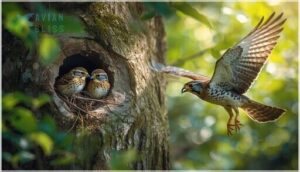
Beyond materials, watch how birds move. During peak nestling feeding, parents make 4 to 20 trips per hour—often arriving together. That paired choreography signals active nesting habits.
You’ll also catch sudden aggression: urban sparrowhawks dive-bomb intruders near chicks, a classic nest defense strategy. Persistent alarm calls, tight circles around one spot, and unusually short flight initiation distances all telegraph “my nest is here.
Selecting Safe Observation Spots
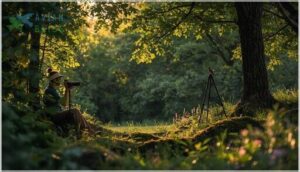
Finding the right spot to watch nesting birds is about balance—you want a clear view without crossing into their personal space. The best observation points let you see the action while keeping birds calm and undisturbed.
Here’s how to choose locations that work for both you and the birds you’re watching.
Ideal Locations for Nest Watching
Your best nest-watching vantage points depend on the habitat you’re exploring. Forest edges and trail access zones let you scan interior canopies without crashing through understory, while wetland viewing platforms or coastal cliffs position you hundreds of meters from island colonies—far enough to prevent disturbance yet close enough for clear sightlines.
Urban rooftops and windows work beautifully for cavity nesters in ledges and eaves.
Maintaining Safe Distances
Distance guidelines for safe observation vary by species and habitat, but a good rule is to stay far enough that birds don’t change behavior. Most songbirds tolerate 15–30 meters, while raptors and colonial waterbirds need 100–400 meters.
If adults flush, vocalize alarm, or hesitate to return within twenty minutes, you’re too close—back off immediately to prevent nest disturbance and predator exposure.
Timing Visits for Minimal Disturbance
Timing your visits around the nesting season dramatically reduces stress on breeding birds. Plan observations during late morning or early afternoon when adults are actively foraging—avoid dawn when eggs are laid and dusk when parents roost.
Skip visits during cold or rainy weather, and never approach nests when fledglings are nearly ready to leave, as premature departure tanks survival rates.
Understanding Nest Site Selection

Birds don’t pick nesting spots by accident—they’re evaluating real estate like seasoned homebuyers, weighing everything from local food supplies to escape routes from predators. You’ll notice patterns once you start watching: some species gravitate toward dense canopy cover, others prefer exposed cliffs, and many won’t even consider a location without nearby water.
Understanding what drives these choices will sharpen your eye and help you predict where to find active nests before the season peaks.
Factors Influencing Nest Location
You’ll notice birds make surprisingly calculated decisions when choosing nesting locations. Recent research shows predator avoidance drives much of nest site selection—ground vegetation density markedly boosts daily survival, while taller trees and denser canopy cover reduce predation risk.
Habitat fragmentation forces birds toward larger contiguous patches, and vegetation structure matters more than simple concealment.
Even human disturbance during territory establishment shifts where sensitive species place their nesting grounds.
Food, Water, and Shelter Considerations
When you’re watching nesting habits, understanding food availability, water source proximity, and shelter quality reveals what actually drives nest placement strategies. These basics of ecological balance shape every habitat preference decision:
- Food landscape structure—European Nightjars in food-poor areas fly 3–6 times farther to forage than birds nesting near abundant prey
- Water depth matters—marsh bird nests over deeper water (average 36 cm) show markedly higher survival due to predator barriers
- Overhead vegetation density—Wood Thrush nests with strong vertical concealment reduce predation substantially
- Habitat fragmentation—broken landscapes force longer, costlier provisioning flights that stress breeding birds
Climate and Predator Avoidance
You’re likely noticing that birds nest where microclimate and predator pressure intersect—those dual forces shape every placement choice. Temperature extremes hit hard: Sagebrush Sparrows endure nest interiors swinging from −8°C to 58°C, while heatwaves slash fitness in 11 tracked species. Meanwhile, habitat fragmentation concentrates predators at edges, forcing birds into a high-stakes trade-off between climate adaptations and predator avoidance.
| Climate Factor | Nesting Impact |
|---|---|
| Spring heatwaves | Reduced fitness in 11 species |
| Cold snaps | Fitness drops in 16 species |
| High precipitation | Lower success when predation is low |
| Temperature rise | Smaller clutches in warmer conditions |
| Extreme weather | Greater offspring mortality risk |
Nest temperature regulation and predator avoidance don’t work in isolation—they’re competing demands. In urbanizing landscapes, six of twelve songbird species actively dodge microhabitats with frequent predator activity, even when those spots offer better climate shelter. That’s the ecological balance at work: environmental conditions set the stage, but predator pressure often writes the final script on where nesting habits can succeed.
Birds sacrifice climate comfort for safety, choosing harsher microclimates over predator-rich shelters in urban landscapes
Monitoring Nests Responsibly

Watching a nest up close feels like witnessing a secret world unfold, but you’ve got to play it smart to avoid becoming part of the problem. The right tools and techniques let you observe without interfering, while understanding the legal boundaries keeps both you and the birds protected.
Here’s how to monitor nests in ways that respect the lives you’re studying.
Observation Techniques and Tools
You’re stepping into a field where precision meets patience—real nest monitoring demands the right toolkit. Modern bird tracking now combines traditional observation practices with advanced technology:
- Acoustic sensors capture breeding behavior and territorial calls without visual intrusion
- Drone surveillance (flown above 50 meters) maps colonies while minimizing ground disturbance
- Camera traps document nest activity continuously, reducing your physical visits
Smart wildlife observation means choosing tools that prioritize the birds’ safety over your data collection goals.
Using Nest Cameras and Binoculars
When you set up nest cameras, place them 6–10 feet back—close enough to capture detail, but far enough to avoid spooking your subjects. Trail cameras with infrared night vision work best; white flash can trigger abandonment.
For binoculars, stay 50–200 meters from raptor nests and closer for tolerant species like robins. Distance protects the birds while sharpening your wildlife observation skills.
Following Ethical and Legal Guidelines
Beyond gear and technique, you need to follow wildlife laws and ethical codes. The U.S. Migratory Bird Treaty Act protects most nests—disturbing them can bring fines up to $5,000. Stay at least 330 feet from eagle nests, and never handle eggs or chicks without permits.
Legal compliance and bird safety aren’t red tape; they’re nest protection that drives real conservation impact through ethical birdwatching.
Supporting Conservation While Observing

Watching birds nest isn’t just about what you see—it’s about what you leave behind, or better yet, what you don’t disturb at all.
Your observations can actually fuel real conservation work when you know how to channel them properly.
Here’s how to turn your birdwatching into meaningful action that protects the species and habitats you’re studying.
Minimizing Human Impact
Surprisingly, your smallest actions shape nest protection and conservation impact more than you might think. Research shows disturbance effects from even low-level human presence reduce breeding success, which is why ethical birdwatching demands we actively minimize our footprint.
Here’s how to support wildlife conservation through safe observation:
- Respect buffer zones of at least 50–100 meters from nests to prevent flushing and abandonment
- Practice noise reduction during dawn and dusk breeding periods when birds are most vulnerable
- Champion habitat preservation by staying on designated trails and keeping pets leashed
Your careful approach becomes conservation efforts in action.
Reporting Observations for Citizen Science
Your careful nest observations can fuel real conservation impact when you channel them into citizen science platforms. NestWatch lets you report species, clutch size, and fledging success through their mobile app, tracking nests every 3–4 days during active periods. eBird accepts breeding codes from “possible” to “confirmed” nesting evidence.
These data submissions help researchers map breeding hotspots, document climate-driven phenology shifts, and guide targeted habitat protection efforts.
Protecting Sensitive Habitats and Species
When you stumble on a nest in designated sensitive zones, respect federal protections under the Migratory Bird Treaty Act—it forbids disturbing eggs or active nests. Buffer distances matter: some small songbirds need 25 m, while colonial waterbirds require over 300 m to prevent repeated flushing.
Habitat protection and species preservation work together. Report imperiled species to local wildlife agencies, helping strengthen ecosystem restoration and bird conservation efforts across fragile landscapes.
Frequently Asked Questions (FAQs)
Do birds need a nest?
Yes, you’ll find that over 95% of bird species build or occupy nests for reproduction—it’s a fundamental instinct.
Even simple ground-nesting shorebirds rely on scrapes, while brood parasites cleverly skip construction entirely.
How do birds nest?
Birds gather materials like sticks, leaves, moss, and mud to build nests through instinctive behavior.
They weave, layer, or attach materials using basal attachment—the method 86% of species rely on for nest construction.
How do you know if a bird has a nest?
Watch for repeated flights to the same spot, alarm calls when you approach, or birds carrying nest materials like grass and twigs—these nesting activity indicators reveal hidden nest sites during breeding season.
When do birds leave their nest?
Most songbirds fledge between 10 to 30 days after hatching, while larger raptors stay 8 to 10 weeks. Flight development, predation risk, and nesting duration shape each species’ unique departure timing.
Why is it important to protect nesting birds?
While a single empty nest seems fragile, thriving populations depend on protecting every breeding site.
Nest preservation ensures species survival, maintains ecological balance, and bolsters habitat protection—safeguarding the bird conservation efforts that sustain entire ecosystems.
Why is nesting a risky time for birds?
Nesting success demands a careful survival strategy. You’re witnessing birds juggle predation risks, climate threats, human disturbance, nest contamination, and energy costs.
These nesting habits expose vulnerable eggs and nestlings to dangers that ultimately shape entire populations.
What time of day are birds most active?
While nocturnal flight occurs for migrants, most birds show peak foraging times at dawn—when morning bird songs erupt—with evening roosting behavior following a secondary afternoon surge.
Daily activity patterns reveal this diurnal rhythm in avian behavior.
How long does incubation typically last for eggs?
Incubation periods vary dramatically across bird species—from just 9–11 days in tiny hummingbirds to 60–80 days in penguins and albatrosses. Body size largely determines egg development time and hatching success.
When do baby birds leave the nest?
Like tiny rebels breaking free, most baby songbirds abandon the nest at 10–21 days post-hatch—sparrows around 14–17 days, cardinals after just 9–11—while raptors linger 8–10 weeks building flight-ready strength.
What sounds indicate nestlings are being fed?
You’ll hear persistent, high-pitched begging calls—squeals that crescendo when parents arrive. These hunger indicators are nestling vocalizations that trigger parental responses, revealing feeding cues central to understanding bird nesting and avian ecology.
Conclusion
Studies show that nearly 70% of nest failures stem from human disturbance—a sobering reminder that your presence alone carries weight.
Observing bird nesting habits means accepting that restraint is part of the craft. You’ll witness extraordinary things if you keep your distance, check your ego at the trailhead, and let the birds dictate the terms. The best observers know when to watch and, more importantly, when to walk away.