This site is supported by our readers. We may earn a commission, at no cost to you, if you purchase through links.
A single air sac mite can trigger respiratory inflammation severe enough to kill a canary in days. These microscopic parasites live deep in your bird’s airways, where you can’t see them until breathing turns labored and tail-bobbing starts. Meanwhile, scaly-leg mites burrow quietly under chicken scales, causing permanent deformities if you miss the early signs.
Bird parasite control methods range from topical pyrethrin sprays that knock down feather lice in minutes to oral ivermectin regimens that clear internal roundworms over weeks. The key is matching the right treatment to the exact parasite, because what works for external mites won’t touch coccidia in the gut.
Effective control starts with accurate identification, follows through with species-appropriate medication, and finishes with environmental cleanup that stops reinfestation before it begins.
Table Of Contents
- Key Takeaways
- Identifying Common Bird Parasites
- Diagnosing Parasite Infestations in Birds
- Treating Internal Parasites in Birds
- Controlling External Parasites: Mites and Lice
- Environmental Cleaning and Disinfection
- Preventing Parasite Reinfestation
- Natural and Supportive Parasite Control Methods
- Frequently Asked Questions (FAQs)
- Conclusion
Key Takeaways
- You’ll need to match specific treatments to exact parasites—pyrethrin sprays work for feather lice in minutes, while oral ivermectin clears internal roundworms over weeks, and what kills external mites won’t touch gut coccidia.
- Air sac mites can kill canaries within days once respiratory symptoms appear, making early detection through fecal testing and symptom monitoring critical before breathing problems escalate to life-threatening distress.
- Environmental cleanup matters as much as medication because parasite eggs survive in cages and litter—thermal treatment above 50°C, complete bedding replacement every seven days, and dust-bathing substrates cut reinfestation rates by 80–100%.
- Quarantine new birds for 30–60 days with separate equipment and regular fecal tests before introducing them to your flock, since a single infected newcomer can restart the entire parasite cycle you just eliminated.
Identifying Common Bird Parasites
Before you can tackle a parasite problem, you need to know what you’re dealing with. Birds face a range of internal and external parasites, each with distinct characteristics and risks.
Let’s look at the most common culprits and how to spot them in your flock.
Air Sac Mites, Scaly-leg Mites, and Feather Lice
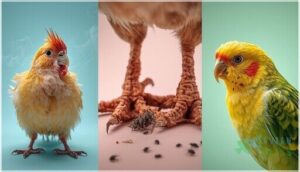
Among ectoparasites, air sac mites hit canaries and finches hardest—respiratory inflammation can turn deadly without treatment. These mites, often causing serious respiratory problems, require immediate veterinary attention.
Scaly-leg mites burrow under chicken scales, reaching 8.71% prevalence in backyard flocks and causing permanent deformities if ignored.
Feather lice infest about 10% of wild birds, but your bird’s preening cuts louse loads in half.
Chemical control and ivermectin regimens tackle all three effectively.
Internal Parasites: Nematodes, Coccidia, and Gapeworm

Internal parasites pose different threats. Nematode prevalence reaches 43.6% in captive parrots and 62.3% in backyard chickens, with Ascaridia and Capillaria species topping the charts. A study showed Ascaridia platyceri prevalence in parrots.
Coccidiosis burden costs poultry operations roughly 8–12% in profits annually. Gapeworm epidemiology shows 42.7% infection rates in juvenile wild birds.
Risk factors like overcrowding worsen transmission, but fecal testing catches these invaders early—treatment outcomes improve dramatically when you act fast.
Recognizing Symptoms and Physical Signs

Spotting trouble early saves birds. Air sac mites cause wheezing in up to 80% of infected finches—that’s your first clue. Heavy louse loads trigger nonstop preening and visible feather damage. Watch for weight loss, diarrhoea, and poor body condition too.
Early detection saves birds—air sac mites cause wheezing in 80% of infected finches, while heavy lice trigger constant preening and feather damage
Egg production drops when hens fight parasites instead of laying. If respiratory noises or plumage problems appear, contact an avian vet fast.
Diagnosing Parasite Infestations in Birds

Catching a parasite problem early can make all the difference in your bird’s recovery. You’ll need to know which diagnostic tests reveal what’s going on inside and outside your bird’s body.
Let’s look at the main methods veterinarians use to confirm parasite infestations and when it’s time to bring in professional help.
Fecal Float and Microscopic Examination
Fecal float is your go-to diagnostic tool for pinpointing parasites in your bird. You’ll mix a fecal sample with flotation solution (SG 1.20–1.27) that lifts lightweight eggs and oocysts to the surface while heavier debris sinks.
Centrifugal techniques beat passive flotation by boosting sensitivity, especially at low egg counts. Microscopic exam then reveals nematode eggs, coccidia, and other gut parasites—detection limits hover around 10–50 EPG, so repeat testing helps catch light infections.
Blood Testing and Droppings Analysis
Blood testing uncovers haemosporidian parasites like Plasmodium that fecal floats miss entirely. Molecular PCR on blood samples identifies infections in over 70% of some wild birds, while hematology reveals anemia and altered liver enzymes from blood parasites.
For gut parasites, quantitative droppings analysis using McMaster or Mini-FLOTAC gives you oocyst counts per gram—making sampling strategy and timing critical for accurate fecal parasite identification and interpreting test results.
- Fresh bird droppings reflect real-time coccidial shedding better than pooled samples.
- Blood PCR detects haemosporidians missed by microscopy alone.
- Counting individual fecal samples improves epidemiological resolution in flocks.
- Seasonal timing affects blood parasite detection rates greatly.
When to Seek Veterinary Diagnostics
When should you call an avian veterinarian instead of watching at home? Respiratory Distress—open-mouth breathing or tail bobbing—requires urgent diagnosis because air sac mites can kill within days.
Weight Loss over 5–10% and severe Fecal Changes demand blood testing and fecal analysis beyond Home Observation.
If Screening Results show parasites or your bird stays fluffed beyond 48 hours, schedule diagnostics—parasite symptoms often mask late-stage disease.
Treating Internal Parasites in Birds

Once you’ve confirmed your bird has internal parasites, the next step is treatment. Antiparasitic medications like ivermectin and fenbendazole are your main tools, but they need to be used correctly to work safely.
Here’s what you need to know about medicating your bird, timing treatments, and tracking whether the parasites are actually gone.
Safe Use of Ivermectin and Fenbendazole
When used correctly, both ivermectin and fenbendazole can tackle internal parasites without putting your bird at risk. Ivermectin safety depends on proper dosing—usually 0.2 mg/kg for pet birds—while fenbendazole risks vary by species. Pigeons show severe species sensitivity to fenbendazole, sometimes fatally.
Key considerations include:
- Dosage guidelines must match your bird’s exact weight and species
- Medication safety requires veterinary oversight for safe dosage calculations
- Residue management matters if your poultry produces eggs or meat
- Monitor appetite and energy levels closely during treatment
Deworming Schedules and Dosage Calculations
Getting your deworming schedule right means balancing prevention with resistance management. Healthy indoor pet birds generally need worming medication every 6–12 months, while outdoor poultry require deworming every 3–6 months. Targeted deworming using fecal egg counts reduces drug pressure.
For safe dosage calculations, use the formula: bird weight (kg) × dose (mg/kg) ÷ concentration (mg/mL) = volume needed. Drug rotation between chemical classes helps prevent resistance.
Monitoring Treatment Effectiveness
You can’t declare victory over parasites just by giving medication. Effective fecal egg counts should drop by at least 90% within 14 days of treatment.
Track weight gain analysis alongside regular fecal tests—treated birds generally gain 25% more weight than untreated flocks.
Plan retreatment intervals based on parasite life cycles and schedule veterinary follow-up to confirm parasite eradication and maintain long-term prevention.
Controlling External Parasites: Mites and Lice
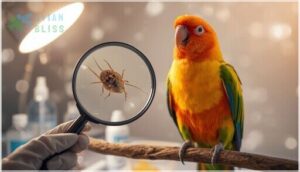
External parasites like mites and lice can make your bird miserable if they’re not dealt with quickly. The good news is that several treatment methods work well when you use them correctly.
Let’s look at the main approaches you can use to eliminate these pests and give your bird relief.
Pyrethrin-based Sprays and Topical Treatments
Pyrethrin-based sprays knock down feather mites and lice fast when you apply them to both your bird and its cage. Look for products labeled safe for avian use with about 0.5 g/L pyrethrins.
- Hold the spray roughly 40 cm from your bird and avoid eyes
- Remove food and water before treatment
- Spray perches and cage bars to kill hiding parasites
Repeat per label to break life cycles and maintain control.
Dusting and Spraying Methods for Poultry
Poultry need both dusting powders and premise sprays for complete ectoparasite control. Diatomaceous earth mixed into dust bath areas lets your birds naturally scrub off lice, while commercial insecticide treatments target northern fowl mites hiding in cracks.
Apply high-pressure sprays to coops every two to four weeks, depending on pest pressure. Never dust individual birds more than once every 14 days to avoid respiratory irritation.
Treating Scaly Mites and Feather Lice
Scaly mites respond well to oral or topical ivermectin at 200–400 μg/kg every 10–14 days for two or three rounds. Budgerigars often clear infections after a single topical dose, while canaries need up to six treatments.
For feather lice, permethrin sprays at 20 mg per bird achieve over 99% control. Treat weekly for five weeks to eliminate lice completely.
Always isolate affected birds to stop direct-contact spread.
Environmental Cleaning and Disinfection

Treating your bird for parasites is only half the battle. The real key is cleaning the environment where those parasites live and breed.
Let’s walk through the disinfection methods that actually work to break the parasite lifecycle in your bird’s space.
Bird-safe Disinfectants for Cages and Perches
After cleaning your bird’s cage, disinfection becomes your next line of defense. Quaternary ammonium products like F10 SC offer broad-spectrum protection at dilutions from 1:500 to 1:125, depending on the pathogen.
Diluted bleach works when mixed fresh (½ cup per gallon), but requires thorough rinsing to protect avian respiratory tissues.
Chlorhexidine gluconate and hydrogen peroxide alternatives provide gentler options, while natural agents like vinegar lack the antimicrobial punch needed for true environmental hygiene.
High-pressure Spray Treatments for Poultry Houses
When managing larger operations, high-pressure washing at 60°C raises disinfectant efficacy and achieves 4.5–6.2 log₁₀ pathogen reductions on cage surfaces.
You’ll disrupt ectoparasite harborages—especially red mite—by spraying from ceiling to floor in poultry houses.
Equipment biosecurity demands dedicated hoses per building to prevent cross-contamination.
Remember that water pressure aerosolizes endotoxin, so maintain proper ventilation and respiratory protection for worker safety during sanitation.
Strategies for Eliminating Parasite Eggs and Larvae
You’ll break the parasite life cycle by layering five tactics: thermal inactivation, litter composting, chemical disinfection, environmental drying, and mechanical removal.
Thermal inactivation involves heating houses to 60°C for two hours, which kills eggs in cracks. Litter composting at 50–60°C denatures helminth stages. Chemical disinfection with oxidizers disrupts membranes once organic matter is scraped away.
Environmental drying below 45% moisture starves larvae. Mechanical removal—scraping belts and ducts—clears hidden reservoirs before any avian disinfectant touches surfaces.
Preventing Parasite Reinfestation
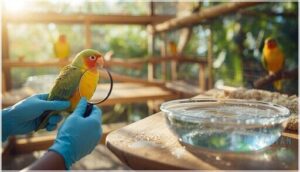
Once you’ve cleared out parasites, the real challenge is keeping them from coming back.
This is where prevention becomes your best defense—and it’s simpler than you might think. Three essential practices will help you protect your birds and stop reinfestation before it starts.
Quarantine Protocols for New Birds
Quarantine is your first line of defense against introducing parasites into your flock. Isolate new birds for at least 30 days—ideally up to 60 days for high-risk cases—in a separate room away from your existing collection.
Effective biosecurity measures include:
- Complete physical separation from resident birds
- Daily monitoring of droppings, feather condition, and behavior
- Dedicated equipment and cleaning tools for quarantined birds
- Staff working with resident birds first, quarantined birds last
- Veterinary health checks and regular fecal tests before integration
These preventative measures greatly reduce your risk of spreading mites, lice, and internal parasites. Weight loss or clinical signs during isolation restart the quarantine clock, so patience protects your entire collection. Most disease agents require four to six weeks of observation to detect, making that minimum 30-day window essential for preventing parasite infestations.
Regular Fecal Tests and Health Monitoring
Annual fecal exams are your most reliable tool for catching hidden parasites before symptoms appear. Many avian veterinarians recommend yearly testing for companion birds and high-risk flocks because sensitivity limitations mean a single sample misses up to 70% of infections. Pair diagnostic testing with weekly weighing—any loss over 10% signals a health problem worth investigating through the parasite life cycle.
| Monitoring Method | Frequency | What It Detects |
|---|---|---|
| Fecal exams | Yearly minimum | Nematodes, coccidia, Giardia |
| Body weight checks | Weekly | Early parasite symptoms, illness |
| Visual health assessments | Daily | Feather condition, behavior changes |
Regular fecal tests paired with structured health indicators dramatically improve diagnostic yield and help you spot parasite infestations before they compromise your flock. Impact monitoring through consistent record-keeping gives you the data to intervene early and prevent reinfestation.
Habitat Cleanliness and Reducing Bird Stress
Your coop’s stocking density directly shapes parasite risk—doubling bird crowding can triple lice loads in hens. Maintain at least 0.5 m² of indoor space per bird and refresh litter frequently to eliminate roundworm eggs and coccidia.
Air quality matters too: ammonia over 25 ppm weakens immunity.
Enrichment strategies like dust-bathing substrates and perches lower stress markers, helping your flock resist infection naturally.
Natural and Supportive Parasite Control Methods

You don’t always need harsh chemicals to keep parasites under control. Simple additions to your bird’s diet and daily care routine can strengthen their natural defenses and make their environment less hospitable to unwanted guests.
Here are a few natural and supportive methods that work alongside medical treatments.
Use of Papaya and Pumpkin Seeds
You’ve probably heard that papaya and pumpkin seeds can help with deworming, but the evidence gaps are real. In poultry trials, seed phytochemicals like benzyl isothiocyanate showed moderate anthelmintic activity against roundworms when used at specific dosage regimens—usually 2–6 g per bird daily for several days.
Safety considerations matter: high doses can impair nutrient absorption, and these natural remedies for parasite control work best as preventive parasite treatments alongside proper antiparasitic medications for birds, not replacements.
Supporting Immunity Through Nutrition and Routine
Think of diet quality as your bird’s first line of defense—vitamin A, D, and E deficiencies slash immune function and open the door to parasites.
To fortify avian health through sound nutrition and daily routines, focus on:
- Pelleted diets with dark greens supply carotenoids that boost resistance
- Probiotics benefits include stronger gut barriers against coccidia
- Health monitoring plus stress reduction catch problems early
Preventive parasite treatments work best when paired with balanced feeding and consistent care.
Bathing and Preening Opportunities for Birds
Beyond nutrition, your bird’s feather cleaning habits directly influence parasite loads. Preening effectiveness drops sharply when beaks are damaged—chickens with even minor beak injuries see ectoparasite numbers skyrocket.
Offer dust bathing substrates like diatomaceous earth or sulfur; they cut mite populations by 80–100% within a week. Water bathing provides comfort but doesn’t reduce parasites, so focus on proper bath depth (2.5–5 cm) and daily opportunities for dustbathing and preening to maintain peak feather condition.
Frequently Asked Questions (FAQs)
Can wild birds transmit parasites to pet birds?
Yes—wild birds carry gastrointestinal parasites and ectoparasites that readily spread to pet birds through shared water sources, contaminated soil, or direct contact at feeders, making biosecurity measures essential for parasite prevention.
How often should bird bedding be completely replaced?
You should replace your small bird’s bedding completely every seven days under normal conditions.
During illness, parasite treatment, or multi-bird housing, daily bedding replacement helps disrupt pathogen life cycles and reduce reinfestation risk.
Are parasite treatments safe during breeding or molting?
Breeding treatment risks and molt treatment timing require careful risk-benefit analysis with your avian veterinarian.
Anthelmintic safety varies by dose and drug, while topical ectoparasiticides during these stress periods demand weighing treatment effectiveness against avian safety and medication interactions.
Can humans contract parasites from infected pet birds?
Certain parasites do carry zoonotic potential—Cryptosporidium, Giardia, and some microsporidia can spread through contaminated droppings or dust.
Risk factors include immunocompromised individuals and inadequate cage hygiene, making preventive measures essential for safe bird ownership.
What temperature kills parasite eggs in bird environments?
Think of parasite eggs as resilient seeds awaiting the right conditions. Heat treatment above 50°C for minutes destroys most parasite eggs through textile laundering and litter composting, while sustained surface temperatures of 45°C eliminate mite eggs during environmental cleaning and disinfection.
Conclusion
Bird parasite control methods work like a three-legged stool: identification tells you what you’re fighting, treatment eliminates the threat, and prevention keeps it from coming back. Miss any leg and the whole system collapses.
You’ve got the diagnostic tools to spot mites before they spread, the medication protocols to clear infestations safely, and the cleaning strategies to protect your flock long-term. Now you can keep your birds breathing easy and thriving.
- https://pmc.ncbi.nlm.nih.gov/articles/PMC8167519/
- https://www.fao.org/4/x0583e/x0583e.pdf
- https://www.fda.gov/animal-veterinary/safety-health/antiparasitic-resistance
- https://www.frontiersin.org/journals/veterinary-science/articles/10.3389/fvets.2020.00101/full
- https://www.kemin.com/na/en-us/markets/animal/poultry/gut-health/resources/vaccination-as-a-tool-in-evolving-broiler-coccidiosis-control