This site is supported by our readers. We may earn a commission, at no cost to you, if you purchase through links.
Your parrot’s dilated pupils and flattened feathers aren’t random quirks—they’re a complex language you need to learn fast. Birds evolved complex visual signaling systems because their survival depended on instant communication across flocks, and those same signals now govern every interaction with you.
While mammals rely heavily on scent and vocalization, birds compress their emotional state, intentions, and physical needs into subtle shifts in posture, feather arrangement, and eye movement that most owners miss until it’s too late. Misreading these cues doesn’t just lead to painful bites; it erodes the trust that forms the foundation of your relationship and can mask serious health problems hiding beneath seemingly normal behavior.
Understanding what your bird is actually telling you transforms frustration into connection and helps you respond appropriately before stress escalates or illness progresses.
Table Of Contents
Key Takeaways
- Birds communicate primarily through visual signals like feather positioning, tail movements, and eye changes because their survival depends on instant flock communication, making these cues far more reliable than the scent-based signals mammals rely on.
- Eye pinning, beak grinding, and feather fluffing can signal either contentment or distress depending on context and accompanying body language, so you must observe multiple signals together rather than interpreting individual behaviors in isolation.
- Birds hide illness instinctively as an evolutionary defense against predators, meaning you’ll miss critical health problems unless you establish baseline behavior patterns and track subtle daily shifts in energy, posture, and appetite.
- Misreading your bird’s body language—such as mistaking fluffed feathers for relaxation when they signal illness, or interpreting constant calling as spite instead of social need—erodes trust and prevents you from responding appropriately to stress or health issues.
Why Birds Use Body Language
Birds rely on body language as their primary communication tool, using physical signals to convey everything from emotional states to survival needs. Unlike mammals, who depend heavily on facial expressions and scent, birds have evolved a distinct system of feather movements, postures, and eye signals to interact with their environment.
Understanding why this communication method developed requires examining three key aspects: the specific purposes body language fulfills, how avian communication differs from what we see in mammals, and the evolutionary forces that shaped these complex signals.
Communication Purposes in Birds
Birds rely on body language as a primary communication method, using nonverbal communication to navigate complex social worlds. Their avian communication fills multiple important purposes:
- Social cohesion – Coordinated postures in flocking species maintain group unity at high speeds
- Mate choice – Elaborate displays combining posture and plumage can increase mating success several-fold
- Aggression signals – Ritualized threat postures resolve most territorial disputes without physical contact
- Predator avoidance – Alarm postures trigger rapid flock responses within fractions of a second
- Family communication – Begging displays greatly influence parental feeding rates and food delivery
Many nocturnal birds rely on achromatic plumage patterns for signaling in low light.
Differences From Mammal Communication
Unlike mammals that depend heavily on olfactory signals and scent-marking for social communication, your feathered companion operates in a world driven by visual reliance and sound. Birds perceive color differently—most are tetrachromatic, seeing ultraviolet wavelengths invisible to you and most mammals.
This spatial geometry of signals means bird behavior combines multimodal signals through coordinated postures and calls, while mammals often rely on persistent chemical cues that don’t require line-of-sight to convey emotional state and behavioral cues.
Birds also use sound to communicate, with each species having a unique song, so you can learn more about acoustic bird communication.
Evolution of Avian Signals
Understanding how these visual signals in birds came to be helps you interpret what your bird is telling you. Avian communication systems trace their acoustic origins back roughly 100-200 million years, evolving separately from mammals.
Sexual selection drove much of this signal diversification—birds that could flash brighter displays or sing more complex songs won more mates.
Phylogenetic influences and cognitive evolution shaped these behaviors over time, with parrots and corvids developing especially elaborate bird signaling repertoires through social learning.
Key Body Language Signals in Birds
Your bird’s body is constantly telling you something, whether it’s through the way feathers sit, how the tail moves, or a subtle shift in posture. Learning to read these physical cues gives you a window into what your bird is thinking and feeling at any moment.
Let’s break down the essential signals you’ll see most often and what they actually mean.
Feather Fluffing and Positioning

Feather fluffing and positioning reveal far more than you might expect. Your bird’s plumage shifts constantly, serving multiple purposes:
- Thermal regulation – Fluffing traps air to conserve warmth in cold environments, while sleek feathers dissipate heat
- Social signaling – Erected feathers communicate excitement, aggression, or courtship intent
- Stress response – Prolonged fluffing with inactivity often signals discomfort or illness
- Plumage display – Targeted feather erection around the head or body enhances visual communication
- Feather condition – Poor grooming leads to unkempt appearance, indicating health concerns
Context matters when interpreting these feather-related behaviors.
Tail Movements and Meanings

Your bird’s tail tells a story you can’t afford to miss. Tail flicking signals alertness or annoyance, often increasing when threats appear nearby. Tail wagging generally indicates happiness and contentment, especially around favorite people.
Feather fanning creates defensive displays that make your bird look larger and more threatening.
Watch for tail bobbing without exercise—it may reveal respiratory problems requiring immediate veterinary attention.
Wing Positions and Displays

Wing stances reveal everything from aggression to illness in your bird. Aggressive postures feature partially extended wings held forward, making your bird appear larger during conflicts. Courtship displays showcase elaborate wing-fanning and spreading movements, particularly in species like riflebirds.
Watch for drooped wings combined with lethargy—these illness signals demand immediate veterinary attention.
Deceptive displays, including the broken-wing act, protect nests from predators through strategic wing gestures.
Head and Eye Movements
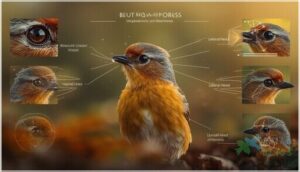
Watch your bird’s gaze—it’s a window into complex visual strategies. Head stances and eye movements coordinate to improve vigilance behavior and social signaling. Key indicators include:
- Rapid head-turning increases when your bird feels vulnerable, signaling heightened alertness
- Head-bobbing during walking stabilizes vision through visual stabilization mechanisms
- Lateral head tilts activate foveal vision for detailed inspection
- Forward eye rotation enhances binocular vision for precise beak control
- Sustained eye contact indicates focused attention or potential threat assessment
Decoding Beak and Eye Behaviors
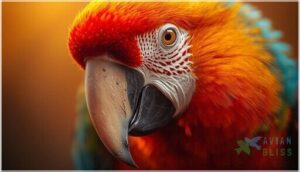
Your bird’s beak and eyes offer some of the most precise clues about what’s happening in their mind, but these signals can easily be misread without the right context. A beak click might mean curiosity in one moment and irritation in another, while rapid pupil changes can signal excitement or aggression depending on the situation.
Let’s break down these specific behaviors so you can read your bird’s intentions with greater accuracy.
Beak Grinding, Clicking, and Screaming
Your bird’s beak isn’t just for eating—it’s a communication tool that speaks volumes. Beak grinding, that soft, repetitive sound before sleep, signals relaxation and contentment while maintaining beak health. Clicking has dual purposes: friendly greetings or territorial warnings, depending on context and posture. Screaming vocalizations differ from normal calls, often indicating distress or environmental stress.
Understanding these beak behavior patterns helps you interpret stress signals and respond appropriately.
Eye Pinning and Pupil Dilation
When you notice your parrot’s pupils rapidly constricting and dilating—called eye pinning—you’re witnessing a powerful arousal signal tied to bird behavior. This avian communication cue marks emotional states ranging from excitement to aggression, depending on context.
Species patterns vary: budgerigars pin during courtship, while Amazons combine it with tail fanning during play.
For welfare implications, combine this with posture and vocalizations before handling to avoid bites.
Contextual Interpretation of Beak and Eye Cues
Context transforms beak movements and eye expressions into clear messages. When you interpret beak signal context alongside eye cue interpretation, you’ll decode your bird’s emotional state display accurately.
Consider three critical combinations:
- Beak grinding with soft eyes signals contentment at bedtime, not distress
- Eye pinning plus open beak often precedes biting during defensive arousal
- Flashing eyes with gentle nibbling indicates exploratory curiosity, distinguishing social signaling from aggression
Recognizing Stress and Aggression
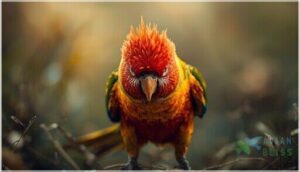
Recognizing when your bird is stressed or turning aggressive can be the difference between preventing a bite and understanding what’s really going on in your pet’s world.
Birds telegraph their discomfort and aggression through specific postures and movements that, once you learn them, become impossible to miss. Let’s break down the warning signs you need to watch for.
Signs of Stress and Discomfort
Birds under stress often show rapid feather plucking, stereotypic movements like pacing, and anxiety-driven vocal changes—from distressed screaming to complete silence. Watch for startle responses, especially in cockatiels prone to night frights.
Physiological markers include elevated corticosterone and reduced activity. Common signs of stress include tremoring, repetitive beak grinding, and postural tension.
These stress-induced behaviors signal when your bird needs environmental adjustments or veterinary attention.
Aggressive Postures and Threat Displays
When stress escalates, you’ll see clear aggression. Your bird may lean forward with a direct threat orientation, raising body feathers and pinning its eyes rapidly. Recognizing these aggressive behavior patterns helps prevent biting triggers:
- Forward lunges with an open beak
- Feather displays—slicked back or puffed at the shoulders
- Wing signals like mantling over food or spreading wings slightly away from the body
- Side-to-side weaving combined with eye pinning
Understanding this bird body language keeps everyone safe.
Territorial and Defensive Behaviors
Beyond immediate threats, you’ll observe birds defending entire territories over time. Territory size varies widely—from just a few acres in small songbirds to hundreds of square kilometers in raptors—with females often claiming larger ranges than males. Watch for nest defense intensity increasing with repeated intrusions, mobbing behavior where groups harass predators, and urban defense patterns showing shorter flight distances near humans.
| Defensive Behavior | Physical Signals | Context & Risk |
|---|---|---|
| Nest defense escalation | Alarm calls, dive-bombing, strikes | Increases with prior predator visits |
| Multi-species mobbing | Group harassment, close approaches | Reduces individual predation risk |
| Territory marking displays | Wing spreading, vocalizations, chasing | Varies by breeding stage and sex |
| Urban tolerance shifts | Reduced escape distance, adjusted aggression | Reflects long-term adaptation history |
| Risk-adjusted responses | Graded intensity by predator type | Parents balance current vs. future reproduction |
Body Language and Bird Health
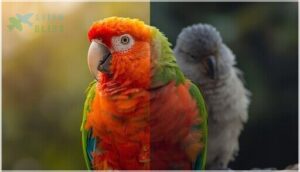
Your bird’s body language doesn’t just reveal emotions—it can also be one of the earliest windows into their physical health. Birds are masters at hiding illness, a survival instinct that makes early detection challenging but absolutely critical.
The following sections will walk you through key health-related signals, from subtle signs of pain to behaviors that mask serious conditions, so you can catch problems before they become emergencies.
Signals of Illness or Pain
When your bird’s not feeling well, you’ll see telltale shifts in posture and behavior. Fluffed feather condition, drooping wings, and a hunched stance often signal discomfort or illness.
Watch for respiratory distress like tail bobbing or open-mouth breathing. Dropping changes—watery, discolored, or reduced—point to gastrointestinal or systemic health issues. Dehydration signs include sunken eyes and thick saliva.
Behavioral changes like reduced vocalization or reluctance to perch indicate avian health concerns requiring prompt attention.
Masked Sickness Behaviors
When your bird is sick, it won’t show obvious signs until late stages—an evolutionary adaptation to avoid predators. Subclinical infections can persist without behavioral changes, with stress unmasking illness suddenly.
Behavioral compensation makes diagnostic delay common, as birds maintain normal-appearing routines despite developed disease. This evolutionary basis for hiding weakness means you’ll often miss critical health indicators unless you’re tracking subtle shifts in energy, posture, and daily patterns.
Birds hide illness instinctively, so you’ll miss critical health signs unless you track subtle daily changes in energy and posture
Monitoring for Early Health Indicators
With daily observation, you can detect health signals before clinical disease develops. Watch for lethargy signs like prolonged perching low in the cage, persistent feather changes including long-term fluffing, appetite loss, dropping changes in color or consistency, and breathing issues such as tail bobbing.
These avian health indicators, combined with regular weighing and veterinary checkups, provide your best defense against masked illness in birds.
Improving Bird-Owner Relationships Through Body Language
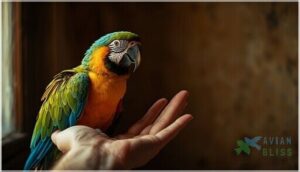
Understanding your bird’s body language is only half the equation—the real transformation happens when you use that knowledge to build trust and strengthen your bond. Misreading signals can create distance or stress, while accurate interpretation opens the door to genuine connection.
Let’s explore practical strategies for avoiding common pitfalls and responding effectively to what your bird is telling you.
Avoiding Common Misinterpretations
Many owners with higher anthropomorphism scores show less attention to species-appropriate needs, leading to misinterpretations of bird communication. You might see comfort-seeking as cuddly affection, or misread fear as stubbornness.
Common pitfalls include:
- Treating fluffed feathers as relaxation when they signal illness
- Perceiving constant calling as spite rather than social contact needs
- Overlooking eye pinning and stiff posture before bites
- Judging welfare by tameness instead of environmental enrichment
Recognizing these emotional state indicators protects your bird’s wellbeing.
Tips for Effective Observation and Response
Tracking subtle cues becomes second nature once you establish baseline behavior through structured observation. Watch your bird for 10–15 minutes across different times of day, noting feather position, posture, and vocalization patterns. Contextual interpretation matters—environmental factors like cage placement shape communication signals.
When you spot stress indicators, adjust responses immediately: slow your approach, minimize stress triggers, and respect avoidance signals to strengthen trust.
Frequently Asked Questions (FAQs)
How can I tell if my bird is anxious versus excited?
Anxiety and excitement produce strikingly different physiological and behavioral patterns. Anxious birds display rigid posture, tense feathers, repetitive screaming, and prolonged freezing.
Excited birds show relaxed stance, brief active play, and exploratory movement with soft feathers and normal vocalizations.
What should I do when my bird displays conflicting body language signals?
When your bird shows mixed signals like eye pinning with feather ruffling, step back and increase distance immediately. Reduce stimulation, defer handling to essential care only, and consider context—recent changes or triggers matter.
If conflicting signals persist, consult an avian behaviorist or veterinarian to rule out illness.
Conclusion
Your bird’s behavior is a constant conversation waiting to be understood. Learning to read and interpret bird body language signals is less about memorizing rules and more about tuning into the subtle shifts your companion displays daily.
Each fluffed feather, pinned eye, and tail movement holds meaning—a direct window into their emotional and physical state. Master this language, and you’ll transform guesswork into genuine connection, catching problems before they spiral and building trust that lasts.
- https://birdtricksstore.com/blogs/parrot-care-blog/parrot-eye-pinning-and-what-it-means
- https://exoticdirect.co.uk/news/parrot-body-language/
- https://pmc.ncbi.nlm.nih.gov/articles/PMC11655281/
- https://todaysveterinarypractice.com/exotic-medicine/performing-an-avian-physical-examination-in-practice/
- https://lafeber.com/pet-birds/bird-behavior/