This site is supported by our readers. We may earn a commission, at no cost to you, if you purchase through links.
Some birds look like someone spilled painter’s palette mid-flight and just went with it. The Scarlet Macaw stretches 96 centimeters of red, yellow, and blue across the sky, while the Lilac-breasted Roller packs eight distinct colors onto a body smaller than your hand.
These aren’t flukes—nature has spent millions of years fine-tuning feather pigments, iridescent nanostructures, and ornamental crests for reasons ranging from attracting mates to regulating body heat.
Whether you’re chasing colorful bird species photos in your backyard or across three continents, knowing what you’re looking at changes everything you see.
Table Of Contents
- Key Takeaways
- Most Colorful Bird Species Worldwide
- Colorful Birds by Region
- Plumage Details That Stand Out
- Best Tips for Bird Photography
- How to Identify Birds in Photos
- Frequently Asked Questions (FAQs)
- Which bird has the most colorful plumage?
- What is the most colorful bird in the world?
- Which animal is the most colorful?
- What does a Bluebird look like?
- What do Australian birds look like?
- Are hummingbirds the most colorful birds?
- What camera settings work best for bird photography?
- Do colorful birds see colors differently than humans?
- Which colorful birds can be kept as pets?
- How do birds maintain their feather colors year-round?
- Conclusion
Key Takeaways
- Bird colors aren’t just beautiful accidents — they’re built from clever biology, whether they’re diet-based pigments like carotenoids in macaws or light-bending nanostructures that make hummingbird feathers shift from green to violet as they move.
- Six species stand out as the world’s most jaw-dropping: the Scarlet Macaw, Keel-Billed Toucan, Mandarin Duck, Lilac-Breasted Roller, Wilson’s Bird-of-Paradise, and Resplendent Quetzal — each tied to a specific habitat that shapes how and where you’ll find them.
- Great bird photography comes down to three practical things: shoot during golden hour, use at least 1/2000s shutter speed for birds in flight, and pick a background (deep blue, neutral gray, or soft bokeh) that lets the feathers do the talking.
- Identifying a bird in a photo gets a lot easier when you look beyond habitat clues — bill shape, body size, and seasonal molt patterns together narrow things down faster than color alone ever will.
Most Colorful Bird Species Worldwide
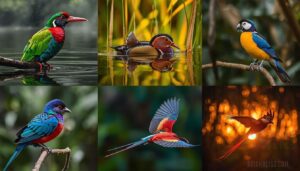
Some birds look like they were painted by someone who had no interest in playing it safe. From cloud forests in Central America to the islands of eastern Indonesia, a handful of species carry colors so sharp they almost don’t look real.
These vivid species need more than stunning feathers to thrive — the spaces they nest in matter just as much, which is why proper bird house cleaning and maintenance plays a bigger role in their survival than most people realize.
Here are six of the most jaw‑dropping birds you’ll find anywhere on the planet.
Scarlet Macaw Photos
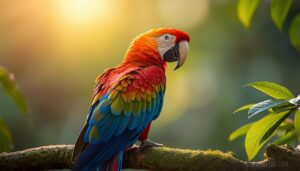
If you’ve ever wanted to photograph colorful birds that stop people mid-scroll, the Scarlet Macaw delivers every time. Stretching nearly 96 cm, its bold color contrast — blazing red body, yellow wing coverts, vivid blue flight feathers — is hard to miss. That distinctive facial white patch frames pale yellow eyes beautifully.
Shoot against green canopy to make the bird plumage and feather texture genuinely pop. Its role as a keystone seed dispersal species helps rainforest regeneration.
Keel-Billed Toucan Photos
Switch gears from the macaw’s bold red, and you’re looking at the Keelbilled Toucan — a bird that looks like someone let a toddler loose with a paint set.
That oversized bill regulates heat exchange, acting like a built-in thermostat.
Catch it during dawn-dusk activity for mid-canopy perching shots that reveal the vivid undertail reveal, colorful leg green, and every wild bill stripe in high definition bird photographs.
Mandarin Duck Photos
From bold toucans to the endlessly photogenic Mandarin Duck — what a shift. The male’s orange sail feathers, emerald crest, and red bill make colorful bird photography feel smooth.
Shoot during Golden Hour Lighting for maximum iridescence, get low for Sail Feather Emphasis, and use Reflections on Water as your backdrop. Cavity Nest Portraits and Gender Color Contrast between mates deliver stunning high-definition bird photographs every time.
Lilac-Breasted Roller Photos
The Mandarin’s bold colors are hard to top — but the Lilac‑breasted Roller gives it a real run. This African beauty stacks eight distinct colors onto one small body, making colorful bird photography feel almost unfair.
- Perch Selection matters: find a bare branch against open sky
- Morning Light hits the turquoise wings perfectly around sunrise
- Tail Streamer Visibility peaks during territorial swoops
- Water Proximity brings reliable perching and active Behavioral Poses
- High‑definition bird photographs reward patience — wait for the head-turn
Wilson’s Bird-of-Paradise Photos
If you want to photograph one of the most surreal colorful bird species worldwide, Wilson’s Bird-of-Paradise is your subject.
This tiny Indonesian rainforest gem — just 16 cm long — rewards patient bird photography with impressive Tail Feather Geometry and vivid structural color.
Nail your Branch Positioning low and close, apply subtle Color Grading Techniques to boost those purples and greens, and time your shot during his Courtship Pose Angles for maximum impact.
Resplendent Quetzal Photos
Few colorful bird species worldwide stop you in your tracks like the Resplendent Quetzal.
Shooting in cloud forests between 900–3,200 meters, use Cloud Forest Framing to place that crimson chest against dark canopy. Courtship Flight Shots during breeding displays, try Macro Feather Texture for those iridescent greens, and don’t forget Tail Streamer Emphasis and Altitude Habitat Context — this Near Threatened species deserves every careful frame.
Colorful Birds by Region
The world is full of colorful birds, and where a bird lives shapes everything about how it looks.
From bold tropical plumage to subtle woodland camouflage, a bird’s habitat drives every detail of its coloring—and Cooper’s Hawk markings and regional variation show just how dramatically that plays out across North America.
Each region has its own cast of characters — from rainforest giants to backyard visitors — and they’re all worth a closer look.
Here’s a tour through five regions and the stunning species that call them home.
South American Rainforest Species
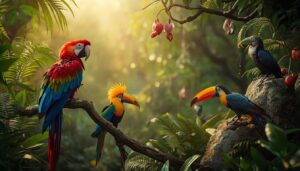
South America’s rainforest is basically a living paint palette — and the birds are the brushstrokes. From the Scarlet Macaw’s electric red wingspan to the Spangled Cotinga’s shimmering cobalt chest, every species turns up the contrast dial.
- Andean Cock-of-the-Rock uses bold orange crests in Territory Behaviors and Vocal Communication displays
- Toco Toucan navigates Feeding Ecology with its oversized bill, cracking tough fruits effortlessly
- Plumthroated Cotinga males flash iridescent violet throats during Seasonal Migrations through fragmented canopy corridors
- Scarlet Macaw faces real pressure from Habitat Fragmentation Impacts, shrinking its ancient flyways year by year
Australian Parrots and Finches
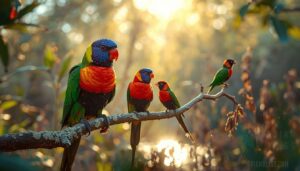
Australia hits differently regarding colorful bird species worldwide. The Rainbow Lorikeet’s blue-and-orange flash and the Crimson Rosella’s rich red plumage make every eucalyptus forest feel electric.
Gouldian Finch morphs — black, purple, or green-headed — reward patient bird photography near waterholes.
Social Flocking behavior, strong Seed Specializations, and vibrant Mating Displays define parrot and finch life here, though Conservation Challenges from habitat loss are real.
Asian Waterfowl and Forest Birds
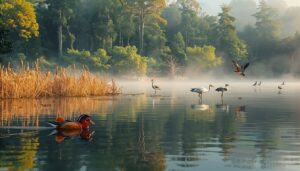
Asia is quietly one of the best regions on the planet for colorful birds. The Mandarin Duck alone — all rust, teal, and orange — looks almost too good to be real. Then there’s the Indian Peafowl, the Himalayan Monal, and the Blue Crowned Pigeon adding serious visual weight.
Three things that make Asian birds unique:
- Altitudinal Migration Patterns shift species between lowland rainforest habitat and mountain zones seasonally
- Migratory Stopover Sites like Poyang Lake, concentrate thousands of birds in one frame
- Vocalization Variations and Nest Site Selection behaviors reward patient, early-morning photographers
Wetland Habitat Loss remains the biggest threat here — so document what you find.
African Rollers and Wetland Birds
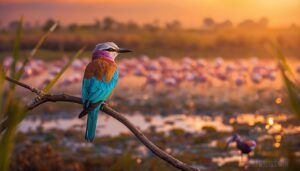
Africa doesn’t hold back. The Lilac-Breasted Roller alone — all turquoise, lilac, and chestnut — turns every savanna perch into a photo op. Its Territorial Perching habit means predictable shots, and watching a Courtship Flight (dramatic rolling dives, loud calls) is genuinely unforgettable.
| Species | Key Feature |
|---|---|
| Lilac-Breasted Roller | Iridescent Habitat Preference: open savanna |
| Flamingo | Colony breeding, wetland ecosystems and bird life |
| American Purple Gallinule | Vivid plumage, Insect Diet |
| African Rollers | Migration Timing varies by region |
Pack patience — and a wide lens.
North American Backyard Favorites
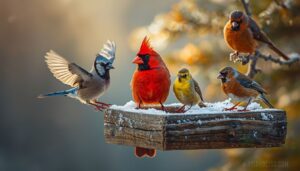
You don’t have to travel far for a jaw-dropping shot. North America’s backyard birds deliver real color — red cardinals, lemon-bright American Goldfinch, deep-blue Blue Jays, and orange-bellied American Robin.
Here’s what actually works:
- Match Seed Mix Preferences — sunflower seeds pull Northern Cardinal pairs reliably
- Nail Nest Box Placement — 5–8 meters up attracts bluebirds
- Use Winter Food Strategies — suet and peanuts keep feeders busy all season
- Learn Territory Song Variations to anticipate movement before lifting your camera
A well-placed bird feeder is basically a portrait studio.
Plumage Details That Stand Out
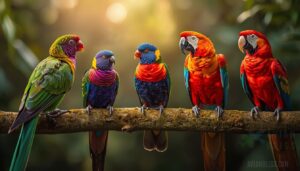
Bird colors aren’t just pretty — they’re packed with real purpose and some surprisingly clever biology. From feathers that shift color depending on the angle you’re looking at to pigments built straight from a bird’s diet, there’s a lot going on beneath the surface.
Here’s a closer look at the plumage details that make these birds genuinely hard to forget.
Iridescent Feather Colors
Watching iridescent plumage shift from green to violet as a hummingbird tilts its head — that’s nanostructure interference doing its thing. Tiny melanosome layering inside each feather barbule creates structural coloration, not paint. The angle-dependent hue changes because light waves bounce off stacked keratin layers and interfere with each other.
Iridescent feathers don’t hold color — they engineer it, bending light through stacked keratin until green becomes violet
For bird photography, this iridescence signaling looks completely different depending on your shooting angle. Move a few inches — whole new bird.
Red, Yellow, and Orange Pigments
Unlike structural color, those blazing reds and oranges you see on cardinals and macaws come straight from chemistry — specifically carotenoid pigments and psittacofulvin chemistry, working together in the feather shaft.
Here’s what’s actually driving that pigmented color:
- Carotenoid Sources come from diet — birds literally eat their color.
- Psittacofulvins handle red and orange feather pigmentation in parrots.
- Melanin Modulation deepens orange tones toward brown.
- Dietary Pigment Intake directly affects color intensity.
- Pigment Genetic Regulation controls how efficiently each bird processes these compounds.
Crests, Tails, and Bills
Color isn’t just about feathers — crests, tails, and bills tell just as much of the story.
Crest Display behavior, as in Wilson’s bird-of-paradise, signals mood instantly. Tail Aerodynamics affect both flight and courtship. Bill Morphology shapes every feeding habit.
For bird photography and bird identification, these structural features — alongside feather coloration and structural color — are your best field guides.
Male Vs Female Plumage
When you’re out photographing birds, sexual dimorphism hits you fast — the male northern cardinal blazes red while his mate wears warm russet tones.
That gap isn’t random. Hormonal Color Regulation and Genetic Sex Expression drive feather coloration mechanisms differently by sex.
Males lean into Brightness Contrast Dynamics for courtship, while females rely on Camouflage vs Display logic, using Structural Feather Dimorphism to quietly disappear into nesting cover.
Juvenile and Adult Color Differences
Young birds are basically wearing disguises.
Juvenile Camouflage keeps them muted and spotted — dull tones that help them disappear before they can fly well.
Then the Molt Color Shift kicks in.
Bill Hue Development and Eye Color Maturation follow gradually, sometimes across several seasons.
These Age-Related Hue Variations make bird identification based on plumage patterns tricky, but understanding feather coloration mechanisms and bird molting patterns turns that challenge into a genuinely fun puzzle.
Best Tips for Bird Photography
Getting a great shot of a colorful bird takes more than pointing your camera and hoping for the best. A few simple habits can make a real difference — better light, smarter settings, cleaner backgrounds.
Here’s what actually works.
Lighting for Vibrant Feather Color
Lighting make or break a shot of colorful plumage. Golden hour boost is real — that warm, low-angle light pulls reds and oranges right out of a scarlet macaw’s wings.
Indoors, soft diffuser use keeps iridescent feathers from blowing out. Try UV enriched lighting for edge glow on hummingbird patches. Spectral calibration around 5500K–6500K keeps your bird photography lighting honest and true.
Camera Settings for Sharp Bird Images
sharp bird shots comes down to nailing your camera settings for birds before the action starts.
Set your shutter speed to at least 1/2000s for birds in flight — wings move fast. For ISO management, don’t fear 1600 in dim light.
Use continuous autofocus modes with eye-tracking, and burst shooting grabs the frame you’d otherwise miss. Aperture selection around f/5.6 keeps feathers crisp.
Backgrounds That Make Colors Pop
The background in your shot is doing half the work — don’t ignore it. Complementary backdrops, like deep blue or green, make orange and red plumage practically leap off the screen, boosting your high-definition bird photographs without any editing tricks.
Here’s what actually moves the needle for photo composition:
- Neutral Gray Backgrounds eliminate color competition, letting saturated feathers dominate the frame naturally.
- Texture Minimalism — keep foliage simple and bokeh soft so feather detail stays the star.
- Framing Distance of 2–5 meters creates clean subject separation with smooth color edges.
- Complementary color pairings (blue behind orange plumage) increase perceived color intensity in bird images.
- Backlighting Halo from a low sun makes iridescent feathers genuinely glow — try it once and you’ll chase it forever.
Master these photography techniques for colorful birds, and your free, colorful bird image collection will look anything but accidental.
Photographing Birds at Feeders
Feeders are basically a bird photographer’s best-kept secret. Smart feeder placement — about 6 to 8 feet from shrubs or cover — gives birds a quick escape route and keeps them relaxed.
Offer seed variety like sunflower hearts and nyjer to pull in different species. Shoot during quiet observation windows at golden hour, adjust your camera angles to eye level, and let the birds come to you.
Ethical Wildlife Photography Practices
Getting a great shot and being a good guest in nature aren’t mutually exclusive.
Keep a respectful distance — a 300mm lens lets you fill the frame without crowding your subject.
Skip flash usage near roosting birds; it genuinely startles them.
Follow leave no trace habits, collaborate with locals who know the terrain, and let conservation and ethical practices in bird photography guide every decision.
How to Identify Birds in Photos
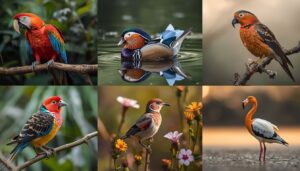
Looking at a photo and not quite sure what you’re seeing? A few key details — color patterns, habitat clues, size — can help you figure it out faster than you’d think.
Here’s what to look for.
Key Color Patterns and Markings
Once you know what to look for, bird plumage starts telling you a whole story. These patterns are your best clues:
- Crown Color Contrasts flash warning or display signals right at eye level.
- Barred Underparts Mosaic blends shadows in dappled forest light.
- Speckle Clusters form irregular groups across the mantle.
- Seasonal Molt Coloration intensifies reds and yellows during breeding.
- Structural coloration and UV Plumage Patterns hide details invisible to human eyes.
Habitat Clues in Bird Images
Plumage patterns tell part of the story — but the background fills in the rest.
Mangrove Water Edge roots and brackish water hint at fish-hunting specialists.
Forest Canopy Texture — dappled light, epiphytes, dense green — points to tropical rainforest birds like tanagers.
Spot Coastal Foam Signs or Grassland Edge Features, and you’ve narrowed your search considerably.
Bird habitats practically label themselves once you start looking.
Size and Shape Comparisons
Once you’ve read the habitat, size and shape become your next shortcut.
A toucan’s beak length variation alone tells you it’s not a finch — that oversized bill is half its 55‑cm body.
Wing morphology, tail ornamentation, and body proportions all vary wildly across the global diversity of colorful bird species, from compact wetland bird species to long‑tailed tropical forest birds.
Seasonal Plumage Changes
Here’s something that’ll change how you ID birds in photos: that "dull" bird you snapped in October might look completely different by March.
Seasonal Color Saturation peaks during breeding, when Feather Pigment Renewal deepens reds and brightens crowns through molt. Vitamins A and E play a direct role in this process — here’s how avian vitamins support breeding-season plumage and fertility.
Geographic Molt Variation means tropical species change less dramatically than temperate ones.
Migration timing and plumage variation also matter — color changes during bird molting often overlap with travel.
Similar-Looking Colorful Species
Even the most colorful bird species worldwide can fool you when two species share nearly identical plumage.
Compare Beak Shape Distinctions first — a keel-billed toucan’s rainbow bill differs clearly from lookalikes. Then check Tail Feather Patterns, Eye Ring Markings, and Mimicry Color Strategies. Geographic Range Overlap narrows it down fast.
Good bird species identification means slowing down and trusting the small details.
Frequently Asked Questions (FAQs)
Which bird has the most colorful plumage?
No single winner exists, but the Scarlet Macaw and Resplendent Quetzal top most lists.
Structural vs pigment coloration, UV reflectance, and sexual selection all shape what makes the most colorful birds in the world so jaw-dropping.
What is the most colorful bird in the world?
No single winner exists, but the Scarlet Macaw — with its blazing red, cobalt blue, and golden yellow — comes closest.
Structural coloration, dietary pigments, and evolutionary signaling all shape what makes the most colorful birds in the world.
Which animal is the most colorful?
Birds win the most colorful animal debate for many — but Tropical Reef Fish, Poison Dart Frogs, Nudibranch Sea Slugs, and Butterfly Wing Patterns give even the most colorful birds in the world serious competition.
What does a Bluebird look like?
Funny how such a small bird carries so much blue.
At 6–8 inches, a bluebird’s compact body, rounded belly, upright perch, and short sturdy legs make it instantly recognizable — pure color on a wire.
What do Australian birds look like?
Australia’s birds are a wild mix of color and personality.
Think rainbow lorikeets with blue heads and orange chests, vivid cobalt fairy wrens, and bold pink galahs — all showcasing stunning Regional Color Palettes unique to this continent.
Are hummingbirds the most colorful birds?
Hummingbirds are stunning, but they’re not alone at the top.
Many tropical species rival them through structural color mechanisms, ultraviolet visibility, and evolutionary color competition — making "most colorful" genuinely hard to crown.
What camera settings work best for bird photography?
Your camera is your net — set it right or the moment flies away. Use 1/1000s shutter speed, continuous AF-C focus mode, and shoot RAW for sharp, color-rich results every time.
Do colorful birds see colors differently than humans?
Yes — and it’s wild. Birds have tetrachromatic perception, meaning four cone types versus your three. They detect ultraviolet vision, spotting UV courtship signals invisible to you entirely.
Which colorful birds can be kept as pets?
Some of the most colorful birds you can keep as pets include parakeets, cockatiels, sun conures, and lovebirds.
Each has unique Pet Care Requirements, Dietary Needs, and Housing Enrichment needs worth researching first.
How do birds maintain their feather colors year-round?
Birds maintain vivid plumage through seasonal molting, dietary pigment intake from insects and fruit, and feather nanostructure repair.
Hormonal color regulation and UV protection mechanisms keep structural coloration mechanisms in feathers sharp year‑round.
Conclusion
Every great colorful bird species photo starts the same way—someone paused long enough to actually look. The birds were always there, flashing iridescent wings through rainforest canopies, tilting crested heads at backyard feeders, drifting across wetlands in breeding plumage.
You just needed the right lens, the right light, and a little knowledge about what you were chasing. Now you have all three.
The only thing left is to get outside and let the birds do the rest.
- https://academy.allaboutbirds.org/wilsons-bird-of-paradise-a-full-spectrum/
- http://m.espacepourlavie.ca/en/biodome-fauna/spangled-cotinga
- https://neotropical.birds.cornell.edu/Species-Account/nb/species/kebtou1/overview
- https://web.stanford.edu/group/stanfordbirds/text/essays/Color_of_Birds.html
- http://www.iucnredlist.org/technical-documents/categories-and-criteria