This site is supported by our readers. We may earn a commission, at no cost to you, if you purchase through links.

You spot a flash of iridescent green skimming across a pond, then notice long-legged silhouettes wading through marsh grass nearby. Water draws birds like a magnet—some paddle across the surface with webbed feet, others probe mudflats with specialized beaks, and a few plunge from breathtaking heights to snatch fish below.
Each species has carved out its own niche in aquatic ecosystems, developing striking adaptations that reveal where and how they make their living.
Learning to identify these types of birds found near water transforms any walk along a shoreline into a detective game, where bill shape, leg color, and feeding behavior decode the story of what you’re seeing.
Table Of Contents
Key Takeaways
- Water birds have evolved specialized adaptations like webbed feet, waterproof feathers, curved bills for probing mud, and salt glands that let them drink seawater—each feature revealing exactly where and how they make their living.
- Wetland loss is hitting hard, with 35% of natural wetlands gone since 1970 and water bird populations down 29% overall, making conservation efforts critical for species like the critically endangered spoon-billed sandpiper with only 490 adults left.
- You can identify water birds by focusing on bill shape, leg color, and feeding behavior rather than just plumage—a long bill reaches deep into mud, bright yellow legs mark yellowlegs species, and diving versus surface-feeding tells you what ecological niche they fill.
- Climate change is creating a migration mismatch where spring green-up outpaces bird arrival by 0.6 days annually, leaving chicks without peak food sources and forcing species to shift their ranges as habitats dry or flood.
Common Types of Water Birds
When you’re out near ponds, lakes, or rivers, you’ll likely spot some familiar faces in the water bird world. These species have adapted beautifully to life on and around water, with features like webbed feet and waterproof feathers that make them perfectly suited for their habitat.
Let’s look at the most common groups you’re likely to encounter on your next visit to the water’s edge.
Ducks (Mallards, American Wigeons, Northern Pintails, Gadwalls, Wood Ducks)

Ducks make up some of the most recognizable water birds you’ll encounter. Mallards, with their bright green heads, remain North America’s most common species, though populations have dropped over 40% in the eastern U.S. over the past two decades. American Wigeons sport blue-gray bills, while Northern Pintails show elegant long tails. Gadwalls and Wood Ducks round out this diverse group, each adapted to different wetland habitats facing pressures from habitat loss and climate impacts.
This decline is partly attributed to genetic pollution from game farm mallards.
Geese and Swans (Canada Geese, Tundra Swans, Mute Swans)
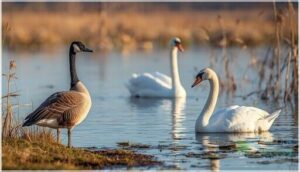
Larger waterfowl like Canada Geese have exploded in numbers, more than doubling since 1990 and now dominating urban parks. You’ll spot them by their black necks and white cheek patches.
Tundra Swans—all white with black bills—winter along the Atlantic coast but face population declines.
Meanwhile, Mute Swans, though stunning, are invasive species that damage wetlands and outcompete native birds through aggressive behavior. These swans were introduced by European settlers and are now considered a harmful invasive species.
Cranes and Rails (Sandhill Crane, Coots)
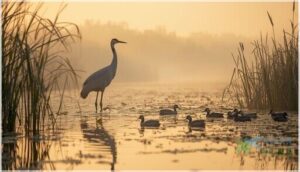
Moving from large waterfowl to lanky waders, you’ll find Sandhill Cranes in shallow wetlands. These gray birds with red crowns now number over 1 million globally, staging by the hundreds of thousands during crane migration.
Meanwhile, American Coots—those dark, chicken-like swimmers—thrive in dense vegetation. Look for them:
- Floating in freshwater marshes
- Bobbing near urban ponds
- Foraging on aquatic plants
- Nesting in emergent reeds
- Wintering wherever water stays open
Shorebirds and Wading Birds
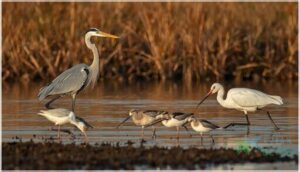
Shorebirds and wading birds are some of the easiest water birds to spot because they hang out in shallow areas where you can see them from shore. These birds have special features that help you tell them apart—like long legs, unique beaks, and distinct feeding behaviors.
Let’s look at what makes these birds different, which species you’re likely to see, and how they’re built for life along the water’s edge.
Identification Features of Shorebirds
You’ll find shorebirds easier to identify when you focus on a few key features. Bill morphology matters—longer beaks reach deeper into mud, while short beaks work surfaces. Leg coloration helps too: yellowlegs show bright yellow, while others have dark or blue-gray legs.
Watch for plumage patterns like Dunlin’s black belly patch or Sanderling’s white wing stripe. Body size and habitat cues complete the picture for confident water bird identification.
Common Species (Sandpipers, Plovers, Ibises)
Among wading birds and shorebirds, you’ll encounter several fascinating groups worth knowing:
- Least Sandpipers — North America hosts about 2.2 million of these tiny Arctic breeders
- Piping Plovers — Roughly 6,000 adults nest across three regional populations
- Glossy Ibises — Around 13,000–15,000 breed in North America, with Massachusetts colonies fluctuating between 47 and 144 pairs
- Spoon-billed Sandpipers — Critically endangered, with only 490 mature individuals remaining globally
- Mountain Plovers — About 18,000 inhabit western grasslands
Population trends for ibis species and sandpiper ID reveal how regional abundance shapes shorebird conservation efforts.
Adaptations for Wading and Feeding
Beyond their striking appearance, wading birds rely on specialized Bill morphology and Leg adaptations to thrive in shallow water. Herons use spear-like bills for impaling fish, while ibises probe mud with curved beaks reaching 10 cm deep.
Long legs let you spot egrets standing in water up to 60 cm, and webbed feet boost swimming thrust by 30%, showcasing striking habitat-specific adaptations for feeding behavior.
Seabirds and Ocean-Associated Birds

Seabirds spend most of their lives tied to the ocean, returning to land mainly for nesting and rest. These birds have evolved impressive features that let them thrive in saltwater environments, from specialized glands to powerful diving skills.
You’ll find different seabird species visiting coasts and estuaries throughout the year, depending on their breeding cycles and food availability.
Seabird Species (Pelicans, Puffins, Albatrosses)
You’ll spot pelicans by their unmistakable throat pouches—eight species worldwide, though pelican conservation efforts focus on declining populations like the Dalmatian pelican.
Puffins, those charming “sea parrots,” face serious threats; puffin decline in Europe has reached vulnerable status, with populations dropping over 50% since 2000.
Albatrosses, the ocean’s largest seabirds, suffer most from albatross bycatch in longline fisheries, threatening 15 of 22 species with extinction.
Unique Seabird Adaptations (Salt Glands, Diving Abilities)
Seabirds pack some serious survival tools you won’t find in your backyard birds. Their adaptations let them thrive where freshwater species can’t:
- Salt glands above the eyes excrete concentrated sodium chloride—more concentrated than seawater itself—keeping them hydrated while drinking ocean water
- Diving depth limits reach 177 meters in murres, powered by extra oxygen-storing hemoglobin
- Waterproof feathers seal out cold water during repeated dives
These osmoregulation mechanisms and species comparative adaptations deliver remarkable foraging energy efficiency in marine environments.
Seasonal Presence Along Coasts and Estuaries
Coastal areas and estuaries see dramatic shifts in water bird migration throughout the year. Waterfowl like ducks and geese flood U.S. wetlands—over 4 billion migratory birds arrive from Canada each year for stopover and wintering habitat. Shorebird surveys in Lake Erie marshes counted 33,690 individuals during spring and 29,379 in fall, showing two distinct seasonal pulses.
Climate effects are already reshaping migration patterns and breeding seasons, making conservation strategies essential for preserving water bird habitats.
| Season | Peak Activity | Species Example |
|---|---|---|
| Spring | Late April–Early May | Shorebirds, dabbling ducks |
| Autumn | July–November | Waterfowl, wading birds |
| Winter | December–February | Seabirds, diving ducks |
| Summer | June–August | Breeding herons, terns |
Water Bird Habitats and Distribution
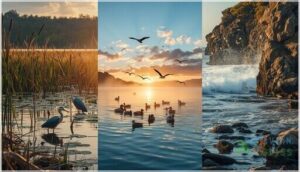
Water birds aren’t picky about where they set up shop—you’ll find them in everything from quiet marshes to crashing ocean waves. Each species has its favorite type of water hangout, and knowing where to look makes spotting them so much easier.
Let’s break down the main habitats where you’re most likely to cross paths with these feathered water lovers.
Freshwater Habitats (Lakes, Rivers, Wetlands)
Freshwater environments like lakes, rivers, and wetland habitats are where you’ll find the highest diversity of water birds. These aquatic habitats support billions of breeding and migrating species each year, but habitat loss impacts and changes to the hydrological regime threaten these critical freshwater ecosystems.
- Wetland bird diversity peaks in winter when seasonal abundance brings thousands of waterfowl and shorebirds together
- Over 4 billion migratory birds rely on U.S. wetlands for stopover and wintering habitat annually
- Conservation strategies must focus on protecting water availability and wetland area to sustain healthy populations
Coastal and Marine Environments
Where land meets saltwater environments, you’ll encounter entirely different bird communities than inland wetlands. Coastal areas and marine waters host over 70 seabird species in some regions, with atoll seabirds alone numbering around 31 million individuals across tropical zones.
These populations bring massive nutrient inputs to islands—averaging 65,000 kg of nitrogen per atoll yearly—while facing marine threats like habitat loss and coastal change from rising seas.
Migratory Patterns and Global Ranges
You’ll see that many water birds travel thousands of kilometers each year along established flyways—routes connecting breeding and wintering grounds across continents. For example, Arctic terns cover over 30,000 km annually between polar regions, while white-rumped sandpipers migrate roughly 9,000–11,000 km from Arctic Canada to South America.
Stopover behavior varies by species: longer-distance migrants like white-rumped sandpipers refuel for about 21 days at staging sites, whereas shorter-distance travelers stop for under a week.
Population trends differ widely along these flyways—recent monitoring frameworks tracking 88 populations found 33% decreasing, 42% increasing, and 25% stable. Flyway conservation efforts now coordinate across more than 100 countries to protect these migratory water birds throughout their global ranges.
Conservation and Threats to Water Birds
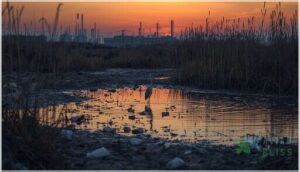
Water birds face some serious challenges, from disappearing wetlands to shifts in weather patterns that throw off their entire life cycles.
Understanding these threats is the first step in protecting the species you’ve come to recognize and enjoy. Let’s look at the main pressures facing water birds and what’s being done to help them survive.
Habitat Loss and Wetland Degradation
You’re watching something quiet and profound unfold across wetlands worldwide. Since 1970, we’ve lost about 35% of natural wetlands—the fastest ecosystem decline on record. Habitat fragmentation and hydrological changes are draining the aquatic ecosystems water birds depend on, with population impacts hitting diving ducks and shorebirds hardest. Conservation efforts matter, but governance trends show even protected sites face declining health.
Since 1970, we’ve lost 35% of natural wetlands—the fastest ecosystem decline on record—draining the habitats water birds depend on
- Wetland decline continues at alarming rates, with 400 million hectares lost since 1970
- Habitat conversion to agriculture remains the primary driver of wetland ecosystem destruction
- Functional drying reduces shallow foraging areas critical for breeding and migration success
Climate Change Impacts
Beyond disappearing wetlands, climate change is rewriting water birds’ survival scripts. You’ll notice migration mismatch as spring green-up outpaces bird arrival by 0.6 days annually, leaving chicks without peak food.
Hydrology changes dry breeding grounds faster, while sea-level rise floods coastal nests—shorebird populations collapse before habitats fully drown.
Bird populations dropped 29% since 1970, with warming ecosystems accelerating habitat shifts and population decline across all waterbird groups.
Conservation Efforts and Birdwatching Ethics
Protection networks now safeguard over 260 million hectares of wetland habitats through international agreements, while ethical birdwatching minimizes disturbance to waterfowl and shorebirds at feeding sites.
You can support water bird conservation through citizen science—population monitoring helps track trends across flyways. Keep playback clips under 30 seconds, avoid flushing birds, and respect closed areas to guarantee habitat preservation for vulnerable species.
Frequently Asked Questions (FAQs)
What sounds do different water birds make?
Like nature’s symphony warming up at dawn, water birds produce distinct calls suited to their lifestyles.
Duck calls quack rhythmically, geese honk in coordination, cranes rattle loudly, shorebirds chirp at high frequencies, and seabirds grunt deeply for colony communication.
How do water birds care for their young?
Water birds show diverse parental investment strategies. Ducks rely on female-only care, while geese and swans practice biparental care.
Chick provisioning varies by species, with seabirds coordinating feeding trips and cranes providing extended post-fledging care through brood defense.
What do water birds eat in different seasons?
You might think water birds eat the same menu year-round, but their diet shifts dramatically. Winter brings carbohydrate sources like seeds and grains, while breeding seasons demand protein needs from invertebrates and insects.
Can water birds survive in urban environments?
Yes, water birds can survive in urban environments by adapting their diet and behavior. Waterfowl like ducks adjust to habitat quality differences, showing flexibility despite pollution impacts.
Urban adaptation succeeds when conservation strategies support healthy wetlands.
How long do various water bird species live?
Water bird species show considerable lifespan differences. Dabbling ducks generally live 5–10 years, while swans and geese can reach 25–40 years. Oceanic seabirds like albatrosses often exceed 60 years in protected environments.
Conclusion
When wetlands face challenges or shorelines change, the types of birds found near water tell us what’s happening beneath the surface. Your growing skill at recognizing a heron’s patient stance or a tern’s plunge-dive connects you to these ecosystems in ways that matter.
Each outing sharpens your eye and deepens your understanding. The birds are there, living their stories—you just need to watch, learn, and let their world unfold before you.
- https://www.fws.gov/press-release/2024-03/continued-decline-wetlands-documented-new-us-fish-and-wildlife-service-report
- https://besjournals.onlinelibrary.wiley.com/doi/abs/10.1111/1365-2664.13845
- https://www.sciencedirect.com/science/article/abs/pii/S0272771424004918
- https://pmc.ncbi.nlm.nih.gov/articles/PMC9679241/
- https://pubmed.ncbi.nlm.nih.gov/33580336/