This site is supported by our readers. We may earn a commission, at no cost to you, if you purchase through links.

Beneath the flurry of forest sounds, the sharp crack of a woodpecker’s beak against bark cuts through like a secret code. This isn’t random noise—it’s a lifeline, a strategy, and sometimes a battle cry. Each tap is backed by muscle and matched with purpose, whether for rooting out a fat beetle grub, carving out a snug nest, or letting a rival know this stretch of timber is already claimed.
When you start noticing why woodpeckers peck wood, you see the forest differently—alive with signals and engineering, every beak strike shaping the wild world around you.
Table Of Contents
- Key Takeaways
- Why Do Woodpeckers Peck Wood?
- How Woodpecker Anatomy Supports Pecking
- Woodpecker Pecking and Forest Ecosystems
- Reasons Woodpeckers Peck Human Structures
- The Ecological Importance of Woodpecker Pecking
- Frequently Asked Questions (FAQs)
- Do woodpeckers ever damage their beaks?
- Can woodpeckers peck through metal surfaces?
- What time of day do woodpeckers peck most?
- Do baby woodpeckers know how to peck naturally?
- How fast do woodpeckers peck per second?
- How long can woodpeckers live in the wild?
- Do woodpeckers ever damage healthy trees permanently?
- How do woodpeckers avoid brain injury from pecking?
- What predators do woodpeckers face in their habitats?
- Are woodpecker populations declining worldwide?
- Conclusion
Key Takeaways
- Woodpeckers peck wood to find food, create nesting cavities, claim territory, and attract mates, each behavior serving a distinct survival need.
- Their specialized anatomy—shock-absorbing skulls, sturdy beaks, strong neck muscles, and unique toes—lets them hammer wood without injury or disorientation.
- By excavating trees, woodpeckers help control insect pests and create nesting sites that other animals depend on, making them essential to healthy forest ecosystems.
- Sometimes, woodpeckers target buildings for food, communication, or nesting when natural options are scarce, causing noticeable but rarely permanent damage.
Why Do Woodpeckers Peck Wood?
Woodpeckers don’t just hammer away at trees for no reason. Their pecking is tied to several deeply rooted needs and behaviors.
For a closer look at the reasons behind these behaviors—including nesting and territory marking—check out this helpful overview of woodpecker habits in Vermont woodpecker facts and behaviors explained.
Here’s what drives them to keep at it.
Foraging for Insects and Food
Picture a woodpecker scanning tree bark with sharp senses—it’s not just pecking for show. This bird is a master of foraging behavior patterns, using insect prey detection and food source localization to pinpoint hidden insects. Tree bark excavation turns up larvae, beetles, even sap, all supporting nutrient acquisition strategies:
For more on their drumming and probing techniques, check out this guide on woodpecker foraging behavior in Rhode Island forests in this resource on woodpecker feeding strategies.
- Scanning for surface crevices
- Listening for larvae movement
- Bark scaling to access galleries
- Deep excavation for prey
- Switching diet seasonally for efficiency
The woodpecker’s feeding habits are influenced by bark beetle populations.
Creating Nest Cavities in Trees
While foraging tests precision, creating nest cavities in trees is real craftsmanship. Woodpeckers embrace cavity excavation, sculpting nesting spaces with strategies shaped by tree selection, wood decay, and nest architecture. Not every tree makes the cut—some species pick decayed stubs for easy pecking, others prefer sound trunks. Each nest becomes shelter, blueprint, and legacy in the wild. The availability of cavity nesting sites is a vital factor in the woodpeckers’ ability to create these nests.
| Nesting Strategies | Tree Selection | Nest Architecture |
|---|---|---|
| Annual new cavities | Dead or live trees | Round or oblong holes |
| Reuse in some spp. | Decay ranks matter | Deep chambered design |
| Both sexes build | Large trunks favored | Wood chips for lining |
| Quick or slow build | Branch vs trunk use | Small openings protect |
Drumming for Communication and Territory
Once a nesting spot is carved, woodpeckers crank up the volume with drumming—nature’s Morse code. Each beat acts as a Territorial Signal, staking claim on the landscape.
If you’re curious about other signature bird calls and what they mean, this guide to common backyard bird sounds breaks it all down.
Drumming Patterns aren’t random; speed, rhythm, and Signal Structure all carry meaning, allowing rivals to size each other up. Specialized neural pathways help woodpeckers turn trees or metal into channels for avian communication and territory defense.
If you’re curious about why these noisy behaviors happen around your home, this breakdown of woodpecker habits and motivations is super insightful: Why Woodpeckers Peck—Behaviors, Communication, and Territory Marking.
Attracting Mates During Breeding Season
Now, all that drumming you hear in spring isn’t just about marking territory—it’s woodpecker flirting in full swing. During the breeding season, Mate Attraction becomes the focal point. Bold Drumming Patterns become the backbone of their Courtship Displays.
Each rhythmic bout is a message, broadcast across the trees: ready to pair up, show off strength, and claim a spot for raising young.
Birdsong isn’t the only sign of avian impact; these noisy displays go hand-in-hand with the ecological benefits highlighted in this explainer about how birds like woodpeckers and insectivores help shape healthy forests and wetlands.
How Woodpecker Anatomy Supports Pecking
If you’ve ever wondered how woodpeckers pull off their relentless pecking, the answer lies in design. Their bodies are loaded with features built for the job. Here’s what makes their anatomy so effective.
Specialized Skull and Shock Absorption

Ever wonder how woodpeckers survive fierce cranial impact, hammering wood all day without a scratch to the brain? Their skull structure is no accident—think spongy bones and shock absorption built for extremes.
Hyoid mechanics act like a safety belt, dispersing force. It’s an integrated brain protection system, where the skull and hyoid apparatus make pecking look easy.
Powerful Beaks and Neck Muscles

Raw power—woodpeckers put Beak Anatomy and Neck Muscle to work in ways you can feel through the timber. Pecking Mechanics are driven by rapid-fire neck muscles, while the skull stays braced, handling each impact. It all comes together so that:
- Muscular contractions deliver force
- The beak’s structure prevents fractures
- The skull absorbs shock, minimizing damage
Unique Toe Arrangement and Tail Feathers
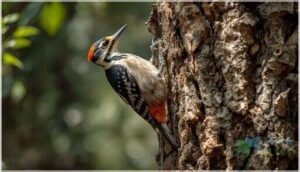
Climbing mechanics come alive in woodpeckers, thanks to their unusual toe configuration and feather structure. You’ll notice their two forward and two backward toes grip tree trunks like living clamps.
The stiffened tail anchors these birds mid-peck, weaving tail and toes into a balance system that lets woodpecker anatomy and physiology thrive in vertical scansorial locomotion across battered wood.
Adapted Tongue and Hyoid Bone Structure

Imagine sliding your tongue out a third of your body length—woodpeckers pull off this acrobatic feat every day. That’s Tongue Protrusion powered by clever Hyoid Mechanics and a unique Bone Structure. Here’s what sets them apart:
- Cranial Adaptations prevent brain damage.
- The hyoid bone wraps behind the skull.
- Barbs grip prey.
- Muscles control extension.
- Feeding Ecology demands reach and flexibility.
Woodpecker Pecking and Forest Ecosystems

Every time you hear that steady tapping in the woods, there’s more happening than meets the ear. Woodpecker pecking doesn’t just shape their own lives—it transforms entire forests around them.
Here’s how their hammering leaves a mark on the ecosystem.
Controlling Insect Populations
When woodpeckers hammer into bark, they’re not just making noise—they’re performing expert Insect Pest Control. By targeting beetle larvae and wood borers, these birds help manage Beetle Population Dynamics and keep insects in check.
This foraging shapes Forest Ecology, acting as Ecosystem Engineering that protects trees from serious infestations and maintains healthy woodland cycles.
Creating Nest Sites for Other Species
Think of tree excavation as nature’s house-building—Cavity Nesting birds like wrens and titmice depend on fresh holes created through woodpecker Ecosystem Engineering.
Your woodland neighbors can’t carve their own nests, so they rely on these abandoned cavities, weaving new Species Interactions and Nest Site Selection into forest life.
It’s a chain reaction that strengthens tree health and shapes ecological balance.
Indicators of Forest Health and Stability
When you spot a healthy mix of abandoned woodpecker cavities and thriving bird communities, you’re looking at living proof of strong forest resilience and ecosystem indicators. Here’s what their presence signals:
- Woodland Biodiversity remains intact.
- Tree regeneration and big, old snags persist.
- Habitat integrity and food chains are stable.
- Forest ecosystems recycle, balancing tree health and wildlife conservation.
Reasons Woodpeckers Peck Human Structures
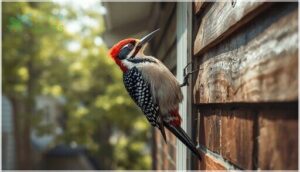
Woodpeckers don’t limit their attention to trees—your walls, roof, and metal siding can catch their interest too. They show up for a handful of clear reasons that might surprise you.
Here’s what usually brings woodpeckers pecking around your home.
Searching for Food in Wooden Buildings
Crunching into your siding, woodpeckers don’t merely follow instinct—they’re tracking insect infestation, sensing larvae beneath layers of cedar, plywood, or lap boards. Their feeding patterns leave trails of small holes, evidence of foraging behavior born in wild forests, now redirected to buildings where wood damage is compounded by siding materials that harbor insects easily overlooked.
| Siding Material | Woodpecker Risk |
|---|---|
| Cedar Shingles | High |
| Plywood (T-111) | High |
| Lap Siding | Moderate |
| Composite Boards | Moderate |
Drumming on Metal and Siding for Communication
After tearing a path through siding for insects, these birds switch tactics: Metal Drumming. That burst of staccato rhythm echoing across neighborhoods isn’t random pecking, it’s a Woodpecker Signal—sonic territoriality at work.
Urban Noises become an amplifier, their communication rolling through gutters and vent caps, broadcasting animal communication in the open code of Acoustic Ecology. Let rivals listen.
Mistaking Surfaces for Nesting Sites
When Metal Drumming fades, you notice something stranger—perfectly round holes chewed into cedar siding or trim. To a woodpecker’s senses, dark wooden planks can imitate the look and feel of natural snags.
This is Surface Mimicry in action—Artificial Nesting right on your wall. Nesting Site Selection isn’t always precise, so Cavity Excavation may begin anywhere a bird senses opportunity.
The Ecological Importance of Woodpecker Pecking

Woodpecker pecking is more than just noise in the forest—it’s a driving force in shaping healthy, balanced ecosystems. The impact of their hammering extends far beyond the trees they choose. Here’s how their actions ripple through the natural world.
Maintaining Biodiversity and Ecosystem Balance
Think of woodpeckers as ecosystem engineers—every strike is part of a bigger plan. They drive forest regeneration, spark new species interactions, and increase habitat diversity. Here’s how they maintain biodiversity and ecological balance:
- Shape forest structure for wildlife.
- Regulate pests, naturally.
- Create opportunities other species can’t, sustaining essential forest ecosystem engineering.
Supporting Wildlife Through Cavity Creation
Every abandoned woodpecker cavity is a hard-won gift to the forest. These pockets in tree trunks—shaped by relentless Woodpecker Behavior—become prime locations for cavity nesting wildlife. Squirrels, owls, chickadees, and even bats move in. Through this ecosystem engineering, woodpeckers drive Biodiversity Enhancement and Wildlife Support, making them silent partners in Forest Conservation.
Every abandoned woodpecker cavity transforms a tree into a vital shelter, helping wildlife thrive and supporting life across the entire forest
| Species Benefiting | Value Gained |
|---|---|
| Chickadees, nuthatches | Safe, snug nesting sites |
| Owls, ducks | Predator escape, microclimate |
| Bats, squirrels | Secure roosting, denning |
| Insects, amphibians | Overwintering havens |
| Martens, porcupines | Shelter through seasons |
Contribution to Tree Health and Forest Dynamics
Transformation lies at the heart of tree health and forest dynamics. When you see a woodpecker pecking, recognize the silent work of ecosystem engineering—targeting diseased wood, shifting forest composition, and kickstarting wood decay.
This sharp-beaked activity weaves together regeneration, resilience, and conservation, ensuring woodland ecosystems stay healthy, diverse, and primed for the next cycle of life.
Frequently Asked Questions (FAQs)
Do woodpeckers ever damage their beaks?
Woodpeckers rarely damage their beaks. Their beak durability and skull anatomy absorb pecking forces, while feather protection helps too.
Even with aggressive pecking, most bill regrowth keeps their beaks functional—nature engineered bird anatomy for this pounding life.
Can woodpeckers peck through metal surfaces?
You won’t see woodpeckers punching holes through metal—Metal Pecking Limits are real. Their Beak Hardness can dent surfaces, but true penetration is rare.
Instead, Woodpecker Drumming on metal is all about Acoustic Signaling, not foraging.
What time of day do woodpeckers peck most?
Picture the forest waking. Most woodpecker pecking erupts just after sunrise—Morning Drumming at its peak—blending with other bird behavior.
Daily Pecking Patterns then taper off, with Sunset Activity minimal, since woodpeckers follow diurnal rhythms and aren’t nocturnal.
Do baby woodpeckers know how to peck naturally?
You won’t see strong pecking right out of the egg—those early days are all about growth, not drilling.
Pecking reflexes and motor learning kick in post-fledging, so true woodpecker skill blooms with fledgling practice.
How fast do woodpeckers peck per second?
Hear the rapid-fire, staccato rhythm—medium-sized woodpeckers drum at 15 to 25 beats per second on tree trunks.
That drumming speed comes from specialized woodpecker anatomy, sturdy beak structure, and precise pecking mechanics honed for explosive pecking frequency.
How long can woodpeckers live in the wild?
Wild Survival isn’t guaranteed for any woodpecker, but most last just 1–2 years, with only a few hitting the upper end of Woodpecker Longevity—up to 12 years—thanks to low Mortality Rates and favorable Age Factors.
Do woodpeckers ever damage healthy trees permanently?
Woodpeckers rarely cause permanent damage to healthy trees, but repeated sapsucker injury patterns, like dense bands of holes, can disrupt growth or invite decay.
Tree Damage Assessment shows most healthy trees recover, showing Forest Ecosystem Resilience to woodpecker foraging impact.
How do woodpeckers avoid brain injury from pecking?
Much like a helmeted stunt rider, woodpeckers rely on specialized Skull Structure and Shock Absorption.
Adaptation mechanisms—including asymmetric beaks, snug brains, and a sling-like hyoid—redirect Pecking Mechanics, dispersing impact and maximizing Cranial Safety for effective Brain Protection.
What predators do woodpeckers face in their habitats?
Across forests and neighborhoods, raptor attacks, snake predation, mammal threats, avian competition, and nest raiders all shape woodpecker survival.
These predators highlight how wildlife ecology and avian behavior fuel forest conservation challenges—and the uneasy balance that defines nature.
Are woodpecker populations declining worldwide?
Population patterns paint a patchwork: while many woodpeckers remain stable, several species face sharp declines due to habitat loss, shifting climate, and shrinking forests.
Conservation status varies, but species extinction risks highlight urgent needs in wildlife ecology and forest conservation.
Conclusion
A fallen log and a standing oak tell opposite stories, yet both are shaped by woodpeckers. What seems like destruction—holes hammered into trunks—actually builds life into the forest.
Each rhythmic blow, driven by reasons as varied as hunger and hope, redefines borders, creates homes, and balances the wild.
When you ask why do woodpeckers peck wood, you’re really glimpsing the restless inventiveness at the heart of healthy woods—where purpose and change are forever entangled.
- https://naturewithbirds.com/woodpecker-drumming-sounds-decoded/
- https://www.scienceofbirds.com/blog/woodpeckers-picidae
- https://lyricbirdfood.com/birding-hub/behavior/what-do-woodpeckers-eat/
- https://www.waldwissen.net/en/forestry/forest-protection/insects/bark-beetles-and-woodpecker
- https://digitalcommons.usf.edu/cgi/viewcontent.cgi?article=20702&context=auk