This site is supported by our readers. We may earn a commission, at no cost to you, if you purchase through links.
Spotting a Blackburnian warbler at 400 yards sounds impossible until you’re behind a quality scope watching that flame-orange throat like it’s ten feet away. Most birders start with decent binoculars, then hit a wall—shorebirds too distant, raptors reduced to silhouettes, dawn light too dim to distinguish field marks. That wall has a name: insufficient optics.
The right spotting scope closes that gap fast, and the difference between a 65mm and 85mm objective lens at first light is the difference between a confirmed lifer and an entry marked "probable." These optics transform distant, indistinct shapes into detailed, identifiable birds, turning frustration into certainty.
These seven wildlife viewing optics cover every budget and habitat, from backyard feeders to remote wetlands. Whether you’re tracking warblers in dense foliage or scanning vast shorelines, the right tool ensures no detail—or species—is left behind.
Table Of Contents
- Key Takeaways
- Top 7 Wildlife Viewing Optics
- Best Optics for Bird Watching
- Magnification Range for Wildlife Viewing
- Objective Lens Size Matters
- Optical Coatings and Prism Quality
- Field of View and Tracking
- Weatherproofing and Field Durability
- Portability for Outdoor Birders
- Accessories for Better Viewing
- Price Versus Performance Comparison
- Frequently Asked Questions (FAQs)
- How do I clean spotting scope lenses safely?
- What eye relief is best for eyeglass wearers?
- Can I use wildlife optics for astronomy?
- How long do spotting scopes typically last?
- Are angled or straight scopes better for birding?
- Can spotting scopes replace binoculars for wildlife viewing?
- How do angled versus straight eyepieces compare?
- What maintenance do spotting scopes require long-term?
- Are spotting scopes suitable for nighttime wildlife observation?
- How does eye relief affect comfortable extended viewing?
- Conclusion
Key Takeaways
- An 85mm objective lens at dawn outperforms a 65mm in low light, making it the smarter pick for wetland and shorebird observation where early sessions are non-negotiable.
- Once you cross 30x magnification, your tripod matters as much as your optics — vibration and atmospheric turbulence will ruin the sharpest glass money can buy.
- BAK4 prisms paired with fully multi-coated lenses push light transmission above 95%, delivering edge-to-edge sharpness and accurate color that cheaper prism glass simply can’t match.
- Budget scopes under $150 with nitrogen-purged, O-ring-sealed bodies handle real field conditions well, but their included tripods almost always need replacing for serious long-range work.
Top 7 Wildlife Viewing Optics
Finding the right spotting scope can make or break your time in the field, whether you’re tracking shorebirds at dawn or glassing a distant raptor.
Getting familiar with key specs before you buy goes a long way, and this guide to the best spotting scopes for birding breaks down exactly what to look for based on real field use.
Each scope on this list was evaluated on magnification range, lens quality, durability, and real-world usability for wildlife observation.
Here are seven options worth your attention.
1. Wozel 25 to 75x HD Spotting Scope
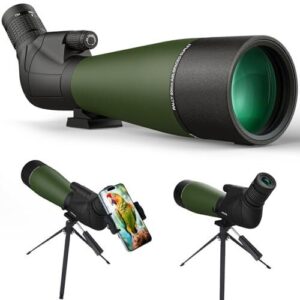
If you’re after a capable, no-fuss spotting scope without spending a fortune, the Wozel 25–75x HD deserves a serious look. Its 80 mm fully multi-coated objective pairs with a BAK4 prism to deliver bright, high-contrast images across the entire zoom range.
You get a 123-foot field of view at 25x, narrowing to 48 feet at 75x — solid numbers for tracking distant wildlife.
At $99.97 with a tripod, phone adapter, and carrying case included, it’s genuinely hard to beat.
| Best For | Hunters, birders, and range shooters who want a solid, feature-packed spotting scope without breaking the bank. |
|---|---|
| Magnification Range | 25–75× |
| Objective Lens | 80mm |
| Prism Type | BAK4 |
| Weatherproofing | Waterproof, fog-proof |
| Tripod Included | Tabletop tripod |
| Phone Adapter | Yes |
| Additional Features |
|
- Bright, clear optics thanks to the 80 mm multi-coated lens and BAK4 prism — great for low-light conditions.
- Comes with everything you need out of the box: tripod, carrying case, phone adapter, and cleaning cloth.
- O-ring sealed and nitrogen-filled housing keeps it working in rain, fog, and rough field conditions.
- The included tripod is pretty basic — serious long-range work will likely call for an upgrade.
- Getting the phone adapter dialed in takes patience, and consistent shots can be hit or miss.
- Starting at 25x means close-range viewing isn’t really in the cards — not the most flexible option for varied distances.
2. Gosky 20 to 60x HD Spotting Scope
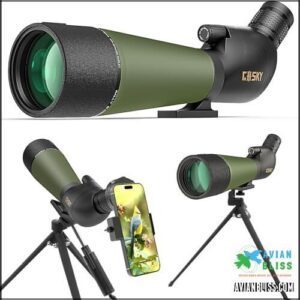
The Gosky 20–60x HD offers enhanced flexibility with a wider zoom floor at 20x, ideal for broad landscape scanning.
Its 80 mm fully multi-coated objective, paired with a BAK4 Porro prism, achieves 95% light transmission—ensuring reliable performance during dawn birding sessions.
At 20x magnification, it delivers an 82.9-foot field of view, narrowing to 48 feet at 60x for focused observation.
The package includes a built-in smartphone adapter, a rubber-armored body, and nitrogen-sealed construction, combining durability with convenience at $149.99.
| Best For | Birdwatchers, wildlife observers, and hobbyist shooters who want a versatile, weather-sealed scope with smartphone shooting capability without breaking the bank. |
|---|---|
| Magnification Range | 20–60× |
| Objective Lens | 80mm |
| Prism Type | BAK4 Porro |
| Weatherproofing | Waterproof, fog-proof |
| Tripod Included | Full metal tabletop |
| Phone Adapter | Yes |
| Additional Features |
|
- The 80 mm multi-coated lens with BAK4 prism pulls in 95% of available light, so dawn and dusk sessions still look bright and sharp.
- Variable 20–60x zoom gives you real flexibility—wide enough for scanning a field, powerful enough to read bullet impacts at the range.
- Built-in smartphone adapter and nitrogen-sealed, rubber-armored body pack a lot of practical value into a $149.99 price tag.
- Image quality drops off noticeably at 60x, especially in low light—don’t count on it for nighttime or deep-sky use.
- The included tabletop tripod is flimsy; you’ll likely want to swap it out for something sturdier if you’re shooting at longer distances.
- Getting the smartphone adapter dialed in takes patience, and a poorly aligned phone can produce halo effects or soft edges in your shots.
3. Gosky 20 60×80 High Power Spotting Scope
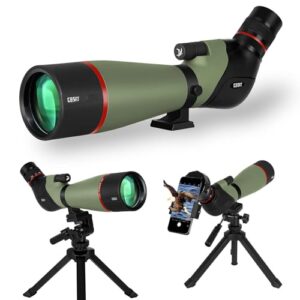
If you want to step up from the 20–60x HD, the Gosky 20-60×80 High Power delivers the same magnification range with a dual-speed coaxial focusing system that makes fine adjustments noticeably smoother.
The 80 mm objective and BaK-4 prisms push light transmission high enough for reliable dawn and dusk viewing.
Its field of view spans 100.5 ft at 20x down to 52.5 ft at 60x, ensuring versatile observation capabilities.
At $189.99, it’s a solid step up in precision.
| Best For | Hunters, wildlife watchers, and casual astronomers who want a versatile, durable spotting scope with digiscoping capability without spending a fortune. |
|---|---|
| Magnification Range | 20–60× |
| Objective Lens | 80mm |
| Prism Type | BaK-4 |
| Weatherproofing | Waterproof, fog-proof |
| Tripod Included | Not included |
| Phone Adapter | Yes |
| Additional Features |
|
- The 80mm objective and BaK-4 prisms pull in plenty of light, making it genuinely usable at dawn and dusk.
- Dual-speed coaxial focusing gives you much finer control than a single knob — big difference when tracking moving targets.
- Nitrogen-purged, sealed housing means you’re not babying it in the rain or fog.
- Image quality gets noticeably soft at 60x — you’ll rarely want to push it that far.
- The included tripod is pretty flimsy, especially if you’re attaching a phone to it.
- The smartphone adapter can be frustrating to align and doesn’t grip heavier phones well.
4. Gosky 20-60×85 Spotting Scope
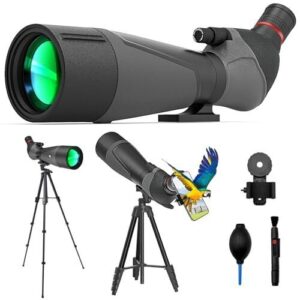
The Gosky 20-60×85 spotting scope features an 85 mm objective lens, significantly enhancing light-gathering capabilities. This design delivers a 101 ft field of view at 20x magnification, providing ample width to track subjects like a hunting red-tailed hawk across open terrain.
FMC coatings and BAK4 prisms ensure images remain sharp and color-accurate across the entire magnification range, from 20x to 60x.
The scope includes a tripod, phone adapter, and carry bag, forming a comprehensive field kit. However, the plastic tripod may wobble in wind, presenting a minor stability concern in breezy conditions.
| Best For | Birders, wildlife watchers, and casual stargazers who want solid optical performance and a full field kit without spending a fortune. |
|---|---|
| Magnification Range | 20–60× |
| Objective Lens | 85mm |
| Prism Type | BAK4 |
| Weatherproofing | Waterproof, dust-resistant |
| Tripod Included | Full aluminum tripod |
| Phone Adapter | Yes |
| Additional Features |
|
- The 85 mm objective pulls in a lot of light, so early morning and dusk sessions still look crisp and bright
- 20–60x zoom gives you real flexibility — wide for tracking birds in flight, tight for reading fine detail at distance
- Comes ready to go out of the box with a tripod, phone adapter, and carry bag all included
- The plastic tripod wobbles in wind and makes fine adjustments frustrating, especially at higher magnifications
- The scope sits rear-heavy on the mount, so you’ll likely need to fiddle with balance to keep it from tilting down
- At 6.2 lb, it’s not the lightest setup to haul on a long hike
5. Gosky 20 60×65 Spotting Scope
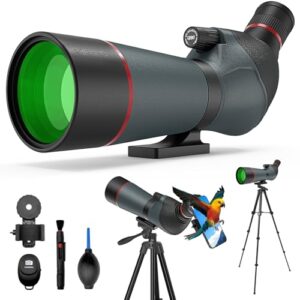
Step down to the 65 mm objective, trading light-gathering for real portability: this scope weighs roughly 4.9 lb and measures just 12.5 inches long, making it backpack-friendly.
The 20–60× zoom delivers a wide 94.5-foot field of view at low power, tightening to 48 feet at 60×. BAK4 prisms and FMC coatings ensure sharp, color-true images.
The included tripod, phone adapter, and dual focusing system complete a capable all-in-one starter kit.
| Best For | Birdwatchers, wildlife observers, and beginner shooters who want a portable, affordable spotting scope without sacrificing too much optical quality. |
|---|---|
| Magnification Range | 20–60× |
| Objective Lens | 65mm |
| Prism Type | BAK4 Roof |
| Weatherproofing | Waterproof, fog-proof |
| Tripod Included | Full aluminum tripod |
| Phone Adapter | Yes |
| Additional Features |
|
- 20–60× zoom with BAK4 prisms and FMC coatings delivers sharp, bright images at a surprisingly low price point.
- Lightweight and compact enough to toss in a backpack — great for hikes, field trips, or travel.
- Comes loaded with extras: tripod, phone adapter, dual focus system, and carrying case right out of the box.
- The tripod legs feel flimsy and may not hold up well for extended or heavy use.
- Phone adapter compatibility is hit or miss — some iPhone and Android users can’t get a secure fit.
- Focusing at mid-range distances takes some fiddling, and a few users have reported foggy images.
6. Vortex Razor HD Spotting Scope
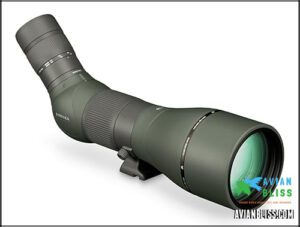
The Vortex Razor HD sets a serious standard at $1,699. Its triplet apochromatic lens with ED glass and XR Plus fully multi-coated surfaces deliver razor-sharp, color-accurate images in the 27–60× range on an 85 mm objective — enough brightness for reliable dawn to dusk sightings of distant raptors or shorebirds.
The argon-purged, O-ring sealed body withstands rain and cold without hesitation.
Dual helical focus knobs let you acquire fast at low power and dial in fine detail at high zoom.
| Best For | Serious birders, hunters, and wildlife watchers who want top-tier optics and plan to use them hard in all kinds of weather. |
|---|---|
| Magnification Range | 27–60× |
| Objective Lens | 85mm |
| Prism Type | ED Triplet |
| Weatherproofing | Waterproof, fog-proof |
| Tripod Included | Not included |
| Phone Adapter | No |
| Additional Features |
|
- The triplet apochromatic lens with ED glass gives you sharp, true-color images that hold up well from dawn to dusk.
- Argon-purged, O-ring sealed body handles rain, snow, and fog without skipping a beat.
- Dual helical focus knobs make it easy to lock onto a target fast and then fine-tune without losing it.
- Brightness drops off noticeably above 27×, so the high end of the zoom range is best in good light.
- The eyecup can be awkward for glasses wearers and doesn’t always stay in place.
- The included scope bag is pretty thin on padding — you’ll probably want a better case if you’re tossing this in a pack.
7. Emarth Waterproof Spotting Scope Kit
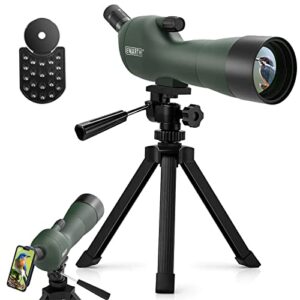
If you’re watching a budget without sacrificing function, the Emarth Waterproof Spotting Scope Kit earns its place. With 20–60× zoom and a 60 mm objective, backed by BAK4 prisms and fully multi-coated lenses, it delivers clear target detail at 100–200 yards—ideal for backyard birding or scanning open fields.
Pair it with one of these top-rated tripods for bird watching and you’ll get rock-solid stability without blowing your budget.
Its rugged design includes waterproof, nitrogen-purged, and rubber-armored construction, ensuring durability in field conditions. At roughly 1.3 lb, it remains lightweight and portable for extended use.
However, clarity fades past 200 yards, and the included 14-inch tripod wobbles in wind, limiting stability in challenging environments.
| Best For | Budget-conscious shooters, birders, and wildlife watchers who need a solid, portable scope for use within 200 yards. |
|---|---|
| Magnification Range | 20–60× |
| Objective Lens | 60mm |
| Prism Type | BAK-4 |
| Weatherproofing | Waterproof, fog-proof |
| Tripod Included | 14in tabletop tripod |
| Phone Adapter | No |
| Additional Features |
|
- 20–60× zoom with BAK-4 prisms and fully multi-coated lenses gives you clear, sharp detail at 100–200 yards without breaking the bank.
- Waterproof, nitrogen-filled construction handles rain, dew, and temperature swings without fogging up on you.
- At just 1.3 lb, it’s easy to pack on a hike or sling over your shoulder for a day in the field.
- Image clarity drops off noticeably past 200 yards, so it’s not great for long-range identification.
- Eye relief basically disappears at 60×, which makes it uncomfortable if you wear glasses.
- The included 14-inch tripod is light and can wobble in wind—you may want to swap it out for something sturdier.
Best Optics for Bird Watching
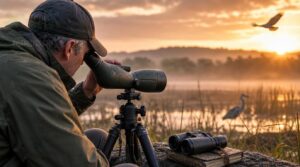
Bird watching puts different demands on your optics depending on where and when you’re out in the field.
The right scope for a backyard feeder setup looks nothing like what you’d reach for at dawn on a wetland or tracking a red-tailed hawk across an open ridge.
Here’s how each habitat and lighting condition stacks up against the optics reviewed above.
Backyard Birding Needs
Your backyard is a living classroom, and the right birding equipment makes all the difference. Compact, lightweight portable spotting scopes with a wide field of view let you track chickadees at feeders without disturbing them.
Smart Feeder Placement Strategies, Water Feature Design, and Habitat Planting Tips draw birds closer. Budget-friendly optics, Nest Box Maintenance, and Predator Guard Solutions keep your setup productive year-round.
Adding moving water attracts birds to your garden provides auditory cues that encourage more frequent visits.
Wetland and Shorebird Viewing
Wetland shorebird watching rewards patience — and the right optics. Migration Peaks pack mudflats with species probing for invertebrates at water depths under 5 cm, so you’ll need a wide field of view at 20× for scanning Roosting Islands and open flats.
Waterproof and fogproof construction manages tidal humidity without fail.
Low-light performance at 80mm+ captures Predator Detection behaviors clearly at dawn.
Forest Habitat Visibility
Forest birding presents unique challenges, as canopy gaps and dense undergrowth drastically limit visibility compared to open wetlands. These conditions demand specialized equipment to overcome restricted sightlines.
Seasonal changes in foliage density significantly impact visibility, increasing predation risk for prey species and narrowing optimal observation periods for birders. A scope with a wide field of view at 20×, strong light-gathering capability, and robust weather resistance is ideal for these dynamic environments.
LiDAR Mapping and viewshed modeling validate that intermediate visibility zones serve as critical bird activity corridors, guiding strategic observation efforts.
Long-distance Raptor Spotting
Raptors demand more from your optics than songbirds do. Wing silhouette identification at 1,000 meters requires 60× to 75× magnification, a minimum 80 mm objective lens diameter for strong light-gathering capability, and a field of view wide enough to track thermal soaring patterns without losing the bird.
Habitat perch scouting along ridge lines helps, and rangefinder error mitigation keeps your distance estimates reliable.
Dawn and Dusk Performance
Dawn and dusk sessions shift everything. Light drops from 1,000 lux to near 10 lux within 30 minutes, making light gathering capability and optical coating quality non-negotiable. These factors aren’t optional extras — they’re your whole game.
Crepuscular contrast hinges on Color Temperature Shifts, transitioning from warm 5,000K mornings to cooler 4,000K evenings. This dynamic range demands precision in optical design to maintain clarity across changing conditions.
Eye Relief Optimization prevents vignetting, while Glove-Friendly Focus and Cold-Weather Handling ensure uninterrupted targeting. These features keep you locked on target, even in challenging environments.
Magnification Range for Wildlife Viewing
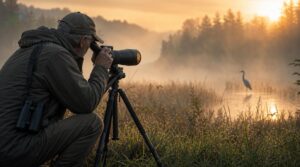
Magnification is the engine that drives everything you do with a spotting scope in the field.
Get it right, and you’re tracking a distant warbler or a soaring hawk with striking clarity — get it wrong, and you’re fighting your own gear.
Here’s what each power level actually means for your time outdoors.
20x Scanning Power
At 20x magnification, your spotting scope transforms into a wide-angle search tool, efficiently scanning vast habitats before transitioning to higher power. This setting excels in maintaining sharp focus on moving subjects through optimized brightness and depth of field, while its light-gathering capability ensures clarity in low-light conditions like dawn.
The scope’s design prioritizes ergonomics and versatility, offering comfortable eye relief during extended use and seamless magnification adjustments from 20x to 60x. These features collectively deliver reliable performance for birding across open landscapes, shorelines, and dim environments.
- Sweeps wide field of view across shorelines instantly
- Maintains eye relief comfort during long sessions
- Preserves brightness balance in dim conditions
- Enables 20x to 60x magnification transitions smoothly
- Delivers reliable birding coverage across open terrain
60x Detail Viewing
Once you’ve scanned with 20x, zooming to 60x is where the real payoff begins. Feather barbs on distant songbirds snap into focus, and iris coloration becomes surprisingly readable.
That clarity depends heavily on a stable tripod — micro‑vibrations and atmospheric turbulence will blur fine detail fast. Your exit pupil also narrows at high magnification, so bright conditions matter.
Use your 20x to 60x magnification range strategically.
75x Long-range Observation
At 75x, your spotting scope reaches its absolute ceiling — and every weakness in your setup gets amplified fast. Atmospheric refraction bends light over long distances, while image stabilization becomes non-negotiable and your fine focus mechanism demands smooth, drift-free adjustment.
Eye relief comfort is critical at high magnifications, as steady, relaxed viewing is essential. Thermal contrast helps reveal distant raptors against open sky, especially when low-light performance and field of view narrow together.
Zoom Clarity Trade-offs
Pushing past 60× means you’re negotiating trade-offs, not just zooming in. Exit Pupil Reduction shrinks the light cone reaching your eye, while Zoom Induced Vibration turns minor hand tremors into blurry chaos.
Here’s what actually suffers at high magnification:
- Resolution Blur Balance deteriorates when atmospheric turbulence compounds optical limits
- Narrow Depth Perception makes focusing on moving subjects genuinely frustrating
- Chromatic Aberration intensifies without premium optical coating quality
- Field of view considerations tighten, complicating target acquisition
Tripod Needs Above 30x
Once you cross 30x, a flimsy tripod becomes your biggest optical enemy. High magnification amplifies every vibration — footsteps, wind, even your breathing. Carbon Fiber Legs cut weight without sacrificing rigidity, while Center Column Minimization keeps your setup rock-solid.
A Weighted Down Tether effectively dampens wind-induced sway, further stabilizing your equipment.
| Feature | Why It Matters | Recommended Spec |
|---|---|---|
| Ball Head Locking | Prevents drift at high zoom | 15–25 lb load capacity |
| Wind Vibration Mitigation | Reduces atmospheric shake | Wide leg stance, tether use |
| Weight Distribution | Improves image stability | Centered load, no column extension |
Objective Lens Size Matters
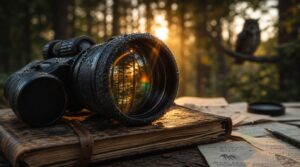
The size of your objective lens shapes everything — how bright your image looks, how much detail you pull from shadows, and how heavy your pack feels at mile eight. Choosing the right diameter is less about "bigger is better" and more about matching the lens to how and where you actually watch wildlife.
Your objective lens size shapes brightness, shadow detail, and pack weight — match it to your habitat, not your ego
Here’s how the main sizes stack up.
65mm Lightweight Lenses
A 65mm objective lens is the sweet spot for birders who’d rather carry less and see more. Magnesium housing keeps weight low without sacrificing rigidity, and internal focusing means no front-element creep mid-session. Apochromatic elements control color fringing on high-contrast plumage edges.
- Excellent field portability with balanced weight distribution
- Close focus capability between 0.6–1.5 meters
- Mount compatibility across PL, EF, and Sony E systems
- Consistent performance during rapid wildlife observation movements
80mm Balanced Performance
The 80mm objective lens hits a real sweet spot for serious birding and wildlife observation. It delivers strong Uniform Illumination from center to edge, solid Glare Management across sunlit wetlands, and reliable Contrast Consistency for picking out subtle plumage detail.
Combined with quality optical coating and extended eye relief, this objective lens diameter ensures dependable low-light performance and edge brightness without the bulk of larger optics.
85mm Low-light Brightness
When light starts to fade, the 85mm objective lens earns its weight. A larger objective lens diameter means a bigger entrance pupil, which directly drives image brightness and night-time contrast in ways smaller lenses simply can’t match.
- Exit Pupil Optimization keeps images usable at dusk magnifications
- Coating Transmission Gains push low-light performance closer to what your eye actually needs
- Prism Light Efficiency via BAK4 glass reduces internal loss
- Lens Scatter Reduction sharpens contrast when ambient light drops
Field Brightness Differences
Even brightness across the full field matters more than most buyers realize. Exit Pupil Uniformity determines whether edge luminance holds steady or dims toward the corners — a problem called Vignetting Control. Quality optics ensure even brightness and minimal falloff, while weaker systems show dim edges and noticeable falloff.
F-number Consistency across the zoom range maintains stable light transmission, preventing drops during magnification changes. Prism Brightness Falloff impacts off-axis zones, but fully multicoated lenses paired with BAK4 glass significantly reduce these losses. Edge Luminance remains sharp and consistent in premium optics, avoiding the washed or dark edges seen in inferior designs.
| Factor | Weak Optics | Quality Optics |
|---|---|---|
| Exit Pupil Uniformity | Dim edges | Even brightness |
| Vignetting Control | Noticeable falloff | Minimal falloff |
| F-number Consistency | Drops with zoom | Stays stable |
| Edge Luminance | Washed or dark | Sharp, consistent |
| Prism Brightness Falloff | Visible off-axis | Tightly controlled |
Portability Versus Clarity
Brightness gains from larger lenses always come at a cost — you’re trading pack space and shoulder strain for that extra low-light performance. Here’s where the Weight‑Brightness Balance gets real:
- Carbon Fiber Frames cut carry weight without sacrificing optical clarity
- Foldable Eyepieces and Low‑Profile Mounts shrink your packable footprint
- Micro-Prism Efficiency maintains image sharpness in lightweight designs
- A portable carrying case protects your investment between locations
Optical Coatings and Prism Quality
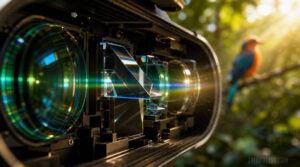
Most birders obsess over magnification and lens size, but what’s happening inside the scope matters just as much.
The coatings on each glass surface and the prism type behind the eyepiece are what separate a sharp, vivid image from a dull, washed-out one.
Here’s what to look for when comparing optical quality across any spotting scope.
Fully Multi-coated Lenses
Fully multicoated lenses make a genuine difference when you’re glassing a marsh at first light. Each air-to-glass surface carries multiple anti-reflective layers, pushing transmission efficiency above 95% and delivering high contrast views with accurate color fidelity.
You get serious ghosting suppression and lens flare control — even backlit subjects stay clean.
The hardcoat protection on quality optical coatings ensures your multicoated green film lens holds up through seasons of hard field use.
BAK4 Prism Benefits
BAK4 prism technology takes everything your multicoated lenses deliver and locks it in. Barium crown glass achieves near-total internal reflection, meaning light transmission stays high from objective to eyepiece with minimal scattering loss.
Here’s what that means in practice:
- Brightness Boost at dawn when Warblers are most active
- Improved Low-Light performance during dusk shorebird surveys
- Reduced Chromatic Aberration keeps color fringing off feather edges
- Uniform Edge Sharpness across the full field, center to periphery
- Rugged Temperature Stability through cold mornings and humid afternoons
The result is consistent high contrast image clarity, shot after shot.
Glare Reduction Coatings
When midday sun hits open water, glare can wash out a shorebird completely. That’s where optical coating quality earns its keep. Multi-layer lens coating technology—built on nano-roughness surfaces and layer count optimization—drives glare reduction across wide angles using wide-angle suppression physics.
A hydrophobic overcoat sheds water spots, while abrasion resistance protects coating efficiency over years of field use. This ensures maintaining strong light transmission consistently, preserving performance in demanding environments.
Color Accuracy Improvements
Color accuracy is where optical coating quality separates a good scope from a great one. Fully multi-coated lenses suppress color aberrations at edges, reduce chromatic aberration, and deliver high contrast imagery when you’re separating a warbler’s yellow throat from green foliage at 60×.
- Color Space Coverage stays consistent across sRGB and wide gamuts
- White Balance Precision preserves true feather tones at dawn and dusk
- Temperature Stability prevents color drift during long observation sessions
- Spectral Reflectance handling reproduces glossy plumage without hue shifts
- Dithering Techniques smooth gradient transitions in subtle feather textures
Edge Clarity Performance
Edge sharpness consistency is what separates a functional scope from a high-quality one in the field. BAK4 prisms and fully multi-coated glass work together to deliver off-axis aberration mitigation, keeping peripheral contrast high even at 75×. This ensures reliable image clarity, optical resolution, and edge brightness uniformity, whether tracking distant subjects or scanning landscapes.
Chromatic fringe control minimizes color aberrations at edges and lens chromatic aberration. By addressing these issues, it maintains edge brightness uniformity and optical precision across varied conditions, from observing shorebirds to examining treelines.
Field of View and Tracking
Field of view is what separates a frustrating session from a great one — especially when something moves fast. At 20×, a wide FOV lets you sweep open terrain; when pushed to 60× or 75×, that window narrows considerably.
How each factor plays out in the field.
Wide Views for Scanning
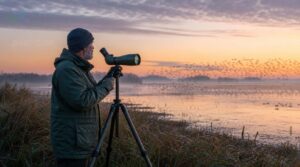
At low power, your spotting scope’s field of view is everything — panoramic coverage at 20× can stretch 101 ft at 1,000 yds with an 85 mm lens. That wide-angle optics advantage makes low-power sweeps essential for birding across open terrain.
Rapid scan comfort depends on:
- Broad field of view size for locating subjects fast
- Low-power sweep reducing image shake during panning
- Glare-free horizons through multi-coated lenses
- Strong low-light performance for dawn bird-watching optics
Narrow Views at High Zoom
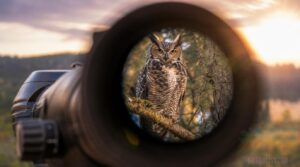
Zoom in to 60× or 75× and your field of view shrinks dramatically — you’re now peering through a keyhole. At that magnification range, edge distortion and chromatic aberration become real concerns, while contrast loss can flatten fine feather detail.
Depth of field narrows sharply, and any handheld shake gets brutally amplified. A solid tripod isn’t optional at this zoom range — it’s essential.
Moving Wildlife Tracking

Tracking a moving deer or fox through a scope is where field of view becomes everything. At 20×, a 100-foot field of view at 1,000 yards gives you real working room — just like GPS collar data shows home ranges that demand broad coverage.
- Variable magnification range lets you scan wide, then close in fast
- Dual-speed focusing system keeps moving subjects sharp without fumbling
- Biologger integration and drone surveillance teach us animals rarely pause — your scope shouldn’t either
- Camera trap networks confirm peak movement windows; plan your glass time accordingly
Image shake at maximum zoom betrays any target. Tripod stability is non-negotiable.
Bird Flight Observation
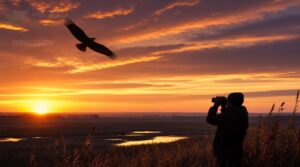
Birds in flight don’t wait. Wingbeat Rhythm varies fast — a hawk’s slow thermal soaring looks nothing like a warbler’s quick flutter.
You need a wide field of view to catch Flight Silhouettes before they disappear. Angled eyepieces help during Crepuscular Glides at dusk, where low-light performance and strong light transmission separate decent birdwatching gear from premium birdwatching gear.
Nocturnal Calls confirm what you glimpsed.
Habitat-based Viewing Distance
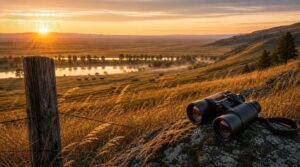
Open field sight lines in grassland push your effective range far beyond what dense canopy occlusion allows — branches cut visibility fast. Water edge glare at dawn demands strong coatings. Gain elevation for that hilltop advantage, or work a valley corridor bottleneck where animals funnel through.
A field of view of 100 feet at 1,000 yards keeps you connected.
Weatherproofing and Field Durability
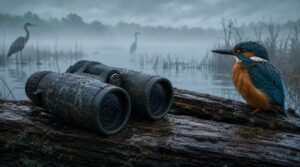
A scope that fogs up or leaks in the field is basically useless, no matter how sharp the glass is. The best wildlife optics are built to handle rain, humidity, and rough handling without skipping a beat.
Here’s what separates the durable performers from the ones that won’t survive a wet morning in the marsh.
Nitrogen-purged Construction
Every scope in this lineup uses nitrogen-purged construction, which means the interior is filled with dry inert nitrogen to guarantee inert atmosphere stability across extreme temperature swings. This nitrogen-filled design eliminates internal condensation, preventing failures that fog your view at dawn.
Gas-purged and O-ring sealed chambers rely on pressure-controlled purging and purging cycle optimization, ensuring waterproof and fog-proof construction for serious birdwatching optics in any weather.
O-ring Sealed Bodies
O-ring seals form the second layer of protection against moisture, complementing nitrogen-filled construction. These elastomer rings depend on precise gland design principles and careful material selection—typically nitrile or FKM compounds—to ensure waterproof and fog-proof performance under pressure.
Compression set prevention also matters; worn rings lose elasticity and leak. Proper installation practices and rigorous failure mode analysis are critical to maintaining lasting rain-proof construction.
Waterproof Rating Differences
IPX rating basics break down simply: IPX7 means depth immersion thresholds up to 1 meter, while higher ratings handle deeper exposure.
Seal material impacts and temperature change affects can degrade O-ring seals over time.
Maintenance verification keeps your nitrogen-filled, rainproof construction performing reliably.
Rubber Armor Protection
Rubber armor grip provides more than a secure hold in wet hands — it serves as your scope’s first line of shock protection in the field. This vulcanized exterior absorbs impact and reduces blunt trauma during drops, while also maintaining seal integrity across temperature swings.
Its non-slip shockproof grip ensures weather resistance and longevity, safeguarding your optics through rigorous use. By combining durability with functional design, it keeps your equipment field-ready season after season.
Fog-proof Performance
Nitrogen-filled construction keeps internal humidity near zero, even when you move from a cold car into humid marsh air at dawn. Your scope’s fog-proof optics rely on four layered defenses:
- O-ring seals maintaining seal integrity to testing standards
- Hydrophilic anti-fog films with dual-layer lens treatment
- Desiccant packaging with moisture indicator alerts
- Waterproof and fog-proof construction ensuring full weather resistance
Portability for Outdoor Birders
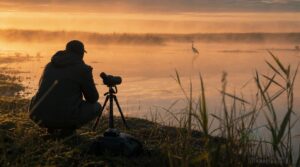
When you’re hiking miles into a marsh or setting up before sunrise, the last thing you want is gear that slows you down. Weight, size, and packability all factor into whether a spotting scope makes it into your bag — or stays in the car.
Here’s how the top picks stack up when portability is the priority.
Scope Weight Comparison
Weight distribution makes or breaks a long day in the field. Lightweight portable optics (2.41 lb) prevent shoulder strain, while heavier scopes (up to 7.58 lb) shift your balance point and increase carrying fatigue greatly. This added weight becomes apparent quickly during backpacking.
Higher tripod loads also require sturdier support. Always check the weight-performance ratio before committing to avoid compromising stability or endurance.
Backpack-friendly Designs
Collapsible designs under 15 inches slide right into a standard hiking pack — no awkward rigging required. The best backpack-friendly spotting scopes pair lightweight, portable optics with smart carry systems so you never sacrifice comfort for clarity.
- Padded shoulder straps (2.5 in wide) reduce pressure on long treks
- Contoured back panel aligns naturally with your spine on uneven terrain
- Integrated load lifters keep the scope close to your center of gravity
- Expandable compression system cinches down when you’re moving between spots
- Built-in rain cover deploys fast when weather turns without unpacking everything
Compact Versus Full-size Scopes
Compact scopes tip the scales at 14 to 22 ounces, giving you real Travel Convenience and Handheld Stability on long hikes without tripod dependency.
Full-size models, weighing between 26 and 40 ounces, deliver better Balance Dynamics and Mounting Flexibility on a sturdy rest.
Smaller objective lens diameters in collapsible designs trade some low-light brightness for genuine lightweight portability and handheld usage freedom.
Carrying Cases and Caps
Once your scope is packed, protecting it matters just as much as choosing it. Hard Shell Cases with crush-resistant EVA construction keep optics safe when gear gets stacked in the truck bed. Padded Soft Sleeves work well for day hikes where weight counts.
Look for Adjustable Interior Dividers, O-ring seals, and waterproof and fogproof construction — these features ensure weather-sealed storage, keeping dust resistance and fogging nonissues.
Prioritize cases with durable, weather-sealed designs to maintain optimal performance in varied conditions.
Hiking and Travel Use
Hitting the trail means every ounce counts. Look for scopes with lightweight carry straps, shock-absorbing housing, and waterproof, dust-resistance-rated bodies that handle downpours without missing a beat. These features ensure durability and portability in challenging conditions.
Rapid setup via quick-release tripod compatibility keeps you focused on distant observations, minimizing gear-related distractions.
For multi-day trips, temperature-resistant batteries and solar charging options extend your time off-grid without compromise, ensuring uninterrupted functionality in remote environments.
Accessories for Better Viewing
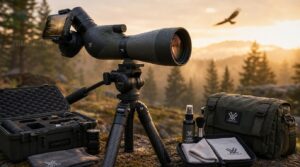
A good scope is only half the story — what comes with it can make or break your time in the field. The right accessories keep your view steady, your glass protected, and your setup ready for whatever the day throws at you.
Here’s what to look for when you’re gearing up.
Tripod Stability Essentials
A wide base and proper leg spread are your first line of defense against image shake at 60× or higher. Lower your center of gravity by keeping heavy scopes close to the head.
Ground spikes grip soft soil firmly, while vibration damping materials absorb subtle movement.
The included tabletop tripod works for flat surfaces, but tripod compatibility and 360-degree rotation matter most for tracking birds in flight.
Smartphone Digiscoping Adapters
Once your scope is rock-steady, a smartphone adapter transforms it into a capable field camera.
- Universal Mount Fit clamps phones 54–87 mm wide without brand-specific hardware
- Fine Alignment micro-adjustments minimize vignetting above 40×
- Aluminum Housing resists corrosion and field wear
- Vibration Dampening locking screws prevent blur during wildlife tracking
- Distortion Mitigation eyepiece spacers sharpen corner detail
Effective digiscoping and photo capture via smartphone requires an 85 mm objective for sufficient brightness.
Lens Covers and Cloths
Your scope’s optical coatings won’t last without proper protection. Snap-on covers and flip-open designs keep front elements shielded from dust and impacts between observations.
Silicone protection absorbs minor shocks during transport.
For lens covers and cleaning cloth maintenance, anti-static cloths resist dust attraction, while microfiber care prevents micro-scratches on fully multi-coated surfaces.
Standard accessory kits include both, keeping your glass field-ready.
Rotating Tripod Heads
A rotating tripod head transforms how you track wildlife, giving you independent pan and tilt control without losing your target. Match your head to your scope’s weight to avoid drift. Key features include:
- Pan Drag Control fine-tunes resistance so your tripod rotates 360 degrees smoothly
- Fluid Head Smoothness suits fast-moving birds; Geared Increment Precision suits stationary subjects
- Tilt Angle Range of 60–90° and Load Capacity Limits determine stability for angled or straight spotting scope setups
Built-in Sunshades
Built-in sunshades block sun, cut glare, and boost contrast, extending comfortable viewing during bright dawn sessions. By enhancing visual clarity, they ensure optics remain weather-sealed and views stay sharp.
Most models use lightweight ABS or polycarbonate for minimal weight impact. This keeps gear portable without sacrificing durability.
Deployment is effortless: simply twist or pull to extend the shade. The mechanism prioritizes simplicity and reliability in field conditions.
Adjustable extensions allow users to tailor coverage to any sun angle, maintaining optimal visibility. This adaptability ensures consistent performance across varying light environments.
Price Versus Performance Comparison
Not every great spotting scope costs a fortune, and not every expensive one justifies the price tag.
Knowing where your money actually goes — whether that’s optical glass quality, weatherproofing, or magnification range — makes the difference between a smart buy and buyer’s remorse.
Here’s how these scopes stack up when you weigh what you spend against what you actually get in the field.
Budget-friendly Spotting Scopes
You don’t need to spend a fortune to get reliable glass in the field. Budget-friendly optics like the Gosky 20–60×80 and Emarth Waterproof Kit deliver solid price versus performance for everyday birdwatching.
Price Trends 2026 show value pack bundles improving fast.
| Scope | Starting Price Range |
|---|---|
| Emarth Kit | Under $80 |
| Gosky 20–60×80 | Under $100 |
| Gosky 20–60×85 | Under $120 |
| Wozel 25–75x HD | Under $90 |
User community reviews and return policy transparency make budget-friendly scopes a confident first buy.
Mid-range Feature Value
Cost-effective optics in the mid-range tier hit a sweet spot where most serious birders reside. These models offer balanced build quality, value-driven durability, and practical lens sizes (65–80mm), ensuring solid low-light performance at dawn.
| Scope | Objective Lens Diameter | Field of View |
|---|---|---|
| Gosky 20–60×80 | 80mm | 82.9–48 ft/1,000 yds |
| Gosky 20–60×65 | 65mm | Moderate scanning width |
| Wozel 25–75x HD | 80mm | 123 ft/1,000 yds |
They deliver reasonable performance with real field results, making them a practical choice for dedicated birders.
Premium Optical Performance
Premium optics aren’t just better — they’re in a different league entirely. ED glass eliminates chromatic aberration, delivering crystal-clear color fidelity even against bright skies. Phase roof coatings on BaK4 prisms push uniform brightness and contrast beyond what mid-range coatings can achieve.
High refractive index glass maintains edge-to-edge sharpness at 75×.
| Feature | Premium Benefit |
|---|---|
| ED Glass | Controls chromatic aberration |
| Phase Roof Coating | Uniform brightness, sharp contrast |
Durability for The Price
Durability doesn’t have to cost a fortune. Budget-friendly optics with aluminum chassis construction, O-ring seal integrity, and nitrogen-purged waterproof and fogproof construction hold up surprisingly well in the field.
| Feature | Budget Reality |
|---|---|
| Impact resistance | 1.2m drop tested |
| Weatherproofing | IPX-rated seals |
| Shock-resistant properties | Rubber armor exterior |
| Simple maintenance | Microfiber wipe sufficient |
| Warranty coverage | 2–5 years standard |
That price-performance ratio is hard to argue with.
Best Value for Birders
Value doesn’t stop at the price tag. The best budget-friendly optics for birdwatching combine a solid magnification range, wide field of view, and strong after-sale support — without draining your wallet.
| Scope Type | Key Value Feature | Bundle Savings |
|---|---|---|
| Entry-level spotting scopes | 20–40× magnification range | Tripod included |
| Mid-range spotting scopes | FMC lenses, BAK4 prisms | Adapter kit bundled |
| Premium value spotting scopes | Lifetime warranty coverage | Case + digiscoping adapter |
| Compact travel scopes | Lightweight, retail discounts | Carry bag included |
| High-resale-value models | Durable rubber armor | Lens cloth set |
Retail discounts and bundled accessories push already-affordable spotting scopes into outstanding territory — making resale value surprisingly strong down the road.
Frequently Asked Questions (FAQs)
How do I clean spotting scope lenses safely?
Start with dust removal using a blower, then apply lens solution to a microfiber cloth — never directly on glass. Wipe gently in circles.
Clean only when needed; coating care matters more than cleaning schedule.
What eye relief is best for eyeglass wearers?
For eyeglass wearers, 15–20 mm of long eye relief is ideal.
Look for high eye point designs with adjustable eyecups that twist up, keeping the full field clear without pressing your glasses against the eyepiece.
Can I use wildlife optics for astronomy?
Wildlife optics handle casual astronomy surprisingly well. With 20–60× magnification, you can explore lunar craters and planets.
Prioritize dew prevention, nighttime stability, and a solid tripod for sharp moon imaging and planetary viewing.
How long do spotting scopes typically last?
With routine maintenance and proper care, a quality spotting scope easily lasts 20–30 years. Structural robustness, O-ring seals, nitrogen-filled construction, and lifetime warranty coverage make long-term durability realistic for most birders.
Are angled or straight scopes better for birding?
Angled scopes reduce neck strain and suit upward birding better, while straight scopes lock onto fast‑moving birds faster.
Your user height and glasses compatibility often decide which feels right all day.
Can spotting scopes replace binoculars for wildlife viewing?
Spotting scopes and binoculars are two sides of the same coin. Scopes excel in magnification and long-range detail, leveraging their design for distant observation.
But binoculars offer faster field of view, zero tripod dependence, and quicker setup time, prioritizing versatility and portability in dynamic environments.
How do angled versus straight eyepieces compare?
Your eyepiece angle shapes comfort more than optics. Angled designs reduce neck strain and improve group ergonomics, while straight versions excel in acquisition speed.
Eye relief and viewing posture matter most for long sessions.
What maintenance do spotting scopes require long-term?
Think of your scope like a trusted field partner — it needs regular care to stay sharp.
Focus on lens cleaning routine, seal integrity inspection, gas fill verification, humidity control storage, and cap and cover maintenance.
Are spotting scopes suitable for nighttime wildlife observation?
For nighttime wildlife viewing, spotting scopes struggle without moonlit performance or external illumination.
Low-light brightness improves with 80–85 mm objectives, but night vision compatibility or thermal imaging integration genuinely outperforms any fogproof, waterproof spotting scope after dark.
How does eye relief affect comfortable extended viewing?
Eye relief determines where your eye sits relative to the eyepiece. Too close and too far—you’ll strain or the image black out.
Adjustable eye cups and ergonomic design let you find consistent eye alignment without fatigue.
Conclusion
Picture a seasoned birder scanning a remote mudflat, watching a rare godwit work the shallows at 400 yards—confirmed only because an 85mm scope pulled every field mark into sharp relief. That’s what the right wildlife viewing optics actually deliver: not just better views, but better certainty.
Match your lens size to your habitat, your magnification to your distance, and your budget to your field conditions. The bird doesn’t wait. Your gear shouldn’t hold you back.
- https://birdschoice.com/pages/binocular-magnification-tips?srsltid=AfmBOopFRx47OlBUPSoHTyi0zs8qtOZVXWseL4yudvD0Jf4QGp3Z911h
- https://www.allaboutbirds.org/news/six-steps-to-choosing-a-pair-of-binoculars-youll-love/
- https://marin.wbu.com/how-to-choose-binoculars
- https://firefield.com/blogs/news/what-is-the-point-of-a-spotting-scope
- https://www.nikonusa.com/learn-and-explore/c/tips-and-techniques/binoculars-for-bird-or-wildlife-watching?srsltid=AfmBOooJMJpX_Cd5aSWjCg8Ths9uPwI-S-T4ZvYv5QlI0N_VdGvN4Vyu