This site is supported by our readers. We may earn a commission, at no cost to you, if you purchase through links.
 You’ll spot several birds that look like cardinals at your feeder, and they’re masters of disguise.
Summer Tanagers sport solid red plumage without the cardinal’s black mask, while Pyrrhuloxias are like cardinals’ desert cousins with gray bodies and red highlights.
House Finches wear rosy-red caps and chests, and Vermilion Flycatchers flash brilliant red bellies.
Even brown Tufted Titmice can fool you in certain lighting.
The trick is watching for key differences: cardinals have that distinctive crest and jet-black face mask that sets them apart.
These lookalikes share similar habitats and feeding habits, making identification tricky.
Knowing the subtle differences between beaks, body shapes, and behavior patterns will turn you into a backyard bird detective.
Table Of Contents
- Key Takeaways
- Cardinal Identification
- Types of Cardinals
- Birds Similar to Cardinals
- Red Bird Lookalikes
- Cardinal Lookalikes by Region
- Distinguishing Cardinal Features
- Frequently Asked Questions (FAQs)
- What birds look like Cardinals?
- Are red birds similar to Cardinals?
- Do cardinals look like males?
- What bird looks like a desert cardinal?
- What is a cardinal bird?
- Do cardinals migrate south during winter months?
- What attracts cardinals to backyard bird feeders?
- How long do cardinals typically live?
- When do cardinals breed and lay eggs?
- Are there any endangered cardinal species?
- Conclusion
Key Takeaways
- You’ll identify true cardinals by their three signature features: a distinctive pointed crest, jet-black face mask around the bill, and thick orange beak that’s perfect for cracking seeds.
- You can distinguish cardinals from red lookalikes like Summer Tanagers and House Finches by watching for behavioral differences—cardinals crack seeds with powerful beaks while staying longer at feeders, unlike tanagers that prefer treetops and fruits.
- You’ll spot different cardinal lookalikes depending on your region: Pyrrhuloxias in southwestern deserts, Summer Tanagers in woodlands, and Vermilion Flycatchers in open desert areas with water sources.
- You can rely on cardinals being year-round residents since they don’t migrate south like many red bird species, making them consistent backyard visitors when you’re filling feeders during winter months.
Cardinal Identification

When you’re trying to confirm you’ve spotted a true cardinal, you’ll want to look for three key features that set them apart from their red lookalikes.
Check for the pointed crest on top of their head, the black face mask around the bill, and their thick orange beak that’s perfect for cracking seeds.
Distinctive Crest
You’ll instantly recognize a Northern Cardinal by its signature raised crest that stands tall like a feathered crown.
That unmistakable crown-like crest is your first clue you’re looking at a true cardinal.
This prominent feature sets cardinals apart from most cardinal look alike birds and serves multiple functions in their daily lives.
- Crest prominence: Cardinals can raise and lower their crest to communicate emotions and intentions
- Crest variations: Male crests appear more vibrant red while female crests show subtle tan coloring
- Crest function: Used for territorial displays, courtship rituals, and expressing alarm or excitement
- Crest evolution: Developed as a visual communication tool that helps birds similar to cardinals establish social hierarchies
- Crest display: Fully erect crests signal alertness while flattened crests indicate relaxation or submission
Black Face Mask
The black face mask around a male cardinal’s bill serves as nature’s most reliable ID badge.
This dark feature contrasts sharply with bright red plumage, making it impossible to miss.
Female cardinals lack this dramatic mask, showing gray face coloring instead.
Many birds mistaken for cardinals, like the Phainopepla, display different mask patterns that help distinguish true cardinals from lookalikes.
Male cardinals use their mask, along with their plumage, to attract mates and defend their breeding season territory, which is a key part of their breeding season and overall social behavior as cardinals.
Feeding Behavior
How does a cardinal’s eating habits help you tell it apart from red birds mistaken for cardinals? Northern Cardinals crack seeds with their thick, cone-shaped beaks and stay at bird feeders longer than most lookalikes.
Their diet composition includes sunflower seeds, safflower seeds, and cracked corn. Notably, you can find products for cardinals online.
- Seed Preferences: Cardinals favor sunflower and safflower seeds over smaller millet
- Foraging Techniques: They hop on ground beneath feeders, scratching through leaf litter
- Feeder Attraction: Cardinals prefer platform feeders and large tube feeders over small ports
- Seasonal Changes: Winter brings increased feeder visits as natural food becomes scarce
- Feeding Duration: Cardinals spend more time at feeders than red birds not cardinals
Habitat Preferences
Beyond seed preferences, you’ll spot cardinals in specific environments that differ from their lookalikes.
These adaptable birds thrive where trees meet open spaces, making backyard identification easier when you know their preferred hangouts.
| Habitat Type | Cardinals | Similar Species |
|---|---|---|
| Wooded Areas | Dense forests, woodland edges | Summer tanagers prefer treetops |
| Suburban Habitats | Parks, gardens, neighborhoods | House finches favor urban areas |
| Backyard Feeders | Regular visitors year-round | Scarlet tanagers rarely visit feeders |
| Territory Range | Permanent residents across North America | Most red bird species migrate seasonally |
Cardinals stick around their nesting locations while other red bird species head south for winter.
To attract these birds, consider using a specialized feeder design to make your backyard a year-round destination for cardinals and to support their permanent residency.
This approach will help you enjoy their beautiful presence throughout the year.
Types of Cardinals

You’ll find only three true cardinal species in North America: the familiar Northern Cardinal, the desert-dwelling Pyrrhuloxia, and the rare Vermilion Cardinal.
Each species has distinct features that’ll help you tell them apart, from the Northern Cardinal’s bright red plumage to the Pyrrhuloxia’s gray body with red accents, which are distinct features that make them unique, including the Northern Cardinal.
Northern Cardinal
You’ll spot the classic Northern Cardinal by its blazing red feathers and jet-black face mask.
These stocky songbirds measure about 8.75 inches long and weigh around 1.5 ounces. Their thick, orange-red beaks crack seeds with ease.
- Males display brilliant red plumage year-round for Mating Rituals
- Females show warm brown tones with red wing patches
- Both sexes have prominent crested heads
- Song Variation includes clear whistles and chip notes and the birds are known for their clear whistles
Vermilion Cardinal
In Central America and northern South America, you’ll find the Vermilion Cardinal, a stunning red bird identification challenge.
Unlike northern cardinal lookalikes, this species has a distinctive crest and vibrant red plumage.
Its habitat specifics include dense forests and woodlands, and diet variations encompass seeds, fruits, and insects.
Conservation status remains stable despite range expansion concerns affecting these red birds in my yard, with a notable concern being their presence in my yard.
Pyrrhuloxia
You’ll find the pyrrhuloxia shares striking similarities with northern cardinal lookalikes, but this desert dweller stands apart.
This red bird identification challenge features gray plumage with a distinctive red face mask and yellow beak.
Pyrrhuloxia habitat spans southwestern deserts, while their pyrrhuloxia diet includes seeds and insects.
Their pyrrhuloxia song resembles cardinals, making these birds that look like cardinals true desert mimics among red birds in my yard.
They’re classified as least concern species on the IUCN Red List, which is a significant factor in understanding the conservation status of this species.
Birds Similar to Cardinals

You’ll encounter several red birds that share the cardinal’s striking coloration but lack its signature features.
These species include the Summer Tanager, Scarlet Tanager, Vermilion Flycatcher, and Tufted Titmouse, each with distinct characteristics that help you tell them apart from true cardinals.
They are important to recognize, as they can be confused with the cardinal due to their similar coloration.
Summer Tanager
You’ll often mistake male Summer Tanagers for cardinals since they’re completely red birds with red feathers.
However, these birds lack the distinctive crest and black face mask that define true cardinals. Summer Tanager identification becomes easier when you notice their sleeker build and different habitat preferences.
The tanager’s breeding range is extensive, spanning from Alaska to Baja California.
Key Summer Tanager features include:
- Female Plumage: Mustard-yellow coloration throughout, unlike female cardinals’ brown-gray tones
- Tanager Habitat: Prefers open woodlands and forest edges over dense cardinal territories
- Tanager Migration: Travels to South America winters, while cardinals stay year-round
- Summer Tanager Diet: Focuses on flying insects and bees, removing stingers before eating
Scarlet Tanager
You’ll notice scarlet tanagers sport brilliant red bodies with jet-black wings, creating a striking contrast that cardinals lack.
Their sleek build and pointed bill distinguish them from stocky cardinals.
The female tanager typically lays eggs in a shallow cup nest made of twigs and grass.
During bird identification sessions, watch for their elusive nature—scarlet tanagers rarely visit feeders.
Males lose their red coloring in winter, unlike cardinals who stay vibrant year-round.
| Feature | Scarlet Tanager | Northern Cardinal |
|---|---|---|
| Plumage Differences | Bright red body, black wings | All-red with black face mask |
| Habitat Comparison | Dense forest canopy | Woodlands, suburbs, parks |
| Migration Patterns | Migrates to South America | Year-round resident |
| Foraging Habits | Insects and fruits in treetops | Seeds at ground level |
| Conservation Status | Declining due to habitat loss |
Stable population.
These woodland specialists prefer mature forests over backyard feeders, making them trickier to spot than their cardinal cousins.
Vermilion Flycatcher

Across the southwestern deserts, you’ll spot the Vermilion Flycatcher’s brilliant red plumage that might fool you into thinking it’s a cardinal.
This striking red songbird displays different hunting behavior and lacks the cardinal’s distinctive crest, making bird identification easier once you know what to look for.
You can find a Vermilion Flycatcher guide online if you’re interested in learning more.
- Flycatcher Habitat: Prefers open desert areas and riparian woodlands near water sources
- Flycatcher Diet: Captures insects mid-flight using sit-and-wait hunting techniques from exposed perches
- Flycatcher Behavior: Performs aerial displays above tree canopy during territorial disputes
- Flycatcher Range: Found from Argentina through Mexico to southwestern United States
- Flycatcher Song: Uses distinctive calls for territorial marking, unlike cardinal’s whistled melodies
Tufted Titmouse
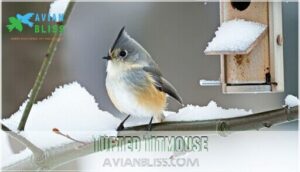
You might mistake a Tufted Titmouse for a cardinal at first glance.
This gray bird sports a prominent crest like cardinals but lacks the vibrant red coloring.
Tufted Titmouse habitat includes deciduous forests and suburban yards.
Their Titmouse diet consists of insects, seeds, and berries.
Titmouse behavior shows acrobatic feeding at bird feeders.
Titmouse vocalizations include distinctive "peter-peter-peter" calls, while Titmouse nesting occurs in tree cavities.
They often use animal fur for nests to create a comfortable environment for their young.
Red Bird Lookalikes
You’ll encounter several red birds that can easily fool you into thinking you’ve spotted a cardinal at first glance.
These lookalikes share similar coloring but lack the cardinal’s distinctive crest, thick orange beak, or specific body shape that makes identification tricky for backyard birdwatchers, particularly due to the distinctive features they lack.
Phainopepla

You might mistake a Phainopepla for a cardinal at first glance, but these desert birds have distinct differences.
Males sport glossy black plumage instead of red, while their distinctive crest resembles a cardinal’s crown.
Key Phainopepla identification features:
- Black coloration with white wing patches
- Desert habitat preference over woodlands
- Silky, glossy feather texture
- Distinctive "wurp" vocalizations
The Phainopepla’s unique characteristics, including its desert habitat preference, set it apart from other birds like the cardinal.
California Towhee
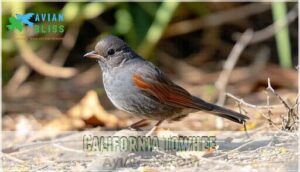
California Towhees might fool you at first glance, but they’re brown birds that look like cardinals without the red.
These medium-sized songbirds share the cardinal’s stocky build and ground-foraging behavior.
Towhee habitat includes California’s chaparral and suburban gardens, where their towhee diet consists of seeds and insects.
Unlike cardinals, towhees lack crests and display uniform brown plumage with rusty undertail patches.
They’re known for aggressive territorial defense against intruders.
House Finch

House Finch identification becomes easier when you understand their key differences from cardinals.
These red finches lack the distinctive crown that makes cardinals stand out among look alike birds.
Finch size runs smaller at just 5-6 inches, while finch plumage shows streaky brown patterns mixed with red patches.
Finch habitat includes urban areas where finch behavior involves flocking together.
Finch diet focuses heavily on seeds and plant matter.
Cedar Waxwing

Cedar Waxwings might fool you at first glance with their sleek crested heads, but they’re quite different from cardinals.
These silky-smooth birds that look like cardinals sport tan and gray waxwing plumage with distinctive black face masks and waxy red wing tips.
Their waxwing diet focuses on berries, while their waxwing habitat includes open woodlands where their high-pitched waxwing song echoes.
Cardinal Lookalikes by Region
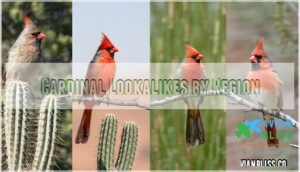
You’ll find different cardinal look-alikes depending on where you’re birdwatching across North America.
The red birds that confuse you in Texas won’t be the same ones you’ll spot in Maine or California.
Southern United States
Across southern states, you’ll spot Northern Cardinals thriving in diverse Cardinal Habitats from swampy woodlands to suburban backyards.
Regional Variations show these birds adapting their Southern Diets to include more insects and berries year-round.
During spring Mating Rituals, males display brighter plumage while defending territories.
Despite stable Conservation Status, proper bird identification helps distinguish cardinals from Summer Tanagers in overlapping ranges.
Western United States
Looking for Desert Cardinals in western states? You’ll spot pyrrhuloxia serving as the region’s cardinal cousin.
These gray birds sport red face masks and yellow beaks. California Lookalikes include House Finch with brown streaking and California Towhee’s plain gray-brown coloring.
Mountain Habitats host vermilion flycatcher’s orange-red plumage. Regional Variations make Western Migration patterns essential for proper bird identification across diverse landscapes, involving complete concepts.
Eastern North America
Throughout Eastern North America, you’ll encounter the Northern Cardinal as the dominant red-crested species.
Regional variations show subtle differences in size and coloration across states. Habitat overlap with Carolina Wrens creates identification challenges in dense understory vegetation.
During breeding seasons, males display more vibrant plumage than their western pyrrhuloxia cousins. Bird identification becomes easier when you understand these migratory patterns and the importance of breeding seasons.
Canada and Mexico
Moving north and south from eastern territories, you’ll find fascinating regional variations in cardinal populations.
Canadian Cardinals adapt to colder climates in southern regions, while Mexican Lookalikes show unique morphological differences.
These habitat overlap zones create identification challenges for bird enthusiasts.
Here are key regional identification factors:
- Migratory Patterns – Northern Cardinal populations remain year-round residents
- Climate Adaptations – Canadian birds develop thicker plumage for winter survival
- Habitat Overlap – Urban development influences distribution in both countries
- Morphological Variations – Size differences help distinguish regional populations
Distinguishing Cardinal Features

When you’re trying to confirm a cardinal sighting, you’ll want to focus on four key features that set these birds apart from their red lookalikes.
You can identify true cardinals by examining their stocky build, distinctive crest, thick orange beak, and the male’s black face mask that extends around the bill.
Size and Build
Cardinals pack a stocky punch with their medium-sized frames measuring 8-9 inches long.
You’ll notice their robust body proportions and dense plumage create a chunky silhouette that’s hard to miss.
Their skeletal structure supports substantial weight variation between males and females.
When comparing bird size and distinguishing features, cardinals appear noticeably bulkier than most red lookalikes you’ll encounter, with a distinct silhouette.
Plumage Coloration
Color patterns tell the real story when identifying red birds.
Male Northern Cardinal plumage blazes brilliant red from head to tail, while female plumage shows warm browns with red highlights on wings and tail.
You’ll spot regional variations in intensity, and seasonal changes can affect brightness.
Unlike other red birds, cardinals maintain consistent bird coloration year-round, making identification easier.
Beak Shape and Size
When examining bird beaks, you’ll notice cardinals sport thick, cone-shaped bills perfectly designed for seed cracking.
This beak functionality sets them apart from tanagers with their thinner, pointed bills or flycatchers with narrow beaks built for insect catching.
The cardinal’s robust bill morphology reflects millions of years of beak evolution, creating feeding adaptations that make bird identification much easier through careful bird comparison.
Song and Call Patterns
When you hear bird songs echoing through your backyard, cardinals stand out with their pure whistle-like tones ranging 1-8 kHz.
Unlike songbirds that mimic others, cardinals lack vocal mimicry abilities.
Their song complexity features repeated syllables in distinct patterns, while regional dialects help identify populations.
Males perform duet singing with mates, using specific call functions for territory defense and communication during bird behavior observations.
Frequently Asked Questions (FAQs)
What birds look like Cardinals?
You’ll spot several red birds that resemble cardinals, including summer tanagers, scarlet tanagers, vermilion flycatchers, and house finches.
However, only cardinals have that distinctive pointed crest and thick orange beak combination.
Are red birds similar to Cardinals?
Red birds aren’t just similar to cardinals – they’re practically cardinal doppelgangers.
You’ll spot summer tanagers, scarlet tanagers, and vermilion flycatchers that’ll make you do double-takes with their brilliant crimson plumage and comparable sizes.
Do cardinals look like males?
Male cardinals are bright red with a black face mask and a tall crest, making them unmistakable.
Female cardinals, though less vibrant, have reddish-brown feathers with subtle red highlights and a similar crest.
What bird looks like a desert cardinal?
You’ll find the Pyrrhuloxia most resembles a desert cardinal.
This southwestern bird shares the cardinal’s distinctive crest and stocky build, but sports gray plumage with a red face mask and yellow beak instead.
What is a cardinal bird?
A cardinal’s a medium-sized songbird you’ll easily recognize by its bright red feathers and distinctive pointed crest.
Males are vibrant red with black faces, while females sport brownish-tan coloring with red highlights.
Do cardinals migrate south during winter months?
Unlike many songbirds, you’ll spot cardinals year-round since they don’t migrate south.
These tough birds stick around through winter, making them reliable backyard visitors when you’re filling feeders with snow on the ground.
What attracts cardinals to backyard bird feeders?
You’ll attract these bright red beauties by offering sunflower seeds, safflower seeds, and cracked corn in sturdy feeders.
They also love peanuts and prefer platform or hopper-style feeders over tube designs.
How long do cardinals typically live?
These feathered friends don’t exactly enjoy retirement years like we do.
You’ll typically see them grace your yard for three to four years in the wild, though some lucky ones reach fifteen years.
When do cardinals breed and lay eggs?
You’ll spot cardinals breeding from March through August, with peak activity in late spring.
They’ll typically lay 2-4 eggs per clutch and can raise 2-3 broods annually when conditions are favorable.
Are there any endangered cardinal species?
Surprisingly, none of the three cardinal species face extinction currently.
You’ll find northern cardinals, pyrrhuloxias, and vermilion cardinals maintain stable populations.
Their adaptability to urban environments has actually helped them thrive rather than struggle.
Conclusion
Picture yourself confidently identifying every red visitor at your backyard feeder.
You’ve now mastered the art of distinguishing true cardinals from their clever mimics.
Remember that distinctive crest, jet-black mask, and sturdy build when spotting birds that look like cardinals.
Watch for behavioral differences too—cardinals crack seeds with powerful beaks while tanagers prefer softer fruits.
With these identification skills, you’ll never mistake a House Finch’s rosy cap for a cardinal’s brilliant red crown again, and you will be able to distinguish them by their powerful beaks and sturdy build.
- https://birdsbulletin.com/birds-that-look-like-northern-cardinals/
- https://www.birdsandblooms.com/birding/bird-photography/birds-look-like-cardinals/
- https://abcbirds.org/blog21/red-birds/
- https://www.allaboutbirds.org/guide/Northern_Cardinal/id
- https://a-z-animals.com/animals/birds/bird-facts/birds-that-look-like-cardinals/