This site is supported by our readers. We may earn a commission, at no cost to you, if you purchase through links.
 You’ll find five spectacular kite birds in Florida that turn every sky into a natural theater.
The Swallow-tailed Kite steals the show with its deeply forked tail, while the endangered Snail Kite works Florida’s wetlands like a master fisherman.
Mississippi Kites cruise open woodlands, White-tailed Kites hover over grasslands like feathered drones, and the elusive Double-toothed Kite occasionally graces migration routes.
These aerial artists inhabit everything from cypress swamps to coastal marshes, each species bringing unique hunting styles and wing patterns.
Think of them as nature’s acrobats, each with signature moves that’ll leave you scanning the skies.
The best viewing spots and timing secrets reveal surprising patterns.
Table Of Contents
- Key Takeaways
- Types of Kite Birds in Florida
- Habitat and Range of Kite Birds
- Physical Characteristics of Kite Birds
- Behavior and Diet of Kite Birds
- Migration Patterns of Kite Birds
- Conservation Efforts for Kite Birds
- Birdwatching Tips for Spotting Kite Birds
- Interesting Facts About Kite Birds
- Frequently Asked Questions (FAQs)
- Are there kites in Florida?
- Where do swallow tailed kites live in Florida?
- What does a kite look like in Florida?
- When do swallow tailed kites breed in Florida?
- What kind of kites live in Florida?
- What do Florida kites eat?
- When can you see Swallow-tailed Kites in Florida?
- What does it mean when you see a swallow-tailed kite?
- What threats do kite birds face in Florida?
- How do kite birds adapt to urban areas?
- Conclusion
Key Takeaways
- You’ll find five distinct kite species in Florida: the Swallow-tailed Kite with its deeply forked tail, the endangered Snail Kite that specializes in apple snails, the sleek Mississippi Kite, the hovering White-tailed Kite, and the rare Double-toothed Kite that occasionally appears during migration.
- You can spot these aerial hunters in diverse habitats from cypress swamps and Everglades wetlands to open grasslands and coastal areas, with each species preferring specific environments that match their unique hunting styles and prey preferences.
- You’ll have the best viewing opportunities during March through September when most species are present for breeding, though timing varies by species—Swallow-tailed Kites migrate to South America for winter while Snail Kites remain year-round in Florida’s wetlands.
- You’ll need quality 8×42 binoculars and should focus on morning hours when these raptors are most active, looking for their distinctive flight patterns like the Swallow-tailed Kite’s acrobatic maneuvers or the White-tailed Kite’s helicopter-like hovering over grasslands.
Types of Kite Birds in Florida
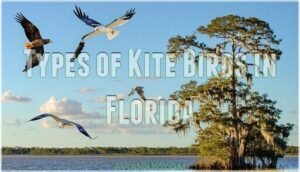
You’ll find five distinct kite species soaring through Florida’s skies, each with unique characteristics that make them easy to identify once you know what to look for.
These graceful raptors include the large Swallow-tailed Kite with its deeply forked tail, the endangered Snail Kite that specializes in eating apple snails, the sleek Mississippi Kite, the hovering White-tailed Kite, and the rare Double-toothed Kite.
The kites mentioned are the Swallow-tailed Kite, the Snail Kite, the Mississippi Kite, the White-tailed Kite, and the rare Double-toothed Kite.
Swallow-tailed Kite
Soaring through Florida’s skies like nature’s own stunt pilot, the Swallow-tailed Kite showcases unmatched aerial acrobatics. You’ll recognize this magnificent raptor by its distinctive forked tail and striking black-and-white plumage.
Watch Florida’s most graceful aerial artist perform breathtaking maneuvers with its signature forked tail streaming behind.
These Everglades birds demonstrate remarkable insect hawking abilities, snatching dragonflies and beetles mid-flight with precision.
- Forest dependence drives their nesting choices in tall cypress and pine trees
- Breeding habits include communal roosting during Florida’s summer months
- Wingspan reaches five feet, making them Florida’s largest kite species
- Migration spans thousands of miles to South American wintering grounds
- Conservation concerns focus on protecting their essential lowland forest habitats
Snail Kite
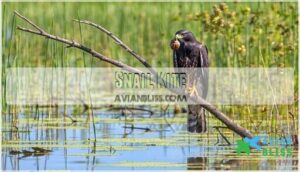
Meeting Florida’s most specialized raptor, you’ll discover the Snail Kite thriving in Everglades wetlands.
Discover Florida’s ultimate specialist—the Snail Kite, perfectly evolved for Everglades wetland life.
This remarkable bird’s Hooked Bill Adaptation perfectly extracts apple snails from shells, making it nature’s ultimate specialist.
The Snail Kite’s survival depends entirely on Wetland Dependency and Water Level Impact, which affects prey availability.
| Feature | Details |
|---|---|
| Apple Snail Diet | Exclusively feeds on freshwater snails |
| Habitat | Everglades marshes and wetlands |
| Bill Shape | Curved hook for snail extraction |
| Conservation | Endangered Status requires protection |
| Population | Monitored since 1969 in Florida |
These Florida birds face ongoing challenges from habitat loss and water management issues.
Ideal nesting sites are often linked to specific water depths in the kite’s habitat.
Mississippi Kite
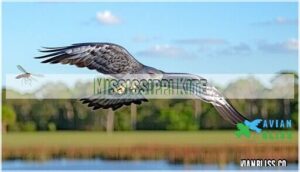
Unlike the specialized snail-eater, the Mississippi Kite stands as Florida’s rarest kite species.
You’ll find these agile raptors in northwestern Florida from April through September, showcasing remarkable agile flight patterns while hunting.
Their insectivore diet makes them natural pest controllers, snatching dragonflies and cicadas mid-air with precision.
Population trends remain concerning for this sleek raptor:
- Southern migration takes them thousands of miles to South America each winter
- Kite identification becomes easier with their distinctive red eyes and gray plumage
- Raptors Florida enthusiasts consider sightings truly special moments
White-tailed Kite
The White-tailed Kite stands out among Florida’s raptors with striking white plumage and bright red eyes.
You’ll find these elegant hunters hovering over central and coastal grasslands year-round, unlike migrating kites.
Their hunting behavior resembles a kestrel’s hovering technique, making kite identification easier.
The whitetailed kite’s conservation status remains stable in Florida habitat, though they’re scarce breeders.
| Feature | Description | Comparison |
|---|---|---|
| Size | 3-foot wingspan | Smaller than Swallow-tailed |
| Plumage Details | White body, gray wings | Most distinctive Florida kites |
| Eyes | Bright red | Unique among raptors Florida |
| Habitat | Open grasslands | Year-round residents |
| Diet | Small rodents | Hover-hunting specialists |
Double-toothed Kite
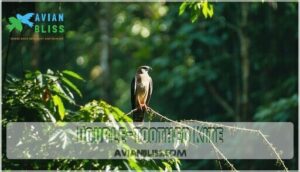
From the common White-tailed Kite, we shift to Florida’s rarest visitor.
The Double-toothed Kite represents a true treasure for Florida avifauna enthusiasts, with only one confirmed Florida Sighting in 2018 near Chassahowitzka.
This elusive species creates significant Identification Challenges with its compact forest-adapted build and specialized double-toothed bill.
Consider these fascinating characteristics:
- Global Distribution spans Central and South American tropical forests
- Habitat Preferences include dense canopy environments unlike other kite birds
- Conservation Status remains stable despite limited Florida wildlife encounters
Habitat and Range of Kite Birds
You’ll find Florida’s kite birds in diverse environments, from the towering cypress trees of the Everglades to open grasslands and coastal areas across the state.
Each species has adapted to specific habitats, with Snail Kites preferring freshwater marshes, White-tailed Kites hunting over agricultural fields, and Swallow-tailed Kites soaring above wooded areas throughout central and southern Florida.
Forests and Wetlands

Exploring Florida’s swamp habitats reveals where kite birds thrive best.
These forest nesting sites in cypress swamps and the Everglades provide perfect hunting grounds when water levels are just right.
Florida ecosystems support incredible prey abundance, from insects to small reptiles.
However, habitat loss threatens these essential areas.
Wetland restoration efforts help maintain Florida wildlife populations.
You’ll discover that healthy forests and marshes create the ideal balance these graceful raptors need for successful breeding and feeding.
Open Fields and Coastal Areas

Open grasslands and coastal zones provide essential hunting grounds where kite birds showcase their aerial mastery.
These Florida ecosystems support diverse prey populations that sustain Coastal Kite Diets, from rodents to insects.
However, Human Encroachment and Habitat Loss threaten these critical Field Nesting Sites.
Salinity Impacts from coastal development alter food chains, affecting bird habitats across Florida.
Open fields also act as carbon sinks, absorbing atmospheric carbon dioxide.
Birdwatching Florida enthusiasts can witness:
- White-tailed Kites hovering motionlessly over prairie grass
- Mississippi Kites diving through salt-tinged air currents
- Swallow-tailed Kites gliding above agricultural boundaries
- Snail Kites patrolling freshwater-saltwater intersection zones
Cypress Swamps and Marshes
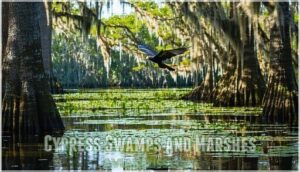
Florida’s cypress swamps and marshes create perfect sanctuaries for kite birds, especially in the Everglades where swamp ecology thrives.
These wetland habitats offer abundant snail populations and diverse prey, supporting marsh biodiversity despite ongoing habitat loss concerns.
Water quality directly impacts food availability, making these environments essential for species survival.
When birdwatching Florida’s swamps, you’ll discover these aerial hunters gliding through ancient cypress canopies with remarkable grace.
Agricultural Fields

While cypress swamps provide rich hunting grounds, kite birds also make themselves at home in agricultural fields across Florida.
You’ll find these adaptable raptors cruising over farmlands, capitalizing on abundant insects and rodents that thrive in cultivated areas.
Crop diversity creates varied prey availability, though field management practices substantially impact their success.
Unfortunately, pesticide exposure and habitat loss from intensive farming pose serious threats to these magnificent bird species in Florida, making sustainable agriculture vital for their survival.
Physical Characteristics of Kite Birds

You’ll recognize Florida’s kite birds by their distinctive long, pointed wings and slender bodies that make them exceptional aerial hunters.
These raptors range from the massive 5-foot wingspan of the Swallow-tailed Kite with its striking black-and-white plumage to the smaller White-tailed Kite’s elegant white underparts and gray wings.
Long, Pointed Wings
Sharp, tapered wings give Florida’s kite birds their signature aerial grace and incredible flight efficiency. You’ll notice how these remarkable raptors cut through the air like living arrows, their pointed wing design creating an aerodynamic advantage that lets them soar for hours without flapping.
The Swallow-tailed Kite showcases this perfectly with its five-foot wingspan, demonstrating superior soaring ability across Florida’s diverse habitats. Each species shows unique wing load characteristics that match their hunting style and environment.
Kite birds use these specialized wings to ride thermals effortlessly, saving energy while scanning for prey below. Their wings work like natural gliders, allowing them to cover vast distances during migration.
- Pointed tips reduce drag and increase maneuverability
- Long wingspan creates excellent lift-to-drag ratios
- Species variation in wing shape matches specific hunting needs
Slender Bodies
Every kite bird you’ll spot in Florida showcases a perfectly streamlined shape that’s built for aerial mastery.
These raptors possess lightweight bone structure and dense muscle density concentrated around their chest, creating ideal body proportions for sustained flight.
Their slender torsos represent millions of years of flight adaptation, allowing these magnificent birds of prey to navigate bird habitats in Florida with remarkable efficiency and grace.
This is partly due to their hollow bone structure, which substantially reduces their overall weight.
Plumage Variations
Beyond their sleek builds, kite birds showcase remarkable plumage diversity across Florida’s skies.
Swallowtailed Kites display crisp black-and-white patterns, while Mississippi Kites feature subtle gray tones.
Seasonal changes transform their appearance throughout the year, and juvenile plumage differs dramatically from adult coloring.
- Color mutations create unique individuals with rare feather patterns
- Regional variations show slight differences between northern and southern populations
- Camouflage patterns help young birds blend into their surroundings
- Adult males often display brighter colors than females during breeding season
Wingspans and Lengths
When you’re identifying kite birds in Florida, size comparison becomes your best friend.
These raptors show remarkable kite dimorphism in their wingspans and lengths, directly impacting their flight efficiency and wing loading capabilities.
Here’s what you’ll encounter:
- Swallow-tailed Kite: Massive 5-foot wingspan with extensive tail length for superior maneuverability
- Mississippi Kite: Compact 3.5-foot span optimized for agile insect hunting
- White-tailed Kite: Medium 3-foot wingspan perfect for hovering over grasslands
Understanding these measurements helps with accurate bird identification across Florida’s diverse habitats.
Behavior and Diet of Kite Birds

You’ll find that Florida’s kite birds demonstrate remarkable hunting skills, with each species using specialized techniques to catch their preferred prey.
The Swallow-tailed Kite snatches insects from the air with precision, while the Snail Kite uses its curved bill to extract apple snails from their shells in freshwater marshes.
Aerial Hunting Techniques
Understanding kite birds’ physical features leads directly to appreciating their remarkable hunting behavior. These aerial hunters showcase incredible techniques that’ll leave you speechless.
Insect hawking involves catching prey mid-flight with precision timing. Rodent hovering requires stationary flight while scanning grasslands below. Snail extraction demands specialized bill work to remove mollusks from shells. Agile swooping allows quick direction changes during pursuit.
| Hunting Method | Target Prey |
|---|---|
| Insect Hawking | Flying insects, dragonflies |
| Rodent Hovering | Voles, mice in grasslands |
| Snail Extraction | Apple snails in marshes |
| Agile Swooping |
Small reptiles, amphibians.
Cooperative hunting occurs when pairs work together, demonstrating sophisticated aerial behavior that makes kiting an art form in Florida’s skies. Their agility is a prime example of aerial feeding strategies.
Small Vertebrates and Invertebrates
Florida’s kite birds showcase remarkable dietary diversity through their snail specialization and rodent predation strategies.
You’ll witness these aerial hunters mastering insect consumption while targeting amphibian prey like frogs and pursuing reptile diet favorites including anoles and snakes.
Here’s what makes their hunting incredible:
- Swallow-tailed kites snatch dragonflies mid-flight with breathtaking precision
- Snail kites use specialized beaks to extract apple snails from shells
- Mississippi kites perform acrobatic catches of flying beetles and cicadas
- White-tailed kites hover motionlessly before diving for unsuspecting rodents
- Multiple species coordinate attacks on snake nests during breeding season
Unique Nesting Habits
Three different kite species showcase fascinating bird nesting behaviors across Florida.
Nest site selection varies dramatically – Swallow-tailed Kites prefer tall cypress and pine trees, while Snail Kites choose dense wetland vegetation.
Nest building materials include twigs and Spanish moss, creating sturdy platforms.
Nesting height preference ranges from moderate to towering heights.
Cooperative nesting involves both parents sharing construction duties, with nesting territory defense ensuring their aerial homes remain secure throughout the breeding season.
Acrobatic Flight Patterns
When you watch Florida’s kite birds perform their aerial gymnastics, you’re witnessing millions of years of evolutionary advantages in action.
These masters of soaring techniques use specialized flight adaptations to navigate air currents with incredible precision.
Their acrobatic flight serves multiple purposes:
- Hunting agility allows swift strikes on insects and small prey
- Energy-efficient gliding during kite migration across vast distances
- Territory displays that showcase fitness to potential mates
Each species demonstrates unique bird behavior, with the swallowtailed kite leading Florida’s most spectacular aerial performances through remarkable species differences.
Migration Patterns of Kite Birds

You’ll notice that kite birds follow different migration patterns throughout the year, with some species traveling thousands of miles between their breeding and wintering grounds.
Understanding these seasonal movements helps you predict when and where you’re most likely to spot these graceful raptors during your birdwatching adventures in Florida.
Spring Migration
When February arrives, kite migration begins as these magnificent raptors return to Florida’s breeding grounds.
Migratory birds like swallow-tailed kites follow established bird migration routes along the Atlantic coast. Their arrival timing signals breeding readiness, with males performing elaborate mating rituals near preferred nesting locations.
This population increase transforms Florida’s skies into spectacular displays of aerial grace and bird migration in Florida. Both parents participate in 28-31 day incubation.
Fall Migration
August signals departure time for Florida’s kite birds as migration triggers activate their southbound journey.
These raptors face incredible survival challenges during their 10,000-mile trek to South America.
Weather impacts and route variations determine success rates, while critical stopover habitats provide essential rest points along bird migration routes.
Understanding bird navigation methods is key to appreciating this feat.
Here’s what makes fall bird migration remarkable:
- Swallow-tailed kites depart Florida between August-September
- Some birds fly nonstop across the Gulf of Mexico
- Weather impacts can delay or accelerate departure timing
- Critical stopover habitats along Atlantic coast support exhausted travelers
- Route variations include both direct flights and multi-stop journeys
Flyways and Routes
Florida’s kite birds navigate distinct migration pathways like seasoned travelers following ancient roadways.
These migratory birds use topographical features as guides, with some crossing the Gulf of Mexico while others hug the Atlantic coast.
Route Obstacles like water barriers shape their journeys, while Stopover Habitats provide essential rest areas.
Flyway Conservation efforts protect these aerial corridors that connect Florida breeding grounds to distant wintering habitats.
Breeding and Wintering Grounds
Following established migration routes, Florida’s kite birds demonstrate remarkable breeding and wintering strategies.
Different species choose distinct nesting habitats and wintering locations based on their specific needs.
Here’s where you’ll find them:
- Swallow-tailed Kites prefer tall cypress trees for breeding, then migrate to South American wintering locations
- Snail Kites remain year-round in Florida wetlands, showing high breeding success when habitat loss doesn’t threaten their specialized kite habitat requirements
Conservation Efforts for Kite Birds
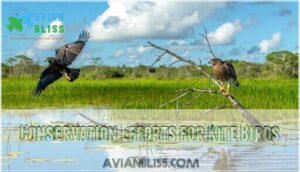
You’ll find that protecting Florida’s kite birds requires teamwork between government agencies, conservation groups, and everyday citizens who support habitat preservation efforts.
Scientists track these birds through regular surveys and work to restore wetlands, while organizations focus on maintaining protected areas where species like the endangered Snail Kite can thrive safely.
Protected Areas and Reserves
Reserve Management creates safe havens where Florida’s kite birds can thrive without human interference.
You’ll discover these magnificent raptors in Everglades National Park and Lower Suwannee National Wildlife Refuge, where Habitat Preservation efforts protect critical nesting sites.
Species Monitoring programs track population health while allowing Public Access for birdwatchers.
Funding Sources support ongoing Florida bird conservation initiatives that maintain these essential habitats for future generations.
Key Features Conservation Focus
Conservation Organizations
Beyond protected areas, bird conservation organizations across Florida champion kite conservation through diverse funding sources and volunteer opportunities.
The Audubon Society leads advocacy efforts while partnering with researchers on critical research initiatives.
These Florida bird conservation groups boost public awareness through community programs, creating a network that guarantees bird conservation efforts protect kite species for future generations.
Habitat Restoration
Restoration breathes life back into Florida’s fragmented landscapes, creating havens where kite birds can flourish.
These targeted efforts rebuild the ecosystems that support thriving populations.
- Wetland Preservation—restoring marshes for Snail Kites’ apple snail hunting grounds
- Forest Management—maintaining tall cypress and pine nesting sites
- Water Quality—ensuring clean conditions that boost prey abundance
- Habitat Connectivity—linking fragmented areas for safer migration routes
Sustainable Land Use Practices
You can protect Florida’s kite birds through smart land management that balances development with conservation.
Agricultural practices now minimize pesticide use near wetlands, while urban planners create wildlife corridors.
These efforts help Snail Kites and Mississippi Kites thrive in the Everglades ecosystem.
| Practice Type | Bird Conservation Benefit |
|---|---|
| Pesticide-Free Farming | Protects food sources for insect-eating kites |
| Wildlife Corridors | Connects fragmented habitats for migration |
| Wetland Buffers | Preserves critical nesting areas for Snail Kites |
Birdwatching Tips for Spotting Kite Birds
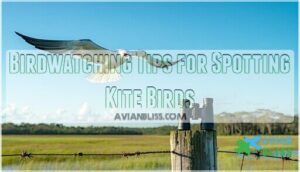
You’ll need quality binoculars with 8×42 magnification to clearly see kite birds’ distinctive features, such as the Swallow-tailed Kite’s deeply forked tail and the White-tailed Kite’s bright red eyes.
Look for these raptors during morning hours when they’re most active, scanning open woodlands, wetlands, and grasslands where they hunt for insects and small prey.
Identifying Kite Birds
Spotting kite birds in Florida can feel like searching for buried treasure.
When you’re in the field, keep your bird identification guide handy and focus on these handy tips:
- Plumage Comparison: Look for bright white underparts or the striking forked tail in species like the Swallow-tailed Kite.
- Tail Shapes and Flight Patterns: Notice the deeply forked tail or the Snail Kite’s hooked bill.
- Size Differences and Call Sounds: Compare body size and listen for distinct calls of the Mississippi Kite to differentiate among Florida’s remarkable kite birds.
Binoculars and Equipment
Once you’ve learned to identify Florida’s kites, proper equipment transforms your bird watching experience from frustrating to fantastic.
Quality binoculars with 8×42 magnification bring distant raptors into sharp focus, while spotting scopes reveal intricate feather details. Tripod stability guarantees steady kite photography during those breathtaking aerial displays.
For the best viewing, consider purchasing 8×42 binoculars.
- Binocular magnification of 8×42 provides ideal clarity for tracking fast-moving kites
- Field guides help distinguish between similar species during quick sightings
- Camera with telephoto lens captures stunning bird photography of soaring raptors
Interesting Facts About Kite Birds
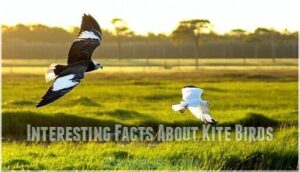
You’ll discover that Florida’s kite birds possess remarkable abilities that set them apart from other raptors, including the Swallow-tailed Kite’s impressive five-foot wingspan and the Snail Kite’s specialized curved bill designed specifically for extracting apple snails from their shells.
These fascinating species demonstrate unique hunting techniques, from the Mississippi Kite’s aerial insect-catching prowess to the White-tailed Kite’s helicopter-like hovering ability over grasslands, showcasing their remarkable abilities.
Unique Physical Characteristics
Florida’s kite bird species showcase stunning distinctive morphology that’ll make you stop in your tracks.
Each raptor displays unique plumage coloration – from the Swallow-tailed Kite’s striking black-and-white contrast to the White-tailed Kite’s ethereal white body.
Their tail morphology varies dramatically, with deeply forked designs enabling precise aerial maneuvers.
Bill adaptations reflect specialized diets, while eye color ranges from deep red to brown, completing their remarkable size variation.
Hunting Techniques
When you watch kite birds hunt, you’ll witness nature’s most skilled aerial performers.
Their hunting mastery includes three remarkable techniques:
- Insect Hawking: Catching flying insects mid-flight with incredible aerial agility
- Hover Hunting: Staying motionless above prey before striking with precision
- Snail Extraction: Using specialized bills to remove snails from shells
These foraging strategies showcase their diverse kite diet and exceptional hunting abilities.
Interactions With Other Bird Species
Aerial ballet unfolds as Florida’s kite species navigate complex relationships with neighboring avian species.
You’ll witness predator-prey dynamics when larger raptors challenge smaller kites, while competition for resources creates territorial disputes.
Interspecies communication occurs through distinctive calls and flight patterns, revealing fascinating bird behavior patterns across diverse habitats.
| Interaction Type | Kite Species Involved | Other Bird Species |
|---|---|---|
| Competition for nesting sites | Swallow-tailed Kites | Red-shouldered Hawks |
| Symbiotic feeding relationships | Mississippi Kites | Cattle Egrets |
| Territorial conflicts | Snail Kites | Red-winged Blackbirds |
| Mixed foraging flocks | White-tailed Kites | Northern Harriers |
Conservation Status and Threats
Behind Florida’s soaring kites lies a concerning reality.
These raptors face mounting pressures that threaten their survival across the state’s diverse ecosystems.
- Habitat Loss from development destroys critical kite nesting sites
- Water Quality changes affect Snail Kite prey availability in wetlands
- Pesticide Use reduces insect populations essential for hunting
- Climate Change disrupts migration patterns and breeding cycles
- Poor bird conservation status requires immediate protective action
Frequently Asked Questions (FAQs)
Are there kites in Florida?
Looking for graceful raptors soaring overhead?
You’ll find five kite species in Florida: Swallow-tailed, White-tailed, Mississippi, Snail, and occasionally Double-toothed Kites.
Each species offers unique characteristics and preferred habitats throughout the state, making Florida a great place for kite spotting.
Where do swallow tailed kites live in Florida?
You’ll find swallow-tailed kites throughout Florida’s woodlands during summer months, especially in tall cypress and pine trees near prey-rich areas.
They prefer nesting in elevated spots within the state’s diverse forest ecosystems.
What does a kite look like in Florida?
You’ll spot Florida’s kites by their distinctive features:
Swallow-tailed Kites display striking black-and-white plumage with deeply forked tails.
While White-tailed Kites show bright white undersides and gray wings with red eyes.
When do swallow tailed kites breed in Florida?
While many birds wait for cooler months, you’ll spot swallow-tailed kites breeding during Florida’s hottest season.
They arrive in March and breed through summer until September, then migrate south to Brazil for winter.
What kind of kites live in Florida?
You’ll encounter five distinct kite species in Florida: the majestic Swallow-tailed Kite, elegant White-tailed Kite, sleek Mississippi Kite, specialized Snail Kite, and the rare Double-toothed Kite that’s occasionally spotted.
What do Florida kites eat?
You’ll find Florida’s kites have diverse diets.
Swallow-tailed kites catch insects mid-flight plus frogs and lizards.
White-tailed kites hunt rodents in grasslands.
Mississippi kites specialize in flying insects.
Snail kites exclusively eat apple snails.
When can you see Swallow-tailed Kites in Florida?
Though you might think these graceful raptors stick around year-round, you’ll actually spot Swallow-tailed Kites in Florida from March through September.
They’re summer visitors who migrate to South America for winter months.
What does it mean when you see a swallow-tailed kite?
Seeing a swallow-tailed kite signals you’re witnessing nature’s grace in action. These elegant raptors represent summer’s arrival, healthy ecosystems, and Florida’s wild beauty soaring overhead with their distinctive forked tails.
What threats do kite birds face in Florida?
You might think kite birds are invincible flyers, but they’re not.
Florida’s kites face habitat destruction, wetland drainage, water level changes, and pesticide poisoning.
Climate change also disrupts their food sources and nesting areas.
How do kite birds adapt to urban areas?
You’ll find kite birds struggling in urban Florida environments.
They can’t easily adapt like other raptors since they need specific habitats – tall trees, open woodlands, and wetlands – that cities typically lack.
Conclusion
Spotting kite birds in Florida rewards patience, preparation, and persistence.
You’ll discover swallow-tailed kites performing aerial ballet, snail kites mastering wetland hunting, and mississippi kites cruising woodland edges.
These magnificent raptors transform ordinary skies into extraordinary wildlife theaters.
Whether you’re exploring cypress swamps, coastal marshes, or agricultural fields, each species offers unique viewing opportunities.
Pack your binoculars, study their flight patterns, and venture into Florida’s diverse habitats.
The kite birds in florida await your discovery, promising unforgettable encounters with nature’s most graceful aerial performers.
- https://www.ces.fau.edu/publications/pdfs/BiodiversityWhitepaper.pdf
- https://bioone.org/journals/the-auk/volume-121/issue-3/0004-8038(2004)121%5B0894%3AEONDAW%5D2.0.CO%3B2/EFFECTS-OF-NATAL-DEPARTURE-AND-WATER-LEVEL-ON-SURVIVAL-OF/10.1642/0004-8038(2004)121[0894:EONDAW]2.0.CO;2.short
- https://www.endangeredspecieslawandpolicy.com/assets/htmldocuments/blog/4/2013/12/2006-biological-opinion-Miccosukee.pdf
- https://www.fws.gov/sites/default/files/documents/2025-01/20250117_bo_kingston_saj-2024-00967_signed.pdf
- https://www.acjv.org/documents/BCR_31_final.pdf