
This site is supported by our readers. We may earn a commission, at no cost to you, if you purchase through links.
Most birders blame their equipment when they can’t pin down that warbler’s field marks, but nine times out of ten, the culprit is poor binocular adjustment. I’ve watched patients squint through $800 optics that were basically configured for someone else’s face.
Your eyes are separated by a distance unique to you—somewhere between 54 and 74 millimeters—and your binoculars need to match that measurement precisely. Without proper adjustment, your ocular muscles strain constantly to merge two misaligned images, triggering headaches within twenty minutes.
The good news? Once you learn how to adjust binoculars for your eyes, the transformation happens in under three minutes, and suddenly those subtle plumage details snap into focus with zero effort.
Table Of Contents
Key Takeaways
- Misaligned binoculars cause eye strain and headaches within 20 minutes because your ocular muscles constantly work to merge two misaligned images, but proper adjustment takes only three minutes and matches your unique interpupillary distance (54-74mm in adults).
- The three-step adjustment process requires setting interpupillary distance by hinging barrels until two circles merge into one, adjusting eyecups based on whether you wear glasses, and calibrating each eye separately using the central focus knob and diopter ring.
- Blurry or double vision usually stems from incorrect diopter adjustment rather than broken equipment, and you should recalibrate all settings whenever someone else uses your binoculars since everyone’s eye spacing and vision differ.
- Proper binocular setup transforms viewing from an exhausting battle with optical equipment into seamless observation where subtle details emerge naturally without constant refocusing or muscle compensation.
Why Proper Binocular Adjustment Matters
Your binoculars won’t work the way they should if they’re not adjusted to match your unique vision. Proper adjustment takes about three minutes and makes the difference between squinting through frustration and seeing crisp, comfortable detail for as long as you want to observe.
Once you’ve mastered the basics, you might want to explore advanced birdwatching equipment options that complement your properly adjusted binoculars.
I’ve seen patients struggle through hours of bird watching with blurred images and splitting headaches, simply because they skipped the setup process.
Skipping binocular setup turns bird watching into hours of blurred images and splitting headaches
Reducing Eye Strain and Fatigue
Misalignment turns what should be a pleasant viewing session into a test of endurance. When your interpupillary distance doesn’t match your eye spacing, your ocular muscles work overtime to compensate, leading to headaches and visual fatigue within minutes. Proper binocular ergonomics isn’t optional—it’s essential eye strain prevention.
Getting the diopter adjustment right is just one part of the equation—choosing binoculars with the right optical design from the start can prevent many of these comfort issues before they begin.
- Eye relief matters: Correct ocular spacing eliminates the constant muscle effort your eyes make to merge two misaligned images
- Diopter adjustment compensates for vision differences between your eyes, preventing one eye from straining to keep up
- Best viewing techniques include maintaining natural head posture and taking breaks every 20-30 minutes
Enhancing Bird Watching Experiences
Beyond comfort, proper binocular focusing transforms how you identify birds in the field. When your interpupillary distance is dialed in and your diopter adjustment matches your vision, you’ll catch subtle plumage patterns and field marks that separate lookalike species.
Optical quality matters most when tracking bird behavior—fast flybys demand quick target acquisition. Eye relief optimized for your eyes, whether you wear glasses or not, means edge-to-edge clarity that reveals every detail your binoculars for bird watching can deliver.
Setting The Interpupillary Distance
The distance between your eyes—usually ranging from 54 to 74 millimeters in adults—needs to match the distance between your binocular eyepieces, or you’ll see two overlapping circles instead of one merged image. This interpupillary distance matters more than most people realize.
Here’s how to nail the interpupillary adjustment: Grip both barrels near the eyepieces and gently hinge them inward or outward while looking through them at a distant object. You’re calibrating the binocular adjustment to match your unique eye distance measurement. Keep moving the barrels until the two circles merge into one perfect circle with no dark shadows at the edges.
You’ll know you’ve achieved proper eyepiece alignment when the view looks like you’re peering through a single telescope instead of two separate tubes. Lock in that position mentally—it’s your personal binocular calibration setting. Every time you use these binoculars, you’ll start here before touching any focus settings, diopter adjustment, or eye relief controls.
Adjusting Eyecups and Eye Relief

Getting the eyecups right is where most people stumble, and it’s often the difference between sharp, comfortable viewing and a frustrating experience. Whether you wear glasses or not changes everything about how you position your eyes behind the lenses.
Once you’ve got the eyecups adjusted for your eyes, the next step is learning how to properly focus binoculars using both the central knob and diopter adjustment together.
Let’s walk through both scenarios so you can dial in the perfect eye relief for your vision.
Eyecup Settings for Glasses Wearers
Wearing glasses doesn’t mean you’re stuck squinting through binoculars. If you wear prescription lenses, fold down or twist those eyecups completely—this is essential for clear eye relief and maintains your full field of view. Here’s what matters for glasses compatibility:
- Eyecup materials with soft rubber or foam prevent smudging your lenses
- Frame sizing affects temple pressure; swap to flexible cups if discomfort persists
- Lens protection requires a slight eye relief increase to avoid peripheral vignetting
- Diopter adjustment still applies even with glasses
- Inspect eyecups regularly—cracks compromise seal and comfort
Optimizing Eye Relief for Comfort
Comfort isn’t negotiable when you’re scanning for warblers at dawn. Eye relief—the distance between your eye and the eyepiece lens—directly impacts eye strain prevention and vision optimization. Most binoculars offer 15 to 22 millimeters of adjustable eye relief, and you’ll find the sweet spot around 16–20 mm for your interpupillary distance.
If you’re using your optics near saltwater, check out these marine-grade binoculars that handle fog and corrosion without compromising eye relief.
Adjust eyecups until you see the full image without vignetting or glare. Proper binocular ergonomics means gentle contact, not pressure. These comfort settings and focusing techniques transform exhausting sessions into seamless observation.
Focusing Each Eye Individually
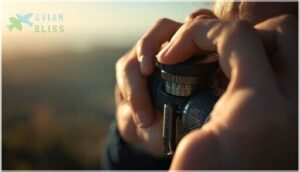
Your eyes aren’t identical twins. They’ve different focusing needs, and your binoculars need to account for that difference.
Here’s how to calibrate each eye separately so you get a sharp, comfortable image every time you look through the lenses.
Using The Central Focus Knob
Locate that textured wheel between the barrels—that’s your central focus wheel, the workhorse of binocular focusing. This mechanism adjusts both barrels simultaneously through internal lens movement, giving you rapid optical alignment without touching individual eyepieces.
Before you start fine-tuning with the diopter adjustment, you’ll master this knob first. Point at a high-contrast target thirty feet away and rotate smoothly until sharpness emerges.
Understanding proper diopter settings is essential for achieving sharp images.
Calibrating With The Diopter Adjustment
Your eyes aren’t carbon copies of each other—that’s where the diopter adjustment earns its keep. After setting your central focus to neutral, close your left eye and rotate that diopter ring on the right barrel until sharpness locks in perfectly.
This fine-tunes optical clarity for eye-to-eye differences, aligning focus calibration between both oculars so you won’t battle persistent blur during every birding session.
Step-by-Step Focusing Technique
Pick a target 30 to 40 feet away—sharp edges work best for optical clarity and focus calibration. Close your right eye, then rotate the central focus wheel until your left eye locks onto crisp detail.
Now close your left eye and fine-tune the diopter adjustment on the right barrel for perfect eye alignment.
Open both eyes—image stabilization should feel automatic, lens adjustment complete.
Troubleshooting Common Focus Issues
Even with careful adjustment, you’ll sometimes run into focus problems that seem impossible to fix. I see this in my practice all the time—patients come in convinced their binoculars are broken when really they just need a simple reset or cleaning.
Let’s walk through the most common issues and exactly how to solve them.
Fixing Blurry or Double Images
Blurry images usually trace back to incorrect diopter adjustment, not mechanical failure. Start by rechecking your focusing techniques: cover one eye, refocus the central knob, then calibrate the diopter ring for the other eye. Proper diopter adjustment is essential for achieving clear and unified images.
Double vision signals collimation errors or prism alignment issues from impacts. If separate barrel testing shows sharp images, your eye relief or interpupillary distance needs fine-tuning, not optical calibration.
Resetting Focus Settings
Think of a full reset as wiping the slate clean—you’re returning both the central focus wheel and diopter adjustment to factory neutral. This optical alignment restores your baseline for proper lens adjustment and eye relief. Many binocular models feature a dedicated reset position, letting you start fresh with focus calibration.
After resetting, walk through your focusing techniques again, using calibration tips from earlier sections to dial in sharp binocular focusing customized to your vision.
Tips for Maintaining Binocular Performance
Once you’ve dialed in your diopter adjustment and eye relief, binocular maintenance keeps that optical alignment sharp.
Wipe lenses weekly with a microfiber cloth—no household cleaners that’ll strip coatings. Store your optics in a padded case away from temperature swings.
Schedule performance checks monthly, inspecting seals and testing binocular focusing. These maintenance schedules prevent the blurry frustrations you just fixed.
Frequently Asked Questions (FAQs)
How often should I clean my binocular lenses?
Clean your binocular lenses only when visible dirt affects your view.
Bushnell recommends minimal lens cleaning to protect delicate optical coatings—prevention through caps and proper storage beats frequent wiping every time.
Can I adjust binoculars for childrens eyes?
Yes, you can adjust binoculars for children’s eyes. Kids need smaller interpupillary distance settings and simplified diopter calibration.
Choose lightweight models with smooth central focus knobs to reduce pediatric optics frustration and support youth eye health.
What causes image shake at high magnification?
Hand tremors, atmospheric turbulence, and optical misalignment—including lens decentering or mirror symmetry issues—all magnify at higher power.
Even small interpupillary distance or diopter errors degrade image quality, causing noticeable shake during binocular focusing.
Do both eyes need identical vision correction?
Not always. Your eyes can have different refractive errors requiring distinct prescription balance. The diopter adjustment on binoculars manages this vision alignment, letting you calibrate each barrel separately for your unique eye correction needs.
Should I recalibrate after sharing my binoculars?
Absolutely—recalibration tips matter here. Each person’s interpupillary distance (usually 55-75mm) and diopter needs differ. Reset eyecups, spacing, and the diopter dial to prevent eye strain, focus problems, and headaches with shared binocular care.
Conclusion
Think of proper binocular setup as your ocular handshake with the device—it only works when both parties align. Once you’ve nailed how to adjust binoculars for your eyes through interpupillary distance, eyecup position, and diopter calibration, viewing becomes seamless instead of exhausting.
Your muscles stop compensating. Details emerge. That three-minute investment pays dividends every time you raise the glass, transforming optical potential into actual clarity you can sustain all day.
- http://ornithology.com/
- https://blog.wordvice.com/formatting-research-paper-headings-and-subheadings/
- https://imaging.nikon.com/sport-optics/guide/binoculars/technologies/technologies_02/
- https://www.kentfaith.ca/blog/article_how-focus-binoculars_3524
- https://www.thisisquest.org/post/how-to-use-your-binoculars