This site is supported by our readers. We may earn a commission, at no cost to you, if you purchase through links.
You spot a small brown bird at your feeder and think “sparrow”—but which one? North America hosts over 50 sparrow species, and many look remarkably similar at first glance.
That little streaky bird could be any of a dozen different species, each with its own subtle field marks, preferred habitats, and distinctive songs. The good news is that with a few key identification techniques, you can move beyond “just another sparrow” and start recognizing the unique characteristics that set each species apart.
Learning to tell different sparrow species apart transforms casual bird watching into a rewarding detective game, where details like beak shape, head stripes, and habitat context become your most valuable clues.
Table Of Contents
- Key Takeaways
- Key Features for Identifying Sparrow Species
- How to Distinguish Sparrows From Similar Birds
- Identifying Common North American Sparrows
- Regional and Habitat Clues for Sparrow ID
- Tips for Identifying Sparrows in The Field
- Rare and Endangered Sparrow Species to Recognize
- Frequently Asked Questions (FAQs)
- Conclusion
Key Takeaways
- You can distinguish among North America’s 50+ sparrow species by focusing on crown stripes, breast streaking, beak shape, and tail characteristics—these field marks remain your most reliable identification tools even during brief observations.
- The five most common North American sparrows—House, Song, Chipping, White-throated, and Savannah—each occupy distinct habitats from urban settings to wetlands, making location context as valuable as visual features for accurate identification.
- Recording songs and calls on your phone provides critical audio evidence for identification since many sparrows, like the White-throated’s “Old Sam Peabody” whistle or the Song Sparrow’s complex trills, announce themselves through distinctive vocalizations before you spot visual details.
- Several sparrow species, including the Saltmarsh, Bachman’s, Baird’s, and LeConte’s, face serious conservation threats from habitat loss, making proper identification skills important not just for birding accuracy but for tracking population declines in threatened species.
Key Features for Identifying Sparrow Species
Sparrows can look maddeningly similar at first glance, but once you know what to look for, the key differences become clear. You’ll want to focus on a handful of reliable features that separate one species from another—things you can spot even when a bird gives you only seconds to observe.
Start by checking the crown stripe, breast streaking, and tail shape—these details matter just as much as the brighter plumage you might notice on yellow birds in North Carolina.
Let’s break down the key characteristics that’ll transform you from guessing to confidently identifying sparrows in the field.
Understanding these visual cues becomes second nature once you apply the same observational skills used in creating enriching feeding environments for captive birds.
Size and Body Shape
When you’re scanning a mixed flock of sparrows, one of your first clues is surprisingly simple: size matters, and body shape tells you more than you’d think at first glance. Understanding the differences in bill shape variations can also aid in identifying specific species.
These physical cues become even more valuable when combined with understanding why birds sing different songs, since vocalizations can confirm what visual features suggest.
Sparrow species range from four to seven inches, with some appearing stocky and compact while others look slender and elongated. You’ll notice wing length and tail shapes vary too—short-tailed birds often seem rounder, while longer tails create a more aerodynamic profile that helps with sparrow identification in the field.
Beak Shape and Size
A sparrow’s bill is like a toolkit designed for its favorite foods—thick and conical for cracking seeds, or thinner and more pointed for picking insects from bark and leaves. The shape and size of a sparrow’s beak are influenced by its adaptive beak morphology, which plays a vital role in its ability to consume various food sources.
When you’re examining beak shapes for sparrow identification, watch for these foraging adaptations:
- Bill length varies from short and stubby in House Sparrows to longer and more tapered in swamp-dwelling species
- Seed cracking specialists have thick, powerful beaks with curved edges
- Feeding strategies shift seasonally—some sparrows switch from insects in summer to seeds in winter
- Beak morphology reflects diet, with ground-feeders showing different characteristics than foliage gleaners
- Bird identification becomes easier once you recognize how bill shape connects to habitat and food preferences
Pay attention to the upper and lower mandible proportions, and you’ll start noticing sparrow species characteristics that separate one type from another!
Head Patterns and Markings
Once you’ve sized up the beak, shift your gaze to the head—that’s where the real visual drama unfolds, with bold stripes, eye rings, and crown patches that act like field marks painted right on the bird’s face.
Look for facial stripes running through the eye or above it, crown colors ranging from rusty red to slate gray, and throat patches in black or white. Cheek marks and eye rings complete these distinctive plumage patterns that make sparrow species characteristics instantly recognizable!
Plumage Colors and Patterns
Beyond the head, you’ll notice that a sparrow’s back, wings, and underparts wear a patchwork of earth tones—streaky browns, warm chestnuts, soft grays, and crisp whites—that blend together in patterns as unique as fingerprints.
Wing bars appear as pale stripes across folded wings, while feather texture and color variation shift through molt cycles, giving you critical clues for pattern recognition and precise bird identification of different sparrow species.
Songs and Calls
If you close your eyes and listen carefully, each sparrow species will introduce itself through a signature melody or sharp chip note that’s just as distinctive as its plumage.
Each sparrow species announces itself through a unique song or call just as distinctive as its feathers
The Song Sparrow delivers rich, varied phrases that change with location, while the White-throated Sparrow whistles its clear “Old Sam Peabody” tune. Learning these vocalization patterns transforms bird watching into audio identification, where call recognition and song variation reveal avian behavior you’d otherwise miss in dense cover.
How to Distinguish Sparrows From Similar Birds
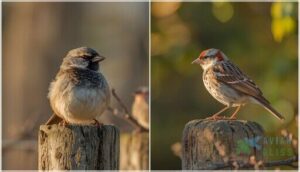
You’ll often spot a small brown bird and wonder—sparrow, finch, or something else entirely?
The truth is, sparrows share their space with several look-alikes that can trip up even experienced birders.
Let’s break down the key differences that’ll help you sort sparrows from their cousins in the field.
Differences Between Sparrows, Finches, and Juncos
You’ll find the most common mix-up in bird identification happens between these three small, brown, seed-eating birds that flock to feeders across North America.
Here’s your quick beak comparison and feather patterns guide:
- Sparrows have conical bills and streaky brown plumage with distinct head patterns
- Finches sport notched tails and thicker beaks for crushing seeds
- Juncos flash white outer tail feathers and solid gray or brown bodies
- Habitat overlap occurs during bird migration seasons
- Sparrow species usually show bolder facial markings than their lookalikes
Master these bird identification techniques, and you’ll confidently separate them at your feeder!
Unique Sparrow Behaviors
Watch a sparrow for five minutes, and you’ll notice their signature ground-scratching dance—a two-footed backward hop that sends leaf litter flying as they hunt for hidden seeds and insects. Unlike finches that perch-feed, sparrows prefer foraging habits close to cover.
Their flocking patterns during migration create tight, chattering groups, and you’ll spot distinctive courtship displays with males puffing chest feathers while singing from exposed perches!
Comparing Bill Shapes and Feeding Habits
A sparrow’s bill works like a specialized tool—thick and conical for cracking seeds, or slender and pointed for plucking insects—and noticing these differences can instantly narrow down which species you’re observing.
Bill adaptation reveals feeding strategies:
- Seed-eating sparrows sport sturdy, triangular bills perfect for crushing tough husks
- Insect specialists display finer, tweezer-like beaks for precise foraging tactics
- Generalist feeders show intermediate beak structure, adapting to seasonal food availability
Identifying Common North American Sparrows
Once you’ve narrowed down that you’re looking at a sparrow and not a finch or junco, the real detective work begins.
North America is home to dozens of sparrow species, but five stand out as the ones you’ll encounter most often in backyards, parks, and wild spaces. Let’s walk through each one so you can confidently put a name to that little brown bird.
House Sparrow (Passer Domesticus)
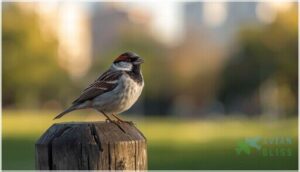
The House Sparrow is probably the sparrow you know best, with its bold black throat patch and gray crown making it a regular fixture in cities, suburbs, and farmyards across North America. Males sport chestnut-brown napes and pale gray cheeks, while females wear softer brown tones overall.
You’ll spot these sparrows in flocks, chirping loudly around buildings and parks—this introduced species from the Passeridae family has mastered urban adaptation completely!
Song Sparrow (Melospiza Melodia)
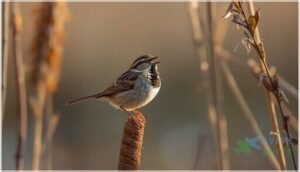
Song Sparrows earn their name with melodious songs that rank among the most recognizable sounds in North American backyards, wetlands, and brushy edges. Look for the heavy brown streaks converging into a central breast spot, along with a long rounded tail and pumping flight pattern.
These sparrows stick to dense cover near water year-round in many regions, though northern populations migrate south for winter.
Chipping Sparrow (Spizella Passerina)
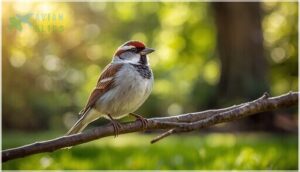
If you’re looking for a sparrow that’s crisp, clean, and surprisingly elegant, the Chipping Sparrow delivers with its rusty crown, sharp white eyebrow, and black eye line that looks like it was drawn with a fine-tip pen.
You’ll spot these sparrows hopping across lawns and open woodlands during breeding season, their soft trilling calls filling suburban neighborhoods and park edges.
Migration patterns bring northern populations south in fall, with flocks gathering in weedy fields and brushy areas.
White-throated Sparrow (Zonotrichia Albicollis)
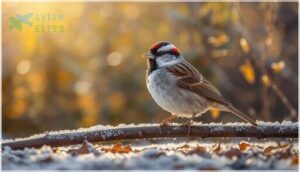
From suburban lawns to northern forests, you can identify the White-throated Sparrow by its bold white throat patch, striking yellow lores (the spot between eye and bill), and distinctive song that sounds like “Old Sam Peabody, Peabody, Peabody.”
These chunky sparrows show two color morphs—white-striped and tan-striped—and you’ll find them scratching through leaf litter with a characteristic double-kick motion.
Key identification features include:
- Bright yellow spot between eye and bill
- Clean white throat contrasting with gray breast
- Black-and-white or tan-and-white striped crown
Migration patterns bring them south from Canadian breeding grounds each fall, where they gather in brushy thickets and woodland edges throughout winter.
Savannah Sparrow (Passerculus Sandwichensis)
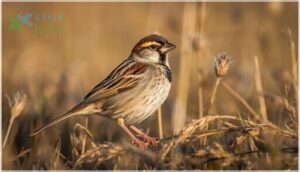
You’ll spot Savannah Sparrows walking briskly through open grasslands and coastal meadows, their streaky brown plumage and short notched tails setting them apart from their forest-loving cousins. Look for their yellowish eyebrow stripe and pink legs—key bird identification techniques that distinguish this sparrow species from similar grassland birds.
Their habitat preferences include open fields and marshes, where they employ ground-foraging strategies, picking seeds and insects while staying low in vegetation.
Regional and Habitat Clues for Sparrow ID
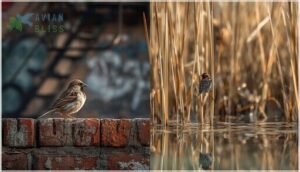
Where you spot a sparrow can be just as telling as what it looks like. Different species claim specific territories, from city parks to coastal marshes, and knowing these preferences narrows down your options fast.
Let’s explore how location and habitat give you the edge in sparrow identification.
Urban Versus Rural Sparrow Species
Your backyard feeder attracts a completely different crowd than the one foraging in a remote prairie, and understanding where sparrows prefer to live can narrow down your ID options faster than any field mark. Here’s how human impact shapes sparrow distribution and what you’ll find in each landscape.
- Urban Habitats: House Sparrows dominate city birds, thriving near buildings and sidewalk cafés.
- Rural Landscapes: Song Sparrows and Chipping Sparrows prefer farmland edges with natural cover.
- Sparrow Migration: Some species shift between urban and rural areas seasonally.
Sparrows of Wetlands, Grasslands, and Woodlands
Each sparrow species has carved out its own ecological niche, with some thriving in cattail-lined marshes while others scratch for seeds in open prairies or flit through woodland understories. The endangered Saltmarsh Sparrow clings to coastal wetlands, while Savannah Sparrows prefer grassland habitats with scattered shrubs.
Woodland ecosystems shelter species like the American Tree Sparrow during migration. Habitat fragmentation threatens these specialized types of sparrows, making sparrow identification through habitat context increasingly critical for conservation.
Seasonal Distribution and Migration Patterns
Understanding when and where sparrows appear throughout the year can turn a confusing identification challenge into a straightforward seasonal puzzle. The American Tree Sparrow breeds in northern habitats but shifts to wintering grounds across southern Canada and the northern USA.
These seasonal distribution patterns mean you’ll spot different sparrow species depending on the month, with breeding patterns and habitat changes creating distinct windows for observation along major migration routes.
Tips for Identifying Sparrows in The Field

Getting out in the field is where sparrow identification really comes to life, but it helps to have a few practical tools and techniques in your back pocket.
The right approach can make the difference between a frustrating guessing game and a confident ID.
Here are three field strategies that’ll sharpen your sparrow-spotting skills.
Using Binoculars and Field Guides
Sharp optics transform sparrow identification from guesswork into precision. Opt for 8x binoculars with close focus—around 6 to 10 feet—so you can resolve subtle crown stripes and malar marks when birds hop near. Pair them with a modern field guide organized by family, and you’ll quickly cross‑reference range maps, head patterns, and habitat notes.
- Practice raising binoculars while keeping your eyes locked on the bird.
- Choose 8x magnification for a steadier, brighter image than 10x models.
- Look for close‑focus distances of 2–3 meters to catch nearby foragers.
- Use field guide range maps to rule out sparrow species unlikely in your region.
- Cross‑check “similar species” notes to spot diagnostic differences in streaking or bill shape.
Birding strategies that integrate optical equipment with systematic field guide tips will sharpen your sparrow species recognition every time you’re out watching.
Noting Behavior and Social Patterns
Watch how a sparrow scratches at the ground or flicks through leaf litter, and you’ll often pinpoint its species before you even glimpse its crown stripes. Flocking patterns reveal identity—Song Sparrows forage solo or in pairs, while White-throated Sparrows gather in loose winter groups. Territorial behavior matters, too; chipping sparrows defend breeding areas with sharp calls, but Savannah Sparrows slip quietly through grasslands.
| Sparrow Species | Foraging Strategies | Social Hierarchy |
|---|---|---|
| Song Sparrow | Ground-scratching, solitary | Loose pairs |
| White-throated Sparrow | Leaf-litter flicking, mixed flocks | Winter groups (5–15 birds) |
| Chipping Sparrow | Lawn picking, territorial | Breeding pairs, aggressive defense |
| Savannah Sparrow | Low vegetation gleaning | Solitary or small clusters |
Observing mating rituals and territorial displays sharpens species identification—males singing from exposed perches signal breeding chipping sparrows, while secretive movements hint at Bachman’s or LeConte’s sparrows in dense cover.
Recording Songs and Calls for ID
Pull out your phone and hit record the moment you hear a trill or chip—those few seconds of audio can crack the toughest sparrow ID when field marks alone leave you guessing. Vocalization patterns vary widely among sparrow species, and call recognition sharpens with practice.
- Song variation differs even within species—White-throated Sparrows whistle clear notes, while Song Sparrows deliver complex, buzzy phrases
- Audio recording lets you compare sounds at home using spectrogram analysis apps
- Bird watchers can upload recordings to ornithological research databases for expert verification and sparrow identification confirmation
Rare and Endangered Sparrow Species to Recognize
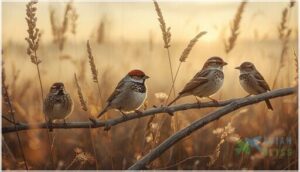
Some sparrows are fighting for survival in habitats that are vanishing fast, making them rare finds in the field.
Spotting one of these endangered species isn’t just exciting—it’s a reminder of what we stand to lose. Here are four sparrows that deserve your attention and protection.
Saltmarsh Sparrow
The Saltmarsh Sparrow is quite literally running out of time, with rising sea levels threatening to swallow its coastal breeding grounds entirely within the next few decades.
You’ll find this endangered sparrow species only in tidal salt marshes along the Atlantic coast, where habitat loss and coastal erosion have pushed populations into sharp decline.
Bird watchers can identify it by streaked plumage patterns, orange facial tones, and grayish nape—though conservation efforts may determine whether future generations get that chance.
Bachman’s Sparrow
While coastal marshes face the ocean’s advance, another imperiled sparrow has been quietly disappearing from the pine flatwoods and scrublands of the southeastern United States.
Bachman’s Sparrow now ranks as a near-threatened conservation status species, with habitat preservation critical for its survival. You’ll need patience and sharp identification skills to spot this secretive sparrow species, which prefers singing from hidden nesting sites rather than exposed perches.
- Warm gray head with buffy breast and brownish-streaked back—subtle plumage patterns compared to showier species
- High-pitched, whistling song that starts with one clear note, then descends into a musical trill
- Breeding habits center on longleaf pine ecosystems with dense ground cover, where fire suppression has devastated populations
- Foraging strategies involve picking seeds and insects from ground vegetation, rarely venturing into open areas where field guides suggest watching carefully
Baird’s Sparrow
Head north to the windswept grasslands of Montana and the Dakotas, and you might encounter one of North America’s most elusive prairie sparrows—Baird’s Sparrow, a species so well-camouflaged that experienced birders can walk right past it.
| Field Mark | Description | ID Tip |
|---|---|---|
| Crown | Orange-buff with black streaks | Distinct central stripe pattern |
| Breast | Fine necklace of streaks | Minimal streaking compared to other grassland sparrows |
| Back | Scalloped pattern, buff and black | Appears scaled in good light |
| Song | High, tinkling trill | Delivered from elevated grass stems during breeding |
Habitat loss from agricultural conversion threatens this sparrow species across its breeding range. You’ll find Baird’s Sparrow in native mixed-grass prairies with moderate vegetation height, where its plumage patterns provide perfect camouflage against dried grasses and seed heads.
During migration routes southward to Mexican grasslands, identification becomes particularly challenging without field guides. Watch for their distinctive foraging strategies—they run mouse-like through grass, rarely flushing unless you’re practically stepping on their nesting sites.
Breeding patterns peak in June and July, when males perform aerial displays uncommon among sparrows, singing while fluttering upward before parachuting back to earth.
LeConte’s Sparrow
Even more secretive than Baird’s Sparrow, LeConte’s Sparrow skulks through wet meadows and marshy grasslands with such stealth that you’re far more likely to hear its insect-like buzz than catch a glimpse of its striking orange face.
Key identification markers you’ll want in your field guides:
- Bright orange eyebrow and cheek contrasting with gray nape
- Purple-streaked back creating distinctive checkered pattern
- Sharp breast streaks confined to sides, leaving belly clean white
Habitat preferences lean heavily toward dense, wet vegetation—sedge marshes and boggy meadows where breeding patterns peak from May through July. Migration routes carry this sparrow species southward to southern U.S. grasslands each winter, though conservation status remains stable thanks to extensive suitable habitat across northern breeding grounds.
Frequently Asked Questions (FAQs)
What do sparrows eat throughout the year?
Sparrows shift their feeding habits seasonally—seed preferences dominate winter months, while insect foraging peaks during nesting season to fuel chick growth.
Fruit consumption supplements their diet, and bird feeding stations attract various sparrow species year-round.
How long do sparrows typically live?
Most sparrows live 3-5 years in the wild, though some reach 7-10 years. Mortality rates are highest during their first year.
Longevity studies show survival strategies like finding good shelter improve lifespan considerably.
When do sparrows breed and nest?
Like clockwork, in spring’s awakening, most sparrow species breed from March through August, with timing varying by region and bird species.
They build cup-shaped nests in dense vegetation, selecting nesting sites that offer protection and concealment.
Can sparrows be attracted to bird feeders?
You can absolutely draw sparrows to your yard with feeders.
House Sparrows flock to cracked corn and sunflower seeds.
While platform or tray designs work best since they prefer ground-level feeding spots.
Do sparrows migrate at night or day?
Most sparrow species migrate at night, using darkness as cover from predators.
Night flight allows them to rest and refuel during daytime hours, though weather effects and altitude changes can alter these avian migration patterns.
Conclusion
What started as “just another brown bird” can become your favorite identification challenge. Each sparrow you learn reveals patterns you’ll carry forever—the rusty cap of a Chipping Sparrow, the bold throat patch on a White-throated, the streaky chest of a Song Sparrow.
With practice, you’ll know how to tell different sparrow species apart by instinct, transforming every walk into an opportunity to spot field marks others miss. Your sparrow expertise starts with that next bird at your feeder.
- https://animaldiversity.org/accounts/Zonotrichia_leucophrys/
- https://a-z-animals.com/blog/song-sparrow-vs-house-sparrow/
- https://www.allaboutbirds.org/guide/Field_Sparrow/id
- https://mileshearn.com/2021/02/14/identification-of-11-sparrow-species-a-photographic-guide/
- https://feederwatch.org/learn/tricky-bird-ids/american-tree-sparrow-and-chipping-sparrow/