This site is supported by our readers. We may earn a commission, at no cost to you, if you purchase through links.
A flash of yellow vanishes into the canopy before you can even raise your binoculars. That’s the warbler paradox: these hyperactive sprites measure barely five inches long, yet over fifty species zigzag through North America each year. You’ll spot them for seconds at a time, often backlit against leaves or silhouetted in shadow.
Learning what to look for when identifying warblers transforms those fleeting glimpses into confident IDs. The secret isn’t memorizing every field mark—it’s training your eye to notice the right details fast. Head patterns, wing bars, and foraging behavior reveal more than plumage alone, especially when a bird won’t sit still.
Table Of Contents
- Key Takeaways
- Key Features to Observe in Warblers
- Distinguishing Warblers From Similar Birds
- Recognizing Warbler Songs and Calls
- Understanding Warbler Habitat Preferences
- Behavioral Clues for Identifying Warblers
- Overcoming Common Identification Challenges
- Essential Tools and Tips for Warbler Identification
- Frequently Asked Questions (FAQs)
- Conclusion
Key Takeaways
- Focus on head patterns, wing bars, and foraging behavior first—these diagnostic features reveal more than plumage alone when warblers move too fast for detailed observation.
- Listen for vocalizations before searching visually, since many warbler species hide in dense foliage and their distinctive songs provide faster, more reliable identification than field marks.
- Habitat preferences narrow your identification pool immediately—knowing whether a species prefers wet spruce bogs, high canopy, or low understory eliminates dozens of lookalikes before you check plumage.
- Bill shape separates warblers from similar birds instantly: their slender, needle-sharp bills built for insect gleaning contrast sharply with the thicker, hooked bills of vireos or conical beaks of seed-eating goldfinches.
Key Features to Observe in Warblers
When you’re learning to identify warblers, you won’t have much time—they move fast, often staying high in the canopy where details blur together. That’s why knowing exactly what to look for makes all the difference between a frustrating guess and a confident ID.
Start by studying common backyard species in your region to build your visual reference library before tackling trickier warblers.
Focus on these four features first, and you’ll start recognizing warblers with the kind of clarity that only comes from training your eye on what truly matters.
If you’re just getting started, this guide to identifying common backyard birds quickly breaks down the core observation skills that make field identification feel intuitive instead of overwhelming.
Size and Shape
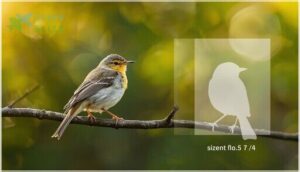
When you’re out there scanning the canopy for warblers, size and shape reveal the first clues. Visual observation starts with body proportions—most warblers clock in around five inches, smaller than a robin but larger than a kinglet. Look for these physical characteristics:
A slim, tapered profile with a noticeably thin bill signals that you’re watching an insect-eater—something you can encourage by setting up a backyard water source that attracts warblers during migration.
- Compact, rounded head with a fine beak
- Wingspans roughly twice their body length
- Short to medium tail shapes
- Delicate silhouette analysis compared to chunkier vireos
- Slim build weighing under 10 grams
For deeper tips on telling warbler species apart, check out this guide to . These warbler identification basics separate species fast.
Plumage Colors and Patterns
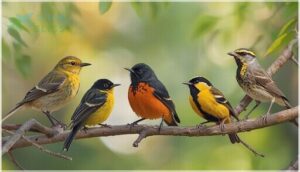
Once you’ve sized up the bird, plumage patterns become your roadmap. Color combinations separate species fast—many warblers pair yellow and black, often with splashes of red or blue. Breast streaks, wing bars, and undertail patches follow distinct feather tracts that vary wildly across species. Males usually flash brighter hues than females, especially during breeding season when molting cycles refresh their wardrobes. Examining features from below is essential, as illustrated by .
Tools like Merlin Bird ID can help confirm tricky identifications by cross-referencing plumage details with your location and date.
| Feature | Breeding Male | Female/Nonbreeding |
|---|---|---|
| Yellow Warbler | Vibrant yellow, red breast streaks | Pale yellow, faint streaks |
| American Redstart | Black body, orange tail patches | Gray-olive, yellow tail spots |
| Blackpoll Warbler | Bold black cap, white cheeks | Greenish, streaky body |
| Magnolia Warbler | Yellow underparts, black necklace | Duller yellow, gray necklace |
| Myrtle Warbler | Yellow rump, black bib | Brownish streaks, yellow rump |
Species dichromatism and plumage variation complicate warbler identification—but that’s what makes visual observation so rewarding.
Head Markings and Eye Stripes
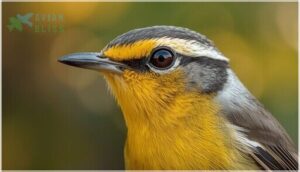
After you’ve noted overall plumage details, shift your focus to the face—head markings often clinch the ID. Check for an eyering first: a bold ring narrows your warbler species list fast.
After noting plumage, check the face—a bold eyering often clinches the warbler ID fast
Then scan for a supercilium (that contrasting eyebrow stripe above the eye) and a dark eyeline running through it. Some warblers flash bright “spectacles,” while others show faint facial patterns that vanish in shadows.
Wing Bars, Tail Spots, and Bill Shape
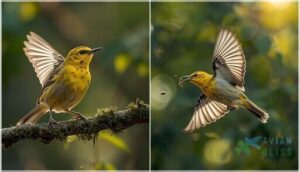
Wing bar patterns tell you a lot—look for pale tips on the wing coverts forming one or two bands. Some warblers, like Blue-winged, show bold white bars; others have faint or no bars at all.
Don’t skip tail spots either: check for white patches at the tail corners when the bird fans or flies.
Distinguishing Warblers From Similar Birds
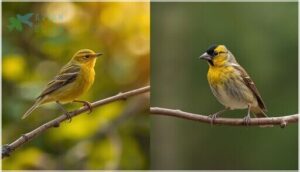
You’re not alone if you’ve mistaken a warbler for something else in the field. Several small, active birds share similar size, color patterns, or behavior with warblers, making quick identification tricky.
Here’s how to separate warblers from their most common lookalikes.
Differences Between Warblers and Vireos
You’ll often find warblers and vireos sharing the same trees, but their differences break the code wide open. Bill structure tells the story first—warblers sport slender, needle-sharp bills for precision foraging, while vireos carry thicker, blunter bills with a subtle hook.
A solid pair of birdwatching binoculars helps you catch these bill details from a comfortable distance—especially the vireo’s distinctive hook.
Plumage patterns reveal even more: warblers flash bold yellows and high-contrast streaking, whereas vireos wear subdued grays and olives that barely catch the light.
Warblers Vs. Kinglets and Goldfinches
Mistaking warblers for kinglets or goldfinches happens constantly in the field, but body proportions reveal species differentiation fast. Kinglets barely reach four inches—smaller and stubbier than most warbler species—while goldfinches sport thicker necks and conical beaks built for seeds, not insects.
- Beak structure: Warblers carry slender, pointed bills for gleaning; goldfinches wield triangular seed-crackers
- Feather patterns: Kinglets flash concealed crown patches; warblers show intricate facial stripes and tail spots
- Behavior: Kinglets constantly flick wings while foraging—warblers move more deliberately through branches
- Auditory recognition: Kinglet calls pierce the air with thin, high-frequency notes; warbler songs deliver clearer, musical phrases
Notable Features Unique to Warblers
Warbler identification hinges on field marks you won’t find together in lookalike species. Their notched, thin beak shapes—designed for insect gleaning—contrast sharply with seed-eaters’ bills.
Eye rings frame distinctive facial patterns, while tail feathers often carry diagnostic white or yellow spots. Leg colors range from pale pink to dark gray, and feather patterns create unique signatures across warbler species that separate them from vireos or sparrows.
Recognizing Warbler Songs and Calls

Learning warbler songs is like cracking a secret code—once you recognize the patterns, identification becomes far easier. Many warblers look frustratingly similar, but their voices give them away instantly.
Here’s what you need to know about using sound to identify these quick-moving birds.
Importance of Vocalizations in Identification
You’ll often hear warblers before you see them—sometimes that’s your only chance at identification. Vocalization patterns are essential bird identification techniques because many species hide in dense foliage.
Song structure and acoustic cues let you distinguish similar species without visual confirmation. Audio identification opens up a whole new dimension of warbler identification, dramatically boosting your detection rates during breeding season and migration when these restless birds stay concealed.
Common Warbler Songs and Calls
Learning a few signature songs unlocks warbler identification like no field mark can. Start with these distinctive vocal patterns that’ll get you 80% of the way there:
- Yellow Warbler sings “Sweet, sweet, sweet, I’m so sweet”—six to ten clear, whistled notes you can easily mimic yourself.
- Chestnut-sided Warbler delivers “Pleased, pleased, pleased to meet-MEET-cha,” with those last two syllables punched louder.
- Common Yellowthroat repeats “wichity-wichity-wichity” from marshy cover where visual confirmation is nearly impossible.
These melodic structures provide auditory cues that work when the bird won’t cooperate visually.
Using Audio Tools for Warbler ID
Your smartphone can transform tough warbler IDs into confident identifications. Merlin Bird ID‘s Sound ID feature analyzes live or recorded audio and proposes matches with spectrograms—visual representations showing frequency patterns over time—so you can compare your recording against reference files. The Warbler Guide app goes further, filtering species by song structure like trills and buzzes.
| Tool | Best Use Case |
|---|---|
| Merlin Bird ID | Real-time identification with spectrograms |
| Warbler Guide App | Filtering by song structure patterns |
| eBird Mobile | Documenting finds with audio recordings |
| Spectrogram Apps | Visual analysis of frequency and pitch |
| Audio Field Guides | Learning species-specific vocalizations |
Get close without disturbing the bird, record 30+ seconds capturing multiple repetitions, then verify app suggestions against range maps and habitat data—automated detection isn’t foolproof, especially with similar-sounding species. Think of these tools as field assistants, not replacements for your ears and experience in birdwatching warbler species.
Understanding Warbler Habitat Preferences

Where you find a warbler tells you almost as much as what it looks like. Different species stake out specific habitats—from towering conifers to soggy wetlands—and knowing these preferences helps you narrow down your ID fast.
Let’s break down the key habitat patterns you’ll encounter in the field.
Typical Habitats for Different Warbler Species
Each warbler species has carved out its own ecological niche, from dense forest canopies to low shrubby thickets, and recognizing these preferences can cut your identification time in half. Think of habitat awareness as your secret weapon—it narrows the field before you even raise your binoculars.
- Forest ecosystems shelter Black-throated Green and Blackburnian Warblers high in coniferous branches
- Wetland habitats attract Prothonotary and Yellow Warblers near water edges and marshes
- Coastal areas host Prairie Warblers in scrubby undergrowth during breeding grounds season
Seasonal Migration Patterns
Timing is critical for warblers—miss their narrow migration windows in spring and fall, and you might wait months for another chance. Most warblers follow established flyway patterns through North America, with peak spring migration hitting mid-April through May and fall movement stretching from August into October.
Track these seasonal migration patterns, and you’ll catch dozens of species at habitat stopovers along their migration routes.
Habitat Clues for Accurate Identification
Where you find a warbler matters as much as when. Forest types tell you what to expect: Blackpolls stick to wet spruce bogs, while Blue-winged Warblers hunt early successional shrubland with patchy saplings.
Check vertical stratification too—Hooded Warblers forage low in dense understory, but Blackburnians work the high canopy.
Riparian zones during migration concentrate multiple species in narrow corridors, making streamside thickets your best bet for diversity.
Behavioral Clues for Identifying Warblers

You can’t rely on color alone when a warbler’s darting through the canopy at lightning speed. That’s where behavior becomes your secret weapon—how a bird moves, feeds, and interacts tells you just as much as its plumage.
Let’s break down the behavioral clues that’ll help you nail your warbler IDs in the field.
Foraging and Movement Styles
How a warbler hunts tells you who it is. Watch for these foraging techniques: some species hang upside down like acrobats on palm fronds, while others creep along bark like miniature nuthatches. During migration patterns, you’ll spot behavioral patterns shift—warblers refuel faster in warm weather, hunting with laser focus in productive habitat selection zones that field guides highlight for birdwatching success.
- Hooded Warblers flash white tail feathers while foraging low in shady understory, creating conspicuous movement
- Blackburnian Warblers glean insects from upper canopy using short flights between stationary feeding sessions
- Mixed flocking strategies let warblers coordinate group movement while maintaining species-specific feeding behaviors and microhabitat preferences
Social Interactions and Feeding Habits
Competition shapes warbler society—from territorial disputes over prime feeding spots to the fleeting alliances formed when mixed flocks sweep through forests like hunting parties. During migration, feeding frenzies emerge, causing dramatic shifts in avian behavior. Social learning occurs as inexperienced warblers shadow veterans to productive patches. Field guides rarely capture these behavioral patterns, but birdwatching reveals how foraging strategies evolve through observation.
| Flocking Behavior | Feeding Strategy |
|---|---|
| Solitary hunters | Ground gleaning |
| Mixed-species groups | Canopy hawking |
| Loose aggregations | Bark probing |
| Territorial defenders | Hover-gleaning |
| Migration assemblies | Sallying flights |
Why Warblers Are Difficult to Photograph
Wildlife photography meets its match with these birds—rapid movement and erratic behavior demand fast shutter speeds of 1/3200 second or higher, even in the low light of forest canopies. Their small size makes focusing tough when they dart through branches.
Birdwatching patience helps, but warbler identification through a camera lens requires split-second timing that tests even experienced nature photography enthusiasts.
Overcoming Common Identification Challenges

Warbler identification isn’t always straightforward, even when you’ve studied field marks and behaviors. You’ll encounter frustrating moments when birds look nearly identical, move too fast to pin down, or show plumage that doesn’t match your field guide.
Let’s tackle the three biggest hurdles that trip up birders and how to work through them.
Similar-Looking Species and Lookalikes
You’ll run into Warbler Mimics all the time—vireos with their thicker bills, kinglets that won’t stop flicking their wings, and even drab goldfinches. These Bird Confusion traps happen because Species Overlap creates real Identification Pitfalls.
Orange-crowned and Tennessee Warblers form classic Lookalike Complexes that challenge even experienced birders. Your Field Guides help, but Species Classification demands patience when Warbler Identification meets these visual puzzles.
Plumage Variations Between Sexes and Ages
Ever notice how a male Yellow Warbler flashes bold red streaks, while females stay subtle? Sexual Dimorphism is your first clue. Age-Related Plumage throws another curve—juveniles sport duller tones, often missing key marks.
Molting Patterns, Geographic Variation, and Ecological Influences all shape Warbler Species Diversity. Your Field Guides and sharp eyes keep Species Classification honest through these shifting identification puzzles.
Dealing With Rapid Movements
Warblers dart through branches with fast wingbeats that test your tracking skills. Scan for motion first—don’t focus yet. Once you spot movement, lock your eyes on the bird before lifting binoculars; looking down means you’ll lose it.
Use 8x magnification for a wider view in cluttered woods. Quick identification relies on catching posture and tail pumps during those fleeting seconds of contact.
Essential Tools and Tips for Warbler Identification

You don’t need expensive equipment to start identifying warblers—just a few practical tools and the right approach. The gear you choose can make the difference between a fleeting glimpse and a confident ID.
Here’s what you’ll want to have ready before you head out into the field.
Choosing Binoculars and Field Guides
You’ll want binoculars in the 8×42 range—that sweet spot delivers optical quality without the hand-shake of higher magnification.
For birdwatching, a field guide customized to North America paired with Merlin Bird ID transforms warbler identification from guesswork into discovery. Look for guidebook formats with detailed range maps and multiple images per species.
These birding accessories become your liberation toolkit, turning fleeting glimpses into confident identifications worth celebrating.
Note-Taking and Photography for ID
Once you’ve got your binoculars ready, capturing what you see through field notes and photos locks in those diagnostic details. Document plumage patterns, behavior, and habitat in real time—memory fades fast with warblers.
- Snap multiple angles and upload to eBird or Merlin Bird ID with accurate photo metadata for digital identification
- Sketch eye rings and wing bars while the bird’s visible; even rough drawings beat memory
- Record camera settings and bird documentation notes—date, location, weather—for later verification
Birdwatching Best Practices for Beginners
Building strong observation skills and birding ethics from day one shapes your entire warbler-watching journey. Start close to home—backyards and local parks let you practice frequently without travel barriers. Early morning around sunrise delivers peak activity, and habitat edges where forest meets meadow concentrate diverse species.
| Birding Best Practices | Why It Matters |
|---|---|
| Stay on trails | Protects habitat and nesting sites |
| Limit playback use | Reduces stress on birds |
| Pack water and sun protection | Ensures birding safety during outings |
| Keep field guide tips handy | Speeds up warbler identification |
| Join local birding groups | Builds beginner equipment knowledge fast |
Frequently Asked Questions (FAQs)
What time of day are warblers most active?
Your best window is early morning—roughly two hours after dawn—when peak foraging aligns with insect activity.
Dawn chorus and warbler migration patterns make this prime time for spotting active, vocal birds before the afternoon lull.
How do weather conditions affect warbler identification?
Weather impacts warbler identification considerably. Fog effects reduce visibility, and light conditions obscure plumage details. Wind impact disrupts song clarity, and rainfall patterns shift migration timing—atmospheric pressure also influences when warblers appear.
Can warblers be identified by their flight patterns?
You might spot a Palm Warbler by its distinctive tail pumping during short flights, but most warblers share similar wingbeat styles—making flight calls identification and aerial foraging behavior more reliable than flight pattern analysis alone.
What role does geography play in warbler identification?
Geography shapes where warblers breed, winter, and migrate across North America. Latitude, elevation, and habitat diversity create distinct regional populations with specific ranges, migration routes, and seasonal timing—essential filters for accurate warbler identification in the field.
How long does warbler migration typically last?
Like waves rolling ashore over weeks, warbler migration stretches across eight to nine weeks each spring—from early April through late May in eastern regions—with individual species peaking for just two to three intense weeks.
Conclusion
Every warbler you’ll ever chase will vanish before you’re ready—that’s the thrill. But now you know what to look for when identifying warblers: head stripes caught in half-light, wing bars flashing through foliage, the tail-flick that separates a yellowthroat from a vireo.
These split-second clues stack into certainty. Your binoculars won’t slow them down, but your trained eye will finally keep pace. The next yellow blur won’t escape unnamed.