This site is supported by our readers. We may earn a commission, at no cost to you, if you purchase through links.
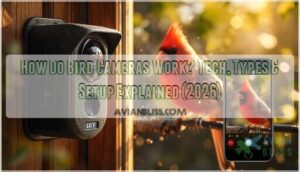
You mount a bird camera outside your window, and within hours, a cardinal lands for breakfast. The camera lens locks onto movement, the sensor captures the shot, and your phone buzzes with a notification—complete with a sharp photo and the bird’s species name.
That’s the core loop of how bird cameras work: motion triggers recording, the device processes what it sees, then sends the footage straight to you. These compact units pack a surprising amount of tech into weatherproof housing. They combine optical sensors, Wi-Fi chips, and AI recognition software to turn your backyard into a live wildlife studio you can monitor from anywhere.
Table Of Contents
Key Takeaways
- Bird cameras combine motion-triggered PIR sensors, AI recognition software, and weatherproof housing to automatically detect, record, and identify species without disturbing natural behavior—turning your backyard into a hands-free wildlife monitoring station.
- These devices offer dual storage options: local SD cards (up to 512 GB) work offline and avoid subscription fees, while cloud storage enables remote access and encrypted backups, though it requires ongoing payments and reliable Wi-Fi.
- Infrared night vision models using 850nm or invisible 940nm wavelengths let you capture nocturnal visitors in complete darkness up to 25 meters away, automatically switching from color daytime footage to black-and-white recordings without spooking birds.
- Strategic placement matters more than expensive gear—mount your camera 3-5 feet high near habitat edges with a clear 6-10 foot flight path, avoid direct sun glare, and position lenses to capture both feeding ports and perches simultaneously.
What is a Bird Camera?
A bird camera is a specialized device that lets you watch and record birds without being physically present. It combines a wildlife feeder or mounting platform with built-in video technology designed for outdoor conditions.
Here’s what makes up a bird camera and how people actually use them.
Some cameras even include audio recording, which helps you capture the distinct songs and calls of yellow birds in North Carolina and other species for easier identification later.
Definition and Purpose
A bird camera is a compact recording device designed to capture still images and video footage of birds as they visit feeders, baths, or natural perches in your yard.
These cameras are especially useful for monitoring bird behavior and health, which can help you spot injuries early and apply proper bird injury home treatment techniques when needed.
Recent innovations have seen rapid growth in the IoT bird feeder camera market technologies used by bird enthusiasts and researchers alike. These smart bird feeders blend camera technology with feeder design, letting you study bird behavior and enjoy wildlife observation without disturbing your feathered visitors.
Key Components and Design
Inside every bird camera, you’ll find a lens, an image sensor, a motion detector, and a housing built to survive rain, snow, and sun. Modern models also leverage IP technology innovations to provide features like live streaming and high-definition video.
Many installations pair these cameras with a ceramic bird bath for garden setups, capturing close-up footage as birds safely drink and bathe on textured, slip-resistant surfaces.
The camera lens captures sharp details, while sensor technology processes each frame. WiFi connects your smart bird feeder cam to your phone, and weatherproof housing materials protect the electronics.
Mounting systems let you secure the feeder wherever birds gather.
Common Uses in Bird Watching
Once you have that camera-equipped feeder in place, its real power unfolds. You can track bird diversity in your yard, identify over 1,000 species with AI-enabled models, and monitor wildlife behavior around the clock.
If you’re also feeding doves properly, position feeders low to the ground where these birds naturally forage.
Live streaming lets you watch feeding patterns unfold in real time, while species tracking builds a time-stamped record of who visits when—turning casual bird watching into systematic wildlife observation.
How Do Bird Cameras Capture Footage?
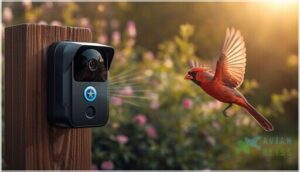
Bird cameras don’t just sit there waiting—they’re built to react the moment something moves. The real magic happens through sensors that detect activity and trigger the recording process, whether it’s noon or midnight.
Here’s how these devices capture your backyard visitors in action.
Motion Detection Technology
When you set up a bird camera for wildlife observation, motion detection acts as its wakeful eye. Most models rely on PIR sensors that detect heat signatures from warm bodies within 10 to 20 meters, though small birds can be trickier to catch than larger animals.
Modern cameras pair these motion sensors with AI filtering and object recognition, using motion algorithms that distinguish feathered visitors from swaying branches. Trigger latency—the delay between detection and capture—has dropped dramatically, with some cameras now recording continuously for live streaming, ensuring you won’t miss that split-second landing.
When you do catch a glimpse, knowing how to tell different sparrow species apart means you can identify your visitor before it flies off again.
Daytime and Nighttime Recording
Light levels shift from dawn to dusk, and your bird camera adjusts its recording strategy to match each phase of the day. In bright conditions, CMOS sensors capture high-definition daytime clarity with vivid feather details. As shadows lengthen, infrared technology kicks in, switching to night vision modes that light up the feeder without disturbing nocturnal visitors.
Night vision transforms how you observe after hours:
- Invisible infrared LEDs let you watch owls and nightjars without spooking them
- Low light recording captures dusk feeders in that magical golden hour
- Motion triggering ensures you don’t miss dawn’s early arrivals
Types of Bird Cameras and Their Features
Bird cameras come in several distinct forms, each built to handle specific conditions and capture different types of footage. Your choice depends on when you want to record, where you’ll place the feeder, and what kind of weather it needs to withstand.
Here’s a breakdown of the main types and what sets them apart.
Smart Bird Feeders With Cameras
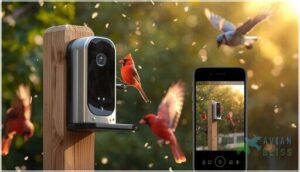
Smart bird feeders turn your backyard into a live nature documentary, blending traditional feeding with high-definition cameras and Wi-Fi so you can watch, photograph, and identify birds without leaving your couch.
These smart feeders combine thoughtful feeder design with motion detection and real-time streaming. You’ll get notifications when birds arrive, capture stunning image quality even from a distance, and track bird behavior patterns that support wildlife conservation efforts.
Infrared and Night Vision Models
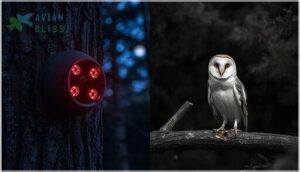
You’ll find bird cameras using infrared illumination at 850nm or invisible 940nm wavelengths to record in complete darkness without spooking birds. These IR sensors switch automatically from daytime color to nighttime black-and-white footage, capturing clear images in low light up to 25 meters away.
No glow cameras with 940nm infrared LEDs eliminate even the faint red glow, making continuous wildlife observation methods genuinely covert for outdoor cameras monitoring nocturnal visitors.
Weatherproof and Outdoor-Ready Designs
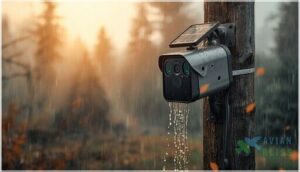
You need a bird camera built to withstand rain, snow, and sun without breaking down. Look for IP65 or IP66 ingress protection ratings that guarantee water resistance and dust-tight seals, protecting outdoor cameras from heavy downpours.
Outdoor materials like UV-stabilized polycarbonate resist sun damage while stainless steel mounting hardware prevents corrosion. Many weatherproof outdoor camera systems now integrate solar power, eliminating battery changes in harsh outdoor surveillance systems.
How Bird Cameras Transmit and Store Data
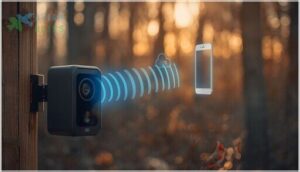
Once your bird camera captures footage, it needs a way to get that data to you and store it safely.
Different models handle this differently, with some relying on Wi-Fi while others save everything locally. Understanding your options helps you pick a setup that matches your needs and tech comfort level.
Wi-Fi Connectivity and Live Streaming
Wi-Fi Connectivity transforms your bird camera into a real-time observation tool. Most models use 2.4 GHz networks for maximum Wi-Fi Range, streaming footage directly to your Mobile App wherever you’re.
- Live Streaming quality usually ranges from 720p to 4K, depending on Camera Resolution and Signal Strength
- Wireless Connectivity lets you watch the Live Feed from your phone, even on vacation
- Network Security matters—protect your camera with a strong router password
- Signal Strength affects performance; place your router closer or add an extender if buffering occurs
- Dual-band cameras (2.4 GHz and 5 GHz) reduce lag in crowded Wi-Fi environments
Local Storage Vs. Cloud Storage
Your storage options shape how you access and protect bird footage. Local backup via SD cards (up to 512 GB on many smart bird feeders) keeps recordings safe even when Wi-Fi fails, giving you offline access without cloud costs. Cloud storage offers remote viewing and data security through encryption, but subscriptions add up—Birdfy’s free plan holds clips for 30 days.
Wildlife monitoring systems often blend both for resilience.
| Feature | Local Storage (SD Card) | Cloud Storage |
|---|---|---|
| Cost | One-time purchase, no fees | Monthly or annual subscription |
| Access | Requires physical card or local network | Remote viewing from anywhere with internet |
| Reliability | Works during Wi-Fi outages | Depends on connectivity and bandwidth |
| Security | Vulnerable to theft or damage on-site | Encrypted off-site backup protects footage |
Mobile App Integration and Notifications
Once your footage sits safe on a card or server, the real magic happens when your phone buzzes with a notification that a scarlet tanager just landed at your feeder.
Apps like Vico Home or Dzees Home send push updates the instant motion triggers recording, letting you tune camera settings and start remote viewing from anywhere. You control notifications, adjust alerts, and even link smart home automation—all without missing a single visit.
Power Sources and Installation Methods
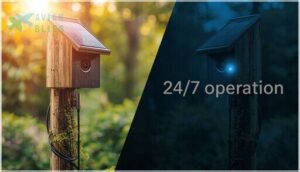
Your bird camera won’t work without power options, and where you put it makes all the difference in what you’ll capture.
Most models offer flexible power that let you set up almost anywhere, from a backyard tree to a remote trail. Here’s what you need to know about powering your camera and placing it where the birds actually want to be.
Battery-Powered and Solar Options
Most bird cameras run on rechargeable batteries or solar panels, giving you the freedom to mount them anywhere without hunting for an outlet. Solar charging keeps your wildlife camera running indefinitely in sunny spots, while battery life usually lasts weeks before needing a refresh.
- Solar panels on smart bird feeders harvest energy continuously, eliminating battery swaps
- Power efficiency varies—some bird feeders with camera gear sip energy, others drain fast
- Charging systems let you swap batteries or recharge via USB without disturbing your setup
Wired Vs. Wireless Setups
Choosing between wired and wireless setups shapes your entire bird observation experience. Wired systems rely on cable management and Power Delivery through Ethernet, offering enhanced Signal Strength and Interference Reduction—your footage stays crisp even during storms. Wireless bird cameras grant installation freedom but face Network Security risks and range limits.
Smart bird feeders and surveillance systems each demand different approaches.
| Feature | Wired (PoE) | Wireless (Wi-Fi) |
|---|---|---|
| Signal Strength | Stable, immune to congestion | Degrades beyond 15–20 meters |
| Power Delivery | Continuous via Ethernet cable | Battery or solar recharged |
| Interference Reduction | Minimal; physical connection | Vulnerable to radio noise |
| Network Security | Lower interception risk | Open to Wi-Fi threats |
| Cable Management | Requires routing, drilling | Minimal physical installation |
Placement for Optimal Bird Observation
Where you mount your camera matters just as much as the system you pick—a faultless wired setup won’t attract birds if it’s pointed at a brick wall. Strategic Feeder Location transforms casual Backyard Birding into genuine Wildlife Observation Methods.
- Position bird cameras 3–5 feet high near natural Bird Habitat edges
- Angle lenses to capture feeding ports and perches simultaneously
- Avoid direct sun glare that washes out plumage details
- Leave 6–10 feet of open flight path in your Garden Layout for approach shots
Troubleshooting and Maintaining Bird Cameras
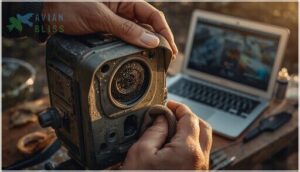
Your bird camera won’t stay sharp forever without a bit of regular care. Dust, dirt, and weather can mess with image quality, and connectivity hiccups can interrupt your live feed when you need it most.
Here’s how to keep your setup running smoothly and fix the most common problems.
Cleaning and Lens Care
A smudged lens turns your crisp 4K bird footage into a blurry mess, so keeping that glass clean isn’t optional—it’s essential. You’ll want to wipe the camera lens weekly with a microfiber cloth, avoiding harsh chemicals that damage coatings critical for high-definition nature photography.
| Lens Cleaning Tips | Camera Maintenance Action |
|---|---|
| Dust removal methods | Use compressed air before wiping |
| Water spot prevention | Dry lens immediately after rain |
| Focal length adjustment | Check clarity after each cleaning |
Your digital photography investment deserves this care.
Solving Connectivity Issues
When your camera keeps dropping offline, you’re fighting the invisible wall between technology and nature. Start by checking Wi-Fi signal strength—most smart bird feeders need at least −65 dBm for stable streaming.
Move your router closer or add an extender to punch through that barrier. Update firmware through your app, then dive into router settings to assign a static IP address. Disable dual-band steering if your camera only speaks 2.4 GHz, and switch to channels 1, 6, or 11 for network configuration that actually works.
Frequently Asked Questions (FAQs)
How does a bird camera work?
Wildlife monitoring happens when motion detection triggers your camera sensors to capture images.
Smart bird feeders use this bird tracking technology, recording through built-in cameras at various image resolutions for quality wildlife photography.
What triggers the bird buddy camera?
Forget manually pressing buttons—your Bird Buddy springs to life when laser detection and proximity activation sense movement near the perch, launching an AI-filtered recording session that motion sensors confirm as genuine bird watching technology in action.
How much does a typical bird camera cost?
Budget options for bird feeders with camera start around $50, while mid-tier smart bird feeders run $150 to $
Premium wildlife camera upgrades with night vision exceed $ Cost factors include subscription fees beyond initial price comparison.
Do bird cameras disturb or scare away birds?
Your gear can spook nervous nesters if you rush installation or flood their space with harsh light.
Thoughtful camera placement, infrared night vision, and installing well before nesting season minimize disturbance factors and encourage bird habituation.
What video quality should I expect from bird cameras?
Most modern bird cameras deliver 1080p High-Definition video, while premium models reach 4K.
Frame Rates usually hit 30fps.
Image Resolution depends on Camera Sensors and Pixel Density, affecting Night Vision clarity in Digital Surveillance setups.
Are bird cameras legal in all locations and settings?
Yes, bird cameras are legal in most public spaces and private property you own. However, privacy laws, surveillance ethics, and wildlife regulations vary by location.
Check local camera ordinances and home security rules before installing outdoor security devices for wildlife conservation.
Conclusion
The next time a chickadee taps your feeder, you’ll know exactly what happens behind the lens—motion sensors wake, the chip processes pixels, and footage lands in your pocket. Understanding how bird cameras work gives you control over every angle, notification, and recording.
You’re not just watching birds anymore. You’re documenting flight patterns, tracking migrations, building a visual archive that spans seasons. Set your camera, dial in the settings, and let the technology do what it does best: capture moments you’d otherwise miss.
- https://www.birdfy.com/blogs/blogs/a-detailed-guide-on-a-smart-bird-feeder-with-camera-2-4ghz-wi-fi
- https://www.gearcheckers.com/en/trail-cameras/how-does-trail-camera-work/
- https://green-backyard.com/blogs/how-to-record-your-bird-box-camera-footage/
- https://www.feathersnapcam.com/blog/post/how-smart-bird-feeder-cams-work
- https://gardepro.com/blogs/gardepro-blogs/trail-camera-pir-sensor-guide