This site is supported by our readers. We may earn a commission, at no cost to you, if you purchase through links.
A chickadee weighs about as much as five paper clips, yet it survives nights that drop well below freezing—without a coat, a nest, or a warm meal waiting for it. It copes with this by shivering almost continuously through the dark hours, burning through fat reserves at a rate that would exhaust its body by morning if it hadn’t fed well the day before.
When snow buries seeds and ice locks the ground solid, a backyard feeder stops being a nice gesture and starts being a lifeline.
Knowing which bird food for winter actually delivers the calories birds need makes the difference between a yard full of life and an empty one.
Table Of Contents
- Key Takeaways
- Why Birds Need Winter Fuel
- Best High-Energy Winter Foods
- Top 10 Winter Bird Food Products
- 1. Wagners Farmers Delight Cherry Bird Food
- 2. Kaytee Nut Fruit Wild Bird Seed
- 3. Kaytee No Mess Seed Suet Mix
- 4. Wagners Cardinal Blend Wild Bird Food
- 5. Wagner Deluxe Treat Wild Bird Food
- 6. Kaytee Wild Bird Ultimate No Mess Seed
- 7. Wagner Farmers Delight Wild Bird Food Cherry
- 8. Wagners Eastern Regional Wild Bird Seed
- 9. Kaytee All American Wild Bird Seed Blend
- 10. Pennington Songbird Nut Fruit Seed
- Match Food to Bird Species
- Storage, Feeders, and Placement
- Frequently Asked Questions (FAQs)
- What food can I leave out for birds in winter?
- When should you stop feeding birds for the winter?
- What not to feed birds in winter?
- How to keep birds warm in winter outside naturally?
- How often should I refill feeders in winter?
- Can birds survive without feeders during winter storms?
- What time of day do birds feed most?
- Do bird feeders attract unwanted pests or predators?
- When should I start winter bird feeding efforts?
- Can bird feeding harm wild foraging instincts?
- Conclusion
Key Takeaways
- Black-oil sunflower seeds and suet are your best winter picks because their high fat content helps birds burn the extra calories they need just to stay warm overnight.
- When snow covers the ground, backyard feeders shift from a nice extra to a real lifeline, so stocking up before the first freeze matters more than most people realize.
- Matching food to species makes your feeder work harder — finches want Nyjer in tube feeders, woodpeckers need suet cages, and ground birds like juncos do best with millet scattered low.
- Fresh water, dry seed storage, and squirrel-resistant placement are just as important as the food itself, since spoiled seed or frozen water can undo all your feeding effort fast.
Why Birds Need Winter Fuel
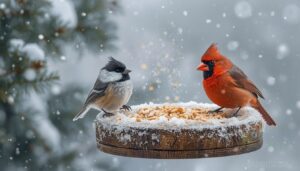
Winter is genuinely tough on birds — their bodies burn through calories fast, just to stay warm. When snow covers the ground, natural food sources disappear almost overnight.
Setting up a suet bird feeder for winter gives birds a high-fat energy source exactly when they need it most.
Here’s what’s actually happening, and why what you put in your feeder matters more than you might think.
Cold-weather Energy Demands
When temperatures drop, birds aren’t just cold — they’re burning through energy at a serious rate. Wind chill effects strip heat fast, and shivering metabolism can spike caloric needs up to five times normal. That’s a lot to ask of a small body.
In winter, birds don’t just feel the cold — they burn up to five times their normal calories just to survive it
Here’s what’s happening out there:
- Fat storage utilization kicks in overnight to survive freezing temps
- Feather insulation efficiency drops without proper nutrition
- Energy caching behavior drives birds to seek nutrient-rich seeds daily
- High-fat seed options for cold weather become critical survival resources
Winter feeding strategies for backyard birds hinge on one thing: energy-dense foods, consistently available.
Thermoregulation and Body Heat
Birds are basically tiny furnaces. Their bodies rely on shivering thermogenesis — rapid muscle movement — to stay warm, while brown fat utilization generates heat without any visible shaking.
Vasoconstriction benefits the core by redirecting blood away from cold extremities.
Feather insulation mechanics trap warm air close to the skin, and metabolic rate adjustments keep avian thermoregulation running.
High-fat, high-protein, energy-dense foods replenish fat reserves fast.
Natural Food Shortages in Snow
Snow doesn’t just look harsh — it cuts birds off from nearly everything they’d normally eat. Ground Forage Blockage hides seeds under inches of ice and slush. Invertebrate Freeze Out stops earthworms cold.
Berry Crop Loss and Snow-Covered Seed Access shrink fast. Reduced Plant Growth means less bud and shoot nutrition too.
- Buried ground seeds become unreachable
- Frozen soil locks away worms and grubs
- Snow-smothered berries vanish from shrubs
- Ice crusts block understory plants completely
- Prolonged storms stretch food gaps for days
Why High-fat Foods Matter
Fat is where the real power is. When natural food disappears under snow and ice, birds need energy dense foods that deliver fast.
High-fat, high-protein seeds improve metabolic efficiency and support vitamin absorption. They fuel cold night survival, territory defense, and even migration readiness.
Seed fat content and high-oil seed benefits make cold climate feeding the difference between a bird that thrives and one that doesn’t.
Best High-Energy Winter Foods
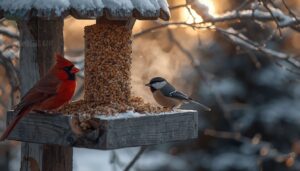
Not all bird food pulls equal weight in winter. The right picks are calorie-dense, easy to find, and genuinely useful across a wide range of backyard species.
Here are seven foods worth keeping stocked from November through March.
Black-oil Sunflower Seeds
Black oil sunflower seed is the workhorse of winter bird feeding — and for good reason. Its oil content hits 40–50%, with a fatty acid profile rich in linoleic acid that fuels bird metabolism through freezing nights.
The compact kernel size suits dozens of species, and its energy density delivers roughly 600–650 kcal per 100g. The higher oil content benefits provide extra calories for birds.
- Fills any standard bird feeder — tube, hopper, or tray
- Attracts cardinals, chickadees, nuthatches, and sparrows
- High-fat, high-protein kernel aids thermoregulation
- Energy-dense foods reduce how often birds must forage
- Harvest timing affects freshness — buy from high-turnover stores
Hulled Sunflower Hearts
Hulled sunflower hearts are simply black-oil sunflower seeds with the shell already removed — less work for birds, less mess for you.
Their high-fat, high-protein profile, plus vitamin E benefits, make them a cold weather stability standout in winter feeding strategies for backyard birds.
Low moisture content keeps them fresh longer.
portable portion packs for cost efficiency and easy refills at your bird feeder.
Safflower Seeds for Winter
Safflower seeds are one of the most energy dense seeds you can offer in winter. Their high-fat, high-protein content makes them genuinely nutrient rich seeds for cardinals, chickadees, and grosbeaks.
Cold-resistant seeds by nature, safflower holds up well in freezers and feeders alike. Squirrels tend to skip them, too — which, honestly, is half the appeal. Easy handling and shell-free kernels round out their value in any winter feeding strategy for backyard birds.
Nyjer Seed for Finches
Nyjer is one of the smallest seeds you’ll offer, but don’t let that fool you. Its nutrient profile is surprisingly dense, packing high-calorie oil content that keeps finches fueled through bitter cold.
- Goldfinches and siskins flock to it reliably.
- Seed size suits narrow finch beaks perfectly.
- Finch preference stays consistent across winter feeding strategies for backyard birds.
- Seasonal availability means stocking up early helps.
Use tube feeders with small ports, and prioritize feeder cleaning weekly to prevent mold. You can mix Nyjer into seed blends for broader appeal.
Unshelled Peanuts and Peanut Pieces
Peanuts punch well above their weight in winter bird feeding. The kernel fat content alone — roughly 14 grams per ounce — makes them one of the most nutritionally dense options you can offer. That high‑fat, high‑protein profile helps thermoregulation on the coldest nights.
Offer unsalted peanut pieces in moderate portions, follow portion size guidelines to limit spoilage, and use squirrelproof seed feeders.
Shells? Toss them in hull compost. Always observe allergen precautions around sensitive pets.
Suet Cakes and Suet Blends
Suet might be the single best cold-weather food you can offer. Pure rendered beef fat delivers a fat-to-protein ratio that fuels birds through freezing nights — some high-energy blends hit 70% fat.
Look for melt-resistant formulas in cold snaps, avoid corn syrup or palm oil, and practice basic suet feeder hygiene by swapping cakes weekly.
Seasonal flavor rotation keeps more species coming back.
Dried Fruit and Mealworms
Beyond suet, dried fruit and mealworms round out a complete seasonal feeding strategy. Think of them as the finishing layer — quick sugars meet concentrated protein.
- Dried fruit delivers antioxidant benefits and fiber support for gut health.
- Mealworms offer mineral enrichment plus roughly 50% protein by dry weight.
- Palatability cues from texture variety attract insectivores like bluebirds and wrens.
- Together they create high-calorie, nutrient-rich wild bird food that winter birds actively seek.
Top 10 Winter Bird Food Products
Not all winter bird foods are created equal, and the right product can make a real difference in how many birds show up at your feeder. Each pick below was chosen for fat content, seed variety, and which species it attracts best.
Here are ten solid options worth keeping on your radar this winter.
1. Wagners Farmers Delight Cherry Bird Food
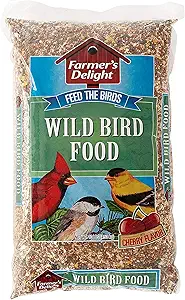
Wagner’s Farmers Delight Cherry Bird Food is a solid all-rounder for winter feeding. The mix combines millet, milo, cracked corn, and oil sunflower seed — exactly what ground feeders and hopper birds need when temperatures drop.
That added cherry flavoring oil draws in cardinals, finches, jays, and sparrows with surprising consistency.
At $12.48 for 10 lb, it’s genuinely cost-effective.
Just watch for moisture — a few buyers have spotted weevils, so transfer it to an airtight container right away.
| Best For | Backyard bird enthusiasts who want an affordable, versatile seed mix that attracts a wide variety of birds like cardinals, finches, and bluejays. |
|---|---|
| Net Weight | 10 lb |
| Price | $12.48 |
| Made in USA | Yes |
| Allergen-Free | Yes |
| Feeder Compatibility | Hopper, tube |
| Squirrel Attraction | Yes |
| Additional Features |
|
- Great value at $12.48 for 10 lb — a bag can last several weeks depending on how busy your feeders get
- The cherry flavoring draws in a solid range of birds, from ground feeders to hopper regulars
- Made in the USA and allergen-free, so it works across all bird life stages
- A few buyers have found weevils inside, so proper storage in an airtight container is a must
- The mix can attract squirrels, chipmunks, and raccoons if you’re not using a protected feeder
- Canadian shoppers have run into delivery delays, and occasional clumping means you may want to rotate with other seed varieties
2. Kaytee Nut Fruit Wild Bird Seed
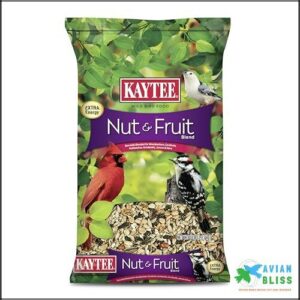
If you want a step up in bird diversity, Kaytee Nut Fruit Wild Bird Seed delivers. This 5 lb blend ($12.59) packs black oil sunflower, peanuts, dried cherries, and mixed nuts into one bag — hitting around 30% crude fat, which is exactly what winter birds need to stay warm.
Cardinals, chickadees, nuthatches, and woodpeckers all respond well to it.
Just store it sealed in a cool spot, since the fruit pieces can clump fast when humidity creeps in.
| Best For | Backyard birdwatchers who want to attract a wider variety of species and don’t mind paying a little more for a premium mix. |
|---|---|
| Net Weight | 5 lb |
| Price | $12.59 |
| Made in USA | Not stated |
| Allergen-Free | Yes |
| Feeder Compatibility | Standard feeders |
| Squirrel Attraction | Yes |
| Additional Features |
|
- Packed with high-calorie ingredients like peanuts, nuts, and dried fruit — great for keeping birds fueled, especially in colder months.
- Draws in a solid range of species including cardinals, woodpeckers, chickadees, and nuthatches.
- The mix of textures and flavors keeps birds coming back and sticking around longer at the feeder.
- At $12.59 for 5 lbs, it’s pricier than your average seed mix — costs add up if you’re refilling often.
- Squirrels and other unwanted critters tend to love it just as much as the birds do.
- The blend can shift between batches, so the ratio of peanuts to sunflower seeds isn’t always consistent.
3. Kaytee No Mess Seed Suet Mix
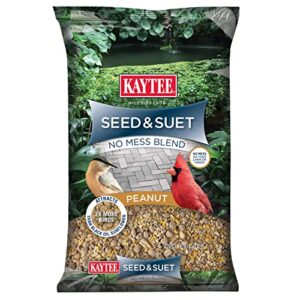
If you love the idea of one bag doing double duty, Kaytee No Mess Seed Suet Mix earns its spot.
It combines hulled sunflower, cracked corn, white millet, and ground peanuts with real rendered beef suet nuggets — all fully edible, no shells, no mess.
That suet component pushes crude fat to around 20–25%, giving woodpeckers, chickadees, and jays the cold-weather fuel they need.
tube, hopper, or platform feeders.
Just keep it sealed and cool between fills.
| Best For | Backyard bird watchers who want one no-fuss mix that attracts a wide variety of birds — especially woodpeckers — without the mess of hulls or separate suet feeders. |
|---|---|
| Net Weight | 10 lb |
| Price | $20.99 |
| Made in USA | Not stated |
| Allergen-Free | Yes |
| Feeder Compatibility | Tube, hopper, platform |
| Squirrel Attraction | Yes |
| Additional Features |
|
- No shells, no debris — keeps your lawn and feeder trays clean between refills
- Real beef suet nuggets add high-energy fat that woodpeckers, jays, and chickadees love in cold weather
- Works in tube, hopper, and platform feeders, so no special setup needed
- Corn and millet fillers make it feel less premium, especially at $2.10 per pound
- Some users find dust and grit in the mix that requires extra feeder cleaning
- The suet ratio is on the low side, which may not cut it for birds that want a higher-fat feed
4. Wagners Cardinal Blend Wild Bird Food
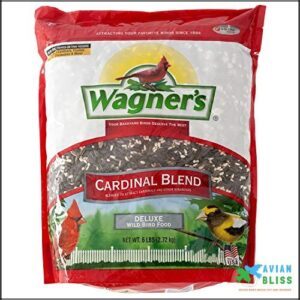
Cardinals are picky eaters — and this blend knows it.
Wagner’s Cardinal Blend packs 60% black-oil sunflower and 40% safflower into every 6‑lb bag, giving you a high‑fat mix that fuels winter birds without loading your feeder with filler.
Safflower also happens to bore most squirrels, so your cardinals, doves, and finches get first dibs.
The resealable press‑lok bag keeps seeds fresh between fills.
At $13.48, it costs a bit more, but the birds notice the difference.
| Best For | Backyard birders who want to attract cardinals, finches, and doves without dealing with squirrel raids or messy seed hulls. |
|---|---|
| Net Weight | 6 lb |
| Price | $13.48 |
| Made in USA | Not stated |
| Allergen-Free | Not stated |
| Feeder Compatibility | Standard feeders |
| Squirrel Attraction | Occasional |
| Additional Features |
|
- The 60/40 sunflower-safflower blend is exactly what cardinals and songbirds love, so you’ll actually see results at your feeder.
- High oil content means birds get real energy from every bite — especially useful during breeding season or cold snaps.
- The resealable press-lok bag keeps seeds fresh and makes storage easy without needing a separate container.
- At $13.48 for 6 lbs, it’s pricier than generic mixes, so it adds up fast if you’re refilling often.
- Safflower slows squirrels down, but it doesn’t stop them completely — some will still figure it out.
- Popular feeders can burn through a bag quickly, which means more frequent trips to the store.
5. Wagner Deluxe Treat Wild Bird Food
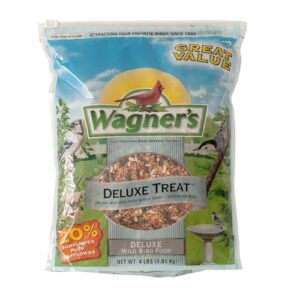
Think of this blend as a little something extra for your backyard crowd.
Wagner’s Deluxe Treat Blend mixes black-oil sunflower with safflower, pulling in cardinals, chickadees, nuthatches, jays, finches, and doves. It works in tube, hopper, and platform feeders, so you don’t need specialty equipment.
Seed waste stays low because birds actually eat most of it.
At $9.48 for 4 lb, it costs a bit more than basic mixes, but you’re feeding quality — and your birds will show up for it.
| Best For | Backyard bird watchers who want to attract a wide variety of songbirds with minimal seed waste and no feeder restrictions. |
|---|---|
| Net Weight | 4 lb |
| Price | $9.48 |
| Made in USA | Yes |
| Allergen-Free | Not stated |
| Feeder Compatibility | Tube, hopper, platform |
| Squirrel Attraction | Yes |
| Additional Features |
|
- Attracts a solid mix of birds — cardinals, chickadees, jays, finches, doves, and more
- Works with any feeder type, so no extra gear needed
- Low waste blend means most of what you pour out actually gets eaten
- At $9.48 for 4 lb, it’s pricier than your average seed mix
- Squirrels love it too, so a squirrel-proof feeder might become a necessity
- Sunflower fans take note — it’s a blend, so don’t expect sunflower to dominate
6. Kaytee Wild Bird Ultimate No Mess Seed
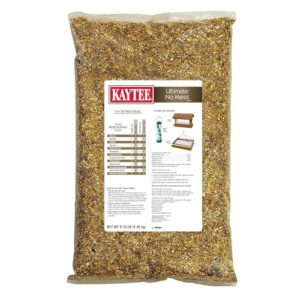
No shells, no mess, no wasted seed on the ground — that’s the whole idea behind Kaytee’s Premium No Mess blend.
It packs hulled sunflower, shelled peanuts, white millet, cracked corn, and canary grass seed into one 9.75 lb bag at $21.99. Calcium carbonate is added to support bone and beak health, which most mixes skip entirely.
Cardinals, chickadees, finches, and nuthatches all go for it.
Works in hopper, tube, and gazebo feeders without any specialty setup required.
| Best For | Backyard bird lovers who want to attract a wide variety of songbirds without dealing with shell mess on patios or garden beds. |
|---|---|
| Net Weight | 9.75 lb |
| Price | $21.99 |
| Made in USA | Not stated |
| Allergen-Free | Yes |
| Feeder Compatibility | Hopper, gazebo, tube |
| Squirrel Attraction | Yes |
| Additional Features |
|
- Zero shells means no hull pile-up under your feeder — your yard stays clean
- Higher peanut and sunflower heart content gives birds more energy per bite than most standard mixes
- Added calcium carbonate is a nice touch most blends skip, supporting overall bird health
- At $21.99 for 9.75 lbs, it runs pricier per pound than bulk seed options from farm co-ops
- Squirrels and larger birds like crows tend to muscle in and crowd out the smaller species you’re trying to attract
- Some buyers have found moths or insects in the bag, so it’s worth airing it out before storing
7. Wagner Farmers Delight Wild Bird Food Cherry
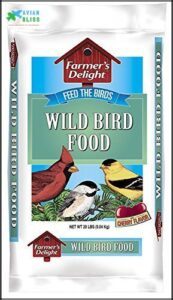
Wagner Farmers Delight Cherry Bird Food keeps things simple — and that’s not a bad thing. The 20 lb bag blends millet, milo, cracked corn, and sunflower seeds, then coats them with a cherry-scented oil to pull birds in from a distance.
Sparrows, finches, and ground feeders respond well to it. It works in hopper and tube feeders without any fuss.
The cherry flavoring is more aroma than flavor, but birds don’t seem to mind one bit.
| Best For | Backyard bird enthusiasts who feed regularly and want an affordable, versatile mix that draws in a wide variety of birds. |
|---|---|
| Net Weight | 20 lb |
| Price | Not listed |
| Made in USA | Yes |
| Allergen-Free | Yes |
| Feeder Compatibility | Hopper, tube |
| Squirrel Attraction | Yes |
| Additional Features |
|
- Attracts a solid range of birds — sparrows, finches, cardinals, and ground feeders all tend to show up
- Works in both hopper and tube feeders, so no need to buy special equipment
- Made in the USA with all-natural ingredients, safe for birds at every life stage
- Squirrels love it too, so a squirrel-proof feeder is basically a must
- The 20 lb bag is a lot if you feed occasionally or have a small yard — you’ll need storage space
- Bird interest can vary depending on your region or the season
8. Wagners Eastern Regional Wild Bird Seed
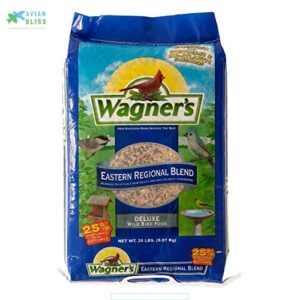
If your backyard gets cardinals, blue jays, chickadees, and finches, this blend was practically built for you. Wagner’s Eastern Regional Wild Bird Seed packs white millet, black oil sunflower, cracked corn, milo, striped sunflower, and safflower into one 20 lb bag — covering the dietary needs of most Eastern songbirds in a single scoop.
It works in tube, hopper, and platform feeders. Safflower keeps squirrels less interested, which is a quiet bonus you’ll appreciate by week two.
| Best For | Backyard birders in the Eastern U.S. who want to attract a wide variety of songbirds — especially cardinals, blue jays, chickadees, and finches — without juggling multiple seed types. |
|---|---|
| Net Weight | 20 lb |
| Price | $24.99 |
| Made in USA | Yes |
| Allergen-Free | Not stated |
| Feeder Compatibility | Tube, hopper, platform, ground |
| Squirrel Attraction | Yes |
| Additional Features |
|
- Six-seed blend covers the dietary preferences of most common Eastern songbirds in one bag
- Works with tube, hopper, platform, and ground-scatter feeders, so it’s flexible no matter your setup
- Safflower seed naturally deters squirrels, giving you a bit of built-in pest control
- At $24.99, it runs pricier than a lot of comparable bulk birdseed options
- The 20 lb bag is bulky — storage can get awkward if you’re short on space
- Stock availability is inconsistent, so you might hit a wait when you’re ready to reorder
9. Kaytee All American Wild Bird Seed Blend
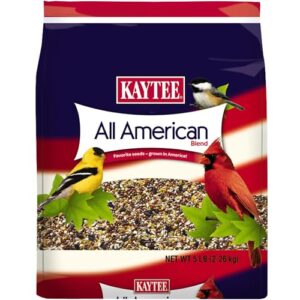
Kaytee’s All American Wild Bird Seed Blend keeps things simple — and that’s not a bad thing. It leads with black oil sunflower and millet, pulling in cardinals, finches, sparrows, chickadees, and blue jays without much fuss.
The 5 lb resealable bag stores easily and stays fresh longer than you’d expect.
It even adds calcium, Vitamin A, and D3, so you’re supporting bird health beyond just calories.
It won’t impress specialty species, but for everyday backyard feeders, it covers the basics reliably.
| Best For | Backyard bird enthusiasts who want a reliable, everyday seed blend that attracts a wide variety of common birds without overcomplicating things. |
|---|---|
| Net Weight | 5 lb |
| Price | Not listed |
| Made in USA | Yes |
| Allergen-Free | Yes |
| Feeder Compatibility | Hopper, tray, ground |
| Squirrel Attraction | Yes |
| Additional Features |
|
- Attracts a solid mix of popular backyard birds like cardinals, finches, and blue jays
- Added calcium, Vitamin A, and D3 means you’re doing more than just filling a feeder
- Works with hopper, tray, and ground feeders with minimal seed waste
- Contains filler seeds that specialty bird species tend to ignore
- Pricier than basic budget blends, so it adds up if you’re refilling often
- Sunflower seeds will likely bring squirrels to the party too
10. Pennington Songbird Nut Fruit Seed
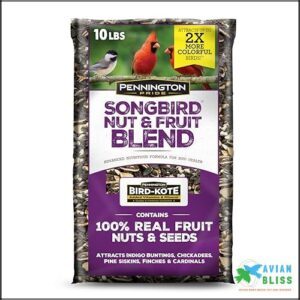
Pennington’s Songbird Nut Fruit Seed takes things up a notch. Where the Kaytee blend keeps it straightforward, this 10 lb mix layers in real fruit — raisins, dried cherries — alongside peanuts, safflower, and black oil sunflower.
That combination pulls in indigo buntings, cardinals, and chickadees with something closer to natural winter foraging.
Pennington’s Bird-Kote formula adds vitamins A and D-3 for bone and immune support.
At $19.97, it costs a bit more, but the bird activity you’ll see makes it worth it.
| Best For | Backyard bird enthusiasts who want to attract a wider variety of songbirds and don’t mind paying a little extra for a premium, nutrient-rich mix. |
|---|---|
| Net Weight | 10 lb |
| Price | $19.97 |
| Made in USA | Not stated |
| Allergen-Free | Not stated |
| Feeder Compatibility | Hopper, gazebo, tray |
| Squirrel Attraction | Yes |
| Additional Features |
|
- Real fruit (raisins, dried cherries) and peanuts make it more appealing to a broader range of songbirds like indigo buntings and cardinals
- Bird-Kote formula adds vitamins A and D-3, supporting bird health year-round
- Works in most common feeder types — hopper, gazebo, or tray
- About 75% of the mix is sunflower seeds, so the fruit and nut content is lighter than it sounds
- Pricier than basic bulk seed options at $19.97 for 10 lbs
- Squirrels love it too, so you may need a deterrent feeder to keep them out
Match Food to Bird Species
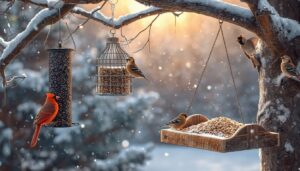
Different birds are picky eaters, and that’s actually good news for you. Once you know what each species likes, you can stock your feeders with purpose instead of guessing.
Here’s a quick breakdown of who eats what.
Cardinals, Jays, and Chickadees
Three bold personalities share your winter feeder — cardinals, Blue Jays, and chickadees — and they all run on high-calorie fuel. Black oil sunflower seed satisfies all three.
Cardinals claim territory through crest display and vocalization patterns, while jays enforce social hierarchy with loud, pushy arrivals.
Chickadees practice cache retrieval quietly, tucking seeds away for later.
Suet and peanuts round out their cold-weather needs.
Finches, Siskins, and Redpolls
Unlike cardinals and jays, finches, siskins, and redpolls arrive unpredictably — their irruptive migration means you might see zero one winter and a hundred the next.
When they show up, flock feeding behavior kicks in fast.
Stock your small-port tube feeders with Nyjer seed. High-fat, high-protein hulled sunflower hearts also work well.
Their winter plumage camouflage blends right into snowy branches, so watch carefully.
Woodpeckers and Nuthatches
Woodpeckers and nuthatches are your bark-foraging regulars. Woodpeckers use zygodactyl feet and tail bracing to hammer into trunks, while nuthatches spiral headfirst down the same tree.
Both rely on suet and black-oil sunflower seed through winter — high-fat, high-protein fuel that sustains their seasonal habitat use.
Mount suet cages on south-facing trunks. Their cavity creation work quietly benefits your whole backyard ecosystem.
Juncos, Sparrows, and Doves
Juncos, sparrows, and doves are your classic ground feeders. Their migration timing brings them right to your yard when natural seeds are buried under snow.
Scatter black-oil sunflower and millet on a low tray near shrubs — that’s habitat selection working in your favor.
Predator vigilance runs high in these species, so nearby cover matters.
Consistent feeding frequency with high-fat seed options keeps them coming back all winter.
Thrushes, Waxwings, and Bluebirds
These fruit-loving birds follow their own winter feeding strategies for backyard birds, shaped by migration patterns and fruit availability.
Attract them with:
- Fresh apple chunks and raisins for thrushes
- Soft berries for waxwings following nomadic routes
- Dried mealworms for bluebirds shifting from insects
- High-fat seed options near nesting cavity areas
- Black oil sunflower seed on open trays
Fruit preference drives their visits more than seed.
Hummingbirds in Cold Weather
Feeding hummingbirds in winter takes a little extra effort, but overwintering hummingbirds depend on it. Use a nectar heater to keep hummingbird nectar from freezing, and add feeder insulation to hold warmth longer.
These tiny birds enter torpor overnight, so torpid energy management starts with reliable sugar access each morning.
Place feeders in microclimate shelters near dense shrubs to block wind and support survival.
Storage, Feeders, and Placement
Getting the right food is only half the job. How you store it, which feeders you use, and where you put them can make or break your winter setup.
Here’s what to know before the next cold snap hits.
Storing Seed in Airtight Containers
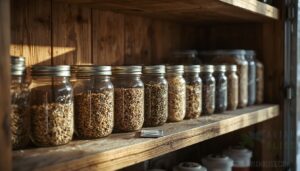
Good seed storage starts before the first snowflake falls. Transfer bulk bags into airtight containers — glass jars or food-grade plastic with tight lids both work well.
Strong container seal integrity keeps moisture out and freshness in. Tuck in a silica gel packet, store in cool, dark conditions, and use a simple batch dating system so you always reach for the oldest seed first.
Preventing Mold and Spoilage
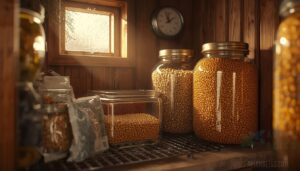
Mold doesn’t announce itself — it just quietly ruins your seed supply. Follow these seed storage guidelines to stay ahead of it:
- Keep Humidity Control steady by storing below 50% moisture using a digital hygrometer.
- Drop in Silica Gel Additives to pull surface moisture away from seeds.
- Prioritize Temperature Stabilization between 40–70°F, avoiding direct sunlight.
- Choose Mold-Resistant Blends with high oil content and moisture-resistant packaging.
- Improve Air Circulation by keeping seed on shelves, never the floor.
Preventing seed mold and disease — and preventing mold and insect infestation in seed storage — means maintaining freshness of bulk bird seed all winter long.
Choosing Feeder Types for Each Food
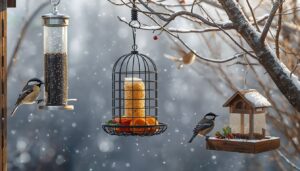
Not every feeder works with every food — and mismatches waste more than you’d think.
Seed tube design meters portions and cuts mess. Suet cage ventilation keeps fat from spoiling in sun. Nut perch barriers let chickadees and titmice feed without crowding. Fruit tray moisture drains fast on open platforms. Mealworm sealed compartments lock in freshness.
Feeder compatibility with winter blends makes every refill count.
Placing Feeders Near Winter Shelter
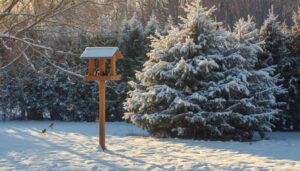
Where you place your feeder matters almost as much as what’s in it. Set it 10 to 15 feet from trees or shrubs — that’s your shelter edge — so birds can dart to safety fast.
Add baffle shields on poles to block climbing predators.
Use windbreak orientation near evergreens and rotate locations seasonally as flocks shift.
Contrast contrast markers help birds spot feeders through snow.
Keeping Water From Freezing
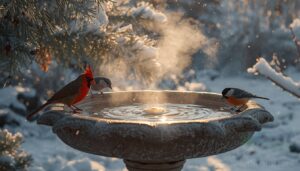
Food isn’t the only thing birds need to survive winter. Fresh water matters just as much for winter bird health — and it freezes fast.
- Use Heated Water Bowls or Insulated Water Troughs to keep liquid water available around the clock.
- Add Circulating Water Pumps to keep water moving and slow ice formation.
- Try a Solar Water Heater for low-cost warmth during daylight hours.
- Practice Sheltered Water Placement near windbreaks to cut heat loss.
Reducing Squirrel Access to Feeders
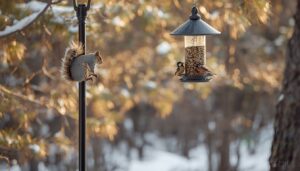
Squirrels can empty a feeder faster than any bird. A few smart moves keep the seeds where they belong.
| Strategy | What to Use | Why It Works |
|---|---|---|
| Feeder Height Strategies | Mount 5–7 feet high | Limits ground-level jumping |
| Squirrel Baffles & Metal Guard Rings | Below-pole cone baffles | Blocks climbing attempts |
| Squirrel Proof Blends | Safflower, nyjer seed | Squirrels largely ignore these |
Weight Sensitive Perches close ports automatically when something heavy lands. Feeder placement tips, like keeping feeders 10 feet from trees, cut jump access too.
Frequently Asked Questions (FAQs)
What food can I leave out for birds in winter?
Winter birds need calorie-dense snacks to survive the cold. Stock your feeder with black oil sunflower seeds, suet, and Nyjer — high-fat, high-protein picks that deliver real energy when temperatures drop.
When should you stop feeding birds for the winter?
Taper off gradually in late February to March once temperatures stay above freezing and snow cover fades.
Watch for bird visitation decline — that’s your clearest sign that seasonal food availability has returned.
What not to feed birds in winter?
Skip bread, chocolate, avocado, moldy seeds, toxic dairy, citrus peels, processed meats, and spicy scraps.
Also avoid suet containing bacon grease, palm or vegetable oils, and corn syrup — these harm more than help.
How to keep birds warm in winter outside naturally?
Place feeders near dense evergreens and brush piles to block wind.
Suet and black oil sunflower seeds fuel natural heat.
Sunlit perches and leaf piles let birds fluff feathers and warm up fast.
How often should I refill feeders in winter?
Think of your feeder like a gas tank in a snowstorm — it empties fast.
Most feeders need refilling every two to three days, but daily checks help you stay ahead of demand.
Can birds survive without feeders during winter storms?
Yes, birds can survive short winter storms by using sheltered roosting sites, natural food caches, and even torpor strategy to cut energy needs — but prolonged storms push their limits fast.
What time of day do birds feed most?
Birds feed most during the morning peak, right after sunrise, and again during the evening surge before dark. Midday brings a natural lull.
Cold snaps and seasonal shifts can extend both windows noticeably.
Do bird feeders attract unwanted pests or predators?
Feeders do bring a few uninvited guests. Spilled seed draws rodents, raccoons attempt night raids, and cats pose a real cat predation risk.
Smart feeder placement and squirrel-resistant bird foods cut most of that trouble fast.
When should I start winter bird feeding efforts?
Start in October when nighttime temperatures drop below 5°C. That’s your regional temperature threshold.
Don’t wait for snow — early migration arrival means birds need your feeders before the first frost hits.
Can bird feeding harm wild foraging instincts?
It’s unlikely. Most birds keep foraging naturally alongside feeders.
A small minority may develop dependency, but offering varied foods, cleaning feeders regularly, and avoiding overfeeding help wild foraging instincts and healthy winter survival.
Conclusion
Picture a chickadee hitting your feeder at first light after a brutal overnight freeze. It’s not browsing—it’s surviving.
The right bird food for winter means that tiny bird makes it to noon, then dusk, then spring. Stock black-oil sunflower seeds, suet, and quality blends.
Keep feeders clean, water thawed, and seed fresh. You’re filling a feeder. You’re closing the gap between a hard night and another morning.