This site is supported by our readers. We may earn a commission, at no cost to you, if you purchase through links.

Your backyard bird feeder might harbor more than cheerful songbirds—it’s a potential intersection point where avian parasites can bridge species barriers and pose zoonotic threats to human handlers, particularly immunocompromised individuals and avian professionals. While most people consider bird-related health risks limited to avian influenza, the reality encompasses a broader spectrum of parasitic organisms that exploit direct contact, environmental contamination, and vector-borne pathways to establish transmission cycles between wild birds, domestic poultry, and human populations.
Understanding avian parasite transmission risks requires examining the intricate relationships between parasite life cycles, host susceptibility factors, and environmental conditions that promote cross-species infection, enabling you to implement evidence-based prevention strategies that protect both avian and human health.
Table Of Contents
- Key Takeaways
- What Are Avian Parasites?
- How Do Avian Parasites Transmit?
- Risks of Avian Parasite Transmission to Humans
- Preventing Avian Parasite Transmission
- Research and Conservation in Avian Parasite Control
- Frequently Asked Questions (FAQs)
- Can avian flu spread human to human?
- What is the mode of transmission of avian encephalomyelitis?
- Do domestic poultry face different parasite risks?
- How do migratory routes influence parasite geographic spread?
- Are antiparasitic drug resistances emerging in bird populations?
- What role do urbanization and habitat loss play?
- Conclusion
Key Takeaways
- Bird feeders and direct contact with avian species create multiple transmission pathways for parasites to humans through contaminated surfaces, environmental spread, and vector-borne routes, with immunocompromised individuals, children under two, adults over fifty-five, and bird handlers facing elevated infection risks.
- Zoonotic parasites from birds—including Giardia lamblia, Cryptosporidium, Toxoplasma gondii, and ectoparasitic mites—cause diseases ranging from prolonged gastrointestinal illness to severe dermatitis, requiring evidence-based prevention strategies beyond typical avian influenza concerns.
- Effective transmission prevention requires implementing rigorous hygiene protocols including handwashing before and after bird contact, wearing protective gear, maintaining two-meter distances from wild birds, and following structured cleaning protocols with EPA-registered disinfectants applied for 1-5 minute contact times.
- Migratory routes and urbanization amplify parasite geographic spread by creating flyway transmission corridors and habitat fragmentation that concentrate host populations, while emerging antiparasitic drug resistance in bird populations necessitates surveillance networks integrating ecological modeling, vaccine development, and mandatory biosecurity measures at commercial facilities.
What Are Avian Parasites?
Avian parasites are organisms that live on or inside birds, deriving nutrients while potentially causing harm to their hosts. These parasites range from external arthropods like mites and ticks to internal protozoa and helminths, each with distinct transmission pathways and health implications.
Understanding the various common parasites affecting wild birds helps in early detection and prevention of serious health complications.
Understanding the types, life cycles, and affected species will help you recognize potential risks and take appropriate preventive measures.
Types of Avian Parasites
You’ll encounter two main categories when dealing with bird parasites: ectoparasites and endoparasites. Understanding this distinction helps you recognize risks and implement effective ectoparasite control strategies.
Ectoparasites live externally—feather mites, lice, and ticks attach to skin and feathers, feeding on keratin, oils, or blood.
Endoparasites include internal nematodes, avian protozoa, and bird tapeworms inhabiting intestinal tracts.
Blood parasites affect circulation and tissue health. Recent research highlights the significance of prevalent gastrointestinal parasites among avian species in certain regions.
Life Cycles of Common Parasites
Understanding parasite transmission dynamics means recognizing that bird parasites follow distinct life cycle patterns affecting host range and parasite development.
Direct cycles complete within single avian hosts, where endoparasites reproduce and shed infectious stages into your environment, while indirect cycles require intermediate hosts—insects or mollusks—before reaching birds.
Some ectoparasites mature within days; others span months, adapting their parasite evolution to seasonal conditions and enabling parasite-borne diseases to persist across ecosystems.
The environmental impact of these cycles is closely related to unsustainable consumption patterns.
Birds Commonly Affected
While life cycles govern transmission potential, you’ll find parasite susceptibility varies markedly among taxonomic groups, with parrot susceptibility to circoviral beak and feather disease particularly pronounced in Psittaciformes.
Whereas songbird parasites—feather mites and bloodborne protozoans—affect Passeriformes including starlings and house sparrows, and waterfowl risks center on avian influenza transmission in Anatidae; pigeons harbor chlamydial ectoparasites that readily colonize urban roosts.
How Do Avian Parasites Transmit?
Understanding how avian parasites move from bird to bird—and potentially to you—requires looking at three distinct transmission routes.
Shared food bowls, perches, and baths create prime opportunities for transmission, which is why recognizing early warning signs of parasitic diseases in pet birds can prevent outbreaks in multi-bird households.
Each pathway carries different risk levels and prevention strategies that you’ll need to understand if you handle birds regularly or maintain feeders in your yard.
Let’s examine direct contact, environmental spread, and vector-borne transmission to see where your greatest vulnerabilities lie.
Direct Contact Transmission Pathways
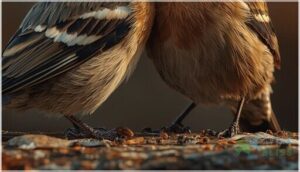
Physical contact between birds—whether through pecking, wing contact, or nest sharing—creates direct transfer pathways for ectoparasites and endoparasites, including bird mites and lice.
When you handle birds without proper parasite control measures, skin transmission can occur through contaminated hands or surfaces (fomite spread), potentially exposing you to zoonotic diseases and avian parasitic infections that require immediate attention and treatment.
Indirect and Environmental Transmission

Beyond beak-to-feather contact, you’ll face environmental risks when parasite stages persist in contaminated water sources, litter, and fomites that bridge flocks and species.
The fecal oral route drives many infections, as coccidia oocysts and viral particles accumulate in barn bedding, soil, and shared drinkers, creating ecological factors that exacerbate zoonotic diseases and vectorborne transmission long after infected birds depart.
Role of Vectors in Parasite Spread
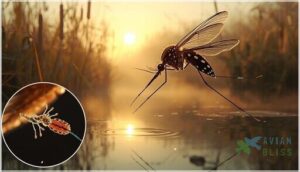
When mosquitoes and ticks serve as disease vectors, you’re dealing with vectorborne diseases that increase parasite transmission beyond direct contact, as these organisms acquire pathogens during blood meals and deliver them through saliva during subsequent feeds.
Creating transmission dynamics shaped by vector ecology, feeding frequency, parasite development stages within vector tissues, and seasonal abundance patterns that necessitate targeted vector control to disrupt zoonotic transmission.
Risks of Avian Parasite Transmission to Humans

While birds carry their own suite of parasites, you need to understand that certain organisms can cross the species barrier and infect humans through direct contact, environmental exposure, or vector-mediated transmission.
Your risk level depends on factors including your immune status, age, occupation, and frequency of bird interaction. Let’s examine the specific zoonotic parasites, vulnerable populations, and diseases you should be aware of when working with or around avian species.
Zoonotic Parasites and Human Infection
When birds carry parasites capable of infecting humans—what we call zoonotic diseases—your risk depends on the type of parasite and how you interact with avian hosts. Infection risk assessment becomes critical because parasite host switching from birds to humans occurs more frequently than you might expect, particularly with certain ectoparasites and endoparasites that don’t discriminate between species.
Understanding avian-related parasitic infections and their human parasite burden requires recognizing that zoonotic disease ecology connects bird health directly to yours—these parasites from birds don’t need permission to cross species barriers.
Bird parasites cross species barriers without permission, linking avian health directly to yours through zoonotic disease ecology
- Protozoa like Giardia lamblia cause intestinal illness through contaminated water or food
- Cestodes such as Diphyllobothrium latum transmit via undercooked fish, depleting vitamin B12
- Trematodes including Opisthorchis viverrini spread through freshwater fish and damage liver tissue
- Nematodes like Toxocara species migrate through your tissues after soil exposure
- Ectoparasites such as Dermanyssus gallinae transmit pathogens through close contact with contaminated environments
High-Risk Groups for Transmission
Your exposure risk to zoonotic diseases from avian influenza, West Nile virus, and parasitic diseases concentrates in vulnerable populations, particularly immunocompromised individuals whose defenses can’t repel ectoparasites and other pathogens that healthy immune systems usually eliminate.
Occupational hazards escalate for bird handlers, veterinary personnel, and poultry workers, while age factors compound susceptibility—children under two and adults over fifty-five face disproportionate infection rates, especially when social behaviors include close bird contact without protective equipment.
Common Parasite-Linked Diseases
Your contact with infected birds doesn’t just risk minor discomfort—you’re potentially exposed to parasitic diseases ranging from gastrointestinal protozoan infections to systemic helminth infestations, with zoonotic risks amplifying during disease outbreaks when avian-related parasitic infections cross species barriers and compromise human health through multiple transmission pathways.
- Giardiasis causes prolonged diarrhea lasting two to six weeks when you ingest Giardia lamblia cysts from contaminated water or surfaces where birds defecate
- Cryptosporidiosis triggers severe watery diarrhea with dehydration, particularly dangerous for immunocompromised individuals exposed to Cryptosporidium oocysts in avian fecal matter
- Avian malaria parasites, while primarily affecting bird populations, illustrate parasite ecology principles that inform zoonotic disease surveillance and prevention strategies
- Toxoplasmosis can transmit when you handle birds harboring Toxoplasma gondii, presenting asymptomatic infections or serious complications in pregnant individuals
- Ectoparasitic mites from northern fowl and other avian species bite humans directly, causing intensely itchy dermatitis requiring antiparasitic treatment for resolution
Preventing Avian Parasite Transmission

You don’t have to accept parasite transmission as an inevitable risk when you work with birds or live near them. Simple, evidence-based strategies can dramatically reduce your exposure to zoonotic pathogens carried by avian hosts.
Let’s walk through the most effective preventive measures you can implement right away.
Best Practices for Bird Handlers
You can’t afford to cut corners when handling birds—your health depends on it. Personal hygiene, including thorough handwashing with soap before and after each contact, forms your first defense against zoonotic infections and bird-related health risks.
Safe handling requires gentle restraint techniques that minimize stress reduction while you wear protective gear like gloves and long sleeves, essential parasite control measures that support both infectious disease prevention and public health awareness.
Cleaning and Disinfection Measures
Your protective gear won’t help much if contaminated surfaces reintroduce parasites into your environment, which is why rigorous cleaning protocols paired with appropriate disinfectant types form the backbone of disease prevention and control.
Follow these surface sanitizing steps for effective parasite control measures:
- Remove organic debris with soap and water before applying EPA-registered disinfectants
- Maintain contact time of 1-5 minutes for equipment sterilization
- Clean high-touch areas daily to reduce bird-related health risks
- Use fresh cloths between sections to prevent cross-contamination
- Wear disposable gloves during all cleaning protocols to maintain personal hygiene
These practices substantially lower public health risks while preventing parasitic infections in both avian and human populations.
Reducing Contact With Wild Birds
Once your surfaces are spotless, pay just as much attention outdoors. Following Bird Distance Guidelines—like keeping two meters from wild birds and never offering food—shrinks the risk of harboring external or internal parasites. Combine deterrents, modify outdoor spaces, manage pet enclosures, and adjust daily routines to shield against bird-related health risks while preventing parasitic infections from taking hold.
| Bird Distance Guidelines | Wild Bird Deterrents | Outdoor Space Modification |
|---|---|---|
| Keep two meters away | Fence off water sources | Install motion-sprinklers |
| Don’t feed wild birds | Spikes, reflective tape | Remove dense hedges |
| Stay on marked paths | Net/cover water | Secure waste bins |
| Limit time near flocks | Signs/posters | Block attic gaps |
| Keep pets distant | Community reporting | Inspect for intrusion |
Research and Conservation in Avian Parasite Control

Understanding how researchers track and combat avian parasites isn’t just about protecting birds—it’s about safeguarding entire ecosystems, including the people who share these spaces.
Scientists worldwide are developing advanced surveillance methods, studying how parasites like Plasmodium relictum (the agent behind avian malaria) devastate vulnerable populations, and leading the development of interventions that could reshape conservation strategies for decades to come.
Here’s what you need to know about the current state of research and where prevention efforts are headed.
Monitoring and Surveillance Efforts
Proactive Parasite Tracking forms the foundation of modern Wildlife Conservation, using Surveillance Methods like remote sensing and quarterly transect surveys paired with Disease Mapping to identify high-risk regions and inform targeted Disease Surveillance.
Vector Monitoring and laboratory Data Analysis feed integrated dashboards, enabling adaptive management of Avian Parasite Transmission and effective response to emerging ParasiteBorne Diseases within this evolving field of applied Epidemiology.
Impact on Bird Populations and Ecosystems
Surveillance data reveal sobering connections between Avian Malaria, vectorborne Parasite Ecology, and measurable Avian Population Decline, particularly in island endemics where Disease Ecology and Conservation intersect with fragile Ecosystem Conservation frameworks.
Bird Migration Patterns compound Ecosystem Disruption through long-distance parasite dispersal, altering host-pathogen dynamics and challenging Wildlife Health and Management protocols that depend on adaptive Conservation Strategies responsive to shifting epidemiological landscapes.
Future Directions in Prevention and Control
Increasingly, resilient Parasite Surveillance networks integrating broad-spectrum monitoring with Ecological Modeling will enable predictive identification of transmission hotspots, while Vaccine Development targeting multiple parasite life stages and enhanced Biosecurity Measures at aviculture facilities represent key Vector Control strategies addressing both parasiteborne diseases and zoonotic transmission, thereby mitigating public health concerns through evidence-based disease prevention and adaptive bird control measures.
- Deploy rapid point-of-care diagnostics delivering results in under thirty minutes for immediate intervention
- Establish cross-border surveillance data-sharing agreements ensuring coordinated rapid response protocols
- Develop oral vaccine baits for wild populations while implementing rigorous non-target safety assessments
- Enforce mandatory quarantine and species-segregated housing protocols at commercial aviculture operations
- Fund public awareness campaigns targeting farmers, rehabilitators, and pet owners on infestation recognition
Frequently Asked Questions (FAQs)
Can avian flu spread human to human?
Yes, avian influenza can spread between humans through prolonged close contact in households or healthcare settings, though human transmission remains inefficient and hasn’t sustained global outbreaks or flu pandemics despite ongoing virus mutations.
What is the mode of transmission of avian encephalomyelitis?
Infected hens pass the virus vertically through eggs to chicks before hatching, while horizontal spread occurs through direct contact, fecal shedding, and environmental contamination of litter and equipment in shared spaces.
Do domestic poultry face different parasite risks?
Domestic bird health varies sharply by housing system, with backyard flocks showing elevated parasite load from soil exposure and intermediate hosts, whereas commercial poultry farm risks concentrate on rapid fecal–oral spread within dense populations.
How do migratory routes influence parasite geographic spread?
Birds don’t just wing it—migratory routes create flyway parasite dynamics that extend pathogen ranges, as migrating birds carry parasites across continents, stopping at sites where disease spread accelerates through dense host populations and active vectors.
Are antiparasitic drug resistances emerging in bird populations?
Resistance mechanisms threaten antiparasitic efficacy in poultry and captive birds, with parasites carrying genetic changes that reduce drug susceptibility through sustained treatment pressure, necessitating drug rotation, monitoring efficacy, and One Health surveillance to track spread dynamics.
What role do urbanization and habitat loss play?
When city sprawl replaces wetlands with pavement, you’re witnessing more than visual change—urban expansion and habitat fragmentation drive wildlife displacement, ecosystem disruption, and biodiversity loss, directly amplifying avian parasite transmission through altered ecological factors influencing disease transmission.
Conclusion
Your backyard feeder represents a crossroads where wildlife meets human responsibility—a boundary requiring vigilance rather than fear. Understanding avian parasite transmission risks enables you to transform potential exposure points into opportunities for informed stewardship through systematic hygiene protocols, strategic environmental management, and recognition of clinical warning signs.
By implementing evidence-based prevention measures while maintaining awareness of zoonotic pathways, you’ll protect both avian populations and human health without sacrificing the enrichment that responsible bird interaction provides.