This site is supported by our readers. We may earn a commission, at no cost to you, if you purchase through links.
You spot an unfamiliar field guides flower on a trail, pull out your phone to snap a photo, and wonder what you’re looking at. That moment of curiosity is where field guides come in.
These compact references help you identify plants, rocks, birds, and more with nothing but careful observation and a few key details. But standing in front of dozens of field guides for beginners can feel overwhelming. Some pack in encyclopedic detail while others focus on quick visual matches.
The right guide depends on what you’re hunting for, where you explore, and how you prefer to learn. Finding one that matches your style transforms random outdoor encounters into meaningful discoveries.
Table Of Contents
- Key Takeaways
- What Makes a Great Beginner Field Guide
- Types of Field Guides for Beginners
- Key Features to Look for in Field Guides
- How to Use a Field Guide Effectively
- Top Field Guides for Beginners: Product Reviews
- 1. Rocks and Minerals Illustrated Guide
- 2. National Audubon Field Guide To Rocks Minerals
- 3. Rocks and Minerals Field Guide
- 4. Geology Composition Notebook
- 5. Botany In A Day Plant Identification Guide
- 6. Botany Plant Identification Atlas
- 7. Plant Identification Terminology Guide
- 8. Weeds of North America Guidebook
- 9. Peterson Field Guide To Medicinal Plants
- 10. Northeast Medicinal Plants Guide
- Matching Your Guide to Your Interests
- Tips for Beginner Field Guide Users
- Frequently Asked Questions (FAQs)
- What should a field guide include?
- What is the best bird watching for beginners?
- What do you need to become a field guide?
- What weather conditions are best for field observations?
- How do I clean and maintain my field guide?
- What clothing and gear enhance field guide usage?
- How do seasonal changes affect identification accuracy?
- Conclusion
Key Takeaways
- Field guides vary widely in format—comprehensive handbooks offer extensive detail for home study, while pocket-sized editions prioritize portability and quick visual matching for trail use.
- Successful identification depends on recording specific physical characteristics like color and texture, then systematically comparing specimens to guide entries using simple field tests.
- Beginners should choose guides that match both their geographic region and specific interests (rocks, wildflowers, medicinal plants, birds), as specialized guides provide more useful detail than general references.
- Building field skills requires consistent practice through nature journaling, joining local naturalist communities, and learning to observe responsibly while developing pattern recognition over time.
What Makes a Great Beginner Field Guide
You wouldn’t head into the woods with a field guide written in a language you can’t read. The same goes for field guides—the best ones meet you where you’re and make identification feel natural, not frustrating.
If you’re birding in wet conditions, check out this guide to rain gear for bird watching to keep yourself dry while you’re flipping through pages.
A few key qualities separate guides that gather dust from the ones you’ll actually reach for on the trail.
Essential Features for Accurate Identification
You need a field guide that brings together the right visual cues and diagnostic features to make identification stick.
Look for guides that organize specimens by morphology keys—those measurable body parts and proportions that separate lookalikes. Habitat context matters too, since knowing where a mineral or plant thrives narrows your search fast.
For even more accurate identification, consider using key characteristics for insect identification as a foundational approach. These identification techniques turn confusion into confidence.
Importance of Clear Photos and Illustrations
A crisp photo captures what words can’t—the subtle grain of quartzite, the exact tint of a warbler’s wing stripe.
Peterson Field Guides and National Audubon Society editions set the standard with high image quality and sharp illustration techniques that let you match what you’re holding to what’s on the page.
Visual aids matter because your eyes do the heavy lifting in mineral identification and rock spotting outdoors.
User-friendly Organization and Portability
The best field guide stays in your pocket, not your car. Peterson Field Guides and DK Smithsonian Handbooks use compact design and visual systems that let you flip to the right page mid-hike.
Easy navigation matters when you’re balancing a specimen in one hand—portable guides with color-coded tabs or illustrated keys keep beginner rockhounding simple. Field ready means field guide selection favors durability over desk-worthy bulk.
Value of Jargon-free, Accessible Language
Clear communication turns a frustrating field guide into one you’ll actually use. Simple terminology, like “shiny” instead of “vitreous luster”, removes language barriers and speeds up identification when you’re standing over a rock you can’t name.
Accessible writing invites beginners into geology without a dictionary, making effective explanation the difference between confident rockhounding and guesswork. Your field guide selection should read like a helpful friend, not a textbook.
Types of Field Guides for Beginners
Not all field guides are created equal, and finding the right type makes all the difference when you’re just starting out.
Some guides pack everything into a detailed handbook, while others keep things simple and portable for quick checks in the field. Let’s look at the main types you’ll encounter and what each one brings to the table.
Comprehensive Handbooks Vs. Pocket Guides

Think of thorough handbooks and pocket guides like two different tools in your naturalist’s kit.
Handbooks—such as DK Smithsonian Handbooks or National Audubon Society volumes—offer extensive depth and reference quality, running hundreds of pages with detailed rock and mineral field guides.
Pocket guides trade handbook depth for field portability, giving you quick identification power when you’re actually outdoors.
Your user experience depends on where you’ll use them most. For more on the key differences between handbooks and guides, understanding their purpose and audience can help you select the right tool.
Regional and Specialized Field Guides
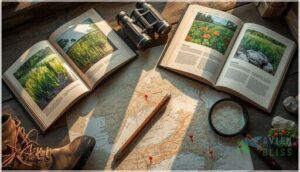
When your hikes stay close to home, a regional focus sharpens your eye. Peterson Field Guide and National Audubon Society editions zero in on specific states or bioregions, highlighting what you’ll actually see—wetland mosses, prairie grasses, or coastal rocks.
Specialized guides drill deeper into micro habitats or conservation tips, while DK Smithsonian Handbooks and Stokes Beginners Guides add geographic mapping to help you pinpoint local treasures.
Digital Apps and Online Resources
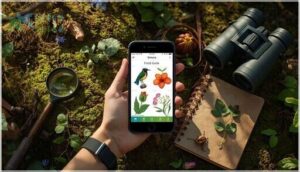
Your phone already holds a field library. Mobile guides from National Geographic and National Audubon Society deliver offline maps, GPS tagging, and camera tools that identify plants or rocks on the spot. Peterson Field Guide apps sync to cloud storage so your notes travel across devices. Online forums connect you with experts, while app reviews help you pick reliable digital tools before you head out.
- Offline field packs keep identification keys accessible without cell service.
- GPS tagging stamps every observation with exact location data.
- Camera integration captures specimen images for later comparison.
- Cloud storage backs up your field notes across all devices.
- Community forums offer real-time ID help from experienced naturalists.
Notebooks and Observation Journals
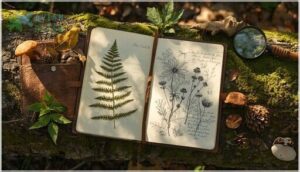
A blank page becomes your field companion the moment you press a pressed leaf between acid-free sheets.
A blank page becomes your field companion the moment you press a leaf between its sheets
Notebook design built for outdoor education includes sketch areas beside ruled lines, waterproof covers for nature study, and pockets that hold loose samples.
Recording field notes sharpens observation skills, while consistent journaling techniques turn random sightings into patterns you’ll recognize season after season.
Key Features to Look for in Field Guides

Not all field guides are created equal, especially when you’re just starting out. The right features can mean the difference between confident identification and hours of frustration flipping through pages.
Here’s what separates a truly helpful beginner’s guide from one that’ll just gather dust on your shelf.
Visual Identification Systems
A strong visual identification system acts like a trail map, guiding you to the right answer faster.
Field guides use color-coded tabs, illustrated comparison charts, and graphic elements to help you match what you’re holding to what’s on the page.
These visual cues and identification keys transform plant identification and mineral identification techniques from overwhelming to manageable, especially when you’re standing in the field.
Detailed Descriptions of Physical Properties
Great field guides describe more than just color types—they detail texture types, shape identification, and material properties so you can confirm what you’ve found.
Look for guides that explain hardness testing using the Mohs scale, note luster variations, and describe crystal forms. These physical property descriptions turn guesswork into confident mineral identification techniques, making rock and mineral collecting both precise and rewarding.
Durability and Compact Size
You’ll want a field guide that survives outdoor activities without falling apart. Look for water resistance, protective covers, and binding strength that won’t loosen after repeated use.
Compact designs—around 3 to 4 inches wide—slip easily into your pocket during nature study. Laminated page materials resist moisture and fingerprints, making geology for beginners practical even in rugged conditions.
Organization by Habitat or Taxonomy
Once you’ve chosen a sturdy, pocket-sized field guide, check how it arranges species. Habitat classification groups organisms by shared environments—forests, wetlands, or deserts—helping you predict which species inhabit a given ecological niche. Taxonomic ranks organize by evolutionary relationships, from kingdom down to species.
Both systems support plant identification and wildlife guides, and many National Audubon Society field guides use habitat grouping to simplify conservation strategies and species grouping.
- Habitat-based layouts mirror real-world observations, letting you match surroundings to likely species
- Taxonomy-based guides clarify evolutionary links and use standardized scientific names
- Visual tabs or color-coded sections speed up lookups during field work
- Both methods appear in respected field guides, so pick the one that fits your learning style
How to Use a Field Guide Effectively

A field guide is only as good as your ability to use it. The difference between a frustrating guessing game and a confident identification often comes down to technique.
Here’s how to turn that guide in your hands into a reliable tool for recognizing what you find in the wild.
Observing and Recording Key Characteristics
Careful observation makes all the difference when you’re learning to identify plants, animals, or minerals. Start by noting the most obvious traits—color, size, texture, and shape. Field notebooks help you track these details in real time. Write down the date, location, and weather conditions for each specimen you examine. Photograph or sketch from multiple angles to capture distinguishing features you might miss later.
| What to Record | How to Document It |
|---|---|
| Physical features | Note color, texture, leaf shape, or crystal habit under natural light |
| Measurements | Use a ruler to record length, width, and proportions accurately |
| Habitat context | Write GPS coordinates, dominant vegetation, and altitude or depth |
| Environmental conditions | Log weather, seasonality, and light conditions during observation |
| Behavioral patterns | Describe movement, actions, and interaction with surroundings objectively |
Good record keeping transforms casual nature observation into reliable data verification. Use predefined fields in your field guide or app to stay consistent. This practice sharpens your observation techniques and builds a personal reference library for wildlife guides and plant identification over time.
Comparing Specimens to Guide Details
Once you’ve recorded your specimen’s traits, open your field guide and match what you see to what’s printed. Place the specimen beside photos or illustrations in your field guides and look for feature matching point by point. Rock and mineral identification demands precision—check luster, crystal habit, and cleavage patterns against guide entries.
- Compare color under the same lighting conditions described in your mineralogy guide
- Align texture patterns with specimen analysis examples to confirm your initial category
- Note whether distinctive markings like veining or speckles match guide comparison images
- Verify size and proportion ratios using the scale references provided
- Cross-reference habitat context from your notes with regional plant identification entries
This systematic observation methods approach builds confidence in your identification techniques.
Using Simple Tests for Identification
Your field guide points you toward simple testing and plant analysis techniques you can use right there in the field. Try the hardness test: scratch your rock with a coin or fingernail to estimate its Mohs scale rating.
For plants, crush a leaf gently to release characteristic scents. Visual inspection of crystal habit or bark texture refines your specimen comparison and sharpens field observation skills during rock and mineral identification.
Tips for Real-time Identification Outdoors
Quick identification outdoors demands sharp nature awareness and steady outdoor navigation skills. Watch for movement, note silhouettes against the sky, and match what you see to your field guide’s key traits.
- Use high-contrast markers on your gear so you can spot it quickly in dim light
- Compare size relative to nearby rocks or branches to estimate scale fast
- Record distinctive features like beak shape or leaf edges for wildlife and plant identification
- Take quick reference photos with distance notes for later confirmation
- Move slowly and minimize route changes to improve real-time tracking without disturbing wildlife
Top Field Guides for Beginners: Product Reviews
You’ve learned the basics of using a field guide, and now it’s time to find the right one for your adventures.
The guides below cover everything from rocks and minerals to plants and medicinal herbs, each chosen for its clarity and usefulness to beginners. Let’s look at what makes each one worth adding to your pack.
1. Rocks and Minerals Illustrated Guide
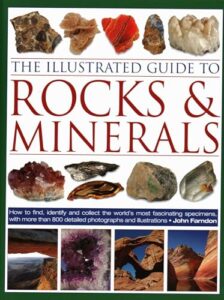
You won’t find 800 pages of technical geology in this guide. Instead, geologist Evelyn Mervine profiles 50 carefully chosen rocks and minerals through stunning original illustrations by Vlad Stankovic.
Each 240-page entry breaks down key identifiers, appearance, and where you’ll actually find these specimens in nature. The paperback format slips easily into your backpack, and the glossary defines tricky terms without sending you elsewhere.
It’s built for real use, whether you’re hiking trails or sorting through your first collection at home.
| Best For | Hobbyists and students who want a visual reference guide to identify rocks and minerals, whether they’re building a collection or exploring geology for the first time. |
|---|---|
| Page Count | 256 |
| Language | English |
| Publisher | Lorenz Books |
| Publication Year | 2018 |
| Weight | 2.31 pounds |
| Primary Focus | Rocks and minerals |
| Additional Features |
|
- Over 800 photographs and illustrations make identification straightforward and visual
- Covers both rocks and minerals with expert explanations of how they form
- Quick-reference checklists help you identify specimens fast without reading the whole book
- At over 2 pounds and nearly 11 inches tall, it’s not the easiest to carry into the field
- Some readers found the color reproduction lacking for identifying specimens by color
- The broad scope means it’s not as deep on any single topic as a specialized guide would be
2. National Audubon Field Guide To Rocks Minerals
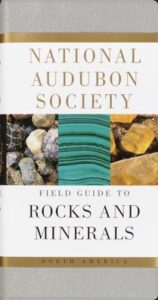
This classic field guide hands you 794 full-color photographs organized by color, so you can match what you’re holding to what’s on the page in seconds. You’ll flip through color-coded tabs to reach minerals grouped by hue, then read descriptions covering 200 minerals and 40 rocks with details on texture, luster, and where they turn up in nature.
The durable vinyl binding takes a beating outdoors, and at 856 pages, it’s hefty but thorough enough to answer most questions right there on the trail.
| Best For | Hikers, rock collectors, and geology enthusiasts who want a comprehensive field reference that organizes minerals by color for quick visual identification on the trail. |
|---|---|
| Page Count | 856 |
| Language | English |
| Publisher | Knopf |
| Publication Year | 1979 |
| Weight | 1.25 pounds |
| Primary Focus | Rocks and minerals |
| Additional Features |
|
- 794 full-color photos organized by color make it easy to match specimens visually without flipping through random pages
- Durable vinyl binding stands up to outdoor use and rough handling in backpacks
- Covers 200 minerals and 40 rocks with detailed descriptions of texture, luster, field marks, and where they’re commonly found
- Small print can be hard to read, especially in low light or for those with vision issues
- Thin pages may tear or wear out with heavy field use over time
- The 856-page thickness makes it bulky to carry compared to more compact guides
3. Rocks and Minerals Field Guide
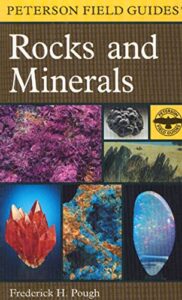
This compact guide packs 385 color photographs and 416 pages into a pocket-sized format that fits your hand at 4.5 x 7.25 inches. You’ll find descriptions of hundreds of minerals listing their geographic distribution, hardness on the Mohs scale, and crystal structures.
It works well whether you’re studying at home or identifying specimens outdoors. The layout requires some dedication to navigate, but once you’re familiar with the organization, you’ll have thorough, accurate information for both casual collecting and serious study.
| Best For | Geology students and rock collectors who want detailed technical information and don’t mind spending time learning the layout. |
|---|---|
| Page Count | 416 |
| Language | English |
| Publisher | Houghton Mifflin Harcourt |
| Publication Year | 1998 |
| Weight | Not specified |
| Primary Focus | Rocks and minerals |
| Additional Features |
|
- Covers hundreds of minerals with thorough details on properties, composition, and crystal structures
- Compact size (4.5 x 7.25 inches) makes it easy to carry in the field
- 385 color photographs help with visual identification
- Not ideal for quick lookups since there’s a lot of text to navigate
- Layout can be confusing for beginners who aren’t familiar with mineral classification
- Hardcover binding quality may disappoint given the price point
4. Geology Composition Notebook
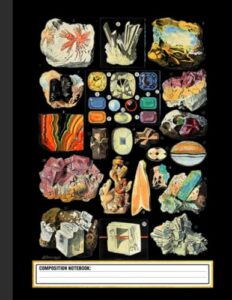
This 120-page college-ruled notebook gives you cream-colored, water-resistant pages designed specifically for geology fieldwork. You’ll find margin guides for sketches, a rock reference list, and quick test prompts for hardness and streak checks.
The spiral wire binding lays flat on uneven ground, while the wipeable polyurethane cover withstands muddy hands without complaint. At 8.5 x 11 inches, it’s ideal for rock collectors, students, and geologists who want a dedicated space to record observations and build identification skills through consistent practice.
| Best For | Rock collectors, geology students, and field researchers who need a durable notebook for outdoor observations and mineral identification. |
|---|---|
| Page Count | 120 |
| Language | English |
| Publisher | Not specified |
| Publication Year | Not specified |
| Weight | Not specified |
| Primary Focus | Note-taking for geology |
| Additional Features |
|
- Water-resistant cream pages and wipeable cover hold up well in field conditions
- Spiral binding lays flat on rocky or uneven surfaces for easy writing
- Built-in rock reference guides and test prompts help with quick mineral identification
- Only 120 pages means frequent replacement for active field workers
- Fixed college-ruled format won’t suit everyone’s note-taking style
- No specialized sections beyond basic geology references
5. Botany In A Day Plant Identification Guide
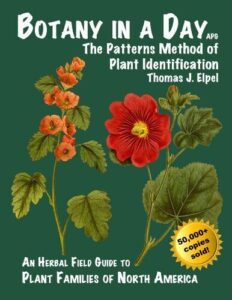
You’ll discover over 200 plant families through the “patterns method,” which teaches you to recognize eight recurring traits instead of memorizing species one by one. This 235-page guide uses full-color illustrations and photographs to show how leaf arrangement, flower parts, and growth habits reveal a plant’s identity.
It’s written in friendly, jargon-free language that works whether you’re studying at home or preparing for fieldwork. Universities and herbal schools use it as a textbook, but you don’t need formal training to identify unknown plants confidently.
| Best For | Beginners and experienced botanists who want to identify plants quickly using pattern recognition instead of memorizing hundreds of individual species. |
|---|---|
| Page Count | 235 |
| Language | English |
| Publisher | HOPS Press |
| Publication Year | 2013 |
| Weight | Not specified |
| Primary Focus | Plant identification |
| Additional Features |
|
- Teaches you to spot eight key patterns across 200 plant families, so you can identify unfamiliar plants without constantly flipping through reference pages
- Full-color photos and illustrations make it easy to compare what you’re seeing in the field with what’s on the page
- Works as both a learning tool at home and a trusted reference for nature programs, herbal schools, and university courses
- Not designed as a pocket-sized field guide, so it’s bulky to carry on hikes or outdoor trips
- The index layout can be frustrating when you’re trying to find specific plants quickly
- Only available in English, which limits accessibility for non-English speakers
6. Botany Plant Identification Atlas
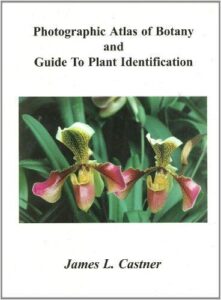
When you’re ready to go deeper than pattern recognition, this spiral-bound atlas gives you over 2,000 color photographs of plant anatomy. At 9.5 x 11 inches and 3.53 pounds, it’s a reference book for your desk, not your backpack.
You’ll see cross sections, magnified views, and annotated details of leaf margins and flower structures. College botany students and Master Gardeners rely on it, though you might want additional guides for complete coverage. Used copies cost less if price matters.
| Best For | College botany students, Master Gardeners, and plant enthusiasts who need a detailed anatomical reference for identifying plants at their desk or workbench. |
|---|---|
| Page Count | 310 |
| Language | English |
| Publisher | Feline Press, Inc. |
| Publication Year | 2005 |
| Weight | 3.53 pounds |
| Primary Focus | Plant anatomy |
| Additional Features |
|
- Over 2,000 color photographs show structural details and microscopic anatomy you won’t find in basic field guides
- Spiral binding lets the book lay flat while you’re comparing specimens or taking notes
- Includes a glossary of specialized terms that helps you learn the language of plant taxonomy
- Too large and heavy at 3.53 pounds to carry into the field for on-site identification
- Doesn’t cover all plant families comprehensively, so you’ll likely need additional guides
- Published in 2005, so it may not include newer taxonomic classifications or recently described species
7. Plant Identification Terminology Guide
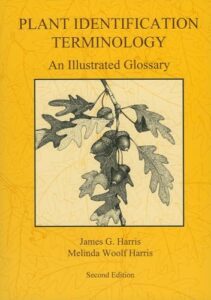
You’ll hit a wall in field guides when terms like “lanceolate” or “cordate” stop you cold. This glossary from University Press of Colorado defines over 2,700 botanical terms with 1,900 clear illustrations.
At 217 pages and just over a pound, it travels better than the atlas but still earns its place at your desk. Professional botanists and serious amateurs use it to decode technical vocabulary in keys. Some users note the organization isn’t strictly alphabetical, and you won’t find Latin pronunciations here.
| Best For | Botanists, botany students, and serious plant enthusiasts who need to decode the technical jargon in identification keys and field guides. |
|---|---|
| Page Count | 217 |
| Language | English |
| Publisher | University Press of Colorado |
| Publication Year | 2001 |
| Weight | 1.05 pounds |
| Primary Focus | Plant terminology |
| Additional Features |
|
- Includes over 1,900 clear illustrations alongside definitions for more than 2,700 terms, making complex botanical vocabulary easier to grasp
- Portable enough at just over a pound to take into the field while still comprehensive enough to keep on your desk
- Covers taxonomy, glossary entries, and plant identification features in one reference book
- Organization can be confusing since terms aren’t always arranged alphabetically
- Missing a pronunciation guide for Latin terminology
- You’ll need some baseline botany knowledge to get the most out of it
8. Weeds of North America Guidebook

Weeds don’t wait for you to learn their Latin names before they colonize your garden. This 656-page guide from University of Chicago Press covers over 600 species organized by plant family, each with a two-page spread featuring photographs and straightforward identification keys.
You’ll find seed viability and germination details that help you understand when and how these plants spread. The family-based organization works well once you recognize basic plant structures, though it’s hefty to carry and assumes some botanical foundation.
| Best For | Gardeners, botanists, and agricultural professionals who need reliable identification of North American weeds and want to understand their germination patterns. |
|---|---|
| Page Count | 656 |
| Language | English |
| Publisher | The University of Chicago Press |
| Publication Year | 2014 |
| Weight | Not specified |
| Primary Focus | Weed identification |
| Additional Features |
|
- Covers over 600 species with clear photographs and identification keys on two-page spreads
- Includes practical seed viability and germination data that helps you predict and manage weed spread
- Family-based organization makes it easier to identify unknown species once you learn basic plant structures
- Requires some botanical knowledge to get the most out of the family-based system
- At 656 pages, it’s too heavy and bulky to carry into the field easily
- Focuses on North American species, so it won’t help if you’re dealing with weeds in other regions
9. Peterson Field Guide To Medicinal Plants
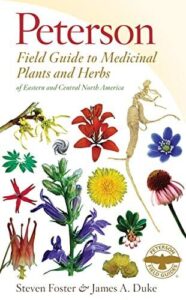
If you’re curious about the healing plants growing around you, this 480-page guide covers over 530 species across eastern and central North America. Color-coded sections speed up your search, while 700+ images show leaves, flowers, and roots in helpful detail.
Each entry explains traditional uses, preparation methods, and important warnings—you’ll know which plants require caution. At 1.3 pounds, it’s portable enough for day hikes. Just remember: read the safety notes carefully and consult a healthcare professional before using any plant medicinally.
| Best For | Hikers, foragers, and anyone interested in learning about medicinal plants in eastern and central North America who wants a reliable, portable field guide. |
|---|---|
| Page Count | 480 |
| Language | English |
| Publisher | Mariner Books |
| Publication Year | 2014 |
| Weight | 1.3 pounds |
| Primary Focus | Medicinal plants |
| Additional Features |
|
- Color-coded organization and 700 images make plant identification quick and straightforward
- Covers 530 species with practical details on traditional uses, preparation, and safety warnings
- Compact size (1.3 lbs) makes it easy to bring along on outdoor trips
- Requires careful attention to warnings and professional consultation before using plants medicinally
- Weight and dimensions might feel bulky for ultralight backpackers
- Limited to eastern and central North America, so it won’t help if you’re exploring other regions
10. Northeast Medicinal Plants Guide
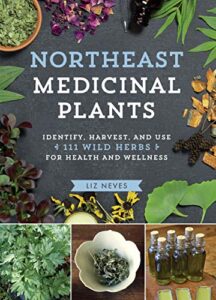
When your foraging grounds stay close to home in the Northeast, this 416-page guide zeroes in on 111 plants from New York to Vermont.
You’ll find color photos that highlight leaf shape and flower details, plus seasonal harvest windows for each species. The book walks you through simple teas and tinctures, with safety notes on toxic lookalikes.
At 1.86 pounds, it’s a bit hefty for all-day hikes, but the regional focus means you won’t wade through species you’ll never encounter.
| Best For | Foragers and herbalists in the Northeast who want a practical field guide for identifying and using wild medicinal plants throughout all four seasons. |
|---|---|
| Page Count | 416 |
| Language | English |
| Publisher | Timber Press |
| Publication Year | 2020 |
| Weight | 1.86 pounds |
| Primary Focus | Wild medicinal plants |
| Additional Features |
|
- Color photographs and clear identification tips help you distinguish medicinal plants from toxic lookalikes
- Organized by season so you know exactly when to harvest each of the 111 plants covered
- Includes practical recipes for teas, tinctures, and salves that beginners can actually make
- At 1.86 pounds, it’s too heavy to carry comfortably on long foraging trips
- Only useful if you live in or visit the Northeast—other regions will need different guides
- Some copies have quality control issues with folded or sealed pages
Matching Your Guide to Your Interests
The best field guide is the one that matches what you actually want to explore.
You’ll get more from a specialized guide than a general one that only skims your interests.
Here’s how to pick the right guide based on what draws you outdoors.
Rock and Mineral Collecting
Rock collecting turns any hike into a treasure hunt. Your field guide should include clear photos showing mineral formation, rock classification by type, and basic petrology concepts. Look for guides with hardness charts, streak test instructions, and gemstone identification tips.
A pocket-sized handbook covering common specimens, geological mapping basics, and rockhounding tips makes outdoor geology accessible—whether you’re fossil hunting or simply curious about that sparkly stone you just found.
| Essential Tool | Why You Need It |
|---|---|
| Rock hammer | Safely extract specimens from outcrops |
| Hand lens | Examine crystal structure and texture |
| Streak plate | Test mineral color in powdered form |
| Field notebook | Record location and specimen details |
| Safety glasses | Protect eyes from sharp mineral fragments |
Plant and Wildflower Identification
Identifying wildflowers by leaf structure and flower patterns transforms any meadow walk into a living botany class.
Your field guide should organize plant habitats clearly, showing seed identification tips and botany basics alongside detailed images.
Look for guides that present plant identification techniques through visual keys—comparing petal counts, leaf arrangements, and bloom seasons—so you can confidently name that purple spike blooming near the trail without second-guessing yourself.
Medicinal and Edible Plants
Wild Edible Plants and Medicinal Plants require careful attention to botanical safety, because toxic lookalikes can cause serious harm. Your field guide should detail edible roots like ginger, explain herbal remedies such as thyme and oregano, and clarify plant chemistry—alkaloids, terpenoids, and flavonoids—so you can practice wild foraging confidently.
- Learn three reliable plant identification techniques for each family you explore
- Look for guides that show leaf venation, flower morphology, and stem characteristics
- Confirm edible species with clear photos to avoid dangerous mistakes
- Practice with non-edible plants first to build your botany skills safely
Bird and Wildlife Observation
Bird Watching and Identification shifts your attention from static plants to creatures that move, hide, and vanish in seconds. Wildlife Guidebooks for Bird Habitats and Migration Patterns should include quick visual keys, while Field Guide Series covering Feather Identification and Wildlife Tracking help you decode signs left behind. Wildlife and Plant Identification overlap when you note fruiting trees that attract flocks.
| Field Marker | What to Record | Why It Matters |
|---|---|---|
| Plumage patterns | Wing bars, tail spots | Separates similar species quickly |
| Beak shape | Length, curvature | Reveals diet and feeding behavior |
| Song and calls | Pitch, rhythm | Confirms ID in dense cover |
| Flight style | Wing beats, glides | Indicates family group |
| Nesting Behaviors | Material, location | Links birds to habitat type |
Wildlife Tracking extends your observation beyond living birds—you’ll spot footprints, droppings, and molted feathers that reveal recent activity.
Tips for Beginner Field Guide Users

Getting started with field guides is one thing, but becoming truly skilled takes practice and patience.
The best naturalists know that learning doesn’t stop when you close the book.
Here are four simple habits that will sharpen your observation skills and deepen your connection to the natural world around you.
Keeping a Nature Journal
Journaling techniques transform fleeting moments into lasting field guides. A nature journal deepens your outdoor adventure by capturing what you see, hear, and feel during each nature study session.
Here’s how to start your conservation diary:
- Record the date, location, and weather conditions at the start of each entry
- Combine quick sketches with brief notes for nature observation
- Use a portable notebook and pencil you can carry easily
- Return to the same sit spot to track seasonal changes
- Add environmental notes about behavior, sounds, and surprising details
Your nature journaling practice builds real environmental education over time.
Joining Communities and Workshops
Your journal grows richer when you share it with others. Local meetups and online forums connect you with experienced mentors who can identify tricky specimens and suggest field guides you’ll love.
Many communities offer outdoor education workshops where you’ll practice nature study alongside fellow learners. These groups strengthen conservation efforts through shared knowledge, and workshop etiquette keeps sessions welcoming for everyone exploring environmental education together.
Practicing Responsible Observation and Conservation
Learning alongside peers deepens your commitment to conservation methods and sustainable practices. Wildlife ethics start with simple steps you can take today:
- Keep a safe distance from all creatures to avoid stressing them or changing their behavior.
- Stay on established trails to protect habitats and prevent erosion.
- Pack out all litter and minimize noise to preserve natural spaces.
Your eco awareness protects what you love studying.
Continuing Education and Skill Building
Your field guide opens the door, but ongoing Professional Development keeps it wide. Weekend workshops, online courses, and micro-credentials strengthen your Skill Enhancement while fitting around your schedule.
Many programs offer Career Advancement through CEUs that count toward certifications. As you build expertise through Educational Resources and structured Learning Strategies, you’ll notice sharper observations, faster identifications, and deeper confidence outdoors.
Frequently Asked Questions (FAQs)
What should a field guide include?
You might think a glossary is enough, but strong field guides include clear photos, identification keys, visual systems, species profiles with habitat notes, and conservation tips to support confident plant identification techniques and insect identification outdoors.
What is the best bird watching for beginners?
Start with a regional field guide that matches birds to your area using clear photos and habitat notes, then practice observing five common species daily to build confidence.
What do you need to become a field guide?
You’ll need a wildlife qualification like FGASA, first aid certification, a professional driving permit, and hands-on field skills in tracking, botany, and plant identification techniques—plus ongoing conservation tips and wilderness safety training.
What weather conditions are best for field observations?
You’ll want clear skies, mild temperatures between 50-75°F, and low humidity for nature study.
Moderate winds keep you steady during outdoor exploration, while some cloud cover reduces glare on your field guides.
How do I clean and maintain my field guide?
Wipe your guide’s cover with a slightly damp microfiber cloth, then dry immediately.
Store it flat in a cool, dry spot away from sunlight. Use clean hands when turning pages to prevent oil transfer.
What clothing and gear enhance field guide usage?
The right outdoor apparel and hiking accessories transform nature study from uncomfortable guesswork into confident exploration.
Breathable long sleeves, waterproof boots with ankle support, and 20-liter field backpacks keep you focused on identification, not discomfort.
How do seasonal changes affect identification accuracy?
Seasonal shifts alter visual cues like leaf color and bloom timing, making diagnostic traits harder to spot.
Observer bias increases when wildflowers fade or bark obscures, so guide adaptation by season improves identification accuracy outdoors.
Conclusion
Field guides for beginners are like maps to a hidden world you’ve walked past your whole life. With the right guide in hand, every hike becomes a chance to decode the landscape around you.
Start with one subject that pulls you in, whether it’s wildflowers or minerals. Take notes, make mistakes, and let curiosity lead. The more you practice, the more you’ll see—and the richer your outdoor experiences become.