This site is supported by our readers. We may earn a commission, at no cost to you, if you purchase through links.
You might have spotted the perfect birdhouse at a local shop, brought it home, and stood in your backyard wondering where on earth to put it. That impulse is more common than you’d think, and the placement you choose can make the difference between an empty box and a thriving nest full of chirping hatchlings.
Birds are surprisingly picky about location—they won’t settle in just anywhere, no matter how charming the house looks. Quiet corners shielded by trees, the right distance from feeders, and proper height all factor into whether your feathered neighbors move in or fly right past.
Getting these details right transforms your yard into a safe haven where birds actually want to raise their young.
Table Of Contents
- Key Takeaways
- Best Locations to Hang Bird Houses in Your Yard
- Should Bird Houses Be Hung or Mounted?
- How High to Hang Bird Houses
- Choosing The Right Direction for Bird Houses
- Species-Specific Bird House Placement
- Predator Protection and Safe Placement
- Maintaining Bird Houses After Installation
- Frequently Asked Questions (FAQs)
- Conclusion
Key Takeaways
- Place your birdhouse 5 to 12 feet high in low-traffic areas, at least 10 to 15 feet from feeders, with the entrance facing east or southeast to balance morning warmth against afternoon heat while keeping prevailing winds and predators at bay.
- Different species need different setups—bluebirds prefer open spaces on poles at 5 to 7 feet with 1.5-inch holes, while chickadees and wrens favor wooded spots at 4 to 8 feet with smaller 1.25-inch entrances tucked into dense cover.
- Predator protection requires smooth pole surfaces, metal guards installed at least 4 feet high, and strategic placement 6 to 10 feet away from cat pathways to give nesting birds real safety instead of just decorative appeal.
- Annual maintenance between broods—removing old nesting materials, scrubbing interiors, checking hardware stability, and sealing cracks before late winter—transforms an empty box into a reliable habitat that birds will return to season after season.
Best Locations to Hang Bird Houses in Your Yard
Finding the right spot for your bird house can make all the difference between an empty box and a thriving family of feathered neighbors. The location you choose affects everything from predator safety to how comfortable parent birds feel raising their young.
For a complete breakdown of height, spacing, and habitat considerations, check out this bird nesting box placement guide.
The right birdhouse location transforms an empty box into a thriving family of feathered neighbors
Let’s look at three key factors that’ll help you pick the perfect place in your yard.
Low-Traffic and Quiet Areas
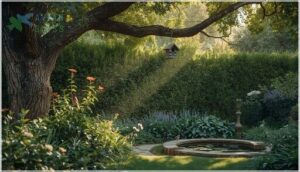
You’ll want to choose low-traffic and quiet areas for successful bird house placement. Noise reduction matters—streets near cul-de-sacs cut traffic volume by up to 60 percent, creating true bird sanctuaries. Quiet zones with daytime sound below 45 decibels support clear bird communication and calm nesting.
Consider these wildlife havens for hanging bird house installations:
- Backyard corners shielded by mature trees and dense hedges
- Fenced perimeters away from driveways and footpaths
- Gardens with foliage that muffles lawn equipment sounds
- Areas near ponds offering cooler microclimates
- Wildlife friendly yards connecting to small woodland fragments
These bird house installation spots improve backyard birdwatching while keeping parent birds relaxed.
Open Spaces Vs. Wooded Spots
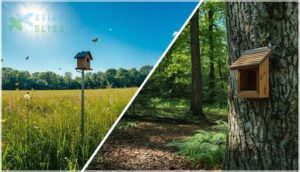
Open spaces and wooded spots both work, depending on your target species. Habitat diversity drives nesting success—edge effects between grass and shrubs boost insect abundance by drawing multiple foragers. Open yards expose nests to predators faster, while wooded areas offer concealment and stable microclimates. Your bird house installation choice shapes predator avoidance and foraging strategies throughout the season.
| Feature | Open Spaces | Wooded Spots |
|---|---|---|
| Visibility | High exposure; easier predator detection | Natural shelter; concealed entrances |
| Temperature | Warms quickly; hot afternoons | Cooler canopy; stable microclimate |
| Insect Access | Flowering grasses; sunny patches | Leaf litter; persistent beetle populations |
| Predator Risk | Faster line-of-sight detection | Slower ground predators; escape routes |
| Best For | Bluebirds; pole mounted bird house | Chickadees; tree mounted bird house |
Distance From Feeders and Birdbaths
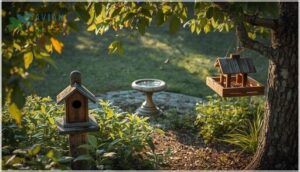
Keep your bird house at least 10 to 15 feet from feeders and bird baths. Feeder proximity raises seed contamination risk near nests, while birdbath placement too close splashes water into entrances.
Nesting safety improves when you separate these backyard birding stations—predators follow scent trails between feeders and water sources. For more on placement benefits and risks, see this guide to combining feeders and bird baths.
- Reduce seed spillage contaminating the nest area
- Prevent water quality issues from droppings and debris
- Lower predator attraction along feeding pathways
- Support cleaner, stress-free bird house placement strategies
Should Bird Houses Be Hung or Mounted?
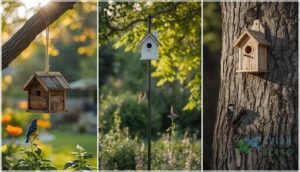
You’ve got three main ways to set up a birdhouse: hanging it from a branch or hook, mounting it on a pole, or attaching it directly to a tree trunk. Each method works better for certain bird species and yard layouts, and each comes with its own set of trade-offs.
If you’re looking for ready-made options, there are plenty of hanging bird houses for sale that come with sturdy hardware already included.
Let’s look at what makes each option worth considering.
Pros and Cons of Hanging
Hanging bird house placement offers real advantages for bird safety and nesting success. You’ll find easier cleaning access, better airflow to reduce moisture, and flexible installation tips for seasonal adjustments.
However, hanging options face challenges too—strong winds can stress birds, swaying branches may deter nesting, and maintenance requires ladders. Regular checks keep cords secure and prevent predator access to your tree-mounted bird house.
Benefits of Mounting on Poles
Pole-mounted birdhouse installations offer superior predator deterrence and weather resistance compared to hanging options. You’ll enjoy three key advantages:
- Mounting ease with adjustable pole heights from 6 to 10 feet
- Space savings by freeing up ground area for gardens
- Pole material durability that outlasts swaying branches
Smooth pole surfaces block climbing predators while keeping your birdhouse placement stable through storms.
Tree-Mounted Bird Houses
Tree-mounted bird house installations feel natural to cavity nesters but require careful tree selection and mounting hardware. You’ll want a trunk diameter of at least 8 inches with minimal branch obstacles blocking flight paths.
The sturdy hook-and-loop strap system secures your bird house at the proper mounting height and angle without drilling into the tree trunk, combining traditional placement with advanced convenience.
For more on reliable materials and advanced mounting, see this guide on the.
How High to Hang Bird Houses
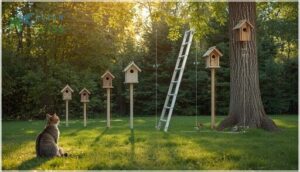
Getting the height right matters more than you might think. Too low, and you’re basically setting up a buffet for cats and raccoons. Too high, and you won’t be able to clean it out when nesting season ends.
General Height Guidelines
Most nest boxes work best at 5 to 12 feet above ground. This mounting height keeps your birdhouse accessible for maintenance while mimicking natural perching heights where cavity-nesters feel secure.
- Yard placement varies by species: bluebirds prefer 5-6 feet in open areas, chickadees 5-7 feet along wooded edges
- Stability checks before nesting season check that your pole or bracket stays straight and secure
- Avoid mounting below 4 feet where domestic pets reach easily
- Most suitable height range balances bird safety with your ability to monitor and clean
Avoiding Predators With Height
Strategic placement at 8 to 12 feet gives you solid height-based deterrence against cats, raccoons, and snakes. These climbing predator barriers make it tough for ground hunters to reach your nesting box placement strategies while still letting parent birds defend the entrance.
Pole-mounted birdhouse options with smooth surfaces work especially well, though tree-mounted birdhouse setups benefit from external guards.
Elevated nesting benefits include better predator height strategies and improved nesting safety tips for vulnerable chicks.
Accessibility for Maintenance
You’ll want easy cleaning within reach, so aim for heights that don’t require a tall ladder. Access panels on your nesting box maintenance design let you check inside without climbing too high, while secure fasteners keep everything stable during bird house maintenance.
Safety equipment matters when you’re over 8 feet up, so plan your bird house placement strategies around what you can maintain comfortably each season.
Choosing The Right Direction for Bird Houses
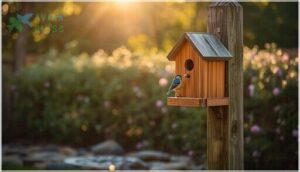
The direction your birdhouse faces matters more than you might think. Wind exposure, temperature swings, and sun intensity all affect whether birds choose to nest—and whether their chicks survive.
Let’s look at three key factors that’ll help you pick the best orientation for your setup.
Facing Entrances Away From Winds
Wind direction matters more than you might think when positioning your bird house. Face the entrance away from prevailing winds to keep drafts and rain out of the nesting cavity. This simple adjustment creates a stable microclimate inside, helping eggs stay warm and chicks thrive.
Proper entrance shielding also boosts predator deterrence by reducing moisture that attracts unwanted visitors, ultimately supporting better nesting success.
East or Southeast Orientation
Orienting your bird house entrance to the east or southeast gives you the best of both worlds—morning sun benefits without afternoon overheating. East orientation helps dry dew quickly and warms the cavity gradually, while southeast exposure maintains stable incubation temperatures throughout the day.
- Morning sunlight deters nocturnal predators lingering near the entrance
- Early warmth encourages breeding activity in late winter and spring
- Gentle sun angles reduce extreme heat that can harm nestlings
Sunlight and Shade Considerations
Beyond morning sun benefits and wind direction, you’ll want to balance dappled light needs across the entire day. Your bird house placement should capture four to six hours of gentle sunlight, ideally under a tree canopy that blocks harsh afternoon rays.
Seasonal sunpath shifts matter too—summer shade protects nestlings from overheating, while winter location adjustments let warming light reach the entrance during colder months.
Species-Specific Bird House Placement
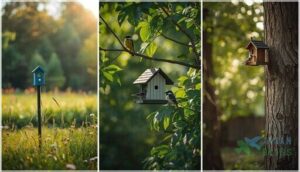
Not all birds look for the same kind of home. Bluebirds need open views, while woodpeckers want something high in the trees.
Here’s how to place houses for the species you’re most likely to attract.
Bluebirds
Bluebirds thrive when you give them the right setup from the start. These cavity nesters need an entry hole size of 1.5 inches and careful bird house placement that matches their bird species habits. Here’s what makes bluebird nesting boxes successful:
- Mount on poles 5 to 7 feet high in an open site with sparse nearby shrubs
- Use pole mounted bird house designs with predator guards to block climbing mammals
- Space boxes at least 100 yards apart for territorial spacing between pairs
- Face entrances away from prevailing winds toward open sky
- Choose sunny field edges over dense woodland for best visibility
Chickadees
Chickadees are a bit different from bluebirds. These small nesters use compact nesting boxes with 1.25-inch entry holes to keep larger birds out. Your hanging birdhouse works great at 4 to 8 feet high on tree trunks or poles. Place them in deciduous woodlands with moderate sun and keep them 10 to 20 feet from feeders so chickadees can enjoy peaceful breeding patterns.
| Chickadee Behavior | Birdhouse Design | Bird Habitat |
|---|---|---|
| Prefer compact spaces | 1.25″ entry hole | Deciduous woods |
| Use various nesting materials | Sloped roof needed | Moderate sunlight |
| Avoid feeder competition | Good drainage required | Tree trunk mounting |
| Territorial during breeding | Rough interior surface | 4-8 feet mounting height |
Wrens
Wrens love hiding in dense cover, so your hanging bird house works perfectly in sheltered thickets! Position the nest box 6 to 10 feet high with a compact 1.25-inch opening in morning sun and afternoon shade.
These energetic birds prefer unpainted wood with rough interiors for better grip.
Keep your wren habitat away from open lawns to protect nesting materials from mowing disturbances and improve bird safety while birdwatching.
Woodpeckers and Owls
Woodpecker habitat and owl nesting require larger birdhouse designs with sturdy construction. Mount boxes 8 to 15 feet high on trees or poles, using 1.25 to 1.5-inch entrances for woodpeckers, while owls need bigger openings.
Install in mature woodland edges where natural tree cavities are scarce. Metal flashing prevents water intrusion, and proper birdhouse installation promotes species coexistence in your nesting habitat!
Predator Protection and Safe Placement
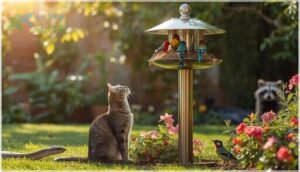
Even the best-placed bird house won’t help your feathered neighbors if predators can reach it. Cats, raccoons, and climbing snakes pose real threats to nesting birds and their eggs.
Here’s how to protect your bird house from unwanted visitors and give nesting families the safety they need.
Installing Predator Guards
Predator guards add a critical layer of nest box security that climbing prevention alone can’t provide. You’ll want to choose between tubular, conical, or cup-style entrance protection based on your pole-mounted birdhouse setup. These predator deterrents create a barrier that raccoons and snakes can’t grip or slide past.
- Install guards at least 4 feet high to block climbing predators from reaching the entrance
- Choose stainless steel or powder-coated hardware that won’t rust during multiple nesting seasons
- Check that the guard doesn’t obstruct your bird’s flight path or block the entrance opening
Distance From Cat Pathways
Cats prowl familiar routes to minimize exposure, so you’ll want at least 6 to 8 feet between your bird house and these pathways.
Position elevated boxes behind dense shrubbery or fence lines cats rarely cross, creating a natural buffer in your backyard.
If a cat’s shortcut sees heavy traffic, extend that distance to 10 feet—predator guards work best when location keeps predators from lingering nearby.
Secure and Stable Mounting
A wobbling bird house won’t protect nests from raccoons or snakes, so your mounting technique matters. Fasten pole-mounted bird house brackets with galvanized bolts rated for 10 pounds to resist wind gusts, and anchor tree trunk installations into solid wood.
Run stability tests by applying gentle pressure—if it shifts, tighten fasteners immediately. Hardware selection determines whether your setup lasts one season or ten.
Maintaining Bird Houses After Installation
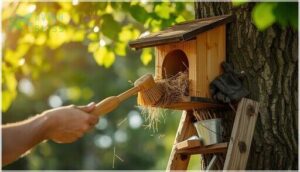
Getting your bird house installed is just the beginning. A little upkeep throughout the year keeps it safe, clean, and ready for the next family of birds.
Here’s what you need to do to maintain your bird house after it’s up.
Cleaning Between Broods
Once the first brood fledges, your nest box maintenance begins. Cleaning between broods isn’t just good housekeeping—it’s essential nest sanitation that prevents disease and encourages reuse throughout the nesting season.
Here’s your brood cycle cleaning checklist:
- Remove old nesting materials and debris to reduce mold growth and discourage pest buildup.
- Scrub the interior with mild soap solution and rinse thoroughly for pheromone removal.
- Let the box dry completely in a warm, shaded area before reassembling.
- Inspect and replace any damaged wood panels to maintain proper nesting habitat conditions.
- Sanitize cleaning tools, perches, and screws to prevent cross-contamination between nest box installations.
This simple maintenance routine keeps your nesting boxes ready for the next family.
Annual Stability Checks
After cleaning between broods, your pole-mounted birdhouse needs an annual stability check before the next nesting season. Inspect the mounting hardware for rust or loosening, test wind resistance with a gentle shake, and confirm the location maintains proper alignment.
Tighten brackets to manufacturer specs, evaluate weather-worn components, and document your maintenance scheduling. A stable mount protects nesting families all season long!
Preparing for Nesting Season
Once you’ve confirmed your hardware is solid, focus on getting nest boxes ready before breeding begins. Late winter is your sweet spot for preparation—southern yards by February, northern zones by mid-to-late March.
Here’s what readiness looks like:
- Clear out old nesting materials and debris completely
- Seal cracks larger than 1/4 inch to keep drafts out
- Confirm drainage holes haven’t clogged with dirt
- Test ventilation openings for proper airflow
- Document which bird species used each box last year
This seasonal timing gives nesting birds clean, safe homes exactly when they need them!
Frequently Asked Questions (FAQs)
Should birdhouses be hung or mounted?
It’s not a one-size-fits-all answer. Mounting options depend on your bird species and yard setup.
Pole mounted bird house installations offer sway reduction and easier predator guards, while hanging styles suit lightweight cavity nesters.
Can I place multiple bird houses near each other?
You can place multiple bird houses near each other if you space them 15 to 30 feet apart.
This nesting density reduces competition while letting different bird species coexist in your backyard cluster placement.
Do different bird species share the same house?
It’s almost unheard of, but different bird species can share a nest box when competition for cavities runs high.
Mixed flocks rarely coexist inside one house—dominant birds usually claim the space first.
What materials are safest for mounting bird houses?
You’ll want non-toxic woods like untreated cedar, rust-resistant metals for pole mounting, and galvanized fasteners.
Avoid pressure-treated lumber and plastics that trap heat, ensuring your bird house location remains safe and eco-friendly year-round.
How does weather affect bird house placement decisions?
Weather patterns shape your placement strategy through rainfall impact, temperature control, and wind protection. Climate zones determine sunlight exposure needs, while pole mounting height and location provide stability during storms and seasonal temperature swings.
Should I relocate a bird house mid-season?
Don’t touch an active nest—abandonment risk is real. Parental stress spikes when you move a bird house mid-season, especially for species like bluebirds. Wait until after fledging, then choose your new site carefully.
Conclusion
Think of your birdhouse like a vacant apartment—only the right location attracts tenants who’ll stay. When you understand where to hang bird houses in your yard, you’re not just decorating; you’re creating habitat that meets real survival needs.
Height, orientation, predator protection, and species preferences all work together. Get those details dialed in, and you’ll transform that empty wooden box into a nursery humming with new life each spring.