This site is supported by our readers. We may earn a commission, at no cost to you, if you purchase through links.
Right now, somewhere above you, a tiny warbler—weighing less than half an ounce—is flying 3,000 miles from the Arctic to Central America without stopping to sleep. Billions of bird species with seasonal migration pull off these jaw-dropping journeys twice a year, finding their way by stars and magnetic fields across entire continents.
But here’s the catch: these ancient flyways are collapsing faster than ever. Climate shifts are scrambling arrival times, glass towers turn migration corridors into death traps, and critical stopover habitats vanish under pavement each season. Understanding which species migrate—and what they need to survive the journey—isn’t just fascinating ornithology. It’s the difference between witnessing one of nature’s greatest spectacles and watching it disappear.
Table Of Contents
- Key Takeaways
- What is Seasonal Bird Migration?
- Key Bird Species With Seasonal Migration
- Major Migration Flyways Worldwide
- Triggers for Seasonal Bird Migration
- Navigation Strategies of Migratory Birds
- Adaptations for Long-Distance Migration
- Migration Timing and Seasonal Patterns
- Threats Facing Migratory Bird Species
- Conservation Efforts for Migratory Birds
- Birdwatching Tips for Observing Migrants
- Frequently Asked Questions (FAQs)
- Conclusion
Key Takeaways
- Roughly 5 billion birds migrate annually along predictable flyways using celestial navigation, magnetic field detection, and learned routes passed down through generations—yet habitat loss, light pollution, and climate change are collapsing these ancient corridors faster than species can adapt.
- Migration timing hinges on photoperiod triggers and food availability rather than temperature alone, but climate change is advancing spring arrivals by 1-2 days per decade while accelerating insect emergence even faster, creating dangerous mismatches between hungry fledglings and peak food sources.
- Birds physically restructure their bodies for migration—tripling body mass, developing specialized wing morphology for efficiency, and using V-formation flight to reduce drag by 29 percent—while behavioral adaptations like nocturnal flight and strategic stopover refueling enable journeys exceeding 3,000 miles without sleep.
- Effective conservation requires coordinated international agreements protecting wetland stopover sites across entire flyways, combined with local actions like reducing window collisions, managing outdoor lighting during peak migration windows, and supporting citizen science programs that track real-time population shifts.
What is Seasonal Bird Migration?
Every year, roughly 5 billion birds travel thousands of miles across continents—and it’s one of nature’s most precise survival strategies.
These journeys follow predictable routes called flyways, and tracking seasonal shifts in bird populations helps scientists understand how climate and habitat changes affect migration timing.
Every year, 5 billion birds execute one of nature’s most precise survival strategies, traveling thousands of miles across continents
Seasonal migration isn’t just wandering; it’s a timed biological rhythm driven by breeding needs, food scarcity, and shifting climates.
Here’s what defines this phenomenon, how migration cycles play out, and why birds stake their lives on these journeys.
Definition and Overview
Seasonal bird migration—the rhythmic pulse of avian movement across hemispheres—defines how bird species respond to seasonal shifts by traveling between breeding and nonbreeding grounds. You’re witnessing a biological marvel driven by seasonal cues like day length and temperature that funnel billions of individuals through flyway networks each year, connecting ecosystems and shaping conservation status worldwide.
- Birds exploit resource abundance in destination habitats
- Migration patterns repeat along traditional corridors
- Energy conservation drives route selection
- Learned behavior sustains flyway fidelity across generations
Annual Migration Cycles
You’re watching a year-round choreography—spring migration from March to May propels birds northward along flyways to breeding grounds where photoperiod and food availability peak.
Meanwhile, fall migration from August to October reverses the journey as daylight shortens and seasonal cues trigger fat accumulation. These migration patterns operate on precise timing, synchronizing breeding schedules with habitat resources and weather shifts across hemispheres.
For a deeper look at how these cycles influence bird populations, explore the full annual cycle of migratory birds.
Benefits of Migration
Migration delivers economic growth—5 billion birds transport nutrients across continents, fertilizing ecosystems that underpin agriculture and fisheries worth billions annually.
But here’s the thing: these journeys also generate social benefits through ecotourism, knowledge transfer via citizen science tracking migration patterns, and environmental resilience as birds disperse seeds and control pests.
Seasonal shifts in bird populations signal habitat health, making conservation efforts and habitat preservation essential for sustaining these natural services you depend on.
Key Bird Species With Seasonal Migration

Every spring and fall, you’ll witness one of nature’s greatest spectacles—billions of birds crossing continents in search of food, breeding grounds, and survival. But here’s the thing: not all migrants follow the same playbook.
Some species cover thousands of miles nonstop while others island-hop along coastlines, and understanding which birds migrate—and how—reveals the astonishing variety within this ancient ritual.
Songbirds
Warblers and other songbirds travel thousands of kilometers between breeding forests and wintering grounds—but here’s the catch: nocturnal migration exposes them to predators and exhaustion.
You’ll witness their survival strategy at stopover sites, where they refuel on insects during seasonal shifts. Bird populations rely on three critical phases:
- Spring’s rapid fueling with frequent migratory hops along flyways
- Fall’s longer flights with strategic stopover fueling
- Night journeys that define warbler migration patterns
Many birds depend on key migration patterns and records that span thousands of miles and test the limits of avian endurance.
Waterfowl
Geese and ducks travel thousands of miles from northern breeding grounds to southern wintering grounds—but here’s the thing: waterfowl habitat along flyways determines survival.
You’ll see their flocking behavior in V-shaped formations that conserve energy during daytime flights, while feather adaptations and body mass tripling prepare them for crossing barrier regions.
Wetland conservation protects stopover sites where bird populations refuel along migration patterns shaped by open water and aquatic plants.
Raptors
Hawks and falcons soar on thermals to conserve energy—eagles gain altitude through rising air currents that optimize ground speed along traditional flyways.
Raptor migration depends on predictable autumn wind shifts for efficient passage across barrier regions like deserts, while hawk behavior shows juveniles learning routes from experienced adults.
Falcon conservation protects these bird populations traveling thousands of miles through eagle habitat shaped by thermal dynamics and bird navigation strategies.
Shorebirds
Sandpipers and plovers triple their body mass before crossing ocean gaps—coastal migration relies on intertidal zones where shorebird habitat provides essential fuel at stopover sites shaped by tidal patterns.
Flocking behavior during these journeys follows repeatable migration patterns along flyways, but here’s the catch: habitat loss at mudflats threatens feather adaptation strategies and energetic flights from Arctic breeding grounds to tropical winters.
Major Migration Flyways Worldwide
Every year, billions of birds follow invisible highways in the sky—routes shaped by geography, food, and millions of years of evolution.
These migration corridors, called flyways, span entire continents and connect breeding grounds to wintering habitats thousands of miles apart. Here’s how the world’s major flyways guide birds across North America, Europe, Asia, and Africa.
North American Flyways
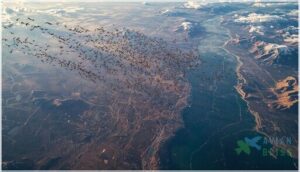
You’ll encounter four major North American flyways that guide roughly 5 billion birds annually—the Mississippi, Central, Atlantic, and Pacific routes connecting Arctic breeding grounds to tropical wintering habitats.
These migration patterns funnel waterfowl, songbirds, and shorebirds through critical stopover sites along river valleys, coastlines, and wetlands, where bird populations refuel before continuing their journey. Flyway conservation depends on protecting these essential bird habitats.
European and Asian Routes
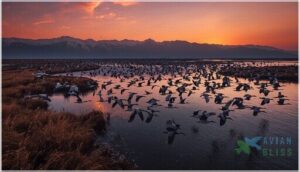
You’ll track millions of birds along the East Atlantic Flyway—stretching from Arctic Russia and Scandinavia down to Western Europe and North Africa—while the Central Asian Flyway connects Russia’s interior to the Indian Ocean rim.
European birding hotspots and Asian migration corridors depend on stopover ecology at Mediterranean and Black Sea wetlands, where bird populations refuel during cross-continental journeys. Route flexibility lets migrants adjust paths when weather shifts or stopover sites degrade.
African Migration Corridors
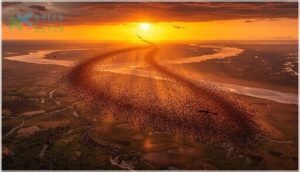
You’ll find one of the world’s most dramatic bird migration spectacles along the African-Eurasian flyway—connecting Greenland and Europe to sub-Saharan Africa through the Sahel Migration belt and savanna routes.
West Africa wetlands and the Nile Delta anchor these migration routes for waterbirds and shorebirds:
- Pulse migrations track seasonal rains across West African mangroves
- Raptors ride thermal columns over Rift Valley corridors
- Shorebirds depend on inland lakes and coastal estuaries
- Conservation efforts protect drought-refuge habitats across the Sahel
- Savanna routes support millions of passerines moving between continents
Triggers for Seasonal Bird Migration

Birds don’t just wake up one morning and decide to fly 5,000 miles—there’s a biological orchestra at work.
Your body runs on circadian rhythms, and birds operate on seasonal cues that override everything else when the time is right.
Here’s what actually flips the switch and sends millions of birds racing across continents.
Changes in Daylight (Photoperiod)
You might think migration timing is all about temperature—but here’s the catch: day length changes drive the whole show.
As solar cycles march forward each spring, your backyard songbirds sense longer daylight cues through their eyes and brain, triggering hormonal shifts that fuel migratory restlessness. This photoperiodism operates like a master clock, synchronizing circadian rhythms with breeding schedules and ensuring birds arrive exactly when food peaks.
Temperature Shifts
But here’s the thing—temperature cues add a second layer of precision to migration timing. Warming spring air boosts insect activity and plant growth, signaling your northward travelers that breeding grounds are ready.
Cool fronts often delay departures until favorable conditions return, while thermal gradients create updrafts that slash energy costs during flight. Climate change is scrambling these seasonal fluctuations, advancing or disrupting migration windows across flyways.
Food Availability
Here’s the catch—food availability dictates when birds actually move. Insect emergence in spring delivers protein for nestlings, while fruit flushes at stopover sites fuel long-distance travelers.
Seasonal plankton blooms draw shorebirds along coastal flyways, and agricultural crops create predictable feeding pockets. When food sources crash at wintering grounds, your migrants depart earlier to exploit breeding season nutrient cycles elsewhere.
Navigation Strategies of Migratory Birds

Birds navigate thousands of miles with astonishing precision, relying on tools you can’t see and instincts honed over millennia.
They read the planet’s magnetic lines, follow the arc of stars across the sky, and memorize landscapes passed down through generations.
Here’s how these extraordinary travelers find their way across continents without a map.
Magnetic Field Orientation
Birds tap into Earth’s invisible highway—magnetic field lines running pole to pole—to find their way across thousands of miles. Here’s how avian navigation works through magnetite mechanisms and compass calibration:
- Magnetite-containing cells in the upper beak detect field angle and intensity for directional cues
- Field inclination shifts with latitude help birds distinguish north-south positioning during flight
- Magnetic cues integrate with other sensory inputs to fine-tune migratory routes across continents
- Birds recalibrate their internal compass at reliable landmarks when local geological anomalies disrupt readings
- Displacement experiments confirm species-specific reliance on magnetic information throughout different life stages
But here’s the catch—magnetically quiet corridors offer clearer passage, which is why many species prefer certain flyways over magnetically chaotic terrain.
Celestial and Visual Landmarks
When twilight paints the horizon blue, you’re witnessing the same navigational canvas birds use across global flyways.
Star patterns like Orion’s Belt and the North Star—paired with the sun’s shifting east-west arc and lunar phase cycles—create celestial mapping tools for avian navigation and migration.
But here’s the thing: visual cues from mountain silhouettes and coastal headlands anchor solar orientation when stars fade at dawn.
Learned Migration Routes
Experience sculpts the flight paths your backyard warblers take each spring—because juvenile birds progressively hone migration routes after their first dispersal journeys. Here’s the catch: learned corridors improve flight efficiency through:
- Shortened distance by favoring direct segments and favorable wind currents
- Precise timing as individuals memorize ideal departure windows across flyways
- Reliable stopover choices that consistently replenish energy along migratory bird migration patterns
Adults demonstrate higher route fidelity, repeating proven habitat selection strategies season after season.
Adaptations for Long-Distance Migration

Migrating thousands of miles isn’t just about willpower—birds literally reshape their bodies and behaviors to survive the journey. From hollow bones that shave off precious grams to sleep patterns that let them rest mid-flight, these adaptations turn an impossible feat into an annual routine.
Here’s how birds pull off one of nature’s most demanding endurance tests.
Physical Adaptations
You’ll notice migratory birds engineer their bodies like ultralight aircraft—long, tapered wings slash air resistance while down feathers trap heat during nocturnal crossings. Wing morphology directly impacts cardiovascular efficiency, enabling species to sustain 25-hour flights across open ocean.
Fat reserves accumulate near flight muscles, boosting body buoyancy and fuel economy. Feather insulation preserves core temperature at 15,000 feet, where avian ecology demands peak endurance from every seasonal migration.
Behavioral Adjustments
Here’s the thing: you’ll watch entire flocks overhaul their social dynamics mid-migration—shifting from solitary hunters to tight roosts for protection and social learning.
Dietary changes track food windows with precision, while migration flexibility lets warblers adjust routes when weather fronts appear. These seasonal behavioral changes sustain avian ecology across thousands of miles, maintaining ecological balance through constant adaptation.
Energy Conservation Techniques
Birds perfect energy conservation through renewable energy strategies borrowed from their own physiology—fat reserves fuel 90 percent of migration flights, while V-formation flight slashes drag by up to 29 percent for trailing individuals.
You’ll observe thermals and tailwinds exploited like natural smart grids, letting raptors glide hundreds of miles with minimal effort. These bird migration patterns showcase sustainable living at its finest, conserving energy across entire flyways.
Migration Timing and Seasonal Patterns

Birds don’t just show up randomly—they move on a clock refined over millennia.
Timing depends on whether they’re chasing breeding opportunities or escaping winter’s grip, and those schedules are shifting faster than ever.
Here’s what drives the rhythm of migration across spring, fall, and a warming world.
Spring Vs. Fall Migration
Spring and fall journeys reveal drastically different migration patterns—you’ll notice spring migration timing accelerates as birds race to claim prime breeding territories. Here’s the catch: fall seasonal movement unfolds more gradually because survival, not courtship, drives the pace.
- Spring flights occur at night to dodge predators and heat stress
- Fall stopovers last longer to build critical fat reserves
- Seasonal cues like photoperiod shifts trigger both cycles
- Climate impact now advances spring arrivals 1-2 days per decade
Flyway dynamics shift with the seasons—spring routes prioritize speed while fall bird behavior emphasizes energy conservation and strategic refueling stops.
Breeding and Wintering Schedules
You’ll see breeding windows open when day length hits critical thresholds—most songbirds begin nest construction and courtship 4 to 6 weeks before eggs appear.
Fledging patterns unfold fast: passerine chicks gain independence 10 to 20 days post-hatch, then adults shift their focus to wintering grounds where loose flocks exploit reliable food along familiar flyways.
Climate Change Effects
But here’s the catch—climate change is rewriting everything you just learned about breeding timing and migration schedules. Warmer springs advance egg laying by several days in temperate species, yet insect emergence accelerates even faster, creating mismatches between hungry fledglings and peak food.
Temperature impacts also delay fall departures in some populations, compressing the entire migratory calendar and forcing birds into riskier weather windows.
Threats Facing Migratory Bird Species

Migratory birds face an uphill battle—one where their ancient journeys collide with modern hazards that didn’t exist when their routes first evolved.
You’ll find that human activity creates three major roadblocks along these flyways, each one capable of decimating populations before they reach their destinations. Here’s the catch: these threats often work together, multiplying the danger at critical stopover sites where birds are already exhausted and vulnerable.
Habitat Loss
Your biggest enemy in bird migration isn’t weather—it’s habitat loss. Deforestation impacts and urban expansion erase the stopover sites that fuel long journeys, while wetland degradation drains the refueling stations shorebirds desperately need.
Here’s what fragmented landscapes steal from migrants:
- Coastal erosion eliminates nesting grounds
- Agricultural intensification limits foraging resources
- Pollution degrades remaining habitats
Conservation efforts and habitat preservation can’t wait.
Light Pollution
Artificial lighting in cities pulls nocturnal migrants off course—you’ve probably watched confused warblers circling streetlights at 2 a.m. Urban glow disorients birds during seasonal migration, causing exhaustion that kills thousands during peak windows.
Here’s the breakdown of nocturnal disruption:
| Light Source | Impact on Migratory Birds | Sky Glow Reduction Strategy |
|---|---|---|
| Skyscraper facades | Repeated collisions, energy depletion | Motion-sensor exterior lights |
| Coastal lighthouses | Attraction leading to fatal strikes | Seasonal dimming protocols |
| Offshore platforms | Seabird disorientation in corridors | Shielded downward fixtures |
| Urban streetlamps | Route deviation, delayed arrival | Amber spectrum bulbs |
Light mitigation means turning off what you don’t need—simple, lifesaving, effective.
Collisions and Predation
Collision risks during bird migration stack up fast—you’re watching entire populations face daily gauntlets of glass, steel, and spinning blades. Window strikes and wind turbine mortality combine with intensified predation from domestic cats to hammer migratory birds at critical stopover sites, while light pollution funnels exhausted flocks into deadly zones where habitat preservation can’t counteract wildlife conservation failures.
Key collision and predation drivers:
- Glass facades and skyscrapers — Reflective surfaces mimic open sky, causing fatal strikes during peak migration windows when birds navigate urban corridors at high speeds.
- Wind turbines in flyways — Rotating blades create invisible hazards that kill thousands of raptors and songbirds annually, especially during nighttime transits through energy-development zones.
- Domestic cat predation — Free-roaming pets at habitat edges increase nest mortality and adult kills, disrupting bird populations already stressed by long-distance journeys and limited refueling opportunities.
Conservation Efforts for Migratory Birds
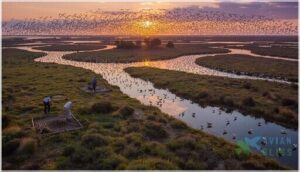
After decades of decline, migratory bird populations are finally getting the coordinated protection they need—but here’s the catch: success depends on action across continents, communities, and countless stopover sites.
You’ll find conservation efforts operating at three distinct scales, from protected habitats spanning hemispheres to backyard initiatives that reshape how birds survive their journeys. Let’s break down the strategies that are keeping migration corridors open and populations resilient.
Habitat Preservation Initiatives
You can’t save a migratory species if you’ve destroyed the places it needs to survive—that’s why habitat preservation sits at the heart of every effective conservation strategy.
Wetland restoration brings back essential stopover zones where waterfowl refuel on invertebrates and aquatic plants, while urban green corridors reconnect fragmented landscapes and reduce collision risks through strategic light management and native plantings that support ecological balance.
International Agreements
When birds cross borders—so do the treaties that protect them. Global cooperation through environmental accords channels resources into migratory bird conservation, linking distant nations through shared commitments to wildlife protection and climate change impact mitigation.
You’ll find these international governance frameworks shaping conservation strategies wherever bird migration patterns demand synchronized action:
- The Ramsar Convention safeguards critical wetland stopover zones across 172 signatory countries
- The Bonn Convention coordinates treaty enforcement for over 600 migratory species worldwide
- Bilateral partnerships—like the U.S.–Canada Migratory Bird Treaty—enforce habitat standards and hunting regulations that span entire flyways
Here’s the thing: wildlife conservation efforts only succeed when nations honor binding obligations.
Community and Citizen Science
You don’t need a PhD to track bird migration—just binoculars and a smartphone. Citizen science programs like eBird transform birdwatching into data contribution, where your volunteer training feeds researchers real-time arrival patterns across flyways.
Community projects forge partnership models linking schools with conservationists, while policy influence emerges when local observations document habitat loss—proving wildlife conservation efforts and ecological balance depend on everyday eyes watching the skies.
Birdwatching Tips for Observing Migrants

Watching migrants in flight is one of nature’s rewards—but timing and location make all the difference.
You’ll need sharp identification skills to separate a vagrant warbler from a year-round resident, plus a few ethical guidelines to keep your observations respectful.
Here’s what you should know about maximizing encounters while minimizing your impact.
Best Times and Locations
You’ll catch peak migration patterns from March to May during spring and August through November in fall—timing matters as much as location.
Focus your efforts at wetlands, marshes, and coastal estuaries where flyway routes converge and stopover sites teem with activity.
Dawn and late afternoon offer prime viewing windows when birds refuel along seasonal bird migration corridors before resuming their epic journeys.
Identifying Migratory Species
You’ll spot migratory birds more reliably by tracking plumage patterns—white wing patches on warblers and bold throat markings on breeding thrushes reveal identity along flyway corridors.
Here’s the catch: juvenile feathers differ drastically from adults, so check these migration cues:
- Beak shapes distinguish flycatchers from warblers at stopover sites
- Feather colors shift between breeding and wintering plumage
- Tail patterns separate near-identical species profiles during peak migration routes
- Underpart brightness signals tropical versus temperate bird species
Ethical Birdwatching Practices
After identifying your target species, you’ll protect them through responsible tourism—maintaining 10 to 30 meters from songbirds prevents nest stress and aids wildlife conservation at critical stopover habitats.
Here’s what sustainable birding demands: avoid playback calls that exhaust migrants, stay on trails to preserve bird-friendly habitats, and share sightings without revealing sensitive roost coordinates—these eco-tourism practices directly fuel conservation efforts protecting 5 billion birds annually.
Frequently Asked Questions (FAQs)
How do juvenile birds learn their first migration route?
Juveniles depart on instinct alone—yet they won’t survive without learning.
Your young birds blend genetic compass cues with social tutoring from adults, refining routes across multiple trips as celestial landmarks and magnetic fields sharpen their migratory behavior.
What percentage of migratory birds survive the journey?
Survival rates vary widely—about 64 percent of short-distance migrants return annually, while long-distance travelers face tougher odds.
Mortality factors like habitat loss, stopover impact, and climate mismatches reshape bird populations each season.
Do all birds within a species migrate together?
Not even close—individuals within a species scatter departures across days or weeks, with males often leading, first-year birds trailing behind, and some stragglers choosing entirely different routes based on experience and local conditions.
How has urbanization changed traditional migration stopover sites?
Urbanization converts wetlands and grasslands into roads and buildings—destroying stopover sites where migrating birds refuel.
Artificial light disorients nocturnal migrants, while habitat fragmentation forces longer flights and increases predation risk.
Can migratory birds adapt to entirely new flyways?
You can teach an old bird new tricks—migratory species show impressive route flexibility, rerouting around barriers and exploiting new stopovers when climate change reshapes their traditional flyways, demonstrating flyway adaptation and migration resilience.
Conclusion
Like ancient mariners reading stars across open seas, bird species with seasonal migration navigate continents through signals we’re only beginning to decode.
But here’s the thing—every glass tower we light and wetland we pave rewrites their maps mid-flight. You’ve now got the field guide to their triggers, flyways, and fragile stopover networks.
The question isn’t whether these journeys will continue—it’s whether we’ll protect the routes that make them possible.