This site is supported by our readers. We may earn a commission, at no cost to you, if you purchase through links.

A bar-tailed godwit doesn’t carry a GPS when it flies 7,000 miles nonstop from Alaska to New Zealand, yet it arrives within a few miles of the same coastal mudflat each year. This precision isn’t luck—it’s the result of a complex navigation system that combines celestial compasses, magnetic field detection, and something more tangible: the landscape itself.
Mountains, rivers, and coastlines become reference points etched into spatial memory, forming what ornithologists call a mental atlas. While magnetic and celestial cues set a bird’s general heading, visual landmarks provide the fine-tuning that separates survival from exhaustion over open water.
Understanding how bird migration and visual landmarks work together reveals not just an evolutionary marvel, but also why protecting certain landscapes matters more than you might think.
Table Of Contents
- Key Takeaways
- How Birds Navigate During Migration
- Role of Visual Landmarks in Migration
- Integration of Compass Systems
- Interplay of Visual and Non-Visual Cues
- Impacts of Habitat Change on Navigation
- Frequently Asked Questions (FAQs)
- What landmarks can birds use when migrating?
- Do birds sense magnetic fields?
- What are two navigational strategies used by birds to migrate?
- How do birds navigate during foggy conditions?
- What happens when migrating birds cross oceans?
- Do all bird species use the same landmarks?
- How do urbanization and light pollution affect migration?
- Can birds adjust routes when traditional paths disappear?
- Conclusion
Key Takeaways
- Migratory birds integrate multiple navigation systems—magnetic field detection, sun and star compasses, and visual landmarks like coastlines, rivers, and mountain ranges—to achieve pinpoint accuracy across thousands of miles, with experienced adults refining inherited directional instincts through spatial memory built over repeated journeys.
- Visual landmarks serve as essential fine-tuning tools that complement celestial and magnetic cues, allowing birds to calibrate their internal compasses against recognizable geographical features and build mental atlases that guide them to the same stopover sites and breeding grounds year after year.
- Habitat destruction, light pollution, and landscape fragmentation directly compromise navigation success by erasing the visual reference points birds depend on, causing route deviation, increased energy expenditure, higher mortality during barrier crossings, and reduced reproductive success when disoriented migrants arrive late to breeding territories.
- Conservation of migratory corridors isn’t just about preserving habitat—it’s about maintaining the visual scaffolding that makes long-distance navigation possible, with protected flyways, wetland restoration, and bird-friendly lighting policies serving as critical interventions to safeguard the geographical features that guide millions of birds across hemispheres.
How Birds Navigate During Migration
Bird migration spans thousands of miles, and you might wonder how these creatures find their way across unfamiliar terrain, open oceans, and shifting landscapes without getting lost. The answer lies in an intricate navigational abilities toolkit, some hardwired from birth and others refined through experience.
Their journeys are timed with seasonal shifts, as birds changing habitats seasonally move between regions to find food, breed, and escape harsh weather.
Let’s explore the core challenges migrants face, how innate and learned skills combine to guide their journeys, and the primary cues they rely on to stay on course.
The Challenges of Long-distance Migration
Long-distance travel tests birds to their limits. Bar-tailed godwits burn half their body weight crossing 10,000 kilometers nonstop, while songbirds face energy demands that force them to double their mass before departure.
Weather hazards like sudden storms cause mass die-offs, and collision risks from towers and buildings kill millions yearly. Habitat fragmentation removes essential stopover sites, turning migratory routes into exhausting gauntlets.
Innate Versus Learned Navigation Abilities
Young birds don’t start from scratch. Many inherit innate directional knowledge encoded in their genes, a genetic predisposition that steers first-time migrants toward the right continent without guidance.
Blackcap warblers show this pattern clearly, with hybrids splitting the difference between parent routes. Yet learned navigation builds on these innate abilities over time.
Adults hone migration patterns through spatial memory, layering visual navigation onto inherited compasses and turning rough bearings into precise pathways you’d recognize year after year.
Overview of Primary Navigational Cues
Once you understand that innate ability sets a baseline, you’ll see that birds layer multiple navigational cues into every journey. They read polarized light patterns, track magnetic field gradients, follow geographical features like coastlines, and even rely on olfactory maps built from atmospheric scent.
Homing instinct combines visual cues and landmarks with acoustic hints, creating a backup system whenever one compass fails during bird migration.
Recent research demonstrates the importance of specific brain regions associated with visual cues in supporting avian navigation.
Role of Visual Landmarks in Migration
You might think birds rely entirely on compasses built into their biology, but many species use what they can actually see on the ground to stay on track.
Many birds that migrate over water combine these visual cues with their magnetic sense to navigate safely across featureless ocean stretches.
Mountains, rivers, coastlines, and even patches of forest serve as recognizable markers that help birds confirm they’re heading the right way. Understanding which landmarks matter and how birds remember them reveals just how visual migration can be.
Types of Visual Landmarks Used by Birds

You’ve probably noticed tall buildings or mountains on road trips—birds rely on similar geographical features as navigational cues.
Coastal features like shoreline contours and estuaries form sharp visual bands, while river corridors such as the Mississippi guide migrants over hundreds of miles. Urban skyscapes including towers and bridges act as vertical landmarks visible from kilometers away.
Mountain ridges, wetlands, and even artificial lights complete the toolkit birds use to stay on course during migration. In addition, many species use landmarks navigation strategies to help maintain the right direction during their long journeys.
Landscape Features Guiding Migratory Routes

River Valleys like the Mississippi align north to south, channeling millions of migratory birds along continuous corridors that match their flight direction.
Coastal Routes trace shorelines from Canada to South America, while Mountain Passes funnel soaring species through low gaps in ridges.
Wetland Chains create repeating visual targets for refueling, and Urban Landscapes now mark many historic flyways, shaping modern bird migration and navigation patterns.
Recognition and Memory of Landmarks

Birds rely on spatial memory in birds to build a mental atlas of reference points along familiar routes. The avian hippocampus stores these detailed spatial maps, binding visual cues to specific directions and distances that improve route optimization over repeated journeys.
- Panorama Recognition: Birds identify locations by skyline patterns and overall visual arrangement, not single features
- Memory Formation: Repeated flights through the same region strengthen location recall and navigation accuracy
- Experience Matters: Juveniles start with inherited compass directions, then gradually replace them with learned shortcuts anchored to remembered scenes
This interplay between innate migratory behavior and learned spatial mapping lets experienced adults navigate curved paths that avoid danger.
Integration of Compass Systems

You might assume birds rely on a single navigation tool, like a GPS with one signal source, but the reality is far more complex.
Migratory species integrate multiple compass systems—solar, celestial, and magnetic—to maintain accuracy across thousands of miles. Let’s examine how each of these systems functions and contributes to successful navigation.
Sun Compass and Circadian Rhythms
Day-flying migrants rely on a sun compass that combines solar orientation with circadian clocks to hold a steady course. Your internal circadian rhythm lets you track the sun’s shifting position throughout the day, compensating for its arc across the sky.
This time compensation allows daily rhythms to calibrate directional sensing, so even when the sun moves 180 degrees from dawn to dusk, bird migration navigation remains precise and unwavering.
Stellar Navigation and The Use of Stars
When darkness falls, many nocturnal migrants switch to a celestial compass that reads celestial navigation patterns overhead.
Night sky orientation depends on three notable adaptations:
- Young birds learn star pattern recognition by watching rotation around Polaris during their first weeks.
- The celestial pole acts as a fixed north reference throughout the night.
- Species like indigo buntings prioritize astronomical cues over conflicting directional information when stars are visible.
Magnetic Field Detection and Orientation
Perhaps the most complex compass system in avian navigation relies on magnetoreception, where cryptochrome proteins in your eye’s retina detect Earth’s magnetic field through light-activated chemical reactions.
You sense the inclination angle—how steeply field lines tilt relative to the horizon—rather than true north. This geomagnetic sense operates alongside magnetite-based receptors in your beak that build a magnetic map by reading intensity variations across landscapes.
Interplay of Visual and Non-Visual Cues

You’ve seen how birds rely on different compass systems—sun, stars, and magnetic fields—to guide their journeys across continents.
But here’s the thing: these tools don’t work in isolation. Birds constantly cross-check visual landmarks against their internal compasses, use backup cues when conditions shift, and adapt on the fly to find their way through landscapes that keep changing beneath their wings.
Calibrating Compass Systems With Landmarks
Think of calibration as a reality check for your bird’s internal compass systems. When migratory songbirds reach the sunset horizon each evening, they align their magnetic compass with that glowing western reference point—an essential step in route refining.
This key calibration process helps you understand how visual cues and compass alignment work together, enabling precise geographic mapping as birds navigate long distances.
Use of Multiple Cues for Route Accuracy
Birds don’t rely on a single navigational cue—they weave together sun, stars, magnetic field, and visual landmarks into what scientists call multi-cue systems. This cue integration creates sensory mapping across thousands of kilometers, giving your migratory songbirds navigation flexibility when clouds hide celestial orientation mechanisms or crosswinds push them sideways.
Route optimization happens because each bird migration navigation method acts as a backup, keeping these travelers accurate even when one signal fails.
Adaptations for Navigation in Changing Environments
Route flexibility means you’re watching Climate Resilience in action. When drought reshapes wetlands or cities replace forests, Adaptive Migration kicks in through Key Updates—birds swap out lost rivers for new ridges, reweight their magnetic sense against fading visual system inputs, and adjust environmental cues mid-journey.
This Cue Reweighting lets navigational cues for birds shift with landscapes, keeping bird migration navigation accurate across decades of change.
Impacts of Habitat Change on Navigation
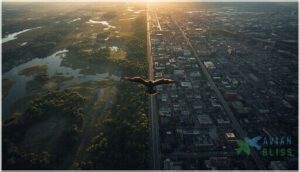
When landscapes shift, birds face a navigation crisis that can throw entire migration routes into disarray.
Deforestation, wetland drainage, and urban sprawl don’t just remove habitat—they erase the visual landmarks that generations of migrants have relied on to find their way. Understanding these impacts, their consequences, and what conservation efforts can do about them reveals how fragile these ancient navigation systems really are.
Effects of Altered or Lost Landmarks
When familiar reference points vanish, you’ll see dramatic changes in bird navigation strategies. Migratory birds encounter route deviation after habitat fragmentation removes visual reference points, forcing detours that add costly kilometers.
Skyglow pollution washes out natural horizon cues, while terrain disruption from deforestation creates visual obstacles. Pigeons traversing altered terrain show less direct paths, and geese tracked in Minnesota became disoriented when a single prominent feature tree fell.
Light pollution and habitat loss erase the visual landmarks birds need to navigate, causing measurable disorientation and longer, less direct migration paths
Consequences for Migration Success
Navigation errors ripple through every stage of the journey, shaping survival rates and reproductive success in ways you mightn’t expect.
Migrants that lose their way often land in habitat fragments with poor food supply, burning precious fat reserves while searching for the next reference point.
Young birds straying from established migration patterns face the highest mortality during barrier crossings, and individuals arriving late to breeding grounds lose access to prime territories, cutting their nesting success even when they survive the flight.
Conservation Efforts to Preserve Migratory Corridors
Across continents, conservation efforts now target the visual scaffolding that migratory birds depend on to complete their journeys. You’ll find strategies that restore the navigational aids these travelers need.
- Protected Flyways link breeding and wintering grounds across more than 20 countries, safeguarding critical migration patterns.
- Habitat Restoration rebuilds wetland chains where waterbirds rest and refuel along migratory corridors.
- Bird Friendly Lighting policies reduce disorientation by dimming artificial light during peak migration.
- International Agreements coordinate actions across 119 countries to preserve stopover sites.
- Conservation Partnerships mobilize billions in finance to maintain visual landmarks that guide navigational aids.
Frequently Asked Questions (FAQs)
What landmarks can birds use when migrating?
In terms of finding their way, migratory birds don’t wing it—they follow mountain ranges, coastal edges, river systems, urban skylines, and forest boundaries as reliable navigational aids for orientation.
Do birds sense magnetic fields?
Yes, you can think of birds as living compasses—many species sense Earth’s magnetic field through magnetoreception.
They detect field inclination using light-activated molecules in their eyes and magnetite particles near their beak.
What are two navigational strategies used by birds to migrate?
The phrase “Different strokes for different folks” applies perfectly here—migratory birds rely on magnetic navigation using Earth’s field for orientation and visual cues like coastlines, rivers, and mountain ranges for precise route optimization during avian migration patterns.
How do birds navigate during foggy conditions?
When fog blocks visual cues, you’ll find birds switching to their magnetic compass, wind direction, and infrasound guidance—nonvisual orientation strategies that keep them moving toward their destination despite zero visibility.
What happens when migrating birds cross oceans?
When migrating birds cross oceans, they rely on compass-based navigation—sun, stars, and magnetic fields—while adjusting their routes to catch tailwinds, transforming their bodies into fuel-efficient flying machines for nonstop journeys spanning thousands of kilometers.
Do all bird species use the same landmarks?
Birds don’t share identical navigation strategies. Each species follows different landmarks based on habitat, migration style, and flight timing—waterfowl track rivers while forest songbirds use stars and mountain ranges overhead.
How do urbanization and light pollution affect migration?
When cities expand and brighten, artificial lighting disrupts nocturnal navigation by washing out stars, pulling migrants into ecological traps with scarce food, and causing disorientation that leads to deadly building collisions.
Can birds adjust routes when traditional paths disappear?
Yes, many species demonstrate migration flexibility when familiar corridors vanish, shifting paths to alternative rivers, coastlines, or ridgelines while increasing reliance on magnetic fields and celestial navigation for route adaptation.
Conclusion
When the next warbler crosses your backyard in spring, consider what you can’t see: its internal compass recalibrating against the ridge to the north, its memory cataloging the river bend below.
Bird migration and visual landmarks represent more than evolutionary efficiency—they’re a fragile partnership between biology and geography. Protect one wetland, one forest edge, and you’re not just preserving habitat. You’re safeguarding the invisible maps that guide millions across hemispheres.
- https://birdsofcolombia.com/pages/migratory-navigation
- https://www.encyclopedie-environnement.org/en/life/orientation-migratory-birds/
- https://vogelhaus-mit-kamera.com/en/blogs/guide-for-bird-lovers-tips-on-feeding-observation-and-more/how-do-carrier-pigeons-find-their-way-home
- https://www.gcbo.org/resources/light-pollution/
- https://pmc.ncbi.nlm.nih.gov/articles/PMC12037376/