This site is supported by our readers. We may earn a commission, at no cost to you, if you purchase through links.
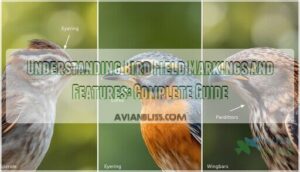
Every flash of color you spot in the trees tells a story—a white eyebrow stripe here, a rusty wingbar there, a forked tail cutting through the air. These aren’t random patterns. They’re nature’s identification badges, carefully placed markings that separate a sparrow from a finch, a hawk from a falcon, a warbler from a vireo.
Understanding bird field markings and features transforms bird-watching from guesswork into recognition, letting you name species with confidence even when your binoculars catch only a quick glimpse. Once you learn to read the crown, lores, speculum, and malar stripe like a visual language, the birds around you stop being generic “little brown things” and start revealing their true identities.
Table Of Contents
- Key Takeaways
- Key Bird Anatomy for Field Identification
- Recognizing Head and Face Field Marks
- Distinctive Wing and Tail Markings
- Identifying Birds by Bill, Body, and Legs
- Effective Strategies for Using Field Marks
- Frequently Asked Questions (FAQs)
- What are the field marks of birds?
- What is the best field guide for birds?
- How do juvenile plumage patterns differ from adults?
- What causes seasonal variation in bird coloration?
- Can birds change their field marks over time?
- How does lighting affect field mark visibility?
- What role does molting play in identification?
- Conclusion
Key Takeaways
- Bird identification relies on learning specific anatomical terms like crown, lores, malar stripe, and speculum, which transform vague observations into precise species recognition by pinpointing exactly where field marks appear on a bird’s body.
- Head and face markings—especially eyebrow stripes, eyelines, and throat patches—provide the fastest and most reliable identification clues from a distance, often revealing a bird’s identity before you even notice wing or tail patterns.
- Combining the Four Keys approach (shape, color patterns, behavior, and habitat) with careful field guide use sharpens your skills faster than memorizing marks alone, since context narrows hundreds of possibilities down to a handful before you check detailed features.
- Seasonal changes through molting cycles, age-related plumage shifts, and lighting conditions all affect field mark visibility, so you’ll need to account for these natural transformations when making identifications in the field.
Key Bird Anatomy for Field Identification
Before you can discover the secrets hidden in a bird’s plumage, you need to know what you’re actually looking at.
Understanding how to identify birds in the wild starts with learning the basic features that distinguish one species from another.
Think of a bird’s body as a map, with each region offering clues that guide you toward identification. Let’s start with the essential anatomy every birder should recognize, beginning with the major body parts and the specialized features that separate one species from another.
Major Body Regions and Their Functions
You can think of a bird’s body structure as five big regions that work together: head, wings, tail, upperparts, and underparts.
The head shape and beak handle all sensory work and feeding, while wing movement powers flight with strong primary and secondary feathers. Tail balance acts like a rudder in the air.
Each region carries field marks—colors, patterns, and plumage details—that reveal species identity in avian morphology studies. In bird identification, observing distinct feather groupings is vital for recognizing different species in the field.
Topographical Terms Used in Birding
Now that you recognize major body regions, you need the precise language birders use to pinpoint field marks.
Topographical regions name specific feather groups—like crown, lores, and mantle—so you can describe exactly where facial patterns, wing topography, and tail features appear.
Learning these terms turns vague observations into clear identifications, helping you match what you see in bird anatomy with detailed descriptions in your field guide. For a deeper dive into the language of bird topography, explore terms that play an essential role in confident bird identification.
Specialized Features Like Cere, Gape, and Rictal Bristles
Beyond standard feather tracts, you’ll encounter three specialized features that reveal species, age, and even health. The cere—a fleshy patch at the bill base—shows bold color in raptors and parrots, aiding cere identification.
Young birds display a bright gape flange around the mouth opening. Rictal bristles, stiff whisker-like feathers near facial markings and lores, guide insects toward the bill and protect eyes during feeding.
Recognizing Head and Face Field Marks
A bird’s head and face hold some of the most reliable identification clues, especially when you’re watching from a distance. These markings often stand out more clearly than wing or tail patterns, making them your first checkpoint in the field.
Learning to spot stripes, patches, and color variations around the eye and face will sharpen your skills faster than you’d expect.
Many field guides for beginners organize birds by these exact features, making it easier to narrow down species during your outings.
Eyebrow Stripe, Eyeline, and Malar Stripe

Three lines drawn across a bird’s face can reveal its identity faster than any other feature. When you master the eyebrow stripe, eyeline, and malar stripe, you’re reading facial patterns that separate hundreds of look-alike species.
Mastering three facial stripes—eyebrow, eyeline, and malar—unlocks faster bird identification than any other field mark
- Eyebrow stripe sits above the eye, often pale and contrasting
- Eyeline cuts through the eye, creating a masked look
- Malar stripe runs down the cheek like a painted mustache
- Stripe variations in color, width, and length offer glare reduction while serving as diagnostic field marks for species separation
Crest, Crown, Eye-ring, and Lore Color
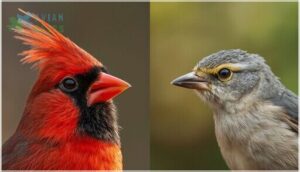
A raised crest instantly tells you a cardinal feels threatened, while crown stripes in sparrows act like fingerprints. You’ll spot white eye rings on Nashville Warblers from yards away, and yellow lores on songbirds transform the face pattern completely.
These features change with feather molting between seasons, so watch for brighter crown patterns and bolder lore variations during breeding months.
Throat Patch and Beak Color Variations

You’ll find throat patches framed by darker stripes on many sparrows, making these blocks of color pop like badges against the chest. Beak colors shift with seasons and age, so starlings flash yellow bills in spring while juveniles carry darker tones year-round.
- Black-throated Sparrows wear bold throat patches bordered by crisp white facial stripes for instant recognition
- White throat patches on White-throated Sparrows contrast sharply with brown backs and gray underparts
- Carotenoid pigments from diet create yellow, orange, or red beak colors in breeding adults
- Two-toned bills with darker tips and paler bases help you separate similar species quickly
- Iridescent hummingbird gorgets shimmer from green to purple as viewing angle changes light reflection
Distinctive Wing and Tail Markings
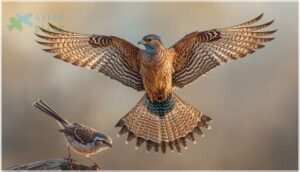
When a bird takes flight or spreads its wing markings, you’ll notice patterns and colors that don’t show up anywhere else on its body. These tail markings are some of the most reliable clues you can use to identify species, especially when birds are perched or moving quickly.
Let’s look at the specific features that make wings and tails such powerful identification tools.
Wingbars, Wing Patches, and Speculum
When you scan a folded wing, you’re looking for three powerful clues: wingbars, wing patches, and the speculum. Wingbars appear as narrow horizontal stripes running across the wing where covert tips align, often in white or buff tones that contrast sharply with darker feathers. Wing patches form larger, rounded blocks of color on the shoulder or upper coverts, flashing brightly during flight identification moments.
| Feature | Key Characteristics |
|---|---|
| Wingbar Patterns | Narrow horizontal stripes from median and greater coverts; white, buff, or yellow tones |
| Wing Patch | Solid color blocks on coverts or shoulder; visible when perched or flying |
| Speculum Shapes | Metallic secondary patch on ducks; iridescent blue, green, or bronze with pale borders |
| Feather Colors | Contrast changes with molt; fresh plumage shows brighter, crisper bars than worn feathers |
The speculum—that iridescent patch of colored secondaries—becomes your best friend when identifying ducks in flight, since metallic greens, blues, and purples catch light differently between species.
Primaries, Secondaries, and Wing Lining
Flight feathers tell two stories: outer primaries create the pointed wing edge you notice first, while inner secondaries form the rounded trailing border.
Primaries show feather notches in raptors and wear patterns that reveal molt stages, and the wing lining underneath contrasts with dark flight feathers to create bold flight patterns that separate soaring hawks from vultures overhead.
Tail Shapes and Feather Patterns
Tail shape and feather patterns work like fingerprints—each species carries unique markers you’ll spot once you know where to look.
- Square tails show same-length rectrices forming a straight edge, typical in woodpeckers
- Forked tails have longer outer feathers that enable agile turns in swallows and terns
- Rounded tails display curved edges where central rectrices extend slightly beyond outer ones
- White tail spots appear on outer feathers, looking dark from above but bright below in flight
- Tail lengths vary dramatically—nuthatches show stubby tails while Mourning Doves sport long, pointed ones
Identifying Birds by Bill, Body, and Legs

When you look beyond a bird’s wings and tail, the bill, body, and legs tell their own story.
These features reveal what a bird eats, where it lives, and how it moves through its world.
Let’s explore the key markings and structures that help you make confident identifications in the field.
Bill Shape, Size, and Color Significance
A bird’s bill reveals its lifestyle like a fingerprint. Bill shapes signal feeding habits: thick conical beaks in finches crack seeds, while long decurved bills in curlews probe deep mud.
Bill size matters too—grosbeaks handle large seeds that smaller birds can’t. Beak colors also shift with seasons; many songbirds brighten from gray to yellow during breeding, helping you identify age and sex in the field.
Mantle, Breast, Bib, and Gorget Features
Beyond the bill, you’ll find rich field marks in plumage patterns that separate species at a glance. The mantle—your bird’s upper back between neck and wings—often contrasts with the head or rump, creating that distinctive “saddle” look.
Check the breast for streaks or spots, and watch for a concentrated bib patch on the throat. In hummingbirds, the gorget flashes iridescent color when sunlight hits just right.
Leg Length and Crissum Markings
You’ll also spot key differences in leg proportions—waders like stilts stretch well above their bodies, while plovers crouch low.
Leg coloration matters too: greenish suggests Greenshank, bright red points to Redshank.
The crissum, those undertail coverts around the vent, can flash rufous or show fine streaking that separates Northern from Louisiana Waterthrush when other field marks overlap.
Effective Strategies for Using Field Marks

You’ve learned the vocabulary of bird anatomy, but knowing what to look for is only half the battle.
The real skill comes from combining those field marks with smart observation strategies that help you narrow down species quickly and confidently. Let’s explore the proven methods that will transform you from a curious observer into a skilled bird identifier.
The Four Keys to Bird Identification
When you’re trying to pin down a mystery bird, shape and size variation give you your first real discovery—think chickadee roundness versus heron lankiness.
Next, scan for color patterns: blocks of light and dark, wingbars, or a bold cap. Watch behavioral traits like tail-bobbing or flycatcher sallies, then consider habitat preferences. These identification strategies work together, transforming hundreds of possibilities into just a handful before you even check detailed field marks.
Field Guide Use and Observation Techniques
Once you’ve sorted shape and pattern, your observation skills deepen when you pair a traditional field guide with birding apps like Merlin Bird ID.
Watch the bird first—note its size, wingbars, and movements—before flipping pages, because it often flies off the moment you look down.
Field note taking sharpens your identification strategies, letting you compare jotted details to multiple sources and confirm tricky species through guide comparison.
Behavior and Habitat as Identification Clues
You’ll gain faster identification when you notice foraging styles—pipits sprint across short grass, while nuthatches spiral headfirst down tree trunks—and flight characteristics like the bouncy undulations of finches versus the direct path of ducks.
Habitat preferences narrow your choices instantly: cattail marshes host rails and bitterns, while open grasslands favor meadowlarks, so matching avian behavior to habitat range becomes your secret weapon for confident field calls.
Practicing With Local Raptors and Waterfowl
Regular visits to nearby wetlands and hawk-watch lookouts sharpen your identification skills faster than field guides alone.
September through November raptor migration along ridgelines lets you compare buteo versus accipiter silhouettes overhead, while winter duck flocks on local ponds train your eye to spot key field marks on bird heads—crown color, eyeline, and lore—plus wing speculums and flanks, building confidence through repeated practice with local species.
Frequently Asked Questions (FAQs)
What are the field marks of birds?
The devil’s in the field marks when spotting birds.
Field marks are visible stripes, spots, colors, and patterns on bird plumage, beak shapes, wing tips, and tail feathers that help you identify species quickly in their natural habitat.
What is the best field guide for birds?
The National Geographic Field Guide to the Birds of North America stands out for thorough coverage, detailed maps, and current taxonomy, while Peterson’s classic illustration style helps you learn field marks quickly.
How do juvenile plumage patterns differ from adults?
Young gulls take four years to mature—that’s a lot of changing looks.
Juveniles show duller plumage coloration, streaked patterns, and muted soft part changes, while adults display bolder feather texture and defined field marks.
What causes seasonal variation in bird coloration?
Hormonal triggers, molt cycles, and pigment changes drive seasonal bird coloration.
Environmental wear fades feather types over time, while signaling functions shape breeding plumage patterns.
Avian characteristics shift with light exposure and diet.
Can birds change their field marks over time?
Yes, field marks shift throughout a bird’s life. Molting patterns, age variations, seasonal changes, and hormonal influences alter feather colors, wingbars, and patterns, while environmental factors like diet can fade or intensify key identification features over time.
How does lighting affect field mark visibility?
Light angle effects dramatically change field mark visibility. Direct front lighting reveals clear details, while side lighting boosts contrast on wingbars and streaks. Backlighting creates silhouettes, hiding color-based features entirely.
What role does molting play in identification?
Molting patterns create age-related changes and seasonal plumage differences that shift field marks dramatically.
Feather wear, molt limits, and missing primaries produce temporary identification challenges, so you’ll need to account for these natural transformations when observing birds.
Conclusion
Mastering markings means moving beyond mystery—transforming every spotted back, streaked breast, and split tail into a readable clue. Understanding bird field markings and features isn’t just memorization; it’s building your own visual vocabulary, one that lets you decode wings, faces, and bills at a glance.
The more you observe, the sharper your eye becomes, until identification shifts from struggle to instinct. Your binoculars reveal stories now, not just silhouettes. Go find them.
- https://indianaaudubon.org/2025/11/18/birding-101-using-external-anatomy-to-understand-birds/
- https://www.basicsofbirding.com/blog/how-to-identify-birds-looking-for-key-field-marks
- https://leesbird.com/2014/09/23/birdwatching-terms-abouts-bird-bill-parts/
- https://www.nature.com/articles/s41598-017-09771-4
- https://carnegiemnh.org/field-guides-an-introduction/