This site is supported by our readers. We may earn a commission, at no cost to you, if you purchase through links.
Every year, billions of animals undertake remarkable journeys across continents and oceans, following routes their ancestors have traveled for millennia. But these ancient pathways are vanishing. The impact of habitat loss on migration has become one of conservation biology’s most pressing concerns, as deforestation, urbanization, and agricultural expansion systematically erase the stopover sites, breeding grounds, and corridors that migratory species depend on for survival.
When a wetland disappears or a forest fragment shrinks below a critical threshold, the consequences ripple far beyond that single location—entire populations can collapse, ecosystems lose essential functions, and the intricate web of life that migration sustains begins to unravel.
Understanding how habitat destruction disrupts these journeys, and what we can do to preserve connectivity across landscapes, isn’t just an academic exercise. It’s essential for maintaining the ecological processes that support biodiversity, nutrient cycling, and the resilience of ecosystems worldwide.
Table Of Contents
- Key Takeaways
- How Habitat Loss Disrupts Migration
- Ecological Consequences of Migration Disruption
- Human Activities Driving Habitat Loss
- Importance of Habitat Connectivity for Migration
- Conservation Strategies to Mitigate Migration Impacts
- Frequently Asked Questions (FAQs)
- What are the consequences of loss of habitat?
- What happens when animals lose their habitats?
- How can natural disruptions affect habitats and animal migrations?
- What are the three types of negative impacts on habitats?
- How does climate change interact with habitat loss?
- Which species are most vulnerable to migration disruption?
- Can migratory species adapt to altered migration routes?
- What role do invasive species play in habitat degradation?
- How do we measure migration success and failure?
- Conclusion
Key Takeaways
- Migratory species depend on connected stopover sites, breeding grounds, and wintering areas that span entire continents, but deforestation, urbanization, and agricultural expansion are systematically erasing these critical habitats, forcing birds to depart with dangerously low fuel reserves and blocking traditional routes that animals have traveled for millennia.
- Habitat fragmentation creates linear barriers like roads and fences that increase wildlife collisions, isolate populations in disconnected patches, and disrupt entire ecosystems by altering predator-prey relationships, collapsing food webs, and weakening essential services like pollination and nutrient cycling.
- Conservation requires landscape-scale approaches that protect entire flyways rather than isolated sites, since fewer than 5% of wetlands support over 70% of waterbird connectivity, making strategic protection of key stopover habitats far more effective than scattered preservation efforts.
- Effective mitigation combines legally protected corridors, active ecosystem restoration projects that rebuild degraded landscapes, international policy agreements that coordinate cross-border conservation, and community engagement that transforms local landowners into habitat stewards through sustainable land use practices.
How Habitat Loss Disrupts Migration
When critical habitats disappear, migratory species lose the lifelines that keep them alive during their journeys.
These stopover sites, where birds rest and refuel between long flights, are essential to understanding how migratory species survive.
You’ll see disruptions play out in three major ways, each one making survival harder for the animals that depend on predictable routes and resources.
These impacts don’t just slow migration down—they can stop it completely, threatening entire populations in the process.
Reduced Availability of Stopover Sites
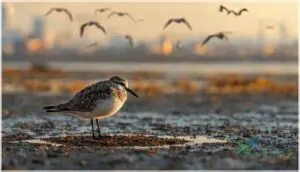
When migratory birds lose access to traditional stopover sites, their entire journey unravels. You’ll see flocks forced to depart with dangerously low fuel loads—sometimes just 20 to 30 percent body fat instead of the necessary 50 percent—because stopover habitats have vanished or degraded beyond use.
When stopover sites vanish, migratory birds depart with dangerously low fuel reserves—just 20 to 30 percent body fat instead of the 50 percent they need to survive the journey
In regions where coastal mudflats have shrunk by over 65 percent, shorebirds can’t refuel adequately, slowing migration patterns and increasing mortality along critical flyways.
Habitat loss is also a major threat to bats, as outlined in this overview of habitat loss impacts on wildlife.
Fragmentation and Barriers to Movement

Roads, fences, and sprawling cities act as linear barriers that cut across migration routes, forcing animals to take longer detours or stop moving altogether.
When highways slice through corridors, wildlife vehicle collisions kill tens of thousands of large mammals each year. Patch isolation traps small populations in disconnected fragments, while edge effects increase predation risk and genetic isolation weakens populations, making climate connectivity nearly impossible in heavily fragmented landscapes.
Conservation efforts are increasingly focused on addressing habitat fragmentation and connectivity.
Loss of Breeding and Wintering Grounds
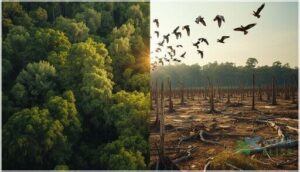
Beyond blocked pathways, habitat destruction eliminates the very destinations that anchor migration patterns. When forests fall to farmland or wetlands drain for development, you lose irreplaceable breeding grounds where birds raise chicks and wintering sites where they rebuild strength.
Habitat degradation at either end disrupts entire life cycles, triggering population crashes. Ecosystem disruption ripples outward as fewer migrants complete their journeys, underscoring why conservation must protect full-range connectivity.
Ecological Consequences of Migration Disruption
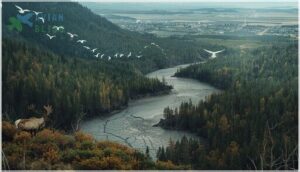
When migration patterns break down, the effects ripple far beyond individual species. Entire ecosystems shift as predator-prey relationships unravel, food webs collapse, and biodiversity suffers.
Birds face mounting challenges from habitat fragmentation, a problem explored in depth through research on the effects of habitat loss on bird populations.
Let’s look at three major ways disrupted migration reshapes the natural world.
Population Declines in Migratory Species
Habitat loss drives steep wildlife population decline across continents, with migratory species especially vulnerable. North America has lost roughly 2.9 billion breeding birds since 1970, many of them long-distance migrants facing shrinking stopover sites and breeding grounds.
Declining bird numbers mirror ungulate population collapse in Africa, where blocked corridors and fragmented landscapes turn once-thriving migrations into conservation emergencies threatened by flyway bottlenecks and vanishing habitat.
Changes in Species Interactions and Food Webs
Cascading disruptions ripple through food webs when you lose critical migration routes. Altered predation timing leaves shorebirds arriving after insect hatches have peaked, forcing adults to feed nestlings on depleted resources. New competitors crowd remaining wetlands, intensifying struggles for invertebrates among ducks and geese.
Shifted scavenging patterns reduce carrion removal by wide-ranging species, while disease transmission increases at congested stopover sites where stressed wildlife, livestock, and people converge.
Disrupted nutrient cycling cuts marine-derived phosphorus delivery to headwaters when spawning runs collapse, shrinking productivity in historically nutrient-poor ecosystems that once depended on migrating salmon and other species.
Impacts on Biodiversity and Ecosystem Services
You see real losses when migratory declines unravel ecosystems. Specialist pollinators vanish first, pushing crops toward lower yields and threatening species extinction in fragmented patches.
Seed dispersal weakens forest resilience against droughts, while collapsed nutrient transport leaves wetlands nutrient-poor.
Ecosystem services—pollination, carbon storage, water regulation—depend on habitat restoration and biodiversity conservation to rebuild the connectivity that habitat loss and habitat degradation have shattered across entire landscapes.
Human Activities Driving Habitat Loss
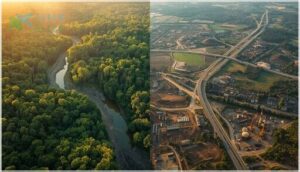
You’ve seen how habitat loss disrupts migration and harms ecosystems, but it’s worth asking: what’s actually causing these landscapes to disappear? The answer lies largely in human activities that reshape, degrade, and eliminate the natural areas migratory species depend on.
Let’s examine three major drivers that are fundamentally altering habitats across the globe.
Deforestation and Urban Expansion
When trees fall and cities sprawl, migratory species lose the connected landscapes they depend on. Deforestation strips away tropical primary forests at roughly 3.7 million hectares yearly, removing vital stopover and wintering habitat. Meanwhile, urban development replaces continuous ecosystems with hard barriers—roads, buildings, and fenced properties—that fragment remaining habitat and force wildlife into dangerous detours. You’re witnessing ecosystem disruption that directly drives biodiversity loss across flyways:
- Highways slice through forests, increasing roadkill for wide-ranging mammals
- Urban sprawl isolates populations in scattered green spaces
- Fragmented edges expose migrants to more predators and invasive species
- Loss of forest cover creates inland migration barriers where birds avoid stopping
Agricultural Intensification
Modern farming practices replace diverse landscapes with uniform crop fields, shrinking the habitat patchwork migrants need. Monoculture impacts strip away hedgerows and wildflower margins, cutting insect populations that fuel migratory songbirds during stopovers.
Meanwhile, pesticide-heavy crop management reduces prey availability across vast agricultural zones, and wetland drainage for irrigation removes critical refueling sites for waterfowl and shorebirds crossing intensively farmed regions.
Infrastructure Development and Pollution
Roads and railways slice through migration corridors, creating deadly barriers that force detours or strand populations entirely. Dams fragment river systems, blocking salmon and other fish from reaching spawning grounds, while urban sprawl floods night skies with disorienting light.
Shipping noise has doubled in Arctic waters within six years, masking whale calls and disrupting navigation during critical journeys.
Importance of Habitat Connectivity for Migration
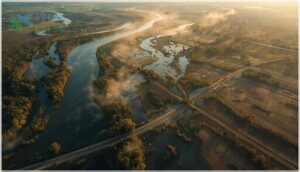
Migratory species don’t just need habitat at their starting point and destination—they need safe passage between the two. When development, agriculture, and infrastructure carve up the landscape, you create a patchwork of isolated fragments that block traditional routes and trap populations.
Understanding how connectivity works, and what happens when it breaks down, is essential for protecting these species.
Role of Corridors and Protected Areas
You might think of wildlife corridors and protected areas as the highways and rest stops that keep migration alive. When habitat loss cuts up the landscape, these connected networks become lifelines. Consider how they work:
- Wildlife corridors link breeding grounds, stopover sites, and wintering areas across hundreds of kilometers
- Protected wetlands along flyways support over 70 percent of waterbird connectivity with fewer than 5 percent of sites
- Purpose-built highway overpasses let migrants cross busy roads safely
Conservation planning that prioritizes habitat connectivity and protects migration routes ensures species can complete their journeys despite surrounding development.
Effects of Habitat Fragmentation
While corridors help, habitat fragmentation still chops landscapes into isolated patches that throw up migration barriers migrants can’t safely cross. When forests become fragmented landscapes separated by roads or cropland, you lose stopover habitats and force birds into longer, riskier flights.
Crowding in remaining patches depletes food fast, and isolation cuts gene flow between populations—making conservation efforts harder and habitat degradation effects more severe along migration routes.
Landscape-Scale Conservation Approaches
Protecting migratory species means thinking bigger than single reserves. Flyway Planning treats entire routes—breeding grounds, stopover sites, wintering areas—as one conservation unit, so you’re safeguarding thousands of kilometers at once. That’s where Landscape Connectivity and Conservation Networks shine: GPS tracking pinpoints exact corridors, Spatial Analysis reveals bottleneck segments, and cross-boundary partnerships restore Habitat Corridors that let migrants move safely despite Habitat Loss and Habitat Fragmentation threatening their journeys.
- Shorebird initiatives rank key refueling mudflats by survival value, guiding where Conservation Strategies for Migratory Species invest first
- Joint Ventures coordinate governments and landowners across borders to deliver Ecosystem Restoration at flyway scales
- Connectivity models simulate thousands of movement paths, highlighting where small habitat fixes yield big gains
- Climate-smart corridor designs align pathways with cooler microclimates so species can track shifting conditions
- Fewer but larger protected blocks boost connectivity metrics by 30–40 percent, reducing Ecological Consequences of Migration Disruption over time
Conservation Strategies to Mitigate Migration Impacts
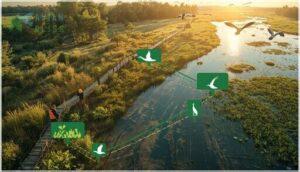
You can’t reverse habitat loss overnight, but you can take meaningful steps to protect migratory species before more populations collapse. Effective conservation requires a mix of habitat protection, ecosystem restoration, international collaboration, and local action.
Here’s what works when you’re trying to safeguard the routes and resources that migratory animals depend on.
Protecting Key Migratory Habitats
You can safeguard migration routes by securing legally protected sites like the Ramsar Convention’s 2,500+ wetlands and National Wildlife Refuges that provide critical stopover habitat. Conservation efforts target high-quality wetlands, coastal marshes, and forest corridors where migratory species refuel.
Since fewer than 5% of wetlands support over 70% of flyway connectivity, protecting these key sites becomes essential to maintain ecosystem services and counter habitat loss across migration patterns.
Restoring Degraded Ecosystems
Beyond securing protected sites, you can actively reverse habitat degradation through ecosystem repair that rebuilds migration pathways. Restoration projects tackle habitat loss by bringing back functionality to damaged landscapes, offering migratory species the stopover sites and breeding grounds they’ve lost:
- Wetland habitat restoration replants native vegetation and restores water flow, creating refueling stations for waterfowl along flyways—projects now cover 2.7 million acres under conservation easements.
- Wildlife corridor restoration reconnects fragmented forests and riparian zones, letting animals move safely between seasonal ranges while tracking shifting climates.
- River and fish passage repair removes outdated dams and fixes culverts, reopening hundreds of miles for salmon, alewives, and shad to reach upstream spawning habitat.
- Reforestation and landscape rewilding rebuild continuous forest cover that migratory birds and mammals use as travel routes between feeding, breeding, and overwintering areas.
- Community-based restoration actions replant native vegetation along streams and coasts, creating “stepping stone” habitats where migrants rest and feed during long journeys.
These conservation efforts don’t just slow ecological decline—they actively reverse habitat degradation, giving wildlife restoration measurable results that support population recovery and ecosystem renewal.
International Cooperation and Policy Initiatives
Because migratory species cross multiple nations, you need global accords like the Convention on the Conservation of Migratory Species of Wild Animals to unify conservation efforts across borders. These international conservation agreements establish policy frameworks through biodiversity governance systems, coordinating wildlife conservation strategies for migratory birds along entire flyways.
International law creates binding commitments that align habitat protection, reduce barriers, and fund conservation strategies where migration routes span continents.
Community Involvement and Sustainable Practices
When you work alongside local communities, conservation efforts gain real momentum. Community engagement turns landowners into stewards through sustainable land use practices that blend eco-friendly methods with livelihoods, reducing the ecological consequences of habitat loss.
Environmental education programs help residents monitor migratory species, restore degraded areas, and adopt habitat-friendly farming. This ensures community involvement in conservation efforts protects corridors where policies alone can’t reach.
Frequently Asked Questions (FAQs)
What are the consequences of loss of habitat?
Habitat loss triggers species extinction, biodiversity loss, and ecosystem disruption. You’ll see population declines as animals lose food and shelter, forcing species into smaller ranges where habitat degradation weakens their survival chances.
What happens when animals lose their habitats?
When animals lose their habitats, they face increased energy demands, reduced survival rates, and population declines that can push species toward extinction.
This, in turn, disrupts ecosystem functions and alters food webs across entire landscapes.
How can natural disruptions affect habitats and animal migrations?
Natural forces like wildfires, droughts, and storms remove shelter and food along migration routes, forcing species to skip stopovers or detour into unfamiliar terrain.
Climate-driven habitat shifts disrupt timing and resource availability.
What are the three types of negative impacts on habitats?
Consider the Yellow Sea tidal flats—over one third gone, along with critical shorebird populations. You’ll see three main threats: habitat destruction (complete removal), habitat degradation (pollution and quality decline), and fragmentation impacts (isolated patches blocking movement).
How does climate change interact with habitat loss?
Climate change forces species to shift their ranges toward cooler zones, but when you clear forests and drain wetlands along these routes, migrants lose essential refuges and stopovers exactly when they need them most.
Which species are most vulnerable to migration disruption?
Which migratory birds, coastal birds, terrestrial mammals, or aquatic species face the greatest risk? Endangered migrants traveling thousands of kilometers, like Arctic shorebirds and salmon, plus vulnerable populations with narrow habitat needs are most threatened.
Can migratory species adapt to altered migration routes?
Yes, many migratory species show route adaptability and migration flexibility when facing habitat shifts. However, species resilience varies widely—long-distance migrants and specialists struggle more than generalists to adjust their migration routes successfully.
What role do invasive species play in habitat degradation?
Invasive species degrade habitats by outcompeting native plants, altering fire regimes, disrupting soil nutrients, and changing water flow patterns.
These biological invasions reduce biodiversity, simplify ecosystems, and force governments to spend millions on habitat restoration.
How do we measure migration success and failure?
Scientists track whether journeys end successfully by monitoring survival rates, route completion, refueling metrics at stopover sites, and recruitment data from breeding grounds.
They also use tracking technology to map animal migration patterns and detect species decline.
Conclusion
Think of migration routes as lifelines stretched across continents—when you sever even one critical point, the pulse weakens everywhere. The impact of habitat loss on migration isn’t just about displaced animals; it’s about dismantling ecological connections that have sustained life for millennia.
Your choices matter here. Supporting corridor protection, demanding sustainable development, and advocating for international conservation agreements can help keep these ancient pathways open, functional, and resilient for generations ahead.
- https://stateofthebirds.nhaudubon.org/state-of-the-birds/threats-to-new-hampshires-birds/habitat-loss/
- https://abcbirds.org/threats/habitat-loss/
- https://www.nature.com/articles/s41598-025-31911-4
- https://nationalzoo.si.edu/migratory-birds/news/travel-alert-migratory-birds-stopover-sites-decline
- https://pmc.ncbi.nlm.nih.gov/articles/PMC8079992/