This site is supported by our readers. We may earn a commission, at no cost to you, if you purchase through links.
Glass towers multiply across city skylines at roughly 200,000 new high-rise buildings per year globally, yet few urban planners account for the millions of birds flying between them each spring and fall.
Urbanization influence on bird movement extends far beyond simple habitat loss—it reshapes migration routes, fractures dispersal corridors, and transforms species composition across entire metropolitan regions. When a forest bird encounters a four-lane highway or a warbler strikes a reflective facade, these aren’t isolated incidents but symptoms of systematic barriers that redirect, delay, or end avian journeys.
Understanding how cities alter movement patterns reveals which species disappear, which adapt, and where targeted interventions can restore connectivity in landscapes dominated by concrete and glass.
Table Of Contents
- Key Takeaways
- How Urbanization Alters Bird Movement
- Effects on Bird Species Diversity
- Urban Barriers and Navigation Challenges
- Behavioral and Physiological Adaptations
- Conservation Strategies for Urban Birds
- Frequently Asked Questions (FAQs)
- How does urbanization affect birds?
- What impact does urbanization have on animal migration patterns?
- What are the factors that influence bird migration?
- Is urbanization stressful for songbirds?
- How does urbanization affect bird disease transmission patterns?
- What role do urban predators play in bird mortality?
- Can birds adapt genetically to urban environments over time?
- Do urban birds experience changes in their lifespan longevity?
- Conclusion
Key Takeaways
- Urbanization kills 365 million to 1 billion birds annually in the United States through glass collisions, road barriers, and infrastructure that fragments migration corridors and intercepts birds during critical stopovers.
- Cities act as filters that eliminate specialist species requiring intact forests or wetlands while urban-adapted generalists like pigeons and house sparrows thrive by exploiting human food sources and nesting in building structures.
- Light pollution pulls nocturnal migrants off course from several kilometers away while traffic noise masks essential contact calls, forcing birds to alter vocal patterns or abandon the noisiest urban corridors entirely.
- Strategic interventions including collision-safe glass with fritted patterns, bird-sensitive lighting below 3000 Kelvin, habitat corridors connecting fragmented green spaces, and community engagement through citizen science projects can transform cities from ecological dead zones into functional landscapes for bird populations.
How Urbanization Alters Bird Movement
When cities expand, they don’t just reshape the landscape—they fundamentally transform how birds move through and interact with their environment. Urbanization disrupts traditional patterns of migration, dispersal, and daily movement in ways that ripple through entire bird populations.
These changes hit especially hard in bird habitats in wetlands, where urban sprawl can sever migration routes and force species to navigate increasingly hostile territory.
Cities reshape landscapes and fundamentally transform how birds move, migrate, and interact with their environment
You’ll see these changes most clearly through three interconnected impacts: the loss and fragmentation of natural habitats, shifts in established migration routes, and altered patterns of dispersal and range expansion.
Habitat Loss and Fragmentation
Habitat destruction sweeps through natural areas as urbanization replaces continuous forests and wetlands with small patches, often under one to ten hectares. This fragmentation effects cascade through bird populations: you’ll see fewer nesting territories, higher nest predation near edges, and specialist species disappearing when patches fall below critical size thresholds.
Urban planning that ignores these patterns accelerates biodiversity loss, while conservation efforts focused on restoring connectivity can reverse ecosystem disruption and maintain bird diversity across fragmented landscapes. Communities are now enhancing bird habitats by developing, which provide essential food and shelter for urban bird species.
Changes in Migration Routes
As cities replace natural corridors, migration patterns shift dramatically. You’ll observe nocturnal migrants bending flight detours around lit downtown cores, where bird densities drop sharply over high-rise districts.
Urban stopovers now concentrate in small parks and tree-lined streets rather than expansive wetlands, forcing route adjustments that add kilometers to journeys. Habitat shifts driven by urbanization, climate change, and artificial light reshape traditional flyways, fundamentally altering avian ecology across metropolitan regions.
Recent studies using the stopover-to-passage ratio metric reveal that over half of all migrating birds utilize habitats within 100 km of coastlines, underscoring the importance of strategic conservation as urban areas continue to expand.
Impacts on Dispersal and Range Expansion
Beyond migration detours, urbanization fundamentally reshapes how birds colonize new territories. Movement barriers like multilane roads and dense high-rises reduce successful crossings for small passerines, shortening dispersal distances and limiting range expansion into fragmented patches. Habitat filter effects favor urban exploiters that tolerate impervious surfaces, while specialists face restricted distributions. Consider how these forces reshape avian adaptation to urban environments:
- Wide roads and building clusters block forest birds from reaching isolated parks
- Delayed dispersal keeps juveniles in stable urban territories longer, slowing colonization
- Urban exploiter spread accelerates as tolerant species hop between neighborhoods
- Heat islands create thermal barriers that many species avoid during range shifts
- Reduced habitat connectivity concentrates adaptable populations while excluding sensitive lineages
Effects on Bird Species Diversity
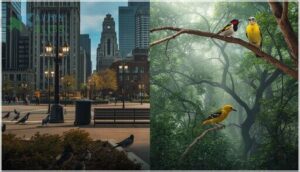
When cities expand, they don’t just reshape the landscape—they fundamentally alter which bird species can survive and thrive in these transformed environments. You’ll notice that urbanization acts like a filter, favoring certain types of birds while pushing others toward local extinction.
As native vegetation disappears and concrete spreads, effects of habitat loss on birds become visible through declining populations of species that can’t adapt to artificial landscapes.
Understanding these shifts in species diversity reveals two dominant patterns: the decline of specialist species that can’t adapt to urban conditions, and the rise of generalist species that exploit new opportunities in human-dominated landscapes.
Decline of Specialist Species
You’ll find that specialist species suffer most when urban sprawl takes over. Habitat fragmentation and habitat loss cut away the mature forests, wetlands, and grasslands these birds need, pushing many toward species extinction.
Forest specialists like the Wood Thrush can drop 80 percent in abundance when development surrounds their patches, highlighting urgent needs for habitat fragmentation mitigation, urban planning reforms, avian conservation efforts, biodiversity conservation strategies, and ecosystem disruption reversal to protect declining bird diversity.
Rise of Urban-Adapted Generalists
Avian resilience shows itself in urban-adapted generalists that thrive where specialists vanish. These species, such as feral pigeons and house sparrows, demonstrate remarkable adaptability in urban environments.
Feral pigeons can reach densities of over 1,000 individuals per square kilometer in downtown cores, while house sparrows nest in building crevices across every inhabited continent. This success is attributed to their behavioral flexibility and broader dietary niches, which allow them to exploit urban resources effectively.
As a result, bird populations persist even as urbanization reshapes avian adaptation patterns across cities worldwide.
Urban Barriers and Navigation Challenges
When birds navigate through cities, they encounter obstacles that their evolutionary history never prepared them for. The urban landscape creates a gauntlet of physical hazards, sensory disruptions, and environmental cues that interfere with their innate navigation systems.
Understanding these barriers helps explain why urban environments prove so challenging for both resident and migratory bird populations.
Impact of Buildings and Infrastructure
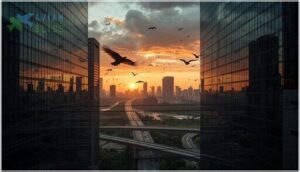
As you walk through urban areas, consider how every glass facade and highway becomes an invisible wall in a bird’s flight path. When buildings, roads, and power lines reshape your city, they create formidable barriers that fragment movement corridors and threaten survival:
- Glass collisions kill 365 million to 1 billion birds annually in the United States, making reflective facades a leading mortality source.
- Road barriers extend 700 meters outward, reducing bird abundance across more than 70 percent of some landscapes.
- Power line impacts alter flight paths up to 1,600 meters away, forcing energy-costly detours around overhead cables.
- Building design choices, especially transparent courtyards behind glass, channel birds into deadly dead-end spaces.
- Urban planning and design that clusters tall structures near habitat patches intercepts migrating birds during critical stopovers.
Understanding these urban ecology dynamics helps you advocate for bird-friendly cities where infrastructure assists rather than obstructs avian movement, transforming building collisions from an inevitability into a preventable tragedy through strategic retrofits and thoughtful architectural choices.
Light and Noise Pollution Effects
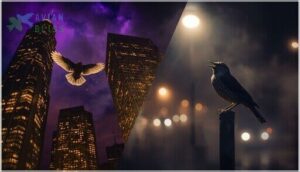
Across urban environments, light pollution and noise pollution create overlapping sonic disturbance and visual chaos that disrupt avian ecology and conservation efforts.
Bright urban glow pulls night-flying migrants off course from several kilometers away, causing bird disorientation that leads to millions of collisions annually.
Meanwhile, traffic noise masks contact calls at frequencies essential for coordination, forcing urban wildlife to shift vocal patterns or abandon the noisiest corridors entirely.
Disruption of Celestial Navigation Cues
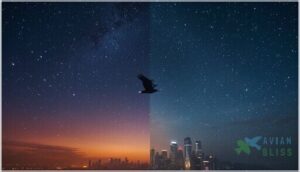
When you see stars fade behind urban skyglow effects and starlight obstruction from towers, you’re witnessing navigation errors unfold in real time. Urbanization dims celestial compasses that migrating birds rely on, while electromagnetic pollution introduces magnetic interference and distorts polarized light patterns at twilight.
These combined disruptions reshape avian ecology and conservation priorities, driving habitat loss and declining bird diversity across metropolitan corridors.
Behavioral and Physiological Adaptations
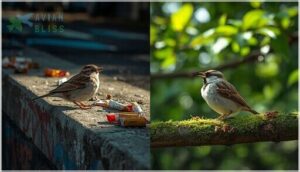
As cities continue to expand, you’ll notice that birds aren’t just passively suffering—they’re actively adjusting how they live, eat, and reproduce in these concrete landscapes.
These adaptations reveal themselves through measurable changes in behavior and internal physiology, from what they choose to eat to how their bodies handle the chronic stress of urban noise and pollution.
Understanding these adjustments helps you grasp which species might thrive in cities and which face insurmountable challenges.
Changes in Foraging and Feeding Patterns
Urban areas reshape foraging behavior in profound ways, with bird populations adapting their feeding behavior changes to exploit novel food source adaptation opportunities.
You’ll notice bird diet flexibility when species shift from insects to fast food remnants or backyard feeders. Human bird interactions supply predictable calories near parking lots and cafes, letting generalists thrive despite habitat loss while specialists struggle with reduced bird diversity.
Altered Breeding and Nesting Behaviors
You’ll find that breeding patterns shift dramatically as city bird populations adapt their nesting strategies to urban habitats. Many species now lay eggs weeks earlier in warmer metropolitan areas, tracking artificial heat islands and altered food peaks.
This bird behavior change affects reproductive success, since clutch sizes usually shrink and fledging rates drop in disturbed sites. Urbanization forces avian behavior adjustments that reshape local bird diversity, with cavity nesters switching from scarce tree holes to building ledges and vents as habitat modification intensifies.
Stress Responses to Urban Environments
Beyond nesting shifts, hormone changes reveal deeper stress physiology at work in urban areas. You’ll notice elevated corticosterone levels as birds face relentless urban noise and pollution, forcing constant bird vigilance that drains energy reserves.
This environmental adaptation comes at a cost—chronic stress weakens immune defenses and lowers reproductive success, adding another layer to the ecological consequences of urbanization that reshape bird diversity across cities worldwide.
Conservation Strategies for Urban Birds
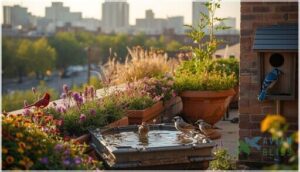
As urban areas continue to expand, you’ll need to think beyond simply acknowledging the problem—effective conservation requires targeted action.
The good news is that cities don’t have to be ecological dead zones for birds. Three key strategies can transform urban landscapes into environments where bird populations can survive and even thrive.
Designing Bird-Friendly Urban Spaces
You can reconceive cities as sanctuaries rather than hazards for birds by embedding Bird Conservation Strategies into every layer of Sustainable Urban Design. Effective Birdfriendly Urban Design includes:
- Collision-safe glass with fritted patterns on building facades to cut strike deaths by up to 90 percent
- Bird-sensitive lighting using shielded, downward-facing fixtures and warmer color temperatures below 3000 Kelvin
- Green Infrastructure layering trees, shrubs, and bioswales to boost native species richness
- Nesting features like nest boxes and dense plantings that provide shelter in Urban Areas
This integrated approach transforms Eco Friendly Buildings and Birdfriendly Cities into functional habitat networks.
Restoring and Connecting Habitats
You can stitch fragmented landscapes back together by creating habitat corridors that link isolated green spaces—tree-lined street trees, vegetated rail lines, and connected parks let birds move safely between feeding and nesting sites.
Infrastructure such as green roofs, wetland restoration projects, and wildlife corridors boost habitat connectivity, turning hostile concrete into functional networks that support both native generalists and vulnerable specialists across your city.
Community Engagement and Education
You’ll find that citizen science projects like eBird and the Tucson Bird Count turn residents into data collectors, tracking species and movement across neighborhoods.
Education programs in schools—such as Bird Buddies—teach children to monitor feeders and recognize local birds, while community events like bird walks and workshops connect your neighbors to conservation efforts.
Bird City initiatives and Lights Out campaigns show how community involvement in conservation transforms bird-friendly city planning from policy into daily practice.
Frequently Asked Questions (FAQs)
How does urbanization affect birds?
When concrete and glass swallow green space, you’ll see bird populations hit a wall—habitat loss fragments ecosystems, pollution clouds survival, and human activity reshapes urban areas, driving avian habitat loss and threatening environmental sustainability through accelerated biodiversity decline.
What impact does urbanization have on animal migration patterns?
Urbanization disrupts migration patterns through habitat destruction and fragmentation, forcing urban wildlife to reroute traditional flyways.
Artificial light disorients nocturnal migrants, while novel food sources prompt some bird populations to abandon seasonal movements entirely.
What are the factors that influence bird migration?
Bird populations rely on seasonal cues, food availability, and genetic predisposition to time their journeys. Magnetic fields guide navigation, while climate change disrupts traditional migration patterns, creating ecological consequences through habitat loss.
Is urbanization stressful for songbirds?
Yes, songbirds face chronic stress in urban environments. Noise pollution, artificial light, and urban heat disrupt their behavior, weaken immune responses, and reduce nestling development, demonstrating how habitat quality and pollution directly affect bird populations.
How does urbanization affect bird disease transmission patterns?
Like a Petri dish in overdrive, cities concentrate birds at feeders and roosts, raising pathogen exchange through crowding, chronic stress, altered immunity, and mosquito-rich habitats that intensify infection cycles across urbanization gradients.
What role do urban predators play in bird mortality?
Free roaming cats kill 3 to 4 billion birds yearly in the United States, representing the largest human-linked source of direct bird mortality.
Cooper’s hawks and corvids markedly increase predation pressure in fragmented urban habitats.
Can birds adapt genetically to urban environments over time?
Over generations, you’ll see detectable genetic shifts in urban bird populations, with selection favoring traits like pollution tolerance, altered wing shape, and boldness near humans—clear evidence of urban evolution and species resilience through genetic adaptation.
Do urban birds experience changes in their lifespan longevity?
You might assume city life always cuts bird longevity short, but urban mortality patterns are more complex.
Survival patterns vary: many city birds live longer thanks to steady food and warmer microclimates, while collision risks and pollution-driven aging factors threaten others.
Conclusion
Will the next warbler that strikes your office window be the last of its kind to attempt that route, or the first to find a way through? The answer depends on decisions you make today.
Urbanization influence on bird movement isn’t irreversible—strategic green corridors, dimmed nighttime lighting, and retrofitted glass can transform cities from death traps into functional landscapes.
Your choices determine whether metropolitan regions become barriers or bridges for species traversing an increasingly human-dominated world.