This site is supported by our readers. We may earn a commission, at no cost to you, if you purchase through links.
A single birder’s checklist, submitted to eBird on an unremarkable Tuesday morning, once helped researchers confirm a species’ range expansion across three states. That’s not an anomaly—it’s how modern ornithology increasingly works, built on thousands of careful field observations logged by people who took the time to get the details right.
The difference between a useful data point and a forgotten note often comes down to method. Learning how to record bird sightings accurately means your observations don’t stay buried in a notebook—they join a living record that shapes conservation decisions, migration research, and habitat protection for years to come.
Table Of Contents
- Key Takeaways
- Why Accurate Bird Sightings Matter
- Essential Details to Record for Each Sighting
- Choosing Your Bird Sighting Recording Method
- Step-by-Step Process to Record Bird Sightings
- Tips for Accurate Species Identification
- Enhancing Observations With Technology
- Organizing and Storing Your Bird Sighting Records
- Analyzing and Reflecting on Your Bird Data
- Best Practices for Sharing Bird Sightings
- Avoiding Common Mistakes in Bird Sightings Recording
- Frequently Asked Questions (FAQs)
- What is the best audio recorder for birds?
- How to log bird sightings?
- Is Banding birds ethical?
- How do I record nocturnal bird sightings effectively?
- Can children participate in bird sighting documentation?
- How do weather changes affect bird identification accuracy?
- What legal rules apply to birdwatching in protected areas?
- How do I handle conflicting sightings with other birders?
- Conclusion
Key Takeaways
- Logging precise details — species, GPS location, time, and behavior — transforms a casual observation into data that drives real conservation decisions.
- Tools like eBird and Merlin don’t just organize your sightings; they connect your records to a global research network that tracks migration shifts and species range changes.
- Consistent method matters as much as observation itself, since switching tools or skipping fields introduces gaps that quietly erode the reliability of your data over time.
- Reviewing your records across seasons reveals migration trends and population changes that no single outing can show on its own.
Why Accurate Bird Sightings Matter
Every bird sighting you record is a small piece of a much larger puzzle. The details you capture — species, location, behavior — feed into conservation efforts, sharpen your own skills, and contribute to global science.
If you’re just getting started, exploring rural bird watching spots puts you where the rarest sightings—and the most meaningful data—tend to happen.
Every bird sighting you record is a small piece of a much larger puzzle connecting conservation, science, and skill
Here’s why getting those details right matters on all three fronts.
Supporting Bird Conservation
Every sighting you record feeds directly into bird conservation in ways that matter. eBird alone receives over 100 million sightings annually, powering habitat restoration decisions and species preservation efforts worldwide. Your bird sightings documentation contributes to:
- Tracking bird migration shifts linked to climate change
- Identifying ecosystem balance disruptions across grasslands and wetlands
- Guiding conservation efforts that protect shrinking species ranges
If you’re new to contributing, the basics of highlight how shared data benefits both research and conservation.
Citizen science, in its essence, is collective impact.
Enhancing Personal Birdwatching Skills
Recording your bird sightings sharpens far more than just your notes. Detailed logs push you to polish bird identification, strengthen species recognition, and deepen your nature connection through real observation.
Tracking bird behavior across habitats builds pattern-reading skills you can’t learn from a book. Over time, habitat exploration and birdcall analysis become second nature, and bird watching transforms into something closer to fluency.
For a deeper dive into the latest, check out resources that can improve your observations.
Contributing to Citizen Science Projects
Your sharpened observation skills don’t have to stop with personal growth—they can fuel something much bigger. Platforms like eBird collect over 100 million bird sightings annually from volunteers worldwide, giving researchers real data for bird conservation and species identification.
When you commit to accurate data logging and data sharing, your checklist becomes a thread in a vast research collaboration, strengthening community engagement and citizen science projects globally.
Essential Details to Record for Each Sighting

Every sighting tells a story, but only if you capture the right details in the moment. Knowing exactly what to record keeps your notes useful, whether you’re revisiting them a month later or submitting data to a citizen science platform.
Here’s what to write down every time you spot a bird.
Date and Time
Date and time are the backbone of any useful bird sighting record. Log the full calendar date — year, month, day — and the exact clock time using local time, not a vague “morning.”
Precise seasonal timing and migration patterns depend on this data. Even a few minutes’ difference in your field notes can reveal whether you caught a dawn chorus or a midday lull.
Exact Location or GPS Coordinates
Location is everything in a bird log. GPS tracking narrows your entry to within 5–10 meters, giving your field notes real scientific weight. Use coordinate systems like decimal degrees for easy upload to mapping tools such as eBird, which automatically geotags your bird sightings.
If GPS locations aren’t available, describe the habitat precisely — a vague “park” won’t cut it.
Weather and Habitat Conditions
Weather shapes what you see in the field more than most birders realize. Temperature Effects and Wind Patterns directly influence bird activity — mild days between 50–75°F keep birds moving, while cold snaps push them into cover.
Note Habitat Diversity too, since wetlands to forest edges reflect Climate Shifts and Ecosystem Changes that affect bird sightings and ecological balance over time.
Number and Behavior of Birds
Two numbers can transform a casual note into invaluable data: how many birds you saw and what they were doing.
For flock dynamics during bird migration, estimate counts using the block method — count 50 birds at one edge, then multiply. Note foraging strategies, flight patterns, and social interactions too.
These behavioral details sharpen bird identification and enrich your birding experiences over time.
Species Identification (Common and Scientific Names)
Always record both the common and scientific name for every bird you observe. Common names like Mallard are easy to use, but they shift over time and vary by region. The scientific name — Anas platyrhynchos — stays stable across taxonomy systems, making your long-term records reliable.
For bird species identification, platforms like eBird follow the Clements taxonomy, so consistent name standardization keeps your data meaningful and comparable.
Vocalizations and Calls
A bird’s voice is often your clearest identification clue. When logging vocalizations, note pitch, rhythm, and call patterns — whether the sound is a slow warble or rapid trill. Bird songs used for territory defense differ from short contact calls.
Frequency analysis tools and apps can capture sound waves for later review, making vocalization records invaluable for confirming tricky bird species identification in ornithology fieldwork.
Choosing Your Bird Sighting Recording Method

The method you choose for recording sightings shapes how useful your data becomes over time. Some birders swear by a worn notebook tucked in their vest pocket, while others rely entirely on apps and cloud storage.
Here are four approaches worth considering, each with its own strengths depending on how you work in the field.
Traditional Field Notebooks
There’s something timeless about a well-made field notebook in your jacket pocket. A quality bird journal built with durable Polydura covers, Wire-O journal binding, and weatherproof paper quality withstands rain, mud, and rough terrain without complaint.
Your field notes stay intact, and quick bird sketching captures markings that words miss. A reliable bird log, roughly 4×6 inches, keeps your notebook light and always ready.
Digital Apps and Online Platforms
Notebooks have limits, and that’s where birding apps step in. eBird, one of the most trusted digital tools for bird tracking, lets you log digital checklists with GPS precision, submit data for review, and tap into data analytics that reveal migration trends.
Three reasons birders rely on mobile apps:
- Real-time species suggestions based on location
- Automatic syncing across devices
- Community-verified sighting records
Online forums and app reviews help you choose what fits your style.
Printable Checklists and Templates
Sometimes the best tool is a well-designed sheet of paper. Printable checklists and templates give your field notes real structure, with columns for species, count, behavior, and location built right in.
Many follow Data Standardization standards like Darwin Core, so your bird list stays compatible with citizen science databases. Customize your journal layout to match how you actually observe, and your field recording becomes far more consistent.
Audio and Photo Documentation
Beyond paper, your camera and audio gear can do a lot of the heavy lifting. A fast shutter speed — 1/1000s or higher — keeps wing movement sharp, while proper Audio Equipment like a shotgun mic improves Field Recording clarity.
Tag each file with GPS data and behavior notes for richer digital documentation. Media Storage and regular media upload keep everything organized and accessible.
Step-by-Step Process to Record Bird Sightings
Good recordkeeping starts before you ever spot a bird. Having the right habits in place — from packing your tools to jotting notes on the spot — makes the difference between a vague memory and a useful record.
Here’s how to move through the process with confidence.
Preparing Your Tools Before Birdwatching

A well-prepared kit is the difference between a missed detail and a complete record. Before heading out, run through these essentials:
- Clean your binoculars and confirm diopter settings for proper binocular selection and optical accessories check
- Pack a weather-resistant field notebook with pre-drawn headings for speed
- Download offline packs in your birding apps like Merlin or eBird
- Carry a 10,000 mAh power bank for smart power management
- Tuck a backup pen alongside your optical accessories
Observing and Identifying Birds in The Field

Once you’re in the field, slow down and really look. Start with body shape and posture — these cues narrow species recognition faster than any app. Notice field marks like wingbars, eyestripes, and tail patterns.
Watch bird behavior closely; a phoebe wags its tail, a woodpecker spirals upward. Habitat analysis sharpens your observation skills, connecting each sighting to its ecological context.
Logging Details Immediately After Sighting

Log your observations the moment the bird is out of sight — memory fades faster than you’d expect. Jot down species, behavior, and habitat in your bird journal while the details are still sharp.
Whether you’re recording bird sightings in a digital app like eBird or a paper bird log, consistent data logging and documenting bird observations immediately transforms a quick glance into invaluable, lasting data.
Tips for Accurate Species Identification

Getting the species right is the difference between a useful record and a frustrating guess. Fortunately, a few reliable approaches make accurate identification much more achievable in the field. Here’s what works best.
Using Field Guides and Mobile Apps
Pairing a solid field guide with the right birding app turns uncertain sightings into confident identifications. For bird ID strategies, Merlin Bird ID remains one of the most effective digital logging tools — snap a photo, record a sound, and it returns a result in seconds.
Strong field guide tips and smart mobile app reviews point you toward:
- Merlin Bird ID for fast photo and sound-based bird identification
- eBird for digital logging and submitting bird sightings to citizen science databases
- Offline packs for reliable species research without internet access
Noting Key Visual Markings
Visual details make or break a confident identification. Start with plumage patterns — is the bird barred, spotted, or streaked? Then work outward: facial markings like eye rings and lore patches, wing bars across the folded wing, tail feathers for shape and banding, and beak shapes that hint at feeding habits.
These structural clues, recorded on the spot, anchor your bird sightings to specific bird species.
Recording Unique Songs or Calls
A bird’s voice is often more reliable than its feathers. Recording bird vocalization in the field means pointing your mic directly at the bird, staying still, and capturing at least 30 seconds to catch full song cycles.
Apps like Merlin and BirdNET support species identification through song pattern analysis and call frequency matching. Upload labeled sound recordings to the Macaulay Library to document bird sightings and bird behavior for the wider bird watching community.
Enhancing Observations With Technology
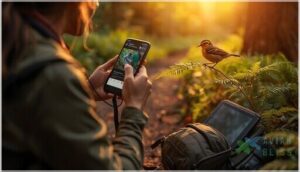
Technology has quietly become one of the most useful field companions a birder can carry into the field.
The right tools don’t just make recording easier — they make your observations sharper and more reliable.
Here are three worth knowing about.
GPS Devices and Mapping Tools
A handheld GPS receiver or a satellite-connected app like eBird can sharpen your data collection considerably. Most consumer units offer 3–10 meter GPS accuracy under open sky, and waypoint logging lets you save productive spots for return visits.
Offline maps keep location tracking active without cell service, and data export via GPX makes sharing bird sightings with conservation projects straightforward.
Smartphone Photography
Your smartphone is already a capable documentation tool for bird watching. A few habits make the difference between blurry snapshots and usable bird portraits:
- Lock focus by tapping the bird on-screen, then shoot in burst mode.
- Select the telephoto camera module over digital zoom for cleaner field marks.
- Frame loosely, leaving room to crop on larger screens.
- Upload photographs with embedded GPS to citizen science platforms like eBird.
Mobile gear and smart camera settings turn casual shots into reliable sighting records.
Digital Voice Recorders for Bird Calls
Audio captures what photos can’t — the exact pitch and rhythm of a call that clinches a tricky ID.
A recorder like the Zoom F3, with its 32-bit float capability, manages everything from a faint warbler to a booming grouse without clipping. For bird watching techniques, prioritize low self-noise units and a windscreen for clean call analysis in breezy conditions.
Organizing and Storing Your Bird Sighting Records

Collecting sightings is only half the job — keeping them organized is what makes the data useful over time. A well-structured system saves you from digging through scattered notes when you’re trying to spot a seasonal pattern or recall a rare encounter.
Here’s what to focus on regarding organizing and storing your records.
Structuring Digital and Paper Logs
A well-structured bird log is only as useful as how easily you can retrieve what’s in it. For digital records, organize your data logging by date, species, or location using spreadsheets or apps like eBird.
Paper bird journals work best with consistent entry templates — same fields every time.
Data standardization across both formats keeps your checklist records clean and your log organization smooth.
Backing Up Data Securely
Once your logs are structured, protecting them matters just as much. Follow the 3-2-1 rule: keep three copies across two storage types, with one off site.
Cloud storage with data encryption — AES-256 is the standard — guards your data collection against theft or loss. Backup automation takes care of the rest quietly.
Combine that with offline archives, and your records stay safe from ransomware or hardware failure.
Categorizing Sightings by Location or Date
Sorting your bird sightings by location or date transforms raw data into something genuinely useful. Location mapping groups records by site — a wetland, a forest trail, your backyard — enabling habitat analysis across visits. Date filtering reveals bird migration timing and seasonal patterns you’d otherwise miss.
Birding apps like eBird make sightings organization straightforward, letting you switch between date and time views or location instantly.
Analyzing and Reflecting on Your Bird Data

Recording data is only half the work—what you do with it afterward is where the real insight begins. Once you start looking back through your entries, you’ll notice things that weren’t obvious in the moment.
Here are the key areas worth paying attention to when you sit down to reflect.
Identifying Seasonal Patterns
Reviewing your bird sightings across seasons reveals migration trends that a single outing never could. Compare your monthly notes year over year and you’ll start seeing seasonal shifts — warblers arriving days earlier, habitat changes pushing shorebirds inland.
Tracking bird behaviors like dawn chorus timing or flock formation adds depth, connecting climate effects and biodiversity patterns to real moments you’ve personally witnessed.
Noting Changes in Species Presence
Consistency is what turns casual bird sightings into real evidence. When you compare your records year over year, habitat changes and population trends become visible — a marsh species gone, an urban generalist thriving.
These patterns matter for bird conservation, biodiversity tracking, and ornithological research. Your notes, shared with the birding community, help document ecosystem shifts and support species conservation on a broader scale.
Recognizing Rare or Unusual Encounters
Some bird sightings stop you cold — a species that simply shouldn’t be there. Vagrant species and unusual migration patterns often trigger automatic flags on platforms like eBird, alerting you to dig deeper.
Rarity Codes (Code 3–5) help gauge how unexpected a find really is. Cross-check Rare Bird Alerts, document plumage and bird behavior thoroughly, and pursue sighting verification through your regional review committee.
Best Practices for Sharing Bird Sightings
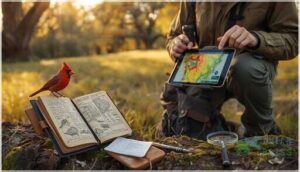
Recording a sighting is only half the work—sharing it well is where your observations gain real value.
Whether you’re submitting to a global database or swapping notes with a local club, how you share matters as much as what you share.
Keep these practices in mind as you start putting your records into the world.
Submitting to Citizen Science Databases
Every checklist you submit to eBird becomes part of a global citizen science effort that drives real conservation decisions. The platform’s automated data validation and species verification tools flag unusual sightings, keeping data collection honest.
Accurate location mapping ties your bird sightings to specific habitats, while checklist management features help you stay organized. Your records don’t just sit there — they fuel community engagement and population research worldwide.
Sharing With Local Birdwatching Groups
Local club meetings and email listservs are where your bird journal truly comes alive. Sharing your bird sightings with the birding community — through Facebook groups, club meetings, or dedicated bird alerts — strengthens community engagement and sharpens everyone’s skills.
Posting your eBird bird list to a local listserv, following group etiquette on social sharing, keeps the conversation accurate and respectful.
Ethical Considerations When Sharing Locations
Responsible sharing doesn’t stop at tagging your local group. Location privacy matters most when sensitive species are involved — posting exact nest coordinates can invite crowds, poachers, or egg collectors.
Platforms like eBird automatically obscure precise points for at-risk birds, a smart conservation ethics safeguard. Strip GPS metadata from photos before uploading, and describe only a general region to keep wildlife conservation and habitat preservation intact.
Avoiding Common Mistakes in Bird Sightings Recording

Even experienced birders slip into habits that quietly undermine their records over time. A few recurring mistakes tend to show up again and again, and knowing them puts you ahead of most. Here’s what to watch for.
Omitting Critical Details
Sighting omissions are one of the most damaging data gaps you can introduce into your records. Forgetting to note the time, exact location, or species details creates observation errors that quietly undermine species monitoring efforts.
When recording bird sightings, these detail inconsistencies and recording biases make your data logging less reliable for tracking populations. Precision isn’t optional — it’s what transforms birding experiences into genuinely useful field science.
Inconsistent Recording Methods
Switching between a paper notebook, eBird, and a second app without a clear system introduces data inconsistencies that quietly distort your records. Method variations — like mixing Traveling and Incidental checklists — create recording biases that make your data logging unreliable over time.
Watch for these common logging errors:
- Incomplete entries from switching tools mid-trip
- Checklist protocol mismatches that skew bird identification methods
- Duplicate sightings from unmerged records
Misidentifying Bird Species
Misidentification is just as damaging to your records as inconsistent logging. In birding, similar species like Purple Finches and House Finches trip up even experienced observers.
Relying solely on plumage — especially in poor light — leads to shaky species identification. Combining field guides, Merlin Bird ID, and careful notes on behavior strengthens your bird identification methods and keeps your data honest.
Frequently Asked Questions (FAQs)
What is the best audio recorder for birds?
What recorder truly captures a warbler’s song without distortion? For most birders, the Tascam DR-05X balances portability and audio quality, making field recording accessible and practical for solid species monitoring.
How to log bird sightings?
Log bird sightings by noting the date, time, location, species, and behavior right after you observe. Use eBird or a field notebook to apply consistent logging best practices and build a reliable bird list over time.
Is Banding birds ethical?
Bird banding raises real questions around bird welfare and banding risks.
When done under proper ethical guidelines, though, it’s a cornerstone of ornithology — generating conservation ethics-driven data that drives meaningful species conservation and wildlife conservation outcomes.
How do I record nocturnal bird sightings effectively?
Nocturnal birding is like fishing in the dark — you can’t see the water, but you can hear every ripple.
Use a red-filtered headlamp, log GPS coordinates, and let passive audio recording capture what your ears miss.
Can children participate in bird sighting documentation?
Yes, children can absolutely participate in bird sighting documentation. Through Family Birding outings, Kid-Friendly Apps like Merlin, and School Birding programs, kids contribute meaningfully to Youth Citizen Science and nature conservation efforts.
How do weather changes affect bird identification accuracy?
Weather patterns shape every bird sighting you make. Bright sun backlit birds hide key markings, while overcast skies reveal subtle plumage details, directly affecting bird identification accuracy and your wildlife observation confidence.
What legal rules apply to birdwatching in protected areas?
When birdwatching in protected areas, Wildlife Protection laws like the Migratory Bird Treaty Act set firm rules you need to follow to avoid fines. These include Access Restrictions, Noise Limits, Photography Rules, and Permit Requirements.
How do I handle conflicting sightings with other birders?
When conflicting sightings arise, focus on respectful dialogue and evidence sharing. Describe what you observed calmly, ask open questions, and use eBird’s review process to mediate disputes through documentation rather than debate.
Conclusion
Think of your field records as stones laid across a river—each one modest on its own, but together they form a path others can follow. Every time you learn how to record bird sightings accurately, you’re not just documenting a moment; you’re extending that path further into the future.
Researchers, conservationists, and birders you’ll never meet will step where your observations lead. That’s a quiet, lasting contribution worth making carefully.
- https://www.discoverwildlife.com/uncategorized/how-to-take-notes-out-bird-watching
- https://support.ebird.org/en/support/solutions/articles/48000803130-how-to-document-your-sightings
- https://www.allaboutbirds.org/news/take-note-tips-for-keeping-a-field-notebook/
- https://www.birds.cornell.edu/landtrust/merlin-bird-id/
- https://ebird.github.io/ebird-best-practices/ebird.html