This site is supported by our readers. We may earn a commission, at no cost to you, if you purchase through links.
Every autumn, a ruby-throated hummingbird weighing less than a nickel crosses the Gulf of Mexico in a single nonstop flight—roughly 500 miles over open water, with no land beneath it and no margin for error.
That journey doesn’t begin with a decision. It begins weeks earlier, when shortening days and dropping temperatures trigger a cascade of hormonal changes that the bird can’t ignore.
Seasonal changes affecting migration run deeper than instinct—they’re written into the biochemistry of thousands of species, fine-tuned over millennia to match the rhythms of a relatively stable climate. That stability is now shifting, and the consequences ripple far beyond the animals themselves.
Table Of Contents
- Key Takeaways
- How Seasonal Changes Trigger Migration
- Climate Change Disrupting Migration Patterns
- Ecological Impacts of Altered Migration
- Species Adaptation and Survival Strategies
- Conservation Approaches for Migratory Species
- Frequently Asked Questions (FAQs)
- How does climate change affect migration?
- What are some examples of seasonal migration?
- What are the factors of seasonal migration?
- How do migratory species navigate across open oceans?
- Which animal groups migrate the longest total distances?
- How does light pollution interfere with nocturnal migration?
- How do young animals migrate without experienced guides?
- Conclusion
Key Takeaways
- Seasonal migration isn’t just instinct—it’s triggered by a precise chain of biological cues, including day length, temperature, and rainfall, that animals have relied on for millennia.
- Climate change is breaking that chain by pushing migration timing out of sync with food availability, a phenomenon called phenological mismatch, which can cut chick survival rates nearly in half.
- Species are adapting by shifting ranges poleward and adjusting departure timing, but behavioral flexibility has limits, and those that depend on fixed day-length cues can’t rewire fast enough.
- Protecting stopover habitats, restoring wetlands, and maintaining climate corridors aren’t just conservation moves—they’re the most direct way to keep these seasonal rhythms from unraveling entirely.
How Seasonal Changes Trigger Migration
Every animal that migrates is in effect reading a set of seasonal signals the natural world sends out each season, and missing even one of those cues can throw the whole journey off.
For birds like egrets, even a slight shift in temperature or daylight can reshape an entire seasonal migration pattern across continents.
These seasonal forces don’t work in isolation — they build on each other, creating a carefully timed chain of events that keeps ecosystems functioning. Here’s a closer look at the key seasonal forces that set migration in motion.
Temperature as a Migration Cue

Temperature acts as one of the most reliable climate signals animals use to time their journeys. When daily temperatures climb into the mid-teens Celsius, migratory songbirds read that as a green light to depart. These thermal thresholds shape migration timing with exceptional precision.
Warmer springs now trigger earlier ecological responses across species, directly linking temperature cues, phenological shifts, and the broader consequences of climate change. Scientists have recently highlighted the impact of early February Arctic shifts on the accuracy of these migration signals.
Photoperiod and Migration Timing

While temperature gets a lot of attention, photoperiod signals — changes in day length — act as the master clock behind migration timing. Birds rely on these cues to trigger Zugunruhe, their internal migratory restlessness, long before conditions shift noticeably.
Seasonal timing depends on these paired systems working together:
- Circadian rhythms coordinate daily activity windows
- Day length crossing specific thresholds initiates departure
- Migration cues align fat storage and hormonal readiness
- Photoperiod stays fixed even as temperature changes and migration timing drifts
That last point matters most. Climate change creates phenological mismatch — migrants arrive after food peaks, with real ecological consequences for survival.
Recent research emphasizes the critical role of day length in migration, shaping the timing and success of these seasonal journeys.
Precipitation Patterns and Resource Availability
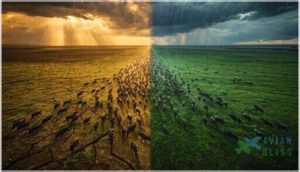
While day length sets the calendar, rainfall is what fills the table. Precipitation patterns shape resource availability in ways that directly drive when and where animals move. In East Africa, wildebeest track rainfall gradients between 800 and 1,200 millimeters annually, following fresh grass pulses.
Drought impacts compress routes, while rain-fed booms pull herds across vast distances. Ecosystem disruption follows when these rhythms break down.
| Precipitation Pattern | Migration Response |
|---|---|
| Seasonal rainfall gradient | Herds track green-up pulses |
| Multi-year drought | Longer routes to shrinking refuges |
| Rain-fed boom years | Earlier departure, better body condition |
| Highly variable rainfall | Unpredictable timing, resource mismatch |
| Reduced wintering ground rain | Delayed departure, lower fat reserves |
Wind and Weather Influences

Beyond rain, wind patterns and atmospheric conditions act as moment-to-moment signals that fine-tune departure decisions.
Migrating birds often read shifting winds like a map, timing their flights to ride favorable currents—a strategy well documented in studies on falcon flight patterns and altitude behavior.
Migratory birds actively select tailwinds, boosting ground speed by up to 37% during spring flights, while headwinds exceeding 10 m/s can halt migration entirely.
Storm impacts from cold fronts temporarily shut down movement, and climate change is already altering these weather forecasting windows that species depend on.
Climate Change Disrupting Migration Patterns

Climate change isn’t just warming the planet — it’s quietly rewriting the migration patterns that animals have followed for thousands of years.
Migration patterns that once ran like clockwork are now shifting in ways scientists are only beginning to fully understand. Here’s what the data is showing us.
Earlier Arrival at Breeding Grounds
Spring is arriving earlier — and so are the birds. Across temperate regions, shifting migration timing means many species now reach their breeding grounds one to two weeks ahead of late twentieth-century norms.
Here’s what that means for species resilience amid climate change:
- Food availability gaps leave early arrivals vulnerable to frost-reduced insect supplies
- Phenological shifts pressure birds to continuously recalibrate breeding ground changes
- Territory competition intensifies, favoring individuals with stronger climate adaptation instincts
- Migration patterns fragment, as not all species advance equally
Altered Migration Routes and Distances
Migration routes aren’t fixed highways — they’re shifting corridors. Climate adaptation is forcing species to rewrite their internal maps.
North American birds have pushed breeding ranges over 500 kilometers poleward, while gray whales now forage deeper into the Arctic, reducing migration distances. These geographic shifts in migration patterns reveal just how dramatically altered migration timing and route flexibility have become under sustained climate pressure.
Phenological Mismatch With Food Sources
Timing is everything in nature — and when it breaks down, food webs feel it first. Phenological mismatch occurs when migration timing no longer aligns with food availability, driven by temperature changes and migration timing falling out of sync.
Here’s what that means for ecosystems:
- Bird chicks hatch after caterpillar peaks, cutting survival rates nearly 50 percent
- Caribou calves miss nutritious plant flushes, reducing recruitment up to fourfold
- Seasonal synchronization collapses when plants advance faster than migrants can track
- Mismatch consequences ripple upward, triggering ecosystem instability across food webs
- Adaptive strategies remain limited when species rely on fixed day-length cues
Radar and Satellite Tracking Data
Tracking technology has transformed how you can understand species migration at a scale once unimaginable. Radar systems across North America detect hundreds of millions of birds moving nightly, while satellite imaging follows narwhals across decades of Arctic routes.
Data analysis from platforms like BirdCast reveals shifting migration patterns tied directly to warming temperatures — giving migration ecology researchers the tools to measure ecosystem resilience before it unravels.
Ecological Impacts of Altered Migration

When animals migrate off-schedule, the effects don’t stop with the animals themselves — the whole ecosystem feels it.
Every relationship built over thousands of years, from predator and prey to plant and pollinator, depends on timing that climate change is now scrambling. Here’s a closer look at where those disruptions are hitting hardest.
Effects on Predator-Prey Relationships
When prey arrival happens earlier, predators can’t always keep pace — and that gap reshapes entire food webs. Altered migration patterns are quietly rewiring predator-prey relationships across ecosystems.
In Arctic tundra, shifting lemming cycles pull foxes and snowy owls into new feeding windows, disrupting trophic cascades. These climate impacts on species interactions ripple outward, threatening ecosystem stability and the broader ecosystem services food webs quietly sustain.
Disruption of Pollination and Seed Dispersal
When pollinators and seed dispersers fall out of sync with the plants they serve, the ecological consequences ripple far beyond a single missed season. Climate adaptation isn’t happening fast enough to prevent serious biodiversity loss across ecosystems.
- Pollinator Decline separates bees from familiar flowers
- Phenological mismatches reduce seed set substantially
- Seed Dispersal failures cluster seeds near parent trees
- Ecosystem Resilience weakens as mutualism partnerships break
- Biodiversity and ecosystems suffer compounding reproductive losses
Changes in Ecosystem Nutrient Cycling
Beyond pollination failures, altered migration reshapes how nutrients move through ecosystems entirely. Migrating Pacific salmon carry marine subsidies — nitrogen and phosphorus — deep into inland rivers, nourishing riparian forests through aquatic linkages that connect ocean productivity to terrestrial cycling.
When climate change impact shortens or disrupts these runs, ecosystem services collapse quietly. Nutrient transport weakens, and the ecological consequences compound across interconnected species adaptation and survival pathways, straining long-term ecosystem management.
Risks to Biodiversity and Ecosystem Stability
These nutrient losses don’t stop there — they weaken ecosystem resilience fundamentally. When migration falters, biodiversity collapse follows a predictable chain: habitat loss strips climate refuge options, species extinction removes functional roles, and ecological balance unravels.
Climate change has already contributed to a 20% decline in native species abundance since 1900, leaving ecosystems too simplified for reliable species adaptation.
Species Adaptation and Survival Strategies

When conditions shift, animals don’t simply give up — they adjust, sometimes in ways that surprise even seasoned researchers.
The species holding on best tend to share a few key traits and strategies worth understanding.
Here’s what’s driving their survival.
Behavioral Plasticity in Migratory Species
Resilience, it turns out, looks a lot like flexibility. When you watch migratory species navigate a shifting climate, behavioral plasticity becomes their most powerful tool.
Many birds now demonstrate migration flexibility by adjusting migration timing — departing days or weeks earlier when spring temperatures rise. This adaptive behavior reflects ecological adaptation in real time, helping reduce phenological mismatch and maintain ecological synchrony before behavioral evolution can catch up.
Shifts in Geographic Ranges
Behavioral flexibility only goes so far — eventually, when local conditions become inhospitable, species relocate entirely. Range Expansion is now documented across continents, with migratory birds in North America shifting poleward roughly 1.5 km per year. These poleward movements and Habitat Shifts reflect Geographic Dispersal driven by warming.
Key patterns shaping Species Relocation include:
- Western North American birds shifting ~2.2 km/year toward cooler latitudes
- Montane species moving upslope, compressing Climate Refuge zones near summits
- Altered migration routes tracking newly suitable habitat connectivity
- Shifting habitats forcing ungulates into entirely new territorial boundaries
Demographic Responses to Changing Seasons
Seasonal shifts reshape more than timing — they reorganize entire Population Dynamics. Age Structure and Sex Differences in Migration Strategies determine who survives. Males usually arrive earlier, increasing storm exposure; juveniles face sharper survival deficits than adults.
| Demographic Group | Seasonal Risk | Migration Strategy |
|---|---|---|
| Adult males | Late-winter storms | Early spring departure |
| Juvenile birds | Food scarcity | Nursery-habitat reliance |
| Partial migrants | Variable conditions | Resident or migratory |
| Adult females | Molt delays | Later departure timing |
These Demographic Shifts drive measurable ecological responses across biodiversity.
Evolutionary Implications for Migratory Animals
Evolution doesn’t wait. When migration timing repeatedly misfires — birds arriving before insects hatch, whales foraging in waters that haven’t warmed — Genetic Adaptation accelerates. Phenological mismatch drives evolutionary processes fast enough to reshape populations within generations.
Watch for these Evolutionary Tradeoffs at work:
- Clock genes like CLOCK and ADCYAP1 rewire migration timing under pressure
- Species Resilience builds through Adaptive Migration supported by phenotypic plasticity
- Migration Evolution favors partial migrants when ecological consequences of full migration worsen
Conservation Approaches for Migratory Species
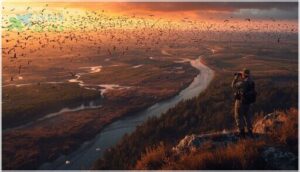
Protecting migratory species isn’t a single-fix problem — it takes a coordinated set of strategies working together across landscapes and borders.
As climate change continues reshaping the routes and rhythms these animals depend on, conservation efforts have had to grow more targeted and more urgent. Here are the key approaches that researchers and wildlife managers are putting into practice.
Habitat Protection and Restoration
When habitat destruction severs migration routes, the entire ecosystem unravels. That’s why wildlife corridors, wetland restoration, and biodiversity conservation matter so much.
Projects reconnecting fragmented landscapes — like western big game corridors and restored stopover wetlands — directly support ecosystem restoration and climate resilience. Protecting high-value sites through coordinated conservation strategies across public and private lands keeps ecological restoration efforts meaningful and biodiversity preservation achievable.
Adaptive Wildlife Management Strategies
Static rules don’t cut it when migration routes keep shifting. That’s why Adaptive Wildlife Management now drives meaningful Wildlife Conservation Efforts — from Climate Informed Corridors that move with warming ranges, to Flexible Harvest Management that adjusts waterfowl regulations annually, to Real Time Closures reducing bycatch during peak movement.
Assisted Migration and Community Co Management further strengthen Adaptive Capacity, keeping Conservation Strategies responsive to ongoing Climate Change Impact across Migration Ecology and Conservation priorities.
Collaborative Research and Monitoring Efforts
No single country can track a Wood Thrush from its Minnesota breeding ground to a Guatemalan winter forest alone — that’s where International Cooperation and Research Networks become indispensable.
Platforms like Movebank and Motus anchor Data Sharing Platforms across Migration Ecology and Conservation, while International Agreements and Community Engagement connect Wildlife Tracking Technology with Conservation Biology insights, strengthening Wildlife Conservation Efforts and protecting Ecosystems globally.
Climate Change Mitigation for Migration Preservation
Protecting species migration isn’t just a wildlife goal — it’s a climate strategy. When you invest in Migration Corridors and habitat restoration, you’re also locking away carbon and stabilizing the seasonal rhythms that hold ecosystems together.
Protecting migration corridors is climate strategy: restore flyways, and you restore the rhythms that hold ecosystems together
- Climate Resilience grows when Adaptive Management guides land-use planning along flyways
- Ecosystem Services depend on Migration Timing staying intact through Climate Change Mitigation policy
- Ecosystem Resilience strengthens when Conservation Strategies span international borders
Frequently Asked Questions (FAQs)
How does climate change affect migration?
Ironically, climate change doesn’t just disrupt animal migration — it quietly rewrites the rulebook entirely.
Shifting temperatures throw off migration timing, trigger phenological mismatch, and force species adaptation, unraveling ecosystem disruption faster than conservation strategies can respond.
What are some examples of seasonal migration?
From Arctic terns completing 80,000-kilometer round trips to monarch butterflies crossing continents, migration takes countless forms — Bird Journeys, Mammal Treks, Insect Flights, and Marine Travels all follow distinct seasonal patterns driven by environmental cues.
What are the factors of seasonal migration?
Migration triggers include environmental factors like temperature shifts, daylength, precipitation, and wind patterns.
These seasonal cues guide animal behavior, shaping species migration timing and routes, with phenological mismatch emerging when ecosystem responses fall out of sync.
How do migratory species navigate across open oceans?
Long-distance migrants use multi cue integration to cross open oceans — blending magnetic field sensing, celestial navigation, ocean currents, and chemical maps into reliable migration routes that keep animal migration patterns and species migration on track.
Which animal groups migrate the longest total distances?
Like runners in a relay race, long distance migrants pass the baton across hemispheres.
Seabird migration champions like Arctic terns log 70,900 kilometers annually, while oceanic travelers like gray whales cover 20, Terrestrial mammals, insect migrations, and other species round out the impressive field.
How does light pollution interfere with nocturnal migration?
Artificial lighting causes light disorientation in nocturnal navigation, pulling migratory species off course.
This migration disruption creates visual confusion, threatening wildlife conservation through significant ecological disruption and lasting environmental impact on animal migration behaviors.
How do young animals migrate without experienced guides?
Think of young warblers as born with a built-in GPS. Innate navigation, geomagnetic cues, and a celestial compass guide their first solo journey — no experienced adults required, just instinct and the stars.
Conclusion
The hummingbird crossing the Gulf carries more than instinct—it carries the accumulated logic of countless generations, each migration a vote for survival.
When seasonal changes affecting migration fall out of sync with the ecosystems they’ve long sustained, that logic begins to unravel.
What you protect today—a stopover habitat, a restored wetland, a stable climate corridor—becomes the thread holding those ecosystems together. The birds will keep flying. The question is whether the world they return to still fits.
- https://pmc.ncbi.nlm.nih.gov/articles/PMC8385336/
- https://www.neefusa.org/story/climate-change/how-climate-change-changing-animal-habits
- https://www.thehappyturtlestraw.com/climate-change-and-its-effects-on-species-migration-patterns/
- https://ecoservantsproject.org/how-climate-change-is-affecting-fall-migration-patterns/
- https://hazzesadventure.com/hazzes-adventure/does-rain-affect-the-serengeti-wildebeest-migration/