This site is supported by our readers. We may earn a commission, at no cost to you, if you purchase through links.
Walk a wetland in late August and you might spot blue-winged teal already pushing south—weeks before most hunters have even pulled their waders out of storage. Meanwhile, mallards won’t budge until ice forces their hand, sometimes holding out until December. Same flyway, same sky, completely different clocks.
Migration differences in waterfowl run deeper than most people expect, shaped by genetics, weather patterns, food availability, and evolutionary pressures refined over thousands of years. Understanding what drives each species keeps you ahead of the birds—and reveals just how finely tuned these migrations really are.
Table Of Contents
Key Takeaways
- Blue-winged teal head south as early as August while mallards won’t budge until ice forces them out, showing how deeply species-specific timing is baked into each bird’s biology.
- Day length, cold fronts, and barometric pressure act as nature’s migration triggers, but climate change is quietly scrambling those cues — pushing departures weeks earlier than they were just a few decades ago.
- Losing wetlands doesn’t just shrink habitat; it forces birds to fly farther between rest stops, crowd into fewer sites, and arrive at breeding grounds out of sync with peak food availability.
- From GPS transmitters to citizen science platforms like eBird, modern tracking tools are giving conservationists the real-time data they need to protect the stopover sites that keep migration routes intact.
Key Factors Influencing Waterfowl Migration
Waterfowl don’t just pick up and leave on a whim—there’s a lot working behind the scenes to get them moving. Everything from the weather outside to the genes they inherited plays a role in shaping when, where, and how far they fly.
Each species handles the journey differently, as you’ll see comparing waterfowl, hummingbird, and warbler migration strategies.
Here are the key factors that drive those decisions.
Species-Specific Behaviors
No two duck species pack their bags the same way. Blue-winged teal are classic early movers — their flocking patterns shift south by August, driven by species-specific migration behaviors tied to shallow wetland dependency.
Mallards? They’ll linger until a hard freeze forces the issue. Foraging strategies, roosting habits, and species distribution all shape when and how fast each species hits the flyway.
Goose migration is distinguished by V-shaped flight formations that help conserve energy during long-distance travel.
Environmental and Weather Cues
Beyond species quirks, the environment itself calls the shots. Photoperiod effects — shifting day length — act as nature’s internal clock, triggering hormonal changes that get birds moving before weather turns ugly. Temperature cues, barometric changes, and wind patterns all layer on top of that signal.
Watch for these environmental factors driving migration patterns:
- Shortening days trigger fat storage and flocking behavior
- Cold fronts push mallards south ahead of freezing wetlands
- Falling barometric pressure signals incoming storms, sparking movement
- Southerly winds create ideal northbound flight conditions in spring
- Climate shifts and ecological shifts are nudging historical weather patterns off-script
Waterfowl adapt their habits to winter weather by seeking new shelter and food as described in this overview of waterfowl habits.
Climate change is quietly rewiring these cues — warmer winters mean some ducks simply don’t go as far south anymore.
Food and Habitat Availability
Weather cues get birds moving, but food sources and habitat quality determine where they stop — and whether they make it. Waste grain now fuels nearly half the diet of some species during migration, yet wetlands still matter deeply for nutrient cycling and overall body condition.
Wetland habitat loss, poor habitat management, and habitat changes reduce those options fast, making habitat conservation and smart wetland management genuinely life-or-death for migrating waterfowl.
Genetic and Evolutionary Influences
Habitat shapes where birds stop, but genetics shapes whether they go at all. Inherited traits — baked into a duck’s DNA long before it hatches — drive migration phenology, timing, and distance through ecological mechanisms refined over generations.
Over generations, birds genetically adapt their routes around new food sources, hardwiring those discoveries into the next generation’s instincts.
- Genetic variation influences route fidelity and philopatry
- Evolutionary pressures tighten schedules in long-distance migrants
- Migration genetics can shift through microevolution across generations
- Epigenetic factors alter timing without changing DNA sequences
- Species adaptation explains why some populations migrate while others stay put
Comparing Migration Timing Across Species

Not all waterfowl run on the same clock, and that gap in timing can span weeks or even months depending on the species. A few key factors shape when birds hit the flyways — and climate change is quietly reshuffling that schedule.
Here’s how the timing breaks down across some of the most well-known species.
Early Vs. Late Migrating Waterfowl
Not all ducks are in a rush. Blue-winged teal are moving south by August, burning through fat reserves before the Gulf crossing, while mallards won’t budge until hard freezes force their hand.
These contrasting survival strategies shape migration phenology in fascinating ways — early migrants claim prime winter habitat, late migrants squeeze extra feeding time from northern fields. Same flyway, completely different clocks.
Influence of Climate Change on Timing
Climate change is quietly rewriting the calendar for waterfowl everywhere. Warmer winters have pushed many species to depart one to three weeks earlier than they did in the 1980s, while fall migration delays are just as common. These timing disruptions ripple through the whole season.
Key climate change impacts on migration phenology include:
- Earlier spring departures due to reduced snow cover and faster ice melt
- Migration delays in autumn as northern wetlands stay open longer
- Timing disruptions from temperature effects overriding daylight cues
- Seasonal changes creating mismatches between arrival and food availability.
Species Case Studies (e.g., Blue-Winged Teal, Mallards)
Two ducks, two completely different playbooks. Blue-winged teal are the early birds — adult drakes hit southern marshes by August, and juvenile flocks follow without any adult guidance, already wired for long hauls toward South America. That Teal Gulf Crossing alone covers thousands of miles.
Mallards? Pure Mallard Flexibility — they linger up north until food disappears. Their Stopover Sensitivity and species-specific migration behaviors make both fascinating case studies in migration timing.
Differences in Migration Routes and Distances
Not every duck is logging the same kind of frequent flyer miles — some species cross entire continents, while others barely leave the county. Where a bird goes, and how far, comes down to a mix of species, habitat, and some surprisingly deep-rooted instinct.
Here’s a closer look at what shapes those routes and distances.
Long-Distance Vs. Short-Distance Migrants

Not all waterfowl migration looks the same — and the gap between long-distance and short-distance migrants is genuinely striking. Some birds cross oceans; others barely leave the county.
Here’s what separates them:
- Flight Endurance — Long-distance migrants sustain intense flight over 60% longer than short-distance migrants.
- Energy Reserves — Long-distance ducks double their body fat before departure, fueling nonstop flights of thousands of miles.
- Fat Metabolism — Black brant burn nearly half their body weight crossing from Alaska to Baja California in 60–72 hours.
- Stopover Strategies — Short-distance migrants hop between nearby wetlands frequently; long-distance migrants depend on a few critical staging areas.
- Migration Timing — Long-distance migrants face tighter survival windows, while short-distance migrants have more scheduling flexibility.
Understanding these migration patterns helps explain why losing even one key wetland can derail entire migration routes for long-distance migrants.
Major North American Flyways

Think of North America’s four flyways as nature’s own highway system — the Atlantic, Mississippi, Central, and Pacific Flyway each carving distinct migration corridors across the continent.
| Flyway | Key Waterfowl Habitats | Flyway Management Focus |
|---|---|---|
| Mississippi | River floodplains, bottomland forests | Largest waterfowl volume |
| Atlantic | Coastal marshes, estuaries | Highest bird diversity |
| Central | Playa lakes, prairie potholes | Great Plains conservation efforts |
Flyway boundaries guide both birds and biologists, shaping flyway management decisions that directly protect these routes.
Importance of Stopover Sites
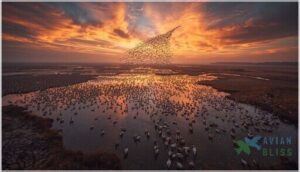
Stopover sites aren’t just rest stops — they’re the difference between a duck arriving on the breeding grounds ready to nest and one that barely makes it. Migration refueling at key stopover points lets birds rebuild the energy reserves lost during long flights.
But habitat fragmentation threatens stopover ecology across major migration routes, squeezing waterfowl migration patterns and limiting critical habitat availability for resting and recovery.
Impact of Habitat and Landscape Changes
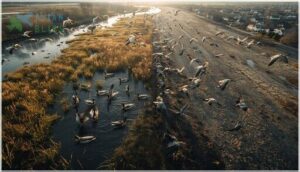
The landscape waterfowl depend on has changed dramatically over the past century, and birds don’t adapt to that overnight. From drained wetlands to sprawling suburbs, these shifts ripple through migration in ways that aren’t always obvious.
Here’s a closer look at the key changes reshaping where and how waterfowl move.
Effects of Wetland Loss and Alteration
Wetland loss hits waterfowl migration hard — and the numbers don’t lie. The U.S. has already lost nearly half its historical wetlands, with some states like California topping 90%. That’s not just habitat destruction on paper; it’s real Migration Disruption playing out every flyway season.
The U.S. has lost nearly half its wetlands, and every acre gone means real migration disruption across the flyways
Here’s what Wetland Degradation and Habitat Fragmentation actually mean for birds on the move:
- Longer flights, less fuel — waterfowl burn more energy traveling between shrinking stopover sites
- Crowded remaining wetlands raise disease risk and food competition
- Timing mismatches mean peak food availability no longer lines up with migration windows
- Coastal wetland loss threatens wintering grounds, especially along the Gulf Coast
These Ecosystem Impacts ripple outward. When wetland habitat loss compounds year after year, Conservation Efforts face an uphill battle keeping waterfowl migration viable.
Agricultural Practices and Waterfowl Movement
Farmland isn’t just a backdrop for migration — it’s become part of the route itself. Flooded Field Habitat draws ducks to feed on leftover grain, while No Till Benefits keep Crop Residue on the surface instead of burying it.
Fields leaving 125–450 pounds of waste rice per acre can feed hundreds of birds daily. Smart Farm Field Management, like Seed Wave Timing and strategic flooding, genuinely shapes waterfowl migration patterns.
Urbanization and Human Disturbance
Cities reshape migration just as much as crop fields do. Urban habitat fragmentation forces waterfowl into smaller, riskier stopovers, while light pollution throws off nighttime navigation. Noise disturbance from boats can cut feeding time by up to a third.
Heat islands keep ponds ice-free longer, tempting some ducks to linger.
Add collision risks from power lines and traffic, and urbanization becomes a serious gauntlet.
Conservation Challenges and Adaptive Strategies

Waterfowl are resilient, but they can’t adapt fast enough to keep up with everything we’re throwing at them—climate shifts, habitat loss, and landscape-scale changes all happening at once.
The good news is that researchers, managers, and conservationists aren’t just watching; they’re actively developing strategies to help populations stay afloat. Here’s a look at the key areas where those efforts are focused.
Climate Change Adaptation in Waterfowl
Climate change isn’t just shifting temperatures — it’s quietly rewriting waterfowl migration patterns one season at a time. Phenological shifts mean birds now arrive at breeding grounds after peak food windows have already closed, driving real energetic costs during nesting.
Adaptive migration helps some species flex their routes, but climate variability is outpacing their ability to adjust. The ecological impacts add up fast.
Habitat Restoration and Management
Restoration is where the rubber meets the road for waterfowl management. Ducks Unlimited alone has protected or restored over 19 million acres through habitat conservation efforts — and that scale matters.
Wildlife refuges use ecosystem management to time water levels with migration waves, creating sustainable landscapes that actually feed and shelter birds.
Wetland habitat loss won’t fix itself, but targeted habitat enhancement and wetland conservation keep migration corridors functional.
Monitoring and Research for Migration Patterns
Understanding waterfowl migration isn’t guesswork — it’s a science built on layered tracking methods and decades of data. Five core research tools drive what we grasp today:
- GPS and satellite transmitters reveal fine-scale routes across thousands of kilometers
- Aerial surveys track seasonal distribution shifts across flyways
- Bird banding links survival rates to migration timing
- eBird citizen science delivers real-time migration patterns at striking resolution
- Integrated migration modeling platforms merge all sources into actionable conservation strategies
Together, these research methodologies for studying avian migration — and the spatiotemporal analysis and long-term ecological data analysis behind them — tell you where the birds are going, and why.
Frequently Asked Questions (FAQs)
How do predators affect waterfowl migration decisions?
Food means nothing if a hawk is waiting. Predator avoidance shapes waterfowl migration decisions constantly — ducks and geese factor in risk assessment at every stopover, adjusting flight patterns and habitat selection to stay alive.
What role does disease play in migration survival?
Disease hits migrating waterfowl hard. Avian influenza alone can kill over 40% of affected flocks, disrupting migration mortality rates and pathogen ecology across entire flyways — a serious threat to waterfowl immunity and survival.
How do young waterfowl learn their migration routes?
Young waterfowl learn migration routes through a mix of Parental Guidance, Innate Navigation, and Environmental Cues — part inherited compass, part family road trip. It’s nature and nurture, literally taking flight together.
Do waterfowl migrate differently at night versus daytime?
Yes — most dabbling ducks follow nocturnal migration patterns, peaking around midnight.
Mallards and pintails use nighttime navigation to avoid predators, reduce heat loss, and ride favorable winds along established flight patterns and migration routes.
How does hunting pressure alter waterfowl movement behavior?
Hunting pressure rewires how ducks move. Birds quickly shift flights to after legal hours, crowd into refuges, and cut daily movement dramatically — turning waterfowl migration and duck hunting into a constant game of adaptation and avoidance.
Conclusion
Like Aldo Leopold watching geese trace the same sky his grandfather once watched, you’re tuning into something ancient. Migration differences in waterfowl aren’t random—they’re a layered system shaped by genetics, weather, and landscapes both intact and vanishing.
The blue-wing that leaves in August and the mallard that waits for ice aren’t stubborn or capricious; they’re precisely calibrated. The more you understand their rhythms, the better you’ll read the marsh before the birds even arrive.
- https://www.divebombindustries.com/blogs/news/protecting-waterfowl-the-impact-of-urbanization-on-waterfowl
- https://www.fws.gov/project/migratory-bird-parts-collection-survey
- https://esajournals.onlinelibrary.wiley.com/doi/10.1002/ecm.1642
- https://pmc.ncbi.nlm.nih.gov/articles/PMC8247866/
- https://doi.org/10.5061/dryad.wwpzgmsrd