This site is supported by our readers. We may earn a commission, at no cost to you, if you purchase through links.
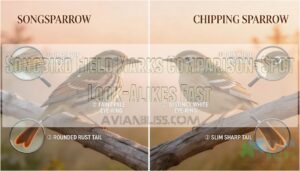
Most songbird mistakes happen before you raise your binoculars. You notice color first, but shape, bill, and wing pattern usually settle the ID faster.
A sparrow with a heavy conical bill tells a different story than one with a slim, pointed bill. A bold eye-ring can separate a vireo from a warbler at a glance.
That’s why field marks comparison matters more than memorizing names alone.
When you compare silhouette, streaking, wingbars, and tail flashes side by side, look-alikes stop blurring together. The bird stays small, the view stays brief, and your decisions get sharper under poor morning light.
Table Of Contents
- Key Takeaways
- Core Field Marks to Compare
- Head and Face Mark Differences
- Wing, Tail, and Body Patterns
- Shape, Bill, and Behavior Clues
- Comparing Common Songbird Look-Alikes
- Frequently Asked Questions (FAQs)
- Why do birds use field marks?
- What is a field mark?
- What are the different types of behavior field marks?
- What are the 5 S’s of birding?
- Which is the best bird song identifier?
- What are the field marks of birds?
- How to identify birds in the field?
- How does geographic range narrow down look-alike species?
- When do juveniles show different markings than adults?
- How does lighting conditions affect perceived plumage colors?
- Conclusion
Key Takeaways
- Bill shape alone — conical for seed-crushers, slender for insect-hunters — often IDs a songbird faster than plumage ever will.
- Comparing silhouette, wingbars, breast streaking, and face markings side by side collapses the confusion between look-alike species.
- Behavior is a field mark too: tail pumping, perch posture, and foraging zone tell you what feather patterns sometimes cannot.
- Lighting, molt stage, age, and season all shift how field marks appear, so context always travels with the visual cue.
Core Field Marks to Compare
When you’re sorting out songbird look-alikes, certain field marks always come first. These are the visual cues that help you separate one species from another at a glance. Let’s walk through the essentials you’ll want to compare every time.
Bill shape, wing bars, and breast streaks are some of the sharpest clues—explore the full breakdown in this guide to key field marks for identifying songbirds.
Size and Silhouette Benchmarks
Before anything else, anchor your eye to size. Body length range for most songbirds runs 8–9 inches; wing chord span usually measures 3–4.5 inches. Tail length ratio adds another silhouette clue.
Mass category — light under 15g, heavier above — shapes how a bird sits and moves. Use relative size as your first birding shortcut.
Silhouette profile narrows everything down fast. These visual cues echo the principles of anthropometric measurement benchmarks used in body measurement research.
Plumage Contrast Versus Overall Color
Once you’ve sized up a bird, turn to plumage patterns. High Contrast Ratio sets warblers apart—think bold wingbars and saturated carotenoid brightness, sometimes boosted by hidden white layers.
Vireos blend in, showing low Color Saturation for Background Matching. Use a comparison chart to map these visual cues.
Field marks like crisp eyelines or uniform streaks make color patterns actionable. Vireos can be identified by their thick stout bills.
Bill Shape and Feeding Adaptation Clues
Plumage patterns get you close — bill shape closes the gap.
A conical bill signals seed-crushing through Bill Muscular Leverage; that broad base gives jaw muscles real mechanical advantage.
Slender bills mean insect gleaning.
Crossed mandibles? That’s the Mandible Crossing Mechanism crossbills use to pry conifer cones.
Feeding Niche Correlation makes bill shape one of your fastest field marks on any songbird comparison chart.
Eye Rings, Eyelines, and Eyebrow Stripes
Bill shape narrows the family. Now the face closes the ID.
An eye ring’s Ring Intensity — bold versus faint — often separates look-alikes instantly. Eyeline Sharpness tells you just as much; check whether it extends behind the eye only.
The superciliary stripe rewards Stripe Width Variation study. Always factor in Lighting Influence — Contrast Enhancement shifts under cloud cover, changing how these visual cues read entirely.
Breast Streaking, Spotting, and Plain Underparts
The chest is where sparrows give themselves away.
Streak Density Variation matters: thick, messy streaks read instantly as different from fine, sparse ones.
Check Spot Position Consistency — Song Sparrows cluster streaks into a central breast spot, others don’t.
Underpart Color Uniformity separates plain-breasted species fast.
Watch for Seasonal Streak Fading and Juvenile Marking Differences, since young birds often show weaker visual clues than adults.
Wingbars, Patches, and Tail-edge Flashes
Wingbars cut straight to species identity. On a perched bird, those horizontal lines do most of the work.
- Molt-Driven Bar Changes fade wingbars in non-breeding plumage
- Juvenile Patch Development produces fainter, differently spaced bars than adults
- Seasonal Flash Brightness shifts tail edge contrast noticeably between spring and fall
- Behavioral Tail Flash during flicking reveals outer-feather patterns invisible at rest
Use a comparison chart to track Habitat Wing Patterns across similar species.
Head and Face Mark Differences
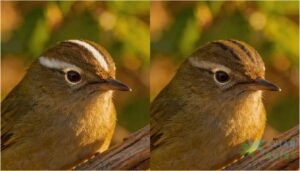
Head and face markings often hold the key when two songbirds seem nearly identical.
You’ll want to focus on subtle stripes, color patches, and shape differences above the bill and around the eye. Here are the main features to compare when sorting out look-alikes.
Crown Stripes and Cap Patterns
The crown is one of the fastest field marks you can check. Adult White‑crowned Sparrows show bold black‑and‑white crown stripes — Crown Stripe Width varies by sex, with males displaying sharper Sexual Stripe Dimorphism.
Immature Cap Contrast drops dramatically in first‑winter birds, shifting to a muted tan. Regional Crown Hue differs by subspecies. The Feather Raising Effect can briefly widen the superciliary stripe.
| Feature | Adult | Immature |
|---|---|---|
| Crown stripe | Bold black-and-white | Tan and brown |
| Visual markers | High contrast | Low contrast |
Supercilium Versus Bold Eyeline
Two stripes, one rule: position tells them apart. The superciliary stripe runs above the eye; the eyeline cuts directly through it.
Diagnostic Widths matter — Louisiana Waterthrush carries a broad white stripe, Northern Waterthrush a narrower yellow one.
Hue Differentiation and Prominence Levels shift with Feather Posture.
Use a comparison chart integrating visual and auditory cues in identification to lock these field marks down fast.
Malar Stripe and Throat Patch Contrasts
The malar stripe and throat patch work as a pair — malar throat synergy in action. That dark line running cheek to chin frames the throat patch, and patch border sharpness tells you the species quickly.
Light condition effects shift contrast at dawn.
Use a comparison chart noting these plumage patterns.
In many songbirds, intraspecific signaling drives these malar markings, making them reliable field identification shortcuts.
Lore Color and Facial Mask Clues
Notice how Lore Color Shifts signal mood—bright tones for optimism, darker hues for danger.
Mask Contrast Dynamics highlight dual personalities; Mask Edge Wear hints at past trials.
Eyebrow Stripe Alertness paired with a lighter mask edge marks awareness.
Facial Mask Alignment, whether symmetrical or not, reveals intent.
Combine superciliary stripe, eye stripe, and Malar Markings for precise field marks amid complex plumage patterns.
Crest Presence or Absence
From lore patterns, shift your gaze upward — crown tells its own story. A crest changes a bird’s entire silhouette.
Tufted Titmouse? Identifiable by outline alone.
Blue Jay raises or flattens its crest, altering its profile instantly — that’s Crest Behavioral Display in action. Crest Shape Variation, from brushy to pointed, accelerates Crest Identification Speed even when plumage details blur at distance.
Eye Color and Eye-ring Visibility
Eye rings anchor the face. A complete eyering against dark plumage triggers instant contrast edge detection — your eye locks on fast. Iris hue variation follows age; juveniles show duller irises, with age-related iris darkening reversing as birds mature. Watch for lighting angle effects at dawn. Binocular focus enhancement reveals broken eye ring edges invisible otherwise.
- Bold eyering makes eyes appear larger
- Pale irises brighten against warm facial tones
- Juveniles show duller, harder-to-read iris color
- Dawn light sharpens eye stripes and eyering contrast
- These field marks accelerate visual identification at distance
Wing, Tail, and Body Patterns

When you’re sorting out songbird look-alikes, patterns on the wings, tail, and body tell you plenty. These marks separate species that seem almost identical at first glance.
Let’s walk through the key features you’ll want to check next.
Single Versus Double Wingbars
Wingbar count is one of the sharpest songbird identification techniques you can develop. A quick glance tells you a lot.
| Feature | Single Wingbar | Double Wingbar |
|---|---|---|
| Positioning Differences | Greater coverts only | Greater and median coverts |
| Contrast Levels | Often bold, isolated | Varied; one bar sometimes fainter |
| Molt Influence | Second bar fades with wear | Both bars visible in fresh plumage |
Blackpoll Warblers flash two crisp white bars. Bay-breasted Warblers match them. Meanwhile, worn Western Tanagers drop to one visible bar — a classic molt influence trap. Shape Variations matter too: bars may appear as dashes, not solid lines. These field marks and plumage patterns for species separation are essential comparison charts for songbirds that sharpen your eye fast.
Rump Patches and Back Streaking
If you’ve mastered wingbar comparison, turn your attention to rump patches and back streaking.
Patch Material Choices and Design Color Palettes matter—bold streak color contrast stands out in field mark analysis for sparrows. Attachment Methods, like sew-on backings, boost durability testing for frequent wear.
Comparison charts for songbirds highlight how plumage patterns and rump patches separate look‑alikes, especially in ground‑foraging species.
Breast Bands, Necklaces, and Central Spots
Field marks like breast bands, necklaces, and central spots are your best visual identification cues when comparing songbirds.
Pay attention to Band Width Variation—some bands broaden with molt or fade with wear, shifting Seasonal Band Brightness.
Necklace Color Contrast and Spot Placement Consistency help separate look-alikes.
Field guides highlight these patterns; integrate them with other cues for reliable, nuanced identification.
Tail Length, Tip Shape, and White Corners
Tail length sets the silhouette before you even reach for your binoculars. A Tail Length Ratio makes a bird look sleek; short tails look chunky.
Check Tip Shape Variants next — square, rounded, notched, or forked.
White Corner Flash is your fastest in‑flight clue, especially against dark tail feathers. Tail Edge Contrast and Tail Silhouette Contrast together lock down a confident ID.
Primary Projection and Wing Length
When you’re comparing songbirds, projection measurement is essential. Longer primaries mean higher aerodynamic efficiency and a slender silhouette. Molt stage effects can shift wing length, so note feather freshness. High aspect ratio and low wing loading signal strong flyers.
For practical ID, watch for:
- Primary extension past tertials
- Wing bars
- Size silhouette
- Habitat and voice context
Plain-bodied Versus Heavily Patterned Songbirds
Ever notice how plain-bodied songbirds melt into foliage while patterned species stand out in open habitats? Camouflage efficiency is key for ground dwellers, while mating display contrast boosts visibility.
Bold wing bars and breast streaks act as field marks.
Patterned birds show higher predator detection risk but excel at visual cue integration.
Foraging strategy and vocal divergence often track with plumage patterns.
Shape, Bill, and Behavior Clues

Shape, bill, and behavior offer quick clues when plumage patterns aren’t enough. You’ll spot differences in posture, feeding style, and movement that separate look‑alikes.
Let’s walk through the key features you can use in the field.
Finch-like Conical Bills Versus Slender Insect Bills
You can spot a finch from a warbler by their bill alone—think nutcracker versus needle.
Finch-like conical bills show Bite Force Mechanics for Seed Crushing Efficiency.
Slender insect bills offer Insect Probing Precision, shaped by Bill Muscle Architecture.
These feeding adaptations based on bill shape create Dietary Constraint Impact. Watch for:
- Bill thickness and tip shape
- Feeding behavior
- Habitat preference
- Plumage contrast
Chunky Versus Sleek Body Proportions
Think of chunky birds as living ballast—deep chests, high wing loading, and squat tail carriage. Sleek songbirds stretch out with longer neck lines and sharper shadow diffusion.
Your eye can sort these size silhouettes fast by Chest Bulk and body mass.
Use the table below to anchor your field marks:
| Weight Class | Chest Bulk | Tail Carriage |
|---|---|---|
| ————–: | : | |
| ————: | : | |
| —————: | ||
| Chunky | Full | Low, Compact |
| Sleek | aerodynamic | High, Even |
| Medium | Moderate | Variable |
| Light | Minimal | Upright |
Ground Foraging Versus Shrub Gleaning
Chunky birds often anchor themselves low, but ground foragers take it further—short legs, probing bills, and steady sweeps through leaf litter. Shrub gleaners, by contrast, hop and flutter with longer legs and flexible necks, working dense foliage for hidden prey.
You’ll spot these differences fast:
- Microhabitat Structure
- Leg Length Adaptations
- Foraging Flight Patterns
Tail Pumping, Flicking, and Bobbing Behaviors
You’ll notice tail pumping, flicking, and bobbing behaviors right after observing foraging style. These movements aren’t random—they’re field marks tied to Predator Deterrence, Social Signaling, and Energetic Cost.
For instance, Palm Warblers bob incessantly; Black Phoebes pump tails to signal vigilance.
Compare tail length variations and microhabitat use with this quick reference:
| Species | Tail Behavior |
|---|---|
| Palm Warbler | Constant bobbing |
| Black Phoebe | Vigorous pumping |
| Spotted Sandpiper | Rhythmic bobbing |
| Junco | Flash/flick white |
Perching Posture and Movement Style
Posture tells you more than you’d expect. Cardinals hold an upright posture—compact, vertical, alert. Warblers show a flatter horizontal angle, stretched low through foliage. These aren’t subtle differences.
Watch balance mechanics too: a bird’s weight shifts constantly on thin perches. Hopping motion is also a field mark—quick, springy bursts identify shrub-dwellers faster than any wing bar or bill shape.
Habitat as a Comparison Filter
Where bird stands shapes what it is. Habitat narrows your list before you raise binoculars.
- Dense shrubs flag small insectivores using Vegetation Structure as a filter
- Moist leaf litter signals Microhabitat Moisture-dependent foragers
- Elevation Gradient shifts assemblages toward mountain specialists
- Edge Effects surface mixed-flock opportunists at woodland boundaries
- Urban Adaptability marks generalists tolerating human-altered spaces
Habitat and range as identification filters cut look-alike confusion fast.
Comparing Common Songbird Look-Alikes
When two songbirds look nearly identical, field marks make all the difference. You’ll want to compare features side by side to spot what matters.
Here’s where you can focus your attention next.
Sparrow Field Marks Side by Side
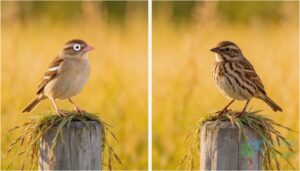
Ever wondered how a songbird comparison chart turns confusion into clarity? Field marks—like wing bar, bill shape, and plumage zones—set sparrows apart.
For instance, Field Sparrows show pale rump color contrast, pink bill color variation, and a neat white eye ring. Seasonal timing and vocal signature cues round out identification.
See the practical breakdown below:
| Field Marks | Field Sparrow | Song Sparrow |
|---|---|---|
| Wing Bar | Two bold white bars | Faint, less distinct |
| Bill Shape | Short, pinkish | Stout, brownish |
| Rump Color Contrast | Pale, subtle | Darker, streaked |
| Leg Feather Hue | Pale, unmarked | Brown, streaked |
Finch Versus Sparrow Bill and Streak Patterns
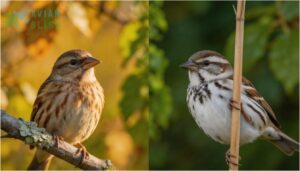
When you compare finch and sparrow field marks, start with bill shape—finches have a deep, conical bill with a strong culmen width for seed‑cracking force, while sparrows show a more slender bill color variation.
Streak density ratio matters: finch streaking is broad and soft, sparrow streaking is crisp and dense.
Seasonal streak changes often alter chest patterns, especially in finches.
Chickadee and Titmouse Face Pattern Differences
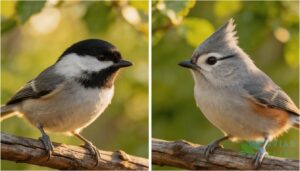
Although both chickadees and titmice share a compact head, you’ll notice Mask vs Crest is your main shortcut.
Chickadees show a clear black cap and throat bib shape, with sharp Cheek Contrast and simple superciliary.
Titmice feature a Forehead Block, perky crest, and more Facial Stripe Complexity—especially in bridled titmice, where malar stripe and eyebrow stripe weave across the face.
Warbler Comparisons by Wingbars and Eyelines

Warblers are where field-mark timing really matters — a split-second glance demands knowing your combinations cold.
- Blackpoll Warbler: bold eyeline shape, high bar contrast, white wingbar placement against olive upperparts
- Bay-breasted Warbler: narrow eyeline, greenish back color pairing patterns, buffy throat anchoring the face
- Pine Warbler: muted wing bars, grayish superciliary, subtler field marks overall
Eyeline and wingbar together — that’s your confirmation.
Thrush-like Songbirds by Breast Pattern
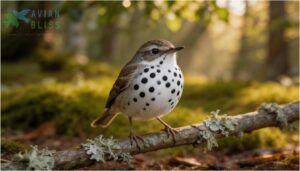
Breast pattern is your fastest thrush separator.
Wood Thrush carries bold, round breast spots — clean black on stark white. Hermit Thrush shows teardrop-shaped spots thinning toward the belly. Swainson’s Thrush spreads dense buffy spots across broader plumage zones.
Bold round spots on stark white define the Wood Thrush, while teardrops and buffy clouds mark its cousins apart
Spot density variance, spot shape types, and breast color contrast lock the ID. Habitat filters first; then work the field marks.
Seasonal Plumage, Molt, and Sex Differences

“identical” birds split by a flash of color or a patch of wear? That’s seasonal plumage and molt effects at work.
Molt timing, prebasic molt, and plumage molt cycles drive these shifts.
Sexual dimorphism in songbirds—males brightening, females dulling—and juvenile plumage mean avian field marks change.
Morphological differences among common songbirds often hinge on these seasonal color shifts.
Frequently Asked Questions (FAQs)
Why do birds use field marks?
Birds don’t develop field marks by accident. Camouflage signaling, mate attraction, and territorial signaling all drive species recognition patterns.
Sexual dimorphism in songbirds, bold colors, and morphological differences evolved for survival — not your benefit as a birder.
What is a field mark?
field mark is any diagnostic visual cue — a color patch, stripe, or shape — that reliably separates one species from another.
Think of it as nature’s ID badge, built right into the bird.
What are the different types of behavior field marks?
Behavioral cues split into five types: Locomotion Patterns, Foraging Strategies, Flight Displays, Social Interactions, and Nesting Behaviors.
Each adds a layer to field marks, habitat cues, and size, silhouette, plumage, habitat, and voice.
What are the 5 S’s of birding?
Think of the 5 S’s as your built-in checklist: Size, Shape, Shading, Sound identification, and Setting. Each one sharpens your spotting strategy before you even raise your binoculars.
Which is the best bird song identifier?
Merlin Bird ID leads the field.
Its machine learning algorithms and acoustic database coverage make songbird vocalization analysis fast and accurate.
Strong frequency range accuracy and crowdsourced validation set it apart from competitors.
What are the field marks of birds?
Distinctive bill color, feather iridescence, and nasal bristle pattern. Leg hue, underwing color, and size silhouette.
Add characteristic field marks like wing bars or cap stripes.
Using field marks for bird identification means combining shape, plumage, habitat, and voice.
How to identify birds in the field?
Start with size, silhouette, plumage, habitat, and voice. Each layer narrows your options fast.
Using field marks for bird identification becomes natural once you train your visual and auditory memory together in the field.
How does geographic range narrow down look-alike species?
Regional species pools and biogeographic provinces cut your candidate list before you raise your binoculars.
Elevation band limits, habitat-specific distribution, and seasonal migration windows eliminate species that simply don’t belong there.
When do juveniles show different markings than adults?
Juveniles show different markings soon after fledging. Their Age-Related Coloration is duller, Fledging Plumage lacks sharp field marks, and Molt Timing means juvenile feather development precedes adult patterns.
Seasonal Plumage Shift further changes these morphological differences among common songbirds.
How does lighting conditions affect perceived plumage colors?
Lighting shifts perceived plumage colors by altering feather reflectance and spectral composition. Diffuse vs direct sun changes field mark clarity.
Illumination geometry affects color patterns.
Seasonal light changes modify how you see plumage zones—essential for field guide-style bird ID.
Conclusion
Forget squinting at a blur of feathers—your next field encounter demands precision. When you train your eye to dissect songbird field marks comparison, look-alikes transform.
A sparrow’s bill, a warbler’s wingbar, a vireo’s eye-ring: these details become your compass. No more hesitating over streaking or silhouette.
You’ll cut through poor light and fleeting glimpses, turning guesswork into certainty. This isn’t just identification—it’s the quiet confidence of knowing exactly what you’re seeing, one decisive mark at a time.
The birds haven’t changed. Your vision has.
- https://www.allaboutbirds.org/news/bird-id-skills-field-marks/
- https://guloinnature.com/birdwatching-basics-part-2-field-marks/
- https://www.basicsofbirding.com/blog/how-to-identify-birds-looking-for-key-field-marks
- http://birdingimagequalitytool.blogspot.com/2015/01/field-marks-lighting-and-avian-anatomy.html
- https://www.birdful.org/how-can-you-tell-a-vireo-from-a-warbler/