This site is supported by our readers. We may earn a commission, at no cost to you, if you purchase through links.
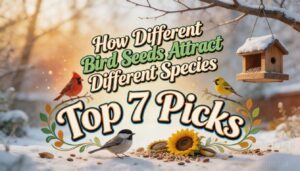
Walk past any well-stocked feeder on a winter morning and you’ll notice something worth paying attention to: goldfinches ignore the sunflower seeds while chickadees won’t touch the nyjer. That’s pickiness—it’s biology.
A bird’s beak shape, jaw strength, and digestive chemistry all determine which seeds it can actually process efficiently, and seed producers have spent decades engineering products around those exact differences.
Black oil sunflower seeds crack open in under two seconds for a cardinal; a goldfinch couldn’t manage the same feat.
Knowing how different bird seeds attract different species turns a generic feeder setup into something that works with nature instead of against it.
Table Of Contents
- Key Takeaways
- Sunflower Seeds by Bird Type
- Black Oil Sunflower Seeds for Cardinals, Finches, Chickadees, and Nuthatches
- Striped Sunflower Seeds for Jays, Grackles, and Larger Woodpeckers
- Hulled Sunflower Seeds for Less Mess and The Same Core Species
- Why Thin Shells Attract Smaller-beaked Birds
- Why Thicker Shells Favor Larger, Stronger-beaked Birds
- Small Seeds for Target Species
- Seed Mixes That Attract More Birds
- Feeders That Match Seed Types
- Top 7 Bird Seed Products
- Frequently Asked Questions (FAQs)
- How do I choose the best bird seed?
- Do birds eat bird seed?
- How do I attract birds to my feeder?
- Does bird seed attract squirrels?
- Do different bird seeds attract different birds?
- Why put a potato in your bird feeder?
- Why should you sprinkle coffee grounds around your bird feeder?
- What seeds help birds survive harsh winters?
- How do seasonal changes affect bird seed choices?
- Which seeds are safest to store long-term?
- Conclusion
Key Takeaways
- A bird’s beak shape and jaw strength directly determine which seeds it can crack efficiently, so matching seed type to species isn’t guesswork — it’s biology working in your favor.
- Black oil sunflower seeds are your best all-around starting point because their thin shells and high fat content attract the widest range of backyard birds, from cardinals to chickadees to nuthatches.
- Seed size acts as a natural filter at your feeder — small seeds like nyjer draw finches and siskins, while thicker-shelled options like striped sunflower quietly push smaller, competing birds out.
- The feeder you use matters as much as what you put in it — tube feeders suit clinging small birds, platform feeders serve ground foragers, and thistle feeders are purpose-built for nyjer’s tiny kernels.
Sunflower Seeds by Bird Type
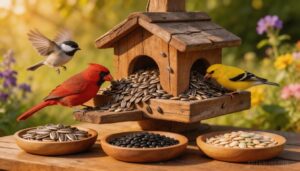
Sunflower seeds are the backbone of most backyard feeding setups — and for good reason. Different varieties pull in very different birds, depending on shell thickness and seed size.
Knowing which seeds match which bird species helps you stock your feeders with purpose, not just habit.
Here’s how each type stacks up.
Black Oil Sunflower Seeds for Cardinals, Finches, Chickadees, and Nuthatches
Black oil sunflower seeds are the single best starting point for a backyard feeding station.
Their high oil content delivers the Winter Energy Boost that Northern Cardinals, goldfinches, chickadees, and nuthatches depend on during cold months.
Thin shells mean even small beaks crack them easily, encouraging consistent Attraction Patterns at your feeders.
Prioritize Feeder Hygiene and proper storage to protect Shelf Life and Nutrient Density.
The seeds are also rich in vitamin E, supporting immune function in visiting birds.
Striped Sunflower Seeds for Jays, Grackles, and Larger Woodpeckers
Striped sunflower seeds tell a different story than their black oil cousins. Their thicker shells act as natural competitive exclusion — filtering out smaller birds and drawing in jays, grackles, and larger woodpeckers instead.
These species have the jaw strength to crack through, rewarding them with high oil content and nutrient density that fuel behavioral feeding patterns and winter energy boost cycles effectively.
Hulled Sunflower Seeds for Less Mess and The Same Core Species
If you’d rather skip the mess, hulled sunflower seeds are worth considering. They’re just black oil sunflower seeds with the shell already removed — same core species attraction, zero shell litter.
Chickadees, finches, cardinals, and nuthatches all show up without hesitation.
Kernel freshness matters here, so store them in an airtight container. Feeder hygiene stays manageable too, since there’s no decomposing shell debris building up below.
Why Thin Shells Attract Smaller-beaked Birds
Shell thinness advantage is really about energy gain ratio — small birds like chickadees and finches spend under two seconds cracking a thin shell, getting maximum kernel reward for minimal effort. beak size compatibility matters more than most people realize.
Nyjer seeds and white proso millet follow the same logic: matching seed size and shell hardness to bill aperture means better feeding efficiency and competitive access to your feeder.
Why Thicker Shells Favor Larger, Stronger-beaked Birds
When a bird’s beak functions like a nutcracker, thick shells stop being a barrier — they become a filter.
For birds built like nutcrackers, a thick shell is not a barrier — it is a filter
Striped sunflower seeds reward only those with the beak force requirements to crack them:
- Jays and cardinals deliver enough force to split tough shells cleanly.
- Shell strength mechanics naturally exclude smaller, competing species.
- Energy payoff seeds inside are calorie-dense, supporting larger body mass.
- Predator deterrence strategy works passively — fewer species compete for the same food.
Small Seeds for Target Species
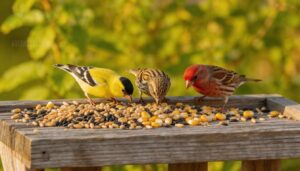
Not every bird is after the big seeds. Smaller species have their own favorites — and knowing which seeds pull in which birds makes a real difference at your feeder.
Here are the small seeds worth stocking up on.
Safflower Seeds for Cardinals, Doves, and Native Sparrows
Safflower seeds are quietly one of the smartest choices you can make. Their nutritional profile — about 38% fat and 16% protein — makes them a genuine winter staple.
Cardinals dominate the perch, cracking tough shells easily. Doves prefer dove ground feeding below the feeder. Sparrow foraging behavior keeps things active at tray level.
Best of all, their bitter coating works as a natural squirrel deterrent.
Nyjer Seed for Goldfinches, Pine Siskins, and Redpolls
Nyjer seed is a finch magnet, plain and simple. Goldfinches, Pine Siskins, and Redpolls have strong seed preferences for its tiny, oil-rich kernels — especially during late fall and winter when Seasonal Nyjer Demand peaks.
Heat-Treated Nyjer Benefits include reduced sprouting and longer freshness.
Follow basic Nyjer Storage Tips: keep it cool and dry.
Smart Feeder Placement Strategies and consistent Finch Feeding Timing keep your station busy all season.
White Proso Millet for Doves, Juncos, Towhees, and Sparrows
White proso millet is the quiet workhorse of ground feeding. Doves, juncos, towhees, and sparrows all gravitate toward its small, easy-to-crack kernels — especially during migration when Seasonal Energy Needs run high.
Nutrient Profile includes around 11% protein and B vitamins that support feather health.
Scatter Feeding Techniques in open, sunlit spots with clear sightlines — that’s your best Predator Safety Measures built right into placement.
Cracked Corn for Jays, Quail, Doves, and Blackbirds
Cracked corn is a high-energy food that jays, quail, doves, and blackbirds genuinely seek out — especially during colder months. Jays exploit it for caching behavior, stashing pieces for later.
For ground feeder placement, scatter it thinly on a clean platform away from brush.
Rotate stock often for mold prevention, and note that squirrel deterrence works better when you pair corn with safflower nearby.
How Seed Size Changes Which Birds Visit
Seed size is basically a filter — it quietly decides which birds show up before you’ve filled a single feeder. Beak morphology drives everything here.
- Handling time favors small-billed finches with tiny nyjer over large kernels
- Competition by size means bigger seeds push smaller birds out
- Seasonal size shifts align dispersal distance with migration timing
Match seed mix composition to your target species.
Seed Mixes That Attract More Birds
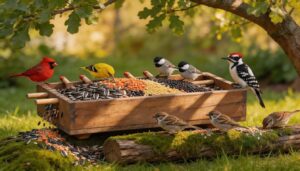
Single seeds are great for targeting specific birds, but a well-chosen mix can turn your feeder into a busy neighborhood spot. The key is knowing which combinations actually work — and which ones just waste your money on seeds that birds won’t touch.
Here are five seed mix strategies worth trying.
Sunflower-heavy Mixes for Broad Backyard Bird Appeal
If you want one feeder that works for almost everyone in your yard, a sunflower-heavy mix is your best starting point. Combining black oil sunflower seeds with striped sunflower seeds covers a wide range of bird species diversity — from cardinals and chickadees to jays and woodpeckers — because you’re matching both beak sizes and high‑fat food preferences at once.
| Bird | Preferred Sunflower Type |
|---|---|
| Cardinal | Black oil sunflower seeds |
| Blue Jay | Striped sunflower seeds |
| Chickadee | Black oil sunflower seeds |
| Woodpecker | Striped sunflower seeds |
| Nuthatch | Black oil sunflower seeds |
Seasonal mix adjustments matter too — bump up the ratio during fall migration for nutrient density optimization when birds need extra fuel.
Millet-rich Blends for Ground-feeding Species
Ground-feeding birds like sparrows, doves, and juncos aren’t interested in climbing feeders — they forage low and prefer it that way.
White proso millet suits them perfectly, and a seed blend with 30–60% millet by weight hits the right balance.
Scatter it on a platform feeder away from tree trunks for squirrel-resistant placement, especially during migration when seasonal energy needs peak.
Nyjer-focused Blends for Finch Feeding Stations
Finches are a different crowd entirely — they cling, they hover, and they want Nyjer seeds delivered through feeder port designs built for small beaks. Nyjer-focused blends work best when oil content optimization keeps seeds fresh and potent.
Add a safflower additive ratio of roughly 10–15% to diversify your finch feeding station. Seasonal blend adjustments and proper blend shelf life storage seal the deal.
Premium Mixes Vs Filler-heavy Budget Blends
Not all mixes are created equal. Premium mixes prioritize nutritional consistency — balanced fat and protein that genuinely promote bird health outcomes. Cheap wild bird seed mixes often load up on milo and red wheat, which most birds simply toss aside.
- Premium mixes reduce feeder waste reduction through better seed acceptance
- Shell quality impact matters — delicate beaks need thinner, uniform shells
- Cost-benefit analysis favors premium long-term: less refilling, less mess
- Nutritional benefits of different bird seeds align with species preferences for seeds
When Single-seed Feeders Work Better Than Mixes
Sometimes a single seed is all you need. Cardinals and finches visit more consistently when black oil sunflower seeds fill a feeder alone — no competition, no distraction.
Nyjer thistle seed stations draw goldfinches without the crowd. Safflower seeds quietly deter grackles.
Single-seed setups offer mess minimization, simplified maintenance, and easy seasonal swaps. They’re the clearest species-specific seed recommendation you can make.
Feeders That Match Seed Types
Picking the right seed is only half the job — the feeder you use matters just as much. Different seeds need different feeder designs to work well and attract the birds you’re actually hoping to see.
Here’s a look at the main feeder types and which seeds they pair with best.
Tube Feeders for Sunflower Seed and Small Clinging Birds
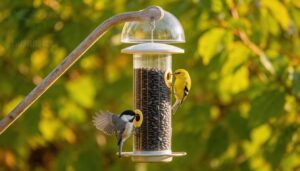
Tube feeders are built for small clinging birds — chickadees, goldfinches, and finches that grip the ports rather than land flat.
Port Size Optimization matters here: smaller openings work well for Black Oil Sunflower Seeds, while White Striped Sunflower Seeds need slightly wider ports.
A Transparent Tube lets you track seed levels at a glance, a Squirrel Guard and UV Coating keep things functional, and proper Feeder Height — around five to six feet — does the rest.
Thistle Feeders for Nyjer and Finch Species
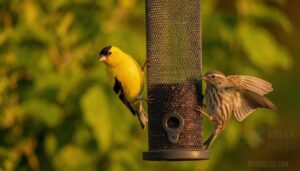
Thistle feeders are purpose-built for nyjer seeds — tiny, oil-rich kernels that standard feeders simply can’t hold.
Port size optimization keeps waste minimal, while mesh panel design lets goldfinches, pine siskins, and redpolls cling and feed comfortably.
Mount yours at four to six feet for ideal feeder height. Seasonal maintenance and regular stock rotation keep nyjer fresh, which directly affects how well you’ll succeed at attracting specific bird species.
Platform Feeders for Millet, Striped Sunflower, and Cracked Corn
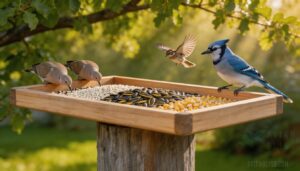
Platform feeders are the workhorses of backyard bird feeding — wide, open surfaces that let doves, sparrows, jays, and quail feed without competition. Their anti-spill features and raised edge design benefits keep millet, striped sunflower seed, and cracked corn from scattering in the wind.
Set yours at four to six feet, practice seasonal seed rotation, and stick to a weekly cleaning routine for attracting specific bird species consistently.
Hopper Feeders for Mixed Seed and Medium-size Birds
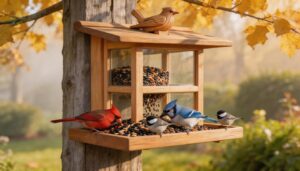
Hopper feeders are the quiet workhorses of any mixed-seed setup.
Their seed flow design keeps black oil sunflower and safflower moving steadily to a wide tray, welcoming cardinals, chickadees, and blue jays simultaneously.
Hopper capacity usually runs two to four pounds — enough for several days.
Built-in squirrel prevention, weather durability, and easy-open lids make your maintenance routine genuinely painless.
Placement Tips That Help The Right Birds Find Each Seed
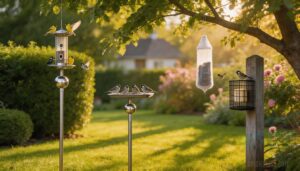
Where you put a feeder matters almost as much as what’s inside it. Keep black oil sunflower feeders 4–6 feet high with nearby shrubs for predator protection.
Use squirrel baffles and shade in summer, sunny spots in winter — that’s seasonal relocation done simply.
Feeder placement guidelines and species-specific seed recommendations work together: height, distance, and feeder location shape which birds actually show up.
Top 7 Bird Seed Products
Choosing the right seed is only half the equation — the product you buy matters just as much. Some bags are packed with quality ingredients that birds actually eat, while others are mostly filler that ends up on the ground.
Here are seven solid options worth keeping in your rotation.
1. Pennington Ultra Songbird Bird Seed
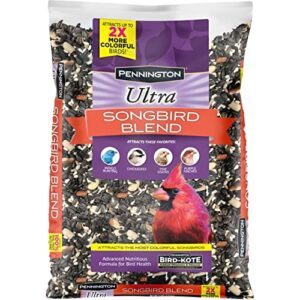
Pennington’s Ultra Songbird Blend is a solid starting point if you want cardinals, finches, chickadees, and sparrows showing up regularly. The mix leans on black oil sunflower seeds as its backbone — smart, since that single ingredient draws more species than almost anything else.
Safflower, peanuts, and dried fruit like raisins and cherries round it out, covering fruit‑seeking birds too.
The 6 lb bag is convenient, though heavy feeder traffic means you’ll restock more often than you’d expect.
| Best For | Backyard birders who want to attract a variety of common songbirds like cardinals, finches, and chickadees without a lot of fuss. |
|---|---|
| Brand | Pennington |
| Weight | 6 lb |
| Bird Target | Songbirds |
| Squirrel Appeal | Not specified |
| Resealable Bag | No |
| Made in USA | Yes |
| Additional Features |
|
- Built around black oil sunflower seeds, which is one of the best all-around draws for songbirds
- No grass seed or red milo filler, so less waste ends up on the ground
- Sealed packaging keeps the mix fresh longer and cuts down on spoilage
- The 6 lb bag goes fast if you’ve got a busy feeder, so restocking becomes a regular errand
- Pricier per pound compared to bulk options at big-box stores
- Won’t do much to attract larger birds or species outside the typical songbird crowd
2. Wagner Black Oil Sunflower Bird Seed
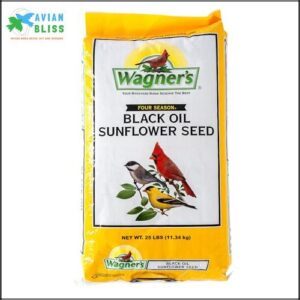
If you want to go even simpler — one seed, one job, done well — Wagner’s Black Oil Sunflower is hard to beat.
At around $40 for a 25 lb bag, it’s a dedicated single-seed option that draws cardinals, chickadees, finches, nuthatches, and woodpeckers without any filler.
The thin shells make it easy for small-beaked birds to crack open quickly, and the high fat content — around 40 to 50 percent — keeps energy levels up, especially during colder months.
| Best For | Bird lovers who want a no-fuss, single-seed option that pulls in a wide variety of backyard birds year-round. |
|---|---|
| Brand | Wagner’s |
| Weight | 25 lb |
| Bird Target | Wide variety |
| Squirrel Appeal | May attract squirrels |
| Resealable Bag | No |
| Made in USA | Yes |
| Additional Features |
|
- Thin shells make it easy for small-beaked birds like chickadees and finches to crack open
- High fat content keeps birds fueled, especially through cold months
- Attracts a solid mix of popular birds — cardinals, nuthatches, woodpeckers, and more
- At $40 for 25 lbs, it’s on the pricier side compared to mixed seed blends
- The bag lacks a velcro closure, so spills can happen if you’re not careful
- May bring squirrels to the feeder, which not everyone is thrilled about
3. Coles Sunflower Meats Bird Seed
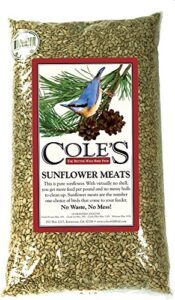
Take that same idea — one seed, no filler — and remove the shell entirely. That’s Cole’s Sunflower Meats in short (pun intended).
These are whole sunflower kernels with virtually no hull, which means zero debris under your feeder. Cardinals, chickadees, nuthatches, finches, and woodpeckers all show up for them.
The guaranteed 38% crude fat makes them a serious energy source year‑round. Just note: the bag isn’t resealable, so transfer it to an airtight container right away.
| Best For | Bird lovers who want a clean, no-mess feeding setup — especially those on balconies, decks, or anywhere shell debris is a real headache. |
|---|---|
| Brand | Cole’s |
| Weight | 20 lb |
| Bird Target | Wide variety |
| Squirrel Appeal | Not specified |
| Resealable Bag | No |
| Made in USA | Not specified |
| Additional Features |
|
- Zero hull waste, so no mess piling up under the feeder
- Pulls in a wide variety of birds — cardinals, chickadees, woodpeckers, finches, and more
- No synthetic additives or artificial flavors — just pure seed
- Pricier than standard sunflower seed options
- Bag isn’t resealable, so you’ll need an airtight container on hand
- Bigger birds like crows and starlings tend to move in fast and crowd out smaller species
4. Wagners Safflower Seed Bird Food
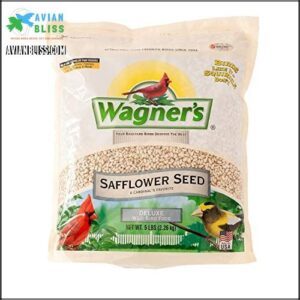
Wagner’s Safflower Seed flips the script on the usual feeder drama. At $11.98 for 5 lbs, it pulls in cardinals, chickadees, titmice, doves, and grosbeaks — while most squirrels and grackles simply walk away. Safflower’s bitter taste and thick hull aren’t appealing to the usual feeder hogs.
resealable bag is a small but genuinely useful touch for keeping seeds fresh between fills.
Use it solo or blend it with a sunflower mix to widen your species range.
| Best For | Backyard birders who want to attract colorful songbirds like cardinals and chickadees without constantly battling squirrels and feeder bullies. |
|---|---|
| Brand | Wagner’s |
| Weight | 5 lb |
| Bird Target | Cardinals, songbirds |
| Squirrel Appeal | Deters squirrels |
| Resealable Bag | Yes |
| Made in USA | Yes |
| Additional Features |
|
- Naturally deters squirrels, grackles, and starlings — so the birds you actually want stick around longer
- Resealable bag keeps seeds fresh and cuts down on waste between fills
- High-fat seed is great winter fuel for small songbirds burning extra energy in the cold
- Thick husks can pile up under your feeder and make for a messy cleanup
- Rich fat content may be overkill in warmer months — worth mixing with lighter seeds come spring
- Shelf life is limited; seeds can go rancid within a year or two if not stored properly
5. Lyric Nyjer Seed Bird Food
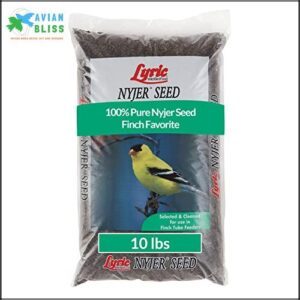
Lyric’s Nyjer Seed is purpose-built for finch feeders — and it shows. The 10 lb bag keeps American goldfinches, pine siskins, and purple finches coming back regularly, especially through cold months when high-fat seeds matter most.
Sterilized during processing, it won’t sprout if spilled on the ground.
You’ll need a narrow-port tube feeder or thistle sock to use it correctly.
Store it somewhere cool and dry, since Nyjer’s oil content degrades faster than most seeds.
| Best For | Backyard birders who want to attract finches year-round, especially during colder months when high-calorie food really counts. |
|---|---|
| Brand | Lyric |
| Weight | 10 lb |
| Bird Target | Finches |
| Squirrel Appeal | Not specified |
| Resealable Bag | No |
| Made in USA | Not specified |
| Additional Features |
|
- Pulls in goldfinches, pine siskins, and purple finches reliably
- Sterilized seed won’t sprout if it hits the ground — less mess to deal with
- The 10 lb bag means fewer trips to refill busy feeders
- Freshness can slip over time, and some birds will flat-out ignore older seed
- You’ll need a tube feeder or thistle sock — it won’t work in a standard feeder
- Pricier per pound than some competing options
6. Striped Sunflower Bird Seed
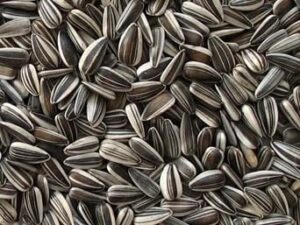
Home and Country USA’s 25 lb striped sunflower bag is a solid pick if your backyard gets regular visits from blue jays, grackles, and larger woodpeckers. Those thicker shells aren’t a barrier — they’re practically an invitation for strong-beaked birds that enjoy the work.
At about 50–60% fat content, the kernels deliver real energy payoff. Worth noting: some shipments include shell debris and non-seed material, so expect occasional feeder cleaning.
Priced at $38.99, it’s best suited for setups where bigger birds dominate.
| Best For | Backyard birders who get visits from blue jays, woodpeckers, and other large, strong-beaked birds. |
|---|---|
| Brand | Home and Country USA |
| Weight | 25 lb |
| Bird Target | Songbirds |
| Squirrel Appeal | Not specified |
| Resealable Bag | No |
| Made in USA | Not specified |
| Additional Features |
|
- High fat content gives birds a solid energy boost, especially useful in colder months
- Works in just about any feeder type — tube, hopper, platform, or just scattered on the ground
- The thick shells tend to keep smaller, more aggressive birds like starlings away
- Some shipments come mixed with shell fragments, twigs, and other debris that can clog feeders
- At $38.99 for 25 lbs, it’s pricier than a lot of standard seed blends out there
- Seed size runs smaller than typical striped sunflower seeds, which not all birds love
7. Wagner Cracked Corn Bird Food
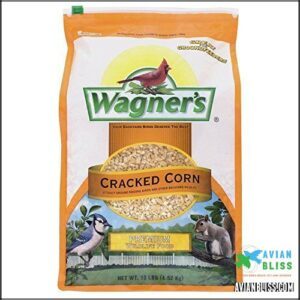
If you’re trying to pull ground-feeding birds like doves, quail, blue jays, and juncos into your yard, cracked corn is one of the most straightforward options out there.
Wagner’s 10 lb bag keeps things simple — single ingredient, allergen-free, and easy to scatter on a platform feeder or directly on the ground.
It also doubles as a smart distraction feed, keeping squirrels and chipmunks busy at a separate spot while your other feeders stay uncrowded.
Just store it in a sealed container once you open the bag.
| Best For | Backyard bird enthusiasts who want to attract ground-feeding birds like doves, quail, and blue jays — or anyone looking for a simple way to keep squirrels away from their main feeders. |
|---|---|
| Brand | Wagner’s |
| Weight | 10 lb |
| Bird Target | Ground feeders |
| Squirrel Appeal | Attracts squirrels |
| Resealable Bag | No |
| Made in USA | Not specified |
| Additional Features |
|
- Draws a wide variety of ground-feeding birds and wildlife with just one clean, allergen-free ingredient
- Works great as a distraction feed to keep squirrels and chipmunks away from your hanging feeders
- Flexible — scatter it on the ground, use a tray feeder, or mix it into your own custom blend
- Bag doesn’t reseal, so you’ll need a separate container to keep the seed fresh after opening
- 10 lbs goes fast if you’re feeding regularly — bulk buyers will likely find a bigger bag more cost-effective
- Attracts squirrels, rabbits, and other critters, which not everyone wants in their yard
Frequently Asked Questions (FAQs)
How do I choose the best bird seed?
best bird seed depends on which birds you want to attract.
Black oil sunflower seeds are your safest starting point — they appeal to the widest range of backyard species, from cardinals to chickadees.
Do birds eat bird seed?
Yes, birds absolutely eat bird seed — it’s one of their primary food sources.
Different species gravitate toward specific seeds based on beak size, fat needs, and natural diet, making seed selection key to attracting your target birds.
How do I attract birds to my feeder?
Start with the right seed. Black oil sunflower seeds attract the widest variety of birds, from cardinals to chickadees.
Add a clean feeder, place it near shrubs, and keep it filled consistently.
Does bird seed attract squirrels?
Bird seed does attract squirrels.
High-fat seeds like black oil sunflower are irresistible to them.
Safflower and nyjer are your best bets for discouraging squirrels while still feeding the birds you want.
Do different bird seeds attract different birds?
Absolutely — different seeds act like invitations to specific guests.
Black oil sunflower draws cardinals and chickadees, while nyjer brings goldfinches, and millet calls in sparrows and doves.
Seed choice shapes who shows up.
Why put a potato in your bird feeder?
Think of a potato as a spare tire — not your first choice, but handy in a pinch.
During cold snaps, a small peeled piece can give ground-feeding birds a quick energy boost.
Why should you sprinkle coffee grounds around your bird feeder?
Sprinkling used coffee grounds around your feeder creates a scent barrier that discourages squirrels and ground pests, helping protect spilled seed, while adding a small boost of nutrients to the surrounding soil.
What seeds help birds survive harsh winters?
Cold winters drain energy fast, but the right seeds make all the difference.
Black oil sunflower seeds, suet, and peanuts deliver the high fat content birds need to stay warm and survive.
How do seasonal changes affect bird seed choices?
Birds need different fuel at different times of year. Winter calls for high-fat seeds like black oil sunflower and suet.
Come spring, shift toward protein-rich options to support nesting and new feathers.
Which seeds are safest to store long-term?
Safflower and whole black oil sunflower seeds store best long-term. Keep them cool, dry, and sealed.
Avoid mixes — different seeds age unevenly.
Nyjer needs extra care; its high oil content turns rancid fast in heat.
Conclusion
As you refill your bird feeders this season, consider the coincidence of bird species and seed preferences. By understanding how different bird seeds attract different species, you create a haven for specific visitors.
With the right seeds and feeders, your backyard becomes a thriving ecosystem.
Choose from our top 7 picks, and enjoy the show. Your feathered friends will thank you. The right seeds make all the difference, attracting the species you love and bringing joy to your yard always.