This site is supported by our readers. We may earn a commission, at no cost to you, if you purchase through links.
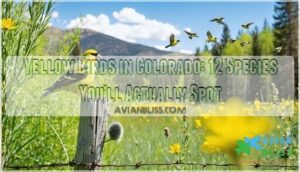 You’ll spot twelve different yellow birds in Colorado throughout the year.
The American Goldfinch brightens backyard feeders with its brilliant plumage.
Wilson’s Warblers dart through mountain willows during migration.
Yellow Warblers nest in riparian areas while Nashville Warblers prefer aspen groves.
Evening Grosbeaks visit in winter flocks.
Western Kingbirds perch on fence posts across plains.
Yellow-headed Blackbirds dominate marsh cattails.
Other species include Magnolia Warblers, Yellow-rumped Warblers, and several flycatcher species.
Each has distinct markings, calls, and preferred habitats.
Timing matters – some arrive only during spring migration while others stay year-round.
Knowing where and when to look makes all the difference, and understanding the distinct markings, calls, and preferred habitats is crucial for spotting these birds, especially during their year-round stay or winter visits.
Table Of Contents
Key Takeaways
- You’ll spot twelve different yellow bird species across Colorado year-round, from American Goldfinches at backyard feeders to Wilson’s Warblers in mountain willows during migration.
- Timing matters most – some species like Evening Grosbeaks only visit during winter flocks, while others arrive during spring migration or stay year-round like American Goldfinches.
- You’ll find yellow birds in distinct habitats: Yellow-headed Blackbirds dominate marsh cattails, Western Kingbirds perch on plains fence posts, and various warblers prefer riparian areas and aspen groves.
- Success depends on understanding each species’ preferred locations, elevation ranges, and migration schedules – spring brings the greatest variety while winter offers reliable residents.
Yellow Birds Overview
You’ll spot dozens of yellow bird species across Colorado’s diverse landscapes from prairie grasslands to mountain forests.
These bright-colored birds include year-round residents like American Goldfinches and seasonal visitors such as Wilson’s Warblers that arrive each spring to breed in riparian areas.
American Goldfinch Prevalence
You’ll find American Goldfinch everywhere in Colorado year-round.
These brilliant yellow birds adapt seamlessly from wild mountain forests to your backyard feeder.
These yellow birds Colorado residents love adapt well to urban feeders and wild habitats.
Their Goldfinch Population thrives thanks to abundant Seed Availability from thistle plants.
Common yellow birds like these form flocks of 40+ individuals during peak feeding times.
The birds’ diet is almost exclusively seeds, making them vegetarian songbirds.
Here’s what makes them special:
- Winter warriors – Their drab winter colors help them survive harsh Colorado conditions
- Late bloomers – Unique Nesting Habits mean they breed in late July when seeds peak
- City slickers – Amazing Urban Adaptation lets them thrive in suburban neighborhoods
These Colorado birds identification favorites change dramatically between seasons.
Males sport brilliant yellow during summer breeding but both sexes turn olive-brown for Winter Survival.
Yellow finches Colorado populations benefit from human habitat changes that create more open weedy areas perfect for foraging.
Wilson’s Warbler Habitat
Wilson’s Warblers prefer dense willow thickets and riparian forests across Colorado’s mountain regions.
You’ll spot these colorado birds near streams and wetlands during migration. Their Nesting Preferences favor shrubby understory while Foraging Behavior targets insects in dense vegetation.
Genetic studies reveal distinct groups. Habitat Threats include development and climate change affecting Conservation Strategies and Breeding Success for yellow warblers colorado.
| Habitat Feature | Wilson’s Warbler Preference |
|---|---|
| Elevation Range | 5,000-11,000 feet |
| Vegetation Type | Dense willows, alders |
| Water Proximity | Within 100 meters |
| Canopy Cover | 60-90% dense |
| Territory Size | 1-3 acres average |
Yellow Warbler Migration Patterns
When do these bright yellow songbirds Colorado residents love most begin their incredible journeys?
Yellow warblers Colorado birders enthusiastically await follow predictable migration triggers that showcase nature’s precision.
Colorado’s yellow birds follow nature’s clockwork, arriving precisely when mountain wildflowers bloom and insects emerge.
- Spring arrival – These small yellow birds reach Colorado breeding grounds by mid-May
- Summer nesting – They establish territories in riparian stopover habitats along streams
- Fall departure – Climate impact drives southward movement starting in August
- Winter retreat – Conservation status remains stable as they winter in Central America
Colorado Birding Hotspots
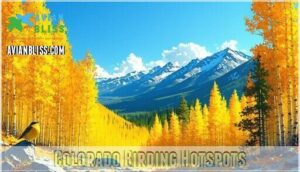
You’ll discover Colorado’s yellow birds across diverse landscapes from towering peaks to sprawling grasslands. Mountain Hotspots like Rocky Mountain National Park and Maroon Bells offer prime identifying yellow birds opportunities during Best Seasons of May through September.
Plains Locations including Pawnee National Grassland provide excellent colorado bird identification chances for species preferring open habitats. Urban Birding thrives in Denver’s City Park and Boulder’s Chautauqua Park where backyard birds colorado enthusiasts spot common species year-round.
These accessible locations serve beginners well while offering Rare Sightings for experienced watchers. Your yellow birds guide should include Chatfield Reservoir for waterside species and Bear Creek Lake Park for mixed habitat diversity.
Check out resources for bird watching supplies to enhance your experience. Bird watching colorado reaches peak activity during spring migration when mountain snow melts create ideal conditions.
Each location offers unique viewing opportunities based on elevation and habitat type.
Warbler Species Found
You’ll encounter several warbler species during your Colorado birding adventures, each with distinct field marks that make identification straightforward.
These small songbirds show up in different habitats throughout the state, from mountain forests to riparian areas along streams.
Nashville Warbler Identification
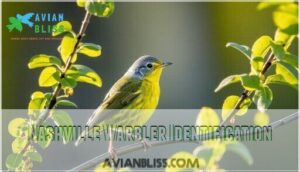
Across Colorado’s diverse landscapes, Nashville Warblers showcase subtle yellow tones that challenge even experienced birders.
These compact warblers require careful observation for accurate colorado bird identification.
Key identification features include:
- Gray head with white eye-ring – distinguishing females from other yellow birds
- Olive-green back contrasting yellow underparts – plumage variations help separate juveniles
- Short, straight bill and active foraging behavior – regional differences affect song analysis
Juvenile markings appear duller than adults, making backyard birds colorado identification tricky for yellow breasted birds enthusiasts.
Consider exploring a Nashville Warbler guide for more details.
Magnolia Warbler Characteristics
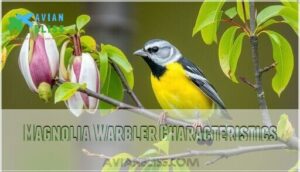
Magnolia Warblers show striking plumage details with bold black necklaces across bright yellow chests.
Males display deeper yellows during breeding habits season while females appear more subdued.
Their song variations include sweet warbling notes that carry through Colorado’s forests.
Watch their unique foraging behavior as they snap insects from branch tips.
The molting process transforms their appearance dramatically between seasons, making identification challenging for colorado bird species enthusiasts.
| Feature | Male | Female |
|---|---|---|
| Chest Pattern | Bold black necklace | Faint streaking |
| Back Color | Black with white patches | Olive-gray |
| Wing Bars | Two distinct white bars | Two white bars |
| Tail Pattern | White patches visible | White patches smaller |
| Head Markings | Gray crown, white eye-ring | Brownish crown |
Yellow-Rumped Warbler Diet
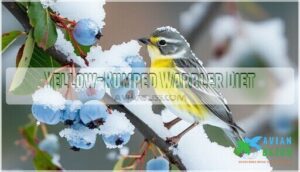
You’ll find these colorado bird species have remarkable dietary adaptations that set them apart from other rocky mountain birds.
Yellow-rumped warblers switch from insect consumption during breeding season to berry preferences in winter.
Their seasonal diet includes caterpillars and beetles in summer, then bayberry and wax myrtle.
The warblers’ bodies produce high concentrations of bile to digest these berries.
This foraging behavior helps colorado wildlife survive harsh winters unlike other yellow bellied birds, showcasing their ability to thrive with remarkable adaptations and a unique dietary preference.
Yellow Bird Migration Patterns
You’ll notice yellow birds follow distinct seasonal patterns as they move through Colorado’s diverse elevations and habitats.
Some species like Evening Grosbeaks appear unpredictably during winter irruptions, while others maintain regular spring and fall migration schedules.
Evening Grosbeak Migration Routes
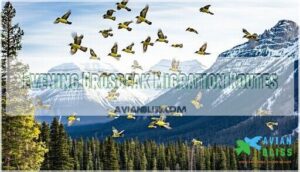
Evening grosbeaks display unpredictable migration patterns in Colorado.
These rocky mountain birds don’t follow regular routes like other native Colorado birds.
Instead, they move based on food availability in northern forests.
Poor cone crops trigger massive southward movements.
Colorado serves as both breeding grounds and winter roosting areas depending on yearly conditions.
Flyways act as natural highways for these birds.
- Irregular timing – Major migrations happen only during food shortages, not annually
- Altitude shifts – Western populations move from mountains to lower elevations for winter roosting
- Flock behavior – Hundreds travel together during irruption years seeking stopover locations
- Climate impact – Weather patterns affect cone production and migration frequency
- Dual role – Colorado functions as both breeding grounds and wintering habitat for Colorado wildlife
Western Kingbird Summer Habits
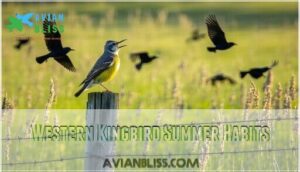
Western Kingbirds establish summer territories in Colorado’s open grasslands and agricultural areas.
You’ll spot their aggressive Territorial Defense as males chase away intruders from fence posts.
Their Feeding Behavior involves catching insects mid-flight then returning to perches.
Nesting Locations include tree cavities where pairs engage in courtship displays.
These native Colorado birds demonstrate remarkable Fledgling Care throughout summer months.
Yellow-Headed Blackbird Flocking Behavior
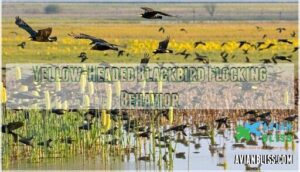
You’ll spot these rare yellow birds in Colorado avian fauna gathering in impressive flocks during breeding season.
Flock size ranges from dozens to hundreds of birds.
Large groups provide foraging benefits through cooperative feeding in marshlands.
Predator avoidance improves dramatically when many eyes watch for threats.
Breeding colonies establish social hierarchy with dominant males claiming prime territories.
This bird behavior makes birdwatching exciting as massive flocks create spectacular displays across wetland areas where bird species congregate, showcasing their unique bird behavior.
Colorado Bird Conservation
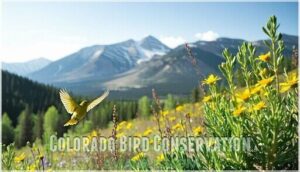
You’ll find that Colorado’s yellow bird populations face real challenges from habitat loss and climate change.
The state’s conservation groups work hard to protect nesting areas and migration routes through habitat restoration and citizen science programs.
Yellow Bird Population Trends
Throughout Colorado’s mountains and plains, yellow bird populations face mounting pressures from climate change and habitat loss.
Half of Colorado birds are declining, with Wilson’s Warblers dropping 6.1% annually, while predation impact increases in fragmented habitats.
Food availability shifts affect migration timing, and however, American Goldfinches remain stable at 43 million, showing conservation success through backyard birdwatching efforts supporting rare yellow birds in Colorado avian fauna, which is a result of backyard birdwatching efforts.
Habitat Preservation Efforts
Colorado’s conservation groups work with landowners to restore over 6,600 acres of riparian habitat since 2005.
These efforts focus on Nesting Site Protection through native cottonwood planting and Wetland Restoration projects.
Food Source Security improves as restored areas support insects that yellow birds need.
Pollution Reduction and Predator Management help Colorado wildlife thrive in these protected spaces.
National parks also contribute to these efforts, protecting over 350 migratory species.
Birdwatching Tours and Guides
Joining guided tours connects you with experienced Colorado birding communities and enhances your yellow bird spotting success.
Professional guides know seasonal patterns and prime locations for target species.
Top Tour Features to Evaluate:
- Guide Expertise – Certified ornithologists who specialize in Colorado birds and bird identification techniques
- Tour Customization – Flexible itineraries targeting specific birdwatching locations based on your skill level
- Ethical Birding – Responsible wildlife viewing practices that protect Colorado wildlife habitats
- Tour Accessibility – Options accommodating different mobility levels and group sizes
- Pricing Options – Various packages from half-day excursions to multi-day ornithology adventures
Frequently Asked Questions (FAQs)
What yellow birds sing at dawn?
Over 70% of dawn singers are yellow songbirds.
You’ll hear American goldfinches, yellow warblers, and western meadowlarks greeting sunrise with distinct melodies.
Their bright songs help establish territory and attract mates during breeding season, with complete concepts like territory establishment being crucial, and also serve to attract mates.
How to attract yellow birds to feeders?
You’ll attract goldfinches and yellow warblers by offering nyjer seeds in tube feeders.
Add sunflower seeds and suet for variety.
Place feeders near shrubs for cover and keep them clean with fresh water nearby.
When do yellow birds molt their feathers?
Most yellow birds molt twice yearly – once in late summer after breeding season and again in early spring before nesting. You’ll notice fewer bright males during fall molting periods.
Which yellow birds nest in backyards?
Brilliant backyard birds bring boundless joy!
You’ll find American Goldfinches, House Finches, and Lesser Goldfinches nesting near feeders.
These cheerful creatures choose shrubs, trees, and dense vegetation for their cozy homes.
What predators threaten yellow birds most?
Cats pose the biggest threat to backyard yellow birds.
They kill billions annually.
Hawks and owls also hunt them regularly.
Snakes raid nests for eggs and chicks.
You’ll notice fewer birds where these predators are active.
Conclusion
Remarkably, the same migration routes that brought early settlers to Colorado now guide yellow birds in Colorado to their seasonal destinations.
You’ll find these twelve species throughout the state if you know where to look.
Each bird follows predictable patterns based on elevation and habitat needs.
Spring brings the greatest variety while winter offers reliable residents.
Your success depends on timing visits with migration schedules and understanding each species’ preferred locations.
- https://www.allaboutbirds.org/guide/American_Goldfinch/id
- https://www.audubon.org/field-guide/bird/yellow-warbler
- https://wildbirdscolorado.com/the-western-tanager-a-symphony-of-color-in-colorados-skies/
- https://www.nwf.org/Educational-Resources/Wildlife-Guide/Birds/Yellow-Headed-Blackbird
- https://cpw.state.co.us/species/yellow-breasted-chat