This site is supported by our readers. We may earn a commission, at no cost to you, if you purchase through links.
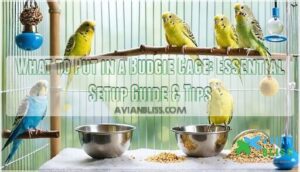 Your budgie’s cage needs essential items for their health and happiness. Start with multiple perches of varying sizes and textures to keep their feet healthy. Include stainless steel food and water bowls that won’t harbor bacteria.
Add safe toys like wooden blocks, bells, and rope toys for mental stimulation. A cuttlefish bone provides calcium for strong beaks and bones. Consider a small bird bath for hygiene and a cage cover for peaceful sleep.
Line the bottom with paper or safe bedding that’s easy to clean. Don’t forget an iodine block to prevent deficiency issues. The right setup creates a comfortable sanctuary where your feathered friend can thrive, but there’s more to think about regarding placement, safety, and creating the perfect environment with essential items for their well-being, and ensuring a healthy lifestyle.
Table Of Contents
- Key Takeaways
- Essential Supplies for Your Budgie’s Cage
- Creating a Safe and Comfortable Environment
- Providing a Nutritious Diet
- Ensuring Mental Stimulation and Exercise
- Additional Considerations for Breeding Budgies
- Frequently Asked Questions (FAQs)
- What to put inside a budgie cage?
- What should a budgie have in its cage?
- What do budgies love most?
- What do you put in the bottom of a budgie cage?
- How often should I clean my budgie’s cage?
- Can I use newspaper as cage liners?
- What type of perches are best for budgies?
- How often should I change the water in my budgie’s cage?
- Are there any specific types of toys that budgies prefer?
- How often should I change cage water?
- Conclusion
Key Takeaways
- Set up the right cage dimensions – You’ll need at least 18" x 18" x 18" for one budgie, but bigger is better. Choose horizontal space over height since budgies fly side-to-side, not up and down.
- Install multiple perches with different textures – You’ll want natural wood perches in various diameters (3/8" to 1/2") placed at different heights. This prevents foot problems and gives your budgie exercise.
- Provide essential feeding supplies and health items – You’ll need stainless steel food and water bowls, a cuttlebone for calcium, and an iodine block to prevent deficiency issues.
- Add mental stimulation through toys and rotation – You’ll want to include safe wooden toys, bells, and rope toys, then rotate them every 7-10 days to prevent boredom and keep your budgie engaged.
Essential Supplies for Your Budgie’s Cage
Setting up your budgie’s cage properly creates a safe and comfortable home that promotes their physical and mental well-being.
You’ll need specific supplies that address their basic needs for food, water, exercise, and enrichment to guarantee your feathered friend thrives in their new environment.
Cage Dimensions and Spacing
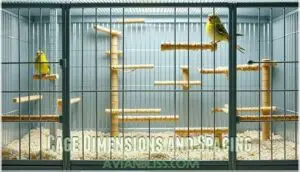
When choosing your budgie’s home, think of it as their personal flight space. The minimum dimensions for a single budgie require 18" x 18" x 18", but bigger is always better for their well-being.
Consider these essential cage dimensions factors:
- Bar spacing should measure 3/8" to 1/2" to prevent escapes or injuries
- Horizontal space matters more than cage height since budgies fly side-to-side
- Horizontal bars provide climbing opportunities and exercise
Your budgie needs enough room to spread their wing span fully without touching the sides. A proper cage shape emphasizes width over height, allowing natural flight patterns. Remember, cage size directly impacts your bird’s happiness and health. Budgies thrive best in cages with safe, non-toxic materials to guarantee their well-being.
Perches and Stands
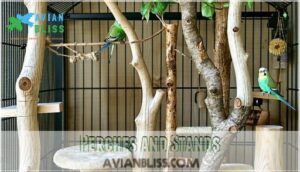
Your budgie’s feet need variety to stay healthy.
Happy feet come from perch variety—mix textures and sizes for natural comfort.
Natural wood perches work best—choose different diameters from 3/8 to 1/2 inch to exercise foot muscles. Place perches at multiple heights throughout the cage.
Natural branches like apple or manzanita provide irregular surfaces that prevent foot problems. Rope perches offer soft resting spots.
Avoid plastic perches since they’re slippery and lack proper texture for healthy gripping. **Natural perches also aid in filing down nails.
Feeding and Drinking Bowls
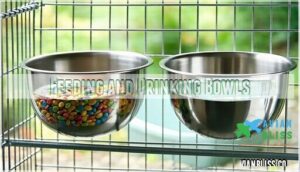
Now that you’ve set up the right perches, your budgie’s feeding and drinking bowls deserve equal attention. These bowls directly impact your bird’s health and daily comfort.
Material safety matters most when selecting bowls. Stainless steel dishes resist bacteria and won’t chip like ceramic options. They’re dishwasher-safe and won’t develop scratches that harbor germs like plastic bowls do.
Bowl placement prevents contamination from droppings. Position your budgie food bowls and budgie water bowls away from perches, keeping them accessible but clean. Each budgie needs its own feeding bowls to reduce competition.
Consider these four key factors:
- Bowl size – Wide, shallow designs let budgies see their food easily
- Water quality – Daily cleaning prevents bacterial growth and illness
- Cleaning frequency – Wash bowls daily with hot, soapy water
- Secure attachment – Clamp-style bowls prevent tipping and spills
Having two sets of bowls allows one to dry completely between uses, reducing contamination risks. For ideal health, consider that proteins aid feather growth.
Toys and Treats
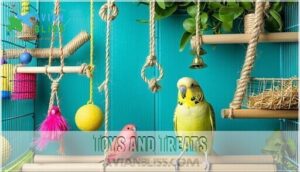
Beyond colorful appearances, budgie cage toys serve essential enrichment needs that keep your feathered friend mentally sharp and physically active.
Stock your cage with Safe Materials like untreated wood, paper, and cotton rope to guarantee safety during play.
Foraging Toys encourage natural hunting behaviors, while budgie shredding toys satisfy their instinct to tear and chew. Include budgie bells toys for auditory stimulation, but rotate these items weekly to prevent boredom.
Many owners find toys available to purchase beneficial for their budgies. Offer Treat Variety through millet sprays and chew sticks as rewards.
This Toy Rotation strategy maintains novelty and supports your budgie’s well-being.
Cage Cover

A budgie cage cover creates nighttime darkness and helps regulate temperature while your bird sleeps.
Choose breathable fabric like cotton or linen that provides draft protection and noise reduction without restricting airflow.
The cover should block light completely while allowing proper ventilation.
Remove it each morning so your budgie can enjoy natural light and maintain healthy sleep cycles.
In winter, covers offer extra warmth, while summer use prevents early wake-ups from sunrise. A quiet environment promotes better rest for your feathered friend.
Creating a Safe and Comfortable Environment
Creating a safe environment for your budgie starts with smart placement and careful preparation.
You’ll need to choose the right location, remove hazards, prepare proper cage lining, and gather essential cleaning supplies.
Choosing a Secure Location
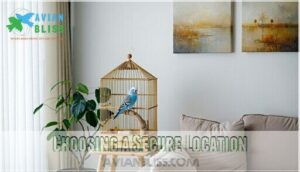
Location matters more than you might think regarding your budgie’s happiness and health. Your feathered friend needs a spot that offers both security and comfort, away from the chaos of daily life.
Here’s how to create the perfect sanctuary for your budgie:
- Position the cage in a corner of a frequently used room – this gives your bird a sense of security while keeping them part of the family action
- Ensure at least one side faces a wall – this provides a safe retreat when your budgie feels overwhelmed or needs quiet time
- Keep the cage elevated at eye level – this prevents your bird from feeling vulnerable and gives them a better view of their surroundings
Draft avoidance is critical for temperature control and your budgie’s comfort. Consider that environmental factors matter for all birds, not just those outside.
Avoid placing the cage near windows, doors, or air vents where sudden temperature changes occur. Kitchen placement creates fume dangers from cooking gases and smoke. Consider noise levels when selecting the spot – vacuum cleaners and boisterous activities can stress your bird.
Family safety improves when cage placement keeps your budgie away from other pets and small children who might accidentally harm them.
Avoiding Sharp Objects
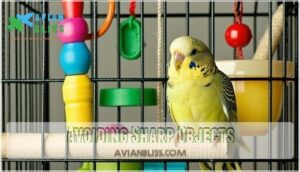
Your budgie’s safety depends on eliminating sharp objects from their cage.
Inspect all cage accessories, toys, and perches for dangerous edges, points, or broken pieces that could cause cuts or injuries.
Check cage construction for protruding wires or rough metal edges, and replace damaged items immediately with safe materials designed for birds.
Toy inspection should include examining hooks, chains, and small parts that might break off, focusing on injury prevention by choosing cage accessories made from bird-safe materials without toxic coatings or sharp components.
Properly Lining The Base of The Cage

Paper towels and newspaper make excellent budgie cage liners using safe materials that simplify cleaning frequency.
These liner alternatives allow proper health monitoring through visible droppings while providing effective odor control.
Change cage liners daily to maintain hygiene and prevent bacterial growth.
Avoid cedar shavings, sandpaper, or scented products that harm budgies.
Multiple newspaper layers enable quick cage cleaning throughout the day, allowing for easy maintenance and promoting a healthy environment with proper health monitoring.
Cage Cleaning Supplies
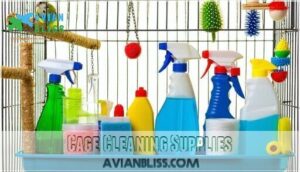
In regards to budgie cage cleaning, safe detergents and bird-safe disinfectant types are your best friends.
Use a soft brush for scrubbing bars and corners, and replace tray liners often for odor control and cage hygiene.
Natural options like vinegar and water or baking soda work well, too.
Consider purchasing specialized cage cleaners for ideal hygiene.
Always rinse thoroughly so no residue lingers.
Keeping up with regular budgie cage cleaning means your bird’s home stays fresh, healthy, and welcoming every day.
Providing a Nutritious Diet

Your budgie’s nutritional needs go beyond basic seed mixes to include specialized dietary components that support ideal health.
A balanced diet requires quality seeds, digestive aids, and essential minerals that work together to keep your feathered friend thriving.
Good Quality Budgie Seed
Quality budgie seed forms the foundation of your feathered friend’s diet.
Choose seed variety blends containing millet, canary grass seeds, and oats for maximum nutritional value.
Organic options guarantee your budgie avoids harmful pesticides and chemicals.
Store seeds in airtight containers to maintain freshness and prevent spoilage.
Fresh sprouting seeds boost nutrition and add excitement to meals.
Replace seeds daily and provide one to two tablespoons per budgie.
Quality budgie seed supports healthy digestion, vibrant feathers, and active behavior in your budgie cage setup.
Grit for Seed Cracking
Why do budgie owners still debate whether grit belongs in their bird’s diet? The truth is, budgies don’t need grit for seed cracking.
Unlike pigeons or doves, budgies remove seed hulls before eating, accessing nutrients directly without requiring insoluble grit for digestion. Grit types include soluble grit (like cuttlebone) for calcium and insoluble grit (sand or pebbles) for grinding.
However, budgie diet research shows insoluble grit poses serious risks. For peak health, consider protein-rich ingredients like peanuts and sunflower seeds.
Grit overfeeding can cause crop impaction, a life-threatening condition where particles block the digestive tract. Modern avian veterinarians agree: skip the budgie grit block entirely.
Your budgie cage setup should focus on quality seeds, pellets, and fresh foods instead. Cuttlebone provides necessary calcium safely, making traditional grit unnecessary and potentially dangerous for your feathered friend’s health.
Cuttlefish Bone for Beak Maintenance
Your budgie’s beak grows continuously, making a cuttlebone an invaluable calcium source for natural beak trimming.
This mineral supplement provides essential nutrients while encouraging healthy chewing behaviors that keep beaks properly maintained.
Attach the cuttlebone to your cage’s side bars using the built-in clip or wire holder.
Replace it monthly or when your budgie has consumed most of it.
The bone placement should be easily accessible but away from food and water dishes to prevent contamination.
Here’s what makes cuttlebones special for budgie health:
- Natural beak conditioning – Your budgie’s instinctive chewing keeps their beak sharp and properly shaped
- Calcium boost – Supports strong bones, healthy egg production, and prevents deficiencies that cause serious health issues
- Mental stimulation – Provides an engaging activity that reduces boredom and destructive behaviors
Most budgies instinctively recognize cuttlebones as food.
Some may ignore them initially, but patience pays off.
You can encourage use by gently scraping the surface to create powder, making it more appealing.
This mineral block becomes part of a balanced budgie diet alongside seeds and pellets.
Iodine Block for Iodine Deficiency Prevention
While cuttlefish bone handles beak maintenance, an iodine block tackles a different nutritional need that’s particularly important for budgies.
These birds are prone to iodine deficiency, which can cause thyroid enlargement, respiratory issues, and poor feather quality.
An iodine block or budgie mineral block provides steady supplementation while offering mental stimulation through chewing.
Replace the block when consumed, and monitor for deficiency symptoms like wheezing or lethargy.
Cuttlebones and mineral blocks work together to support your budgie’s complete nutritional needs, addressing issues like thyroid enlargement.
Ensuring Mental Stimulation and Exercise
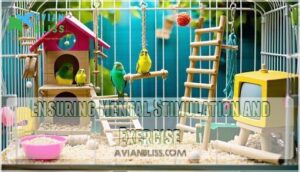
Mental stimulation and exercise are essential for keeping your budgie healthy and happy in their cage environment.
You’ll need to provide a variety of engaging toys, swings, and perches to prevent boredom and encourage natural behaviors.
Variety of Toys and Treats
Three essential categories of budgie toys and treats keep your feathered friend mentally sharp and physically active.
Chew toys made from safe materials like untreated wood satisfy natural gnawing instincts. Foraging toys challenge their problem-solving skills while hiding treats inside puzzle feeders.
Enrichment needs include shreddable items, swings, and bells that encourage exploration. Offer treat variety through millet sprays, dried fruits, and seed sticks.
Quality budgie cage accessories provide mental stimulation when strategically placed throughout their space. To find the best options, explore various safe wood options for your budgie.
Mix textures and difficulties to prevent boredom while supporting your budgie’s natural behaviors.
Rotating Toys Regularly
Just like a child outgrows their favorite toy, budgies need fresh challenges to stay mentally sharp.
Toy Boredom sets in when the same budgie toys sit unchanged for weeks, leading to destructive behaviors and stress.
Scheduled Rotation every 7-10 days prevents this issue effectively. Keep half your budgie cage accessories available while storing the rest. This approach maximizes Cognitive Enrichment without overwhelming your bird.
Smart rotation strategies include:
- Mix textures – Alternate between wood, rope, and paper budgie enrichment items
- Change placement – Move toys to different cage areas for novelty
- Introduce foraging challenges – Hide treats inside budgie foraging toys weekly
- Vary complexity – Simple bells one week, puzzle toys the next
- Monitor preferences – Note which toys generate excitement
This systematic Toy Variety approach delivers consistent Behavioral Benefits while keeping your budgie engaged and mentally stimulated.
Importance of Swings and Perches
Movement enriches your budgie’s world, transforming their cage into an active playground.
Swings and budgie perches made of natural materials create essential exercise opportunities while preventing foot problems through varied textures and diameters.
| Feature | Benefit |
|---|---|
| Perch Variety | Prevents foot sores and arthritis |
| Swing Placement | Encourages natural movement patterns |
| Material Safety | Non-toxic woods guarantee budgie health |
| Foot Health | Different diameters exercise foot muscles |
| Enrichment Value | Reduces boredom and stress behaviors |
Quality budgie swing placement at different cage heights mimics natural branch hopping.
Choose perches from apple wood or manzanita rather than plastic dowels.
Your budgie toys should complement these movement accessories, creating a dynamic environment that satisfies their instinctual need for exploration and physical activity.
Bird Bath for Bathing
A bird bath transforms your budgie’s cage into a spa-like retreat.
Regular bathing keeps feathers healthy and provides mental stimulation. Choose shallow dishes to prevent drowning risks.
Bath Setup Essentials:
- Bath Types – Use shallow dishes (1-2 cm deep) or cage-attached baths for safety
- Water Temperature – Provide room temperature water for comfortable bathing
- Bath Frequency – Offer baths 1-2 times weekly, adjusting to your budgie’s preferences
- Cleaning Baths – Change budgie bath water daily to prevent bacterial growth
- Bath Safety – Make certain rough-bottomed water bowls for secure footing during bathing
Additional Considerations for Breeding Budgies
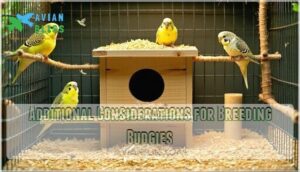
If you’re planning to breed your budgies, you’ll need specialized cage setups that go beyond basic pet housing.
Breeding pairs require specific nesting areas, additional space considerations, and specialized substrates to support successful reproduction and chick rearing.
Breeding Cages and Nesting Areas
Beyond entertainment, budgies need specialized environments for breeding success. Your breeding cage setup requires careful planning to support healthy reproduction and chick development.
Breeding cages differ substantially from standard budgie housing. You’ll need larger dimensions—minimum 24" long x 18" high x 14" deep—to accommodate growing families. The nesting box size should measure approximately 10" high x 8.5" deep x 8.25" wide, providing adequate space for incubation considerations and chick rearing needs.
Key breeding cage requirements include:
- Proper nesting materials like pine wood shavings for comfort and hygiene
- Strategic perch placement near the nesting box entrance for easy access
- Minimal toys to reduce distractions during breeding periods
- Enhanced ventilation to prevent respiratory issues in confined spaces
- Easy-access cleaning features like slide-out trays for daily maintenance
Parent bird health depends on maintaining pristine conditions throughout the breeding process.
Multi-storey Cages for Separate Pairs
When breeding budgies, multi-storey cages with separate compartments solve territory issues between pairs.
These vertical cage setups prevent aggressive behaviors and guarantee each pair has dedicated space for successful breeding.
Pair Separation Benefits:
| Advantage | Description |
|---|---|
| Reduced Stress | Each pair maintains their own territory without interference |
| Better Monitoring | You can track individual pairs’ progress and health easily |
| Resource Control | Separate feeding stations prevent competition over shared resources |
Multi-level cage compatibility depends on proper spacing between compartments.
Install dividers that allow visual contact but prevent physical interaction.
This cage setup lets you manage multiple breeding pairs simultaneously while maintaining their natural behaviors.
Position perches and toys strategically in each compartment.
Budgies need adequate vertical space to move freely without crowding.
Each level should accommodate standard cage accessories including nesting boxes, food dishes, and water containers.
This arrangement maximizes your breeding space while giving each pair the privacy they need for successful reproduction.
Sand Sheets or Loose Sand for Breeding Cages
Sand sheets or loose sand create essential breeding environments for budgie pairs. These substrates provide natural nesting materials while maintaining proper hygiene in breeding boxes.
However, sand dangers exist if not properly managed.
Consider these key factors for breeding hygiene:
- Sheet texture matters – smooth sand sheets prevent foot injuries while loose sand allows natural digging behaviors
- Bacterial growth prevention requires regular cleaning and replacement of sand materials
- Alternative liners like paper may be safer for inexperienced breeders concerned about sand-related health risks
Sand helps with nesting box preparation and supports budgie breeding success when used correctly as cage liner substrate. Budgies also require comfortable lining material in their nesting boxes.
Dietary and Cleaning Supplies for Breeding Cages
When breeding budgies, maintaining proper nutrition and cleanliness becomes your top priority.
Stock up on breeding pellet needs and calcium supplementation through budgie cuttlebone and budgie grit block to support egg production.
Your chick feeding schedule requires soft foods and hand-feeding formulas.
Nest box hygiene demands daily cleaning with bird-safe disinfectants—disinfectant safety is essential since harsh chemicals can harm developing chicks.
Keep breeding boxes spotless by replacing cage liner frequently.
Your dietary supplies should include extra vitamins and minerals.
Proper cage hygiene prevents disease transmission that could devastate your breeding program and growing chicks.
Frequently Asked Questions (FAQs)
What to put inside a budgie cage?
Like knights of old protecting their castle, you’ll want essential perches, toys, food dishes, water, cuttlebone, and safe cage liner.
Include swings, chewable toys, and hiding spots for comfort and enrichment.
What should a budgie have in its cage?
Your budgie needs perches of varying diameters, toys for mental stimulation, food and water dishes, cuttlebone for calcium, and safe cage liner.
Include swings, foraging toys, and hiding spots for enrichment.
What do budgies love most?
Freedom’s the gift budgies cherish most.
They love spacious flight, engaging toys, social interaction, fresh foods, and natural sunlight.
Your feathered friend thrives with variety, mental stimulation, and safe exploration opportunities.
What do you put in the bottom of a budgie cage?
Line your budgie’s cage bottom with newspaper, paper towels, or commercial cage liners.
These materials are safe and absorbent, and easy to change daily.
Avoid cedar shavings, sand, or cat litter, which can harm your bird’s health.
How often should I clean my budgie’s cage?
Fresh air keeps homes healthy, so clean your budgie’s cage weekly with thorough cleaning.
Spot-clean daily by removing droppings and replacing food.
Weekly deep-cleans include washing perches, toys, and dishes with hot soapy water, then disinfecting safely, which helps keep your home healthy.
Can I use newspaper as cage liners?
Yes, you can use newspaper as cage lining.
Choose plain newsprint without colored inks or glossy sections.
Avoid magazines or treated papers.
Change it daily to maintain cleanliness and monitor your budgie’s health through droppings, which helps in assessing overall health.
What type of perches are best for budgies?
Natural wood perches, rope perches, and mineral blocks work best—they’re safer than plastic dowels, prevent foot problems, and keep your budgie’s feet healthy through varied textures and diameters.
How often should I change the water in my budgie’s cage?
Change your budgie’s water daily to prevent bacterial growth and contamination. Clean water dishes with hot, soapy water during daily changes to maintain proper hygiene and your bird’s health.
Are there any specific types of toys that budgies prefer?
Budgies gravitate toward chewable toys like wooden blocks, paper strips, and cardboard. They’ll also enjoy swings, ladders, and foraging toys that hide treats. Rotate toys weekly to prevent boredom.
How often should I change cage water?
You’ll want to refresh your budgie’s water daily to keep it clean and bacteria-free. Fresh water prevents illness and keeps your feathered friend healthy and happy.
Conclusion
Creating the perfect budgie habitat isn’t just about filling a cage—it’s about crafting a home where your feathered friend can flourish.
Now that you know what to put in a budgie’s cage, you can transform their space into a stimulating environment.
Remember, the right combination of perches, toys, nutrition, and safety features makes all the difference, and your budgie’s happiness depends on thoughtful preparation and regular maintenance of their living space.