
This site is supported by our readers. We may earn a commission, at no cost to you, if you purchase through links.
 Pigeons can see at night, but they aren’t exactly night owls. Their eyes are highly sensitive to light, thanks to a large number of rod cells in their retinas.
This means they can spot shapes and navigate in dim conditions, like under moonlight or streetlights. While they don’t see as well as true nocturnal animals, pigeons still manage short flights or find their way back to roosts after dark.
Notably, they can also detect ultraviolet light, giving them a unique edge in low-light situations. So, while they’re more active by day, pigeons can handle the night if nature calls.
Table Of Contents
Key Takeaways
- Pigeons can see at night, but their vision is about 80% less effective compared to daylight, relying on moonlight or ambient lighting for navigation.
- Their eyes are highly sensitive to light and can detect ultraviolet light, giving them a unique advantage in low-light situations.
- While they’re not nocturnal, pigeons can handle short flights or return to roosts at night when necessary.
- Pigeons prefer to avoid flying at night due to vision limitations but can stay alert to predators even while resting.
Pigeon Night Vision Basics
You’ll be surprised to learn that pigeons can see in low light conditions, though their night vision is about 80% less effective than their daytime sight.
Unlike nocturnal birds, pigeons rely on moonlight and ambient light sources to navigate after dark, using their highly sensitive eyes that can detect ultraviolet light invisible to humans.
Pigeon Eye Anatomy
Pigeon eye architecture showcases nature’s extraordinary optical engineering, making your own vision seem rather ordinary by comparison.
Pigeons’ intricate eyes reveal the wonders of nature’s design, offering a perspective far beyond what human vision can comprehend.
These remarkable avian structures are perfectly adapted for superior visual processing.
Pigeons possess:
- Strategically positioned eyes on the sides of their head, creating a staggering 340° horizontal field of view
- Photoreceptor density exceeding 400,000 per square millimeter in peripheral vision areas
- Unique head-bobbing movement that enhances depth perception beyond human capabilities
Their anatomical advantages include specialized color channels that detect ultraviolet light, incredible light sensitivity that outperforms humans, and remarkable visual acuity in both central and peripheral vision.
This sophisticated system enables pigeons to process visual information with extraordinary precision and clarity.
Light Sensitivity
Moving beyond eye structure, a bird’s response to light reveals fascinating adaptations.
Pigeons possess extraordinary light sensitivity that outperforms human vision in dim conditions.
| Feature | Pigeons | Humans |
|---|---|---|
| Photoreceptor Density | 400,000+ receptors | 200,000 receptors |
| Night Vision Reduction | 20% capacity | Poorer night vision |
| Light Navigation | Possible with moonlight | Limited capability |
| Environmental Change Detection | Highly sensitive | Less responsive |
You’ll find their twilight vision remarkable—they can’t see perfectly in darkness, but they navigate surprisingly well using available light.
Their eyes detect subtle environmental changes that would escape your notice, making pigeon nocturnal activity possible despite not being true night birds.
Ultraviolet Vision
Beyond their remarkable light sensitivity, pigeons possess an extraordinary ability to see ultraviolet light that’s completely invisible to humans.
Their pentachromatic vision system includes specialized receptors that detect UV wavelengths, giving them a visual superpower you’d never suspect.
- When you watch a pigeon bobbing its head in what seems like an ordinary courtyard, it’s actually seeing the UV-reflective patterns in feathers for mate selection, spotting UV-marked food sources, and detecting predators through their UV signatures.
This UV perception transforms how pigeons navigate at dawn and dusk when UV light is most dispersed, enhancing their limited night vision capabilities.
Can Pigeons See at Night
Unlike their daytime precision, pigeons experience a dramatic 80% reduction in visual acuity after sunset.
Their light adaptation speed substantially impacts their ability to navigate in darkness.
| Condition | Vision Quality | Activity Level |
|---|---|---|
| Full Moonlight | Moderate | Limited |
| City Lights | Fair | Cautious |
| Complete Darkness | Poor | Minimal |
While you might spot pigeons perched during nighttime, they’re virtually "flying blind" without specialized nocturnal adaptations.
They can detect basic shapes and movement when ambient light exists, but their remarkable bird eyesight becomes severely compromised.
For nocturnal predator evasion, they rely more on staying motionless than visual detection.
Pigeon Color Perception
You’ll be amazed to discover that pigeons can see more colors than you can, thanks to their pentachromatic vision system that includes ultraviolet light detection.
While your eyes have three color channels, a pigeon’s exceptional five-channel vision allows them to perceive a wider spectrum of colors even in low light conditions.
Though they can’t see infrared wavelengths, their ability to see more colors is due to their exceptional vision system, making ultraviolet light detection a key aspect of their visual capabilities.
Pentachromatic Vision

Have you ever wondered how pigeons see the world around them? Unlike humans with our limited three-color vision, pigeons possess extraordinary pentachromatic vision with five distinct color receptors.
This remarkable evolutionary advantage allows them to perceive colors beyond our imagination.
- Their specialized visual pigments can detect an expanded spectral range, including colors invisible to the human eye.
This color perception superpower helps pigeons distinguish subtle environmental differences even in dim light. While not true "night vision," their enhanced spectral sensitivity gives them a visual edge in low-light conditions.
The pigeon’s unique avian vision system represents one of nature’s most sophisticated color detection mechanisms.
Ultraviolet Light Detection
While humans are limited to seeing three color channels, pigeons enjoy an extraordinary UV perception that reveals an entirely different world.
Their specialized receptors detect ultraviolet light invisible to our eyes, giving them enhanced vision particularly beneficial during twilight navigation. This remarkable adaptation within their avian eyesight allows pigeons to perceive environmental details we miss completely.
Birds’ feathers have structural colors arising from light interacting with feather structures.
This pigeon vision superpower virtually transforms dusk into daylight, providing them with a unique advantage through improved navigation and better recognition of their surroundings, which is made possible by their UV detection capabilities and superior predator detection.
Infrared Light Limitations
While pigeons can detect ultraviolet light with remarkable clarity, they lack the ability to perceive infrared wavelengths.
Unlike owls and snakes, pigeons can’t detect heat signatures or thermal vision patterns in their environment.
Their night vision capabilities depend entirely on ambient light sources such as moonlight or city illumination, not on infrared perception.
This wavelength detection limitation is a significant constraint in their otherwise impressive visual range.
Pigeon Behavior at Night
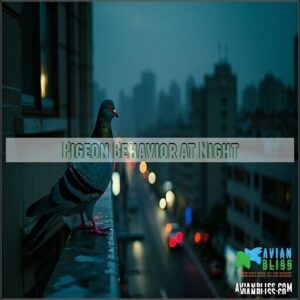
You’ll notice that pigeons typically avoid flying at night, preferring to find secure, dark spaces where they can rest while remaining alert for predators.
Despite their limited night vision, these intelligent birds can maintain a state of semi-alertness during darkness, with one side of their brain staying awake to monitor surroundings even as they appear to be sleeping.
Nocturnal Activity
While their color perception is extraordinary, pigeons also display surprising nocturnal activity patterns.
During nighttime hours, these birds aren’t completely inactive as you might expect.
Their unique sleep patterns allow them to maintain awareness with one brain hemisphere while resting the other.
Though they’re not true nocturnal birds, pigeons exhibit limited movement after dark, especially in urban environments where light pollution disrupts their natural roosting habits.
This pigeon nocturnal activity typically involves essential functions like digestion rather than extensive flight.
Predator Avoidance
While active during daylight, pigeons don’t simply become helpless at night.
Their limited night vision still helps them avoid predators through several tactics. They’ll seek nighttime shelters in dense trees or building crevices, using urban adaptations to their advantage.
When threatened, pigeons display remarkable vigilance behavior, keeping one eye partially open during sleep.
Their camouflage tactics work well in dim conditions, and they rely on group defense strategies—roosting in flocks where multiple birds can alert others to danger through subtle movements or warning calls, utilizing effective warning calls.
Social Behavior
Frequently during nighttime hours, pigeons transform their flock into a sophisticated survival network with fascinating social behaviors you mightn’t expect.
Their nocturnal social structure includes:
- Establishing clear flock dynamics with sentinels positioned strategically around sleeping members
- Using subtle cooing and wing movements as communication methods in darkness
- Maintaining strict social hierarchy that determines sleeping positions (dominant birds get safer spots)
- Pausing mating rituals completely during night hours to focus on survival
- Employing cooperative behavior where birds take turns keeping watch
You’ll notice pigeon sleeping habits reflect their vulnerability—they’ll huddle closely in sheltered locations, sharing body heat while minimizing exposure to pigeon predators. This remarkable pigeon nocturnal activity demonstrates their evolutionary adaptation to nighttime dangers, showcasing their ability to form a survival network.
Pigeon Visual Acuity
You’ll be amazed to learn that pigeons have vision capabilities far superior to your own, with over 400,000 photoreceptors dedicated to their sideways vision alone.
While they can’t see perfectly in darkness, their eyes are highly sensitive to light, allowing them to navigate effectively under moonlight or city glow when most birds would be virtually blind.
Distance Vision
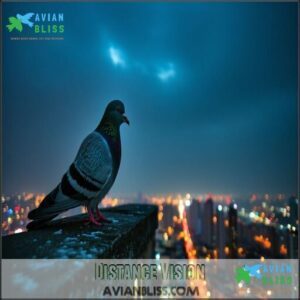
While human eyes struggle to discern objects in dim light, pigeons exhibit remarkable distance vision that puts our visual range to shame.
Their extraordinary acuity comparison reveals they can spot tiny details up to 2-3 times farther than humans can.
Through specialized monocular cues, these birds maintain clear sight lines across impressive distances even as daylight fades.
Their depth perception doesn’t diminish with darkness like ours does, and a pigeon’s eyesight processes visual information differently, allowing their field of view to retain sharpness when bird night vision becomes essential for survival.
Peripheral Vision
I’ll create a 63-word peripheral vision section for your article about pigeon vision.
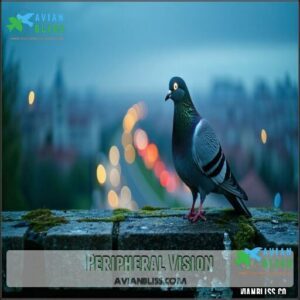
Instead of eyes at the front of their heads, pigeons possess remarkable lateral acuity with a stunning 340-degree panoramic view.
Their side-mounted eyes deliver:
- Instantaneous motion detection that spots predators approaching from nearly any angle
This extraordinary spatial orientation allows pigeons to maintain constant predator awareness while feeding.
Unlike humans with our limited field of vision, pigeons’ eyesight provides near-complete surveillance of their surroundings, enabling them to have constant predator awareness.
Low Light Conditions
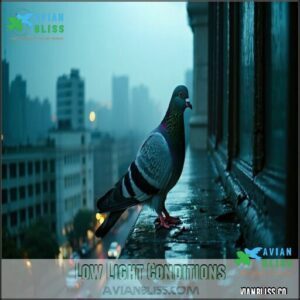
Pigeons’ exceptional visual acuity doesn’t completely disappear when the sun sets.
Under low light conditions, their eyes adapt surprisingly well to dim light vision, though they’re not nearly as capable as true nocturnal birds.
You’ll find pigeons can navigate during twilight hours, detecting movement and shapes when moonlight offers minimal illumination.
Their pigeon eyesight is remarkably sensitive to urban illumination, allowing them to function around city lights. However, light pollution impact can disrupt their natural patterns.
Unlike owls, pigeons lack specialized night vision adaptations, but their twilight navigation abilities prove more impressive than many realize.
Night Flying Capabilities
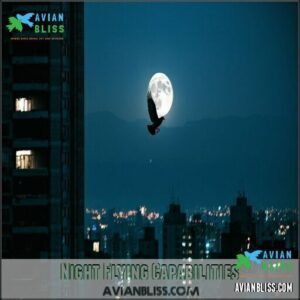
You’ll be surprised to learn that pigeons can actually fly at night, though they’re limited by their 80% reduced vision in darkness.
They rely heavily on moonlight and ambient city lights, using their remarkable memory of landmarks rather than their daytime navigation tools, which is a key factor in their ability to navigate with reduced vision.
Navigation Challenges
After examining eyesight capabilities, let’s explore why nighttime presents unique navigation challenges for pigeons.
Unlike nocturnal birds, pigeons face significant hurdles when flying after dark.
Their navigation depends primarily on:
- A magnetic compass that detects Earth’s magnetic fields for orientation
Without adequate light, pigeon eyesight loses effectiveness, forcing them to rely heavily on sensory alternatives like infrasound use and memory.
Urban obstacles become particularly dangerous as they can’t see them clearly.
This is unlike migratory birds, who often use celestial cues for navigation.
That’s why pigeons typically avoid nighttime orientation altogether, preferring to rest until daylight returns.
Obstacle Avoidance
During night flight, birds navigate obstacles with remarkable precision despite their limited vision capabilities.
They rely less on pigeon vision and more on memorized routes and spatial awareness. Their behavior adapts to darkness, using subtle cues to navigate without bumping into things.
| Obstacle Type | Collision Risks | Avoidance Method |
|---|---|---|
| Buildings | High at corners | Sensory input from air pressure |
| Trees | Medium with branches | Training methods improve detection |
| Power lines | Extremely high | Environmental factors aid awareness |
| Other birds | Low to medium | Pigeon senses detect movement |
| Water bodies | Low visibility surfaces | Bird eyesight uses reflection cues |
You’ll notice their ability to use subtle cues to navigate through obstacles, which is crucial for their survival during night flights.
Moonlight Dependence
Under the glow of a full moon, pigeons rely heavily on lunar navigation for nighttime flights.
Their visual threshold adapts to moonlight intensity, allowing limited night vision when ambient light is sufficient.
- Their nighttime acuity decreases by approximately 80% compared to daytime vision, making them dependent on reasonable moonlight conditions.
Though not naturally nocturnal, pigeons can utilize their senses to navigate by moonlight if necessary, displaying remarkable behavioral adaptations to their environment.
Pigeon Intelligence and Recognition
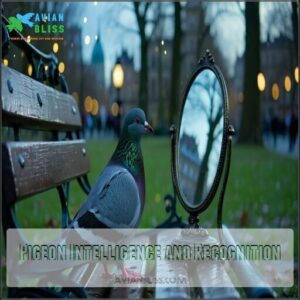
You’ll be surprised to learn that pigeons can recognize your face from a distance and remember if you’ve been kind or threatening to them.
They’re also smart enough to pass the Mirror Test, recognizing themselves in reflections while showing curiosity about mirrors and even enjoying certain TV shows.
Facial Recognition
While night navigation relies on their unique senses, these birds showcase another remarkable ability during daylight hours.
You’d be amazed at their Human Face ID capabilities! Through exceptional pigeon vision capabilities, they can recognize individual people, forming strong pigeon-owner bonds while also mastering threat recognition.
Their pigeon cognition allows them to distinguish between hundreds of human faces, even detecting subtle mimicry.
This facial recognition skill helps them remember who’s friend or foe with surprising accuracy.
Self Recognition
Beyond recognizing your face, these remarkable birds can identify themselves. Pigeons pass the Mirror Test—a gold standard of self-awareness that many animals fail.
When looking at reflections, they demonstrate genuine self-recognition rather than treating their image as another bird.
- A pigeon’s cognitive abilities include distinguishing between its own reflection and that of another pigeon, showing sophisticated identity perception that rivals some mammals.
Their intelligence extends far beyond what you’d expect from a common city bird. Pigeons’ intelligence, however, isn’t unique, as other bird species also exhibit remarkable cognitive skills.
Object Recognition
While pigeons can recognize themselves in mirrors, their object recognition skills are equally impressive.
You’ll be amazed by their ability to identify up to 725 different objects through feature detection and shape constancy.
Even in dim conditions, their pattern recognition helps them navigate obstacles.
This contextual awareness extends to distinguishing between familiar objects, though their night vision capabilities can’t match truly nocturnal birds.
Protecting Pigeons From Predators
You’ll need to implement specific safety measures to protect your pigeons from predators like cats, dogs, hawks, and eagles, especially at night when their limited vision makes them vulnerable.
You can use deterrents such as reflective tape on wing feathers to ward off aerial predators or install ultrasonic devices to keep cats at a distance from your aviary.
Cat Deterrents
Now that you understand how pigeons recognize potential threats, let’s protect them from one of their main predators – cats. While pigeons lack strong night vision capabilities, cats excel in nocturnal hunting, making them particularly dangerous.
To create effective cat deterrents:
- Use motion-activated water sprinklers like the Scarecrow Sprinkler, which startles cats without harming them or your pigeons.
- Natural repellents like citrus peels, coffee grounds, or commercial cat-repelling granules create invisible boundaries cats won’t cross.
For DIY solutions, try placing pine cones or chicken wire around coops – cats hate walking on these surfaces. One option is using elevated bird baths to further protect the pigeons.
Motion-activated ultrasonic devices emit frequencies irritating to cats but harmless to birds, providing community safety without disrupting your neighborhood’s peace. Safe deterrents are essential when pigeons rest during vulnerable nighttime hours.
Dog Training
Training your dog to coexist with pigeons requires focused obedience training.
Teach commands like "leave it" and "stay" when pigeons are nearby.
Leash training prevents surprise chases that terrify these birds with limited night vision.
Socialize puppies early around birds, using positive reinforcement when they remain calm.
Understanding a dog’s natural chasing instinct is essential for effective training.
Consistent correction of prey-drive behaviors creates a neighborhood where pigeons—despite their poor nocturnal eyesight—can rest safely at night, thanks to effective training and positive reinforcement.
Eagle and Hawk Deterrents
While you’ve mastered dog training, hawks and eagles pose different threats to your pigeons.
Apply shiny duct tape to wing feathers—these visual deterrents confuse predators’ hunting patterns. For coop protection, install reflective objects that create disorienting flashes.
Habitat modification, like overhead netting, creates physical barriers while audible deterrents keep raptors at bay. You might also consider specialized pigeon products for added protection.
Remember, pigeons’ limited night vision makes them vulnerable after dark, so focus on securing their nighttime shelter for maximum pigeon survival.
Pigeon Care and Safety
You’ll need to provide proper shelter for your pigeons at night since their limited night vision makes them vulnerable to predators and hazards.
If you find an injured pigeon after dark, you should place it in a warm, quiet space with minimal light disturbance until you can get proper veterinary care.
Injured Pigeon Care
Discovering an injured pigeon requires swift action for survival.
First, examine wounds carefully and clean them with warm saline solution to prevent infection.
For pigeon rescue success, create a quiet recovery space with soft bedding away from drafts, as these birds have limited night vision and need security.
Offer small amounts of bird seed and fresh water, but avoid force-feeding which causes stress.
Monitor for signs of pain management needs like wing-drooping or labored breathing.
Veterinary access is essential – contact a wildlife rehabilitator or avian vet within 24 hours, as pigeon injuries often require professional treatment.
Meanwhile, keep the bird warm and minimize handling to support pigeon health.
Nighttime Shelter
Shield your pigeons at night with a well-designed shelter that guarantees safety and comfort.
These nocturnal birds, despite their limited night vision, thrive with secure spaces that protect against predators and harsh weather.
Here are three key tips for creating the perfect safe roosting space:
- Choose durable materials like wood or metal, ensuring the structure resists strong winds and keeps moisture out.
- Elevate the shelter, providing perches off the ground to avoid predators and create a secure sleeping zone.
- Locate wisely—place the shelter against walls or near natural barriers to reduce exposure to noise and temperature swings.
Consider purchasing a suitable nighttime roost for ideal safety. A thoughtful pigeon shelter means peaceful, safe nights.
Hazard Prevention
Nighttime can be risky for pigeons, so focus on creating safe environments.
Light pollution disorients their navigation, so add decals to windows to prevent collisions.
Secure wires, block toxic foods, and provide safe shelters against predator attacks.
Remember, pigeon vision capabilities are no match for nocturnal birds.
| Hazard | Solution | Why It Matters |
|---|---|---|
| Light Pollution | Use window decals | Prevents disorientation, collisions |
| Loose wires | Secure or remove | Avoids injury risks |
| Poison Prevention | Block toxic foods | Protects health |
| Predator Attacks | Install fencing | Safeguards bird survival |
Frequently Asked Questions (FAQs)
Can pigeons see in the dark?
Imagine this scenario: a world viewed through twilight goggles.
Pigeons see in the dark better than humans, but not perfectly.
Their sensitive, ultraviolet-tuned eyes help them navigate under moonlight or city lights, though vision remains limited, and this is a key factor in their ability to navigate under various light conditions.
Do pigeons have night vision?
Pigeons don’t have true night vision, but they see better in low light than humans.
They rely on their sensitive eyes to navigate moonlit or city-lit areas, though their vision still drops substantially after dark.
Are pigeons nocturnal?
No, pigeons aren’t nocturnal.
They’re active during the day and typically sleep at night.
However, they can stay somewhat alert while resting, using their sharp senses to detect predators or changes in their surroundings.
Can pigeons fly at night?
Surprisingly, pigeons can fly at night, but it’s rare since they prefer daylight.
Their light-sensitive eyes help navigate under moonlight or city lights, yet limited vision makes nighttime flights risky and unnatural for them.
Do pigeons have good eyesight?
Their eyesight is incredible, sharper and more colorful than yours.
With a wide field of vision, they spot subtle movements and even ultraviolet light.
However, they’re diurnal creatures, relying mostly on daylight for their visual superpowers.
How do pigeons see?
Keeping your eyes peeled like a hawk isn’t just for you—pigeons excel too.
Their pentachromatic vision sees ultraviolet light, and their wide field of view and photoreceptors grant them remarkable clarity and depth perception.
What do pigeons do at night?
At night, pigeons usually sleep in safe, enclosed spaces to avoid predators.
They rest for around 10 hours, staying alert with one eye open if needed.
Their split-brain function helps them monitor their surroundings while asleep, which is a unique ability that allows them to rest and remain alert.
Why do pigeons not fly at night?
Pigeons aren’t night owls because their vision drops by about 80% in low light.
They rely heavily on visual cues for navigation, and flying in the dark increases their risk of injury or disorientation.
How do pigeons see humans?
Pigeons see you as familiar and useful, recognizing faces and distinguishing friend from foe.
Their sharp color vision, including ultraviolet light, helps them spot subtle differences, making them surprisingly good at knowing who’s who, with sharp color vision being particularly notable.
Which bird gets the most visibility at night?
Owls dominate nighttime visibility with their incredible adaptations.
Their huge eyes gather light effectively, while a specialized retina enhances low-light vision.
Combined with silent flight, they’re unparalleled predators under the moonlight—nature’s ultimate night-vision experts with incredible adaptations!
Conclusion
Did you know pigeons’ retinas are packed with rod cells, making them sensitive to dim light?
While pigeons aren’t true nocturnal creatures, they can see well enough at night to navigate short flights or return to roosts under moonlight or streetlights.
Their ability to detect ultraviolet light adds to their low-light advantage.
So while they prefer daylight, pigeons can handle nighttime when necessary.
Next time you wonder, "**Can pigeons see at night?
**"—now you know, they can!
- https://www.osapublishing.org/josa/abstract.cfm?uri=josa-47-9-827
- https://www.verywellmind.com/what-is-the-trichromatic-theory-of-color-vision-2795831
- https://digitalcommons.unl.edu/cgi/viewcontent.cgi?referer=https://www.google.com/&httpsredir=1&article=1460&context=icwdm_usdanwrc
- https://www.sciencedirect.com/science/article/abs/pii/004269899490149X
- https://archives.evergreen.edu/webpages/curricular/2011-2012/m2o1112/web/birds.html