This site is supported by our readers. We may earn a commission, at no cost to you, if you purchase through links.
 Yes, blue jays are aggressive birds. You’ll often spot these bold backyard bullies defending their territory with loud calls and intimidating displays.
They’ll fearlessly chase away larger birds and even small mammals from feeders, claiming all the seed for themselves. During nesting season (spring to mid-summer), their protective instincts kick into overdrive as they guard their young.
Don’t take it personally though—this scrappy behavior helps them survive and thrive. Their intelligence actually makes them more effective at their territorial tactics, using problem-solving skills to outmaneuver competitors.
Understanding their natural behaviors can help you create a more peaceful backyard ecosystem.
Table Of Contents
Key Takeaways
- You’ll notice blue jays fiercely defend their territory, especially during nesting season, using loud calls and aggressive displays.
- They often dominate feeders with their size and intelligence, but they’re not as hostile as their reputation suggests.
- Blue jays’ mimicry of hawk calls and problem-solving skills highlight their adaptability and cleverness in competitive environments.
- You can reduce conflicts by creating separate feeding zones, offering alternative food, and landscaping with dense shrubs.
Blue Jay Aggression Overview
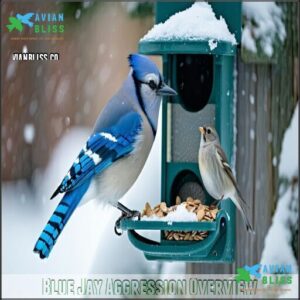
You’ll notice blue jays aren’t shy about asserting themselves at your backyard feeder, using their intelligence and size to establish dominance through raised crests and loud calls.
Here’s a short, engaging blockquote in the same tone as the paragraph:
Blue jays command the feeder with calculated confidence—their raised crests and piercing calls advertising their dominance with unmistakable authority.
Their reputation as aggressive birds stems primarily from defensive behaviors around their nests and competition for food resources, rather than from genuine malice toward other species.
Territorial Nature
You’ve likely witnessed blue jay aggression if you’ve spent time watching your backyard feeders.
These striking birds fiercely defend their territory, especially during breeding season.
Blue jays demonstrate their territoriality through:
- Loud alarm calls that warn others of nearby predators
- Mobbing behavior against intruders like owls until they retreat
- Resource guarding of feeding grounds and nesting sites
- Spatial dominance displays that establish bird territoriality boundaries
This defensive nature helps guarantee their survival and reproductive success.
Aggressive Displays and Vocalizations
Beyond their territorial boundaries, you’ll recognize blue jay aggression through their distinctive displays and vocalizations.
When blue jays feel threatened, they communicate their intentions clearly: they use a variety of methods to establish dominance.
| Display Type | Visual Signals | Purpose |
|---|---|---|
| Crest Display | Raised feathers on head | Intimidation |
| Body Posture | Puffed chest, spread wings | Size exaggeration |
| Hawk Mimicry | Perfect hawk calls | Scaring competitors |
Their vocal repertoire includes harsh "jay-jay" territorial calls that warn intruders to back off, which is a form of intimidation tactics. These tactics effectively establish dominance in your backyard bird hierarchy. Blue jays use these displays for resource defense purposes, showcasing their ability to adapt and thrive.
Defensive Aggression
When threatened, blue jays shift into remarkable defensive aggression mode.
They’ll fiercely protect nestlings from predators, using their sharp beaks and aggressive behavior to drive away threats.
You’ll often witness their mimicry defense, imitating hawk calls to scare potential attackers.
This isn’t just limited to predator response—blue jays display intraspecies aggression when competing for resources.
Even after an injury, they maintain defensive postures rather than showing vulnerability.
Seasonal Variations in Aggression
When blue jays defend their territory, they’re not equally aggressive year-round. Their temperament changes with the seasons, a fascinating aspect of blue jay behavior.
You’ll notice distinct patterns in their aggressive behavior:
- Spring breeding season brings peak territorial aggression
- Summer molting season shows reduced confrontations
- Fall migration stress can trigger defensive reactions
- Winter flocking creates a temporary social truce
- Resource scarcity during harsh months intensifies competition
Unlike other aggressive bird species, blue jays’ winter aggression is remarkably lower as they focus on survival. This change is a key part of their territorial behavior and social dynamics.
Are Blue Jays Aggressive
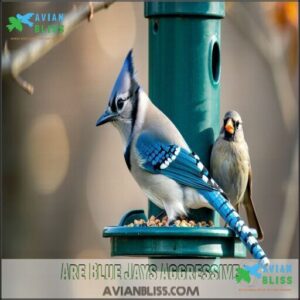
Despite their reputation, blue jays aren’t as aggressive as commonly believed.
You’ll notice their crest display reveals their mood—raised when agitated, lowered when calm.
Their infamous bird aggression is often misunderstood; studies show only 1% have evidence of nest raiding in their stomachs.
They’re actually outcompeted at bird feeders by woodpeckers, grackles, and squirrels.
When you hear their loud calls, it’s typically defensive rather than offensive behavior.
Their mimicry purpose serves as protection, imitating hawk calls to warn family members of danger.
Through human interaction, you’ll discover they’re more cautious than confrontational.
Their successful urban adaptation demonstrates their adaptability rather than dominance.
While they can be bold at feeders, blue jay behavior isn’t typically hostile without cause.
Understanding are jays aggressive requires observing context—they’re protective of family but not the neighborhood bullies they’re made out to be.
Blue jays’ behavior can even impact other species, as they’re known to intimidate even cardinals.
Blue Jay Interactions With Other Birds
You’ll often see blue jays asserting their dominance at feeders, using their size and loud calls to scatter smaller birds before swooping in to claim the best seeds.
Their interactions with other backyard birds reveal a complex social structure where they’re not always the bullies they’re made out to be, as they frequently yield to larger species like woodpeckers and grackles, showing that blue jays are part of a larger ecosystem.
Food Competition
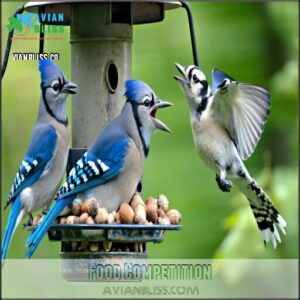
When food resources become scarce, you’ll notice blue jays asserting acorn dominance at your feeders.
They aren’t always the bullies they’re made out to be, though.
Studies show they’re often outcompeted by woodpeckers and grackles during feeder battles.
Their varied diet breadth—from insects to nuts—and clever caching strategies actually help them avoid constant aggression.
Bird behavior experts note that resource scarcity, not inherent meanness, typically triggers their competitive displays.
Size Advantage

Size matters in the bird world, and Blue Jays hold a significant advantage.
At 9-12 inches long with a wingspan of 13-17 inches, they’re markedly larger than many backyard birds.
This physical dominance helps establish their position in the foraging success hierarchy. Their size aids in predator avoidance and nest defense, allowing them to control resources more effectively.
You’ll notice smaller birds often yield when these bold birds appear.
Intimidation Tactics

Beyond their physical stature, blue jays employ clever intimidation tactics against other birds.
You’ll often witness their raised crest displays signaling aggression while their vocalization mimicry of hawk calls creates deceptive behavior that scares away competitors.
Their loud squawks combined with threatening postures constitute classic bird aggression triggers.
When truly threatened, they’ll engage in mobbing behavior, gathering in groups to drive away predators.
These territorial behavior patterns showcase the blue jay’s psychological warfare in backyard bird interactions.
Impact on Smaller Bird Species
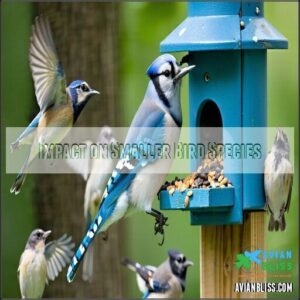
Many smaller birds face significant challenges when blue jays dominate their habitat.
Their impact on the ecosystem balance includes:
- Nest raiding, reducing successful breeding for songbirds
- Creating food scarcity through aggressive competition at feeders
- Altering bird behavior patterns through intimidation and mimicry impact
- Contributing to population control of certain species
You’ll notice bird dominance hierarchies shift when blue jays appear, triggering bird aggression among species that would otherwise coexist peacefully, due to the blue jays presence.
Blue Jay Intelligence and Aggression

You’ll find that blue jays aren’t just aggressive birds but also highly intelligent members of the corvid family, using tools and mimicking predator calls to outsmart competitors.
Their seemingly bullying behavior at your feeder actually showcases complex problem-solving skills and social strategies that help them survive in competitive environments.
Problem-Solving Abilities
While blue jays may intimidate other birds at feeders, their aggression stems from remarkable cognitive skills.
You’ll notice these birds can solve complex problems that stump many other species.
Research confirms blue jays excel in spatial memory tasks and demonstrate tool use capabilities—using sticks, paper, and even feathers to reach food.
Their innovation strategies reveal sophisticated bird intelligence that contributes to their survival and sometimes aggressive bird behavior patterns.
Some birds even exhibit vocal learning abilities, mimicking sounds in their environment, showcasing their ability to adapt and thrive through innovation strategies.
Social Learning
While blue jays showcase impressive problem-solving skills, their social learning abilities truly set them apart in the bird world.
You’ll notice they don’t just learn independently—they acquire knowledge through observation and interaction with their families and flocks.
Blue jay social learning includes:
- Passing down mimicry development from parents to offspring
- Sharing vocal learning techniques within family groups
- Spreading innovations throughout communities when new food sources are discovered
- Teaching family members to recognize predators through cultural transmission
- Developing complex bird social behaviors through repeated interactions
Tool Use for Food Acquisition
Captive blue jays have demonstrated remarkable tool-use learning, using items like newspaper strips to rake in food pellets from outside their cages.
While you’ll never spot this behavior in wild blue jays, laboratory studies have shown they can use sticks to acquire food.
This cognitive flexibility highlights their problem-solving abilities, though the evolutionary implications remain unclear.
This intelligent food acquisition strategy differs substantially from their typical wild foraging behaviors, showcasing their ability to adapt to new situations with cognitive flexibility.
Mimicry as a Defense Mechanism
While blue jays use tools to obtain food, their vocal talents serve a different purpose.
You’ve probably heard their perfect hawk call deception—it’s not just showing off! This interspecies communication strategy creates predator confusion among smaller birds, scattering them from feeders.
Blue jays’ mimicry effectiveness is remarkable, allowing them to clear feeding areas or warn their own kind of danger.
Their vocal mimicry is a clever defensive tactic in their behavioral arsenal.
Managing Blue Jay Aggression
You can effectively manage blue jay aggression in your yard by making simple adjustments to your feeding stations and landscape design.
With strategic placement of feeders and the creation of separate feeding zones, you’ll reduce territorial conflicts while still enjoying these intelligent, colorful visitors.
Feeder Placement and Design

Blue jays’ intelligence shapes their strategic feeder behavior.
Strategic feeder placement can reduce aggressive incidents at your bird stations. Position feeders near cover like shrubs or trees where smaller birds can retreat quickly.
Choose hopper or tray-style feeders rather than hanging ones, as blue jays prefer these designs. Understanding their omnivorous diet needs can further optimize feeder selection.
Placing squirrel baffles above feeders can minimize seed spillage while accommodating larger feeder sizes that blue jays require for comfortable feeding.
Creating Separate Feeding Areas
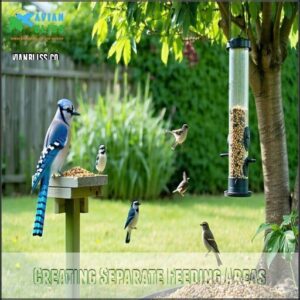
To establish bird harmony in your yard, set up multiple feeders at varying heights and distances.
Strategic spatial arrangement reduces competition and minimizes aggressive bird interactions.
Place platform feeders for blue jays at least 15 feet from tube feeders that smaller birds prefer.
Consider using specialized feeding trays for larger birds.
Your bird feeding strategy should include distinct zones—one for ground feeders, another for perching birds, creating peaceful bird feeder behavior through thoughtful design.
Providing Alternative Food Sources

To keep peace among your feathered visitors, offer a variety of food sources specifically for blue jays.
Providing supplemental feeding stations with peanuts, sunflower seeds, and suet can reduce competition at your main bird feeders.
Blue jays’ varied diets mean they’ll happily feast on these alternatives, especially during winter feeding when natural foods are scarce.
You can find a suitable peanut feeder online.
This strategy improves overall bird interactions and minimizes aggressive bird behavior from these bold backyard residents.
Landscaping to Reduce Territorial Conflicts

Strategic landscaping can substantially reduce territorial conflicts with blue jays.
Plant dense shrubs as visual obstructions between feeding areas to minimize resources competition.
Native plants create natural barriers that limit aggressive birds’ territory size while supporting local ecology.
For those seeking to implement this, consider purchasing a barrier for effective results.
According to bird behavior studies, blue jay interactions are less confrontational when their sightlines are broken up.
In urban areas, thoughtful bird habitat design creates harmony where even these bold backyard visitors can coexist peacefully, promoting a more natural ecology and harmony.
Frequently Asked Questions (FAQs)
Will Blue Jays attack humans?
While extremely rare, you might experience Blue Jays swooping near your head during nesting season if you’re too close to their young.
They’re generally wary of humans and won’t attack unless they feel threatened.
Why do Blue Jays have a bad reputation?
Like playground bullies with wings, Blue Jays have earned their bad reputation through nest raiding, eating eggs and nestlings of other birds.
Their loud confrontational calls, and mimicry that scares smaller birds away, are also part of the reasons for their bad reputation.
Is it good to have Blue Jays in your yard?
Blue jays benefit your yard by helping spread oak trees, controlling insect populations, and warning other birds of predators.
Their beautiful blue plumage and entertaining antics also add visual interest to your outdoor space, making them a valuable addition.
Are Blue Jays aggressive?
Yes, blue jays can be aggressive.
You’ll notice their raised crest signals aggression, especially when defending territory or food sources.
Their squawking and mimicry of hawk calls often intimidate smaller birds at feeders.
Are Blue Jays dangerous?
Blue jays aren’t dangerous to humans despite their bold personality. They’ll defend their nests but won’t attack you unprovoked. You’re perfectly safe enjoying these intelligent, colorful birds.
What is blue jay behavior?
Known for intelligence, blue jays communicate through crest positions and vocalizations. You’ll notice they form tight family bonds, mimic other species brilliantly, and use tools. They’re protective during nesting season.
Do Blue Jays attack?
When threatened, you’ll see blue jays attack potential predators or nest intruders.
They’re fiercely protective of their young and territory, swooping down with raised crests and loud calls to defend what’s theirs.
They exhibit this behavior to safeguard their area from possible dangers.
Are Blue Jays mean birds?
Blue jays aren’t inherently mean, but they’ll defend their territory and young vigorously.
You’ll notice they’re assertive at feeders and use their loud calls and raised crests to communicate dominance when needed.
Is a blue jay a songbird?
Calling a blue jay a songbird is like calling a crow a soprano—it’s technically true but a bit misleading.
While they belong to the songbird family, their calls are more squawks than melodies.
Why do Blue Jays attack Bluebirds?
Blue Jays may attack Bluebirds to defend their territory or food sources.
They’re protective of their nests and sometimes see Bluebirds as competition.
It’s less about aggression and more about survival instincts kicking in.
Conclusion
It’s no coincidence that blue jays stand out as both intelligent and aggressive birds.
Their bold behavior, while sometimes frustrating, plays a key role in their survival.
If you’ve ever wondered, “Are blue jays aggressive birds?” the answer is yes—but understanding their instincts can help you coexist peacefully.
By adjusting feeder placement, offering alternative food, and designing your yard thoughtfully, you can minimize conflicts and enjoy these fascinating, scrappy birds without too much drama.
- https://academy.allaboutbirds.org/how-birds-make-colorful-feathers/
- https://www.nationalgeographic.com/animals/article/year-of-the-bird-brains-intelligence-smarts?loggedin=true
- https://naturecanada.ca/news/blog/5-weird-facts-about-blue-jays/
- http://mailto:AskMaryStone
- https://www.allaboutbirds.org/guide/Blue_Jay/id