This site is supported by our readers. We may earn a commission, at no cost to you, if you purchase through links.
When you walk through Alaska’s boreal forests, you might hear a sharp drumming sound echoing through the spruce trees. That’s likely one of the seven woodpecker species that call this northern wilderness home. These birds have adapted to some of the harshest conditions on the continent, thriving in habitats that range from burnt forest snags to backyard feeders in Anchorage.
Some species, like the Black-backed Woodpecker, depend entirely on fire-damaged forests, while others visit suburban suet feeders during the long winter months.
Whether you’re a seasoned birder or just curious about the wildlife in your area, knowing how to identify these distinctive birds opens up a whole new dimension to exploring Alaska’s forests.
Table Of Contents
- Key Takeaways
- Woodpecker Species Found in Alaska
- Identifying Alaska’s Woodpeckers by Appearance
- Habitats and Distribution Across Alaska
- Behavior and Calls of Alaskan Woodpeckers
- Conservation Status and Population Trends
- Frequently Asked Questions (FAQs)
- Does Alaska have woodpeckers?
- How do you tell the difference between a Downy Woodpecker and a hairy woodpecker?
- What is the difference between a red-headed woodpecker and an acorn woodpecker?
- What are the tall birds in Alaska?
- What is the tall bird in Alaska?
- Do both male and female woodpeckers peck?
- What is the difference between a downy and hairy woodpecker?
- What are the benefits of woodpeckers?
- How do woodpeckers find food?
- Are there any endangered woodpecker species?
- Conclusion
Key Takeaways
- Alaska hosts seven distinct woodpecker species, ranging from the tiny Downy Woodpecker at backyard feeders to specialized species like the Black-backed Woodpecker that depends entirely on burned forests for survival.
- You can identify these birds by combining size, bill shape, and head markings—males typically show red patches that females lack, while species like the Hairy Woodpecker have bills as long as their heads compared to the Downy’s stubby beak.
- Most Alaska woodpecker populations remain stable or increasing, with Black-backed Woodpeckers growing 3.7% annually, though habitat loss from post-fire logging and climate-driven forest changes threaten their long-term survival.
- These birds serve as essential forest architects by controlling wood-boring insect populations, creating nest cavities that benefit dozens of other species, and helping forests regenerate naturally after disturbances like wildfires.
Woodpecker Species Found in Alaska
Alaska is home to seven woodpecker species, each with its own look and habitat preferences. You’ll find everything from tiny Downy Woodpeckers visiting backyard feeders to specialized three-toed species thriving in remote mountain forests.
Here’s what you can expect to see across the state.
Downy Woodpecker
The Downy Woodpecker is Alaska’s smallest woodpecker species, recognized by its short bill and black-and-white markings. You’ll find it in deciduous and mixed forests across over 400,000 square kilometers, from Southeast to Interior Alaska.
Its foraging habits shift seasonally—digging for insects in winter, gleaning in summer. Despite low genetic diversity in Alaska populations, breeding behavior remains stable, with population stability documented since 1993. They’re known to visit backyard bird feeders in urban areas.
Hairy Woodpecker
If you’re looking for a bigger bird with a chisel-like bill, the Hairy Woodpecker is your match. At 24 cm, it’s nearly twice the size of the Downy, with a bill as long as its head—perfect for serious bark excavation. Males sport a red head patch; females don’t.
You’ll find them year-round in Alaska’s old-growth forests, especially the Tongass, where snags provide nesting sites. They consume large numbers of wood-boring insects in their diet.
American Three-Toed Woodpecker
You’ll recognize the American Three-toed Woodpecker by its distinctive yellow head patch and black-and-white speckled plumage. This species thrives in Alaska’s coniferous forests, particularly post-fire habitat where beetle larvae—its primary diet—are abundant.
With a population of 1.6 million across its range, it nests in dead trees and faces conservation challenges from habitat loss, though population fluctuations occur naturally following disturbances.
Black-Backed Woodpecker
Unlike its three-toed cousin, the Black-backed Woodpecker depends entirely on burnt trees and snag-rich forests in Alaska’s coniferous woodlands. You’ll spot its shiny black plumage as it strips bark for beetle larvae—its primary food source.
With 1.7 million globally, this fire ecology specialist nests in recently burned areas but faces threats from post-fire logging that removes critical nesting sites.
Northern Flicker
You’ll often hear the Northern Flicker’s unmistakable “wake-up” call echoing through Alaska’s open woodlands before you spot its spotted breast and white rump in flight. This ground-foraging woodpecker identification expert feeds heavily on ants—making up 45% of its diet composition—and thrives where trees meet open spaces.
- The red-shafted Alaskan subspecies displays bright reddish wing linings
- Hybridization zones in southeastern Alaska create mixed-trait populations
- Despite stable Alaska numbers, population declines of 1% yearly affect its broader range
Yellow-Bellied Sapsucker
The Yellow-Bellied Sapsucker is a distinctive bird with its red forehead and white shoulder stripe, known for drilling sap wells in aspen and birch trees. This boreal breeding specialist arrives in Alaska’s interior by May, with males typically showing up first. During the summer months, they can be spotted in east-central regions, where their stable population reflects healthy habitat conditions.
| Feature | Male | Female |
|---|---|---|
| Throat color | Red patch | White or pale |
| Migration timing | Arrives late March | Arrives early May |
| Nest site reuse | Up to 7 seasons | Up to 7 seasons |
Red-Breasted Sapsucker
The Red-breasted Sapsucker stands out with its completely red head and chest—a stunning feature you won’t see on other Alaska woodpeckers. Found in southeast Alaska’s hemlock and spruce forests, this species accounts for up to 74% of the global population. You’ll recognize them by their feeding habits of drilling neat sap wells.
Key identification features:
- Size and markings: Similar to an American Robin (8–9 inches), with a white wing patch and black back showing yellow bars
- Vocalizations: Soft “whee-ur” or nasal “weep weep” calls, plus irregular drumming that slows at the end
- Conservation outlook: Listed as “Least Concern” with increasing population trends in Alaska, though they need mature forests to thrive
Identifying Alaska’s Woodpeckers by Appearance
Spotting woodpeckers in Alaska gets easier once you know what to look for. Each species has its own mix of size, color patterns, and markings that help you tell them apart in the field.
Let’s break down the key features that make identification straightforward.
Size and Bill Characteristics

When you’re trying to tell Alaska’s woodpeckers apart, size and bill shape are your best friends.
The downy woodpecker is the smallest species at just 5.5 to 7 inches, with a short, stubby bill under 2 cm long. Hairy woodpeckers are noticeably larger, reaching 10.5 inches, with a dagger-like bill that’s nearly as wide as their head at 3.4 cm.
Plumage Patterns and Colors
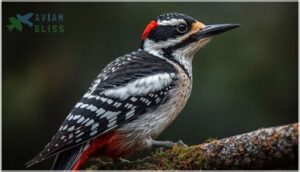
Alaska’s woodpeckers wear feathers like fingerprints—each pattern tells you exactly who you’re looking at. Black-and-white barring shows up in over 80% of species, making it the go-to identification feature.
- Sexual dimorphism: Males sport red patches; females don’t
- Regional color variations: Darker plumage in rainier southern forests
- Pattern elements: Stripes, spots, and bold contrasts dominate
- Seasonal influences: Brightness shifts with precipitation changes
- Color trait frequency: White wing spots appear in 60% of specimens
Distinctive Head Markings
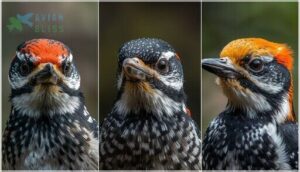
Head markings serve as nature’s name tags for woodpeckers in Alaska. Male head patches—like the red nape on 98% of male Downy and Hairy Woodpeckers—separate the sexes instantly. Facial stripe patterns vary widely: Black-backed Woodpeckers show bold white lines cutting across black faces, while Northern Flickers sport mustache-like stripes. Sapsucker head color shifts from dull in juveniles to bright red in adults.
| Species | Male Marking | Female Marking |
|---|---|---|
| Downy Woodpecker | Red occipital patch | White head stripes only |
| Black-backed Woodpecker | Yellow crown patch | Solid black crown |
| American Three-toed | Yellow cap present | No yellow cap |
Differences Between Downy and Hairy Woodpeckers
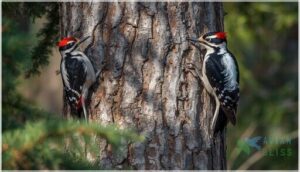
Telling these look-alikes apart takes a sharp eye. You’ll notice Downy and Hairy Woodpecker differences in five key areas:
- Size comparison: Hairy Woodpeckers stretch to 10 inches—50% taller than their Downy cousins at 7 inches
- Bill length: Hairy bills match their head length; Downy bills measure just one-third
- Tail spots: Downy Woodpeckers sport black spots on white outer tail feathers; Hairies show pure white
- Habitat preference: Downies adapt to backyards; Hairies need mature forest patches
- Population trends: Both remain stable across Alaska’s woodlands
Habitats and Distribution Across Alaska
Alaska’s woodpeckers aren’t picky about where they live, but each species does have its favorite spots. From towering mountain forests to your own backyard, these birds know how to find the right habitat for their needs.
Let’s look at where you’re most likely to find each type across the state.
Coniferous Forest Dwellers
When exploring coniferous forests across Alaska, you’ll find several woodpecker species thriving among the spruce trees. Black-backed woodpeckers and American three-toed woodpeckers show strong spruce forest association and mixedwood habitats. Hairy woodpeckers favor old-growth preference with dense needleleaf cover exceeding 60%.
These species depend on snag density needs—around 42–52 dead trees per 100 acres—for nesting and feeding. Even burned forest breeding occurs successfully in these areas.
Burned Forest Specialists
Beyond intact coniferous forests, you’ll discover specialized woodpeckers thriving in Alaska’s burnt trees. Black-backed Woodpeckers are the stars here, moving into burned areas within weeks for post-fire foraging on beetle larvae. They need high snag habitat—at least 15 dead trees per acre—to nest and feed.
Unfortunately, salvage logging impact reduces their numbers by removing critical snags, disrupting ecosystem renewal and the natural fire regime effects these birds depend on.
Tongass National Forest Populations
The Tongass National Forest shelters at least five woodpecker species in its old-growth stands. You’ll find Hairy Woodpeckers serving as indicator species here, occurring at about 0.1 birds per acre in undisturbed areas. However, habitat fragmentation from timber harvest threatens these populations:
- Monitoring challenges make detecting population changes difficult
- Old-growth dependence means coniferous forests are critical
- Sustainable forestry practices increasingly protect breeding sites
Mountain and High-Elevation Species
In Alaska’s coniferous forests, you’ll find Black-backed and American Three-toed Woodpeckers thriving above 700 meters. These montane habitats support both species year-round, though climate impacts are shifting their nesting trends—warmer temperatures now trigger earlier breeding.
Their foraging behavior centers on insect-infested snags following fires or floods. Elevation adaptations let them exploit high-altitude beetle larvae, making recently burned areas particularly attractive.
Backyard and Suburban Visitors
You’ll most often spot Downy and Hairy Woodpeckers at your Alaska backyard bird feeders, especially during winter visitation months when they rely on suet and sunflower seeds. These suburban backyard residents provide excellent insect control, devouring thousands of beetle larvae annually.
Attracting woodpeckers to yards works best with well-stocked bird feeders and scattered trees nearby. Regional variation means Far North locations see fewer species, while habitat influence from wooded areas boosts feeder preferences considerably.
Behavior and Calls of Alaskan Woodpeckers
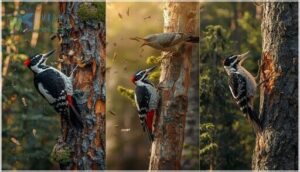
Watching woodpeckers in Alaska means more than just spotting their colors and patterns. You’ll also notice how each species sounds and behaves differently as they search for food and defend their territory.
Let’s look at the key behaviors and calls that help you identify these birds in the field.
Drumming and Pecking Patterns
If you’ve ever wondered why woodpecker drumming sounds different from tree to tree, it’s all about substrate selection. These birds produce impact forces reaching 1,200 to 1,400 g-force—roughly 14 times stronger than what causes human concussions.
Woodpeckers drum at forces 14 times stronger than what causes human concussions, choosing trees carefully for the right sound
Physical adaptations like reinforced skulls and specialized hyoid bones protect their brains during this intense woodpecker behavior, letting them drum up to 12,000 times daily across Alaska’s forests.
Territorial Calls and Vocalizations
You’ll hear distinct territorial calls when woodpeckers defend their space. Downy Woodpeckers produce rapid “pik-pik-pik” sequences, while Hairy Woodpeckers belt out louder “peek-peek-peek” calls. Northern Flickers use a persistent “wick-a-wick-a-wick” sound.
These bird calls peak during dawn and dusk, with males successfully deterring intruders in 89% of encounters. Acoustic monitoring shows these Alaska species vocalize 10-20 times hourly during breeding season.
Foraging and Feeding Techniques
You’ll notice woodpeckers in Alaska use three main foraging techniques based on their seasonal diets and foraging efficiency:
- Tree excavation – Black-backed and American Three-Toed Woodpeckers drill 3–8 holes daily, targeting beetle larvae in burned forests where insect consumption peaks at 75%.
- Bark peeling – Hairy Woodpeckers strip bark to access hidden insects beneath.
- Sap extraction – Yellow-bellied Sapsuckers drill precise holes for tree sap, comprising 23% of their annual woodpecker diet.
Nesting and Breeding Habits
Alaska woodpeckers start cavity nesting between February and May, with breeding season stretching through July. Males excavate nest holes 8–14 inches deep in live or dead trees, usually 12+ feet high. Clutch sizes vary by species, generally 3–8 white eggs per brood. Incubation lasts 10–14 days, with both parents sharing duties. After 20–27 days, fledglings emerge, staying close for parental care while mastering foraging skills—fledgling success depends heavily on cavity height and food availability.
| Species | Clutch Size | Incubation Period |
|---|---|---|
| Downy Woodpecker | 3–6 eggs | 13 days |
| Hairy Woodpecker | 5–8 eggs | 12–14 days |
| Black-backed Woodpecker | 2–6 eggs | 13 days |
| Northern Flicker | 5–8 eggs | 11–13 days |
Conservation Status and Population Trends
Alaska’s woodpeckers are doing better than you might expect, but they’re not out of the woods yet. Some species are holding steady or even growing in numbers, while others face real challenges from habitat loss and shifting climate patterns.
Let’s look at how these birds are faring and what’s being done to protect them.
Stable and Increasing Populations
Good news for birdwatching in Alaska: most woodpecker species are holding steady or even growing in numbers. Population monitoring shows encouraging signs:
- Black-backed Woodpeckers have increased by 3.7% annually in recent surveys
- Downy Woodpeckers jumped 8% since 1970 across North America
- American Three-toed Woodpeckers show consistent breeding success throughout Alaska’s coniferous forests
- Hairy Woodpeckers remain stable year-round, especially in southeastern Alaska
- Habitat resilience after wildfires actually helps some species thrive
Conservation strategies are working.
Habitat Loss and Climate Change Threats
Despite recent gains, Alaska’s wildlife faces real pressures. Forest fragmentation from logging cuts nesting sites by 30% in some areas. Fire management after burns drops Black-backed Woodpecker numbers by 60%.
Climate-driven range shifts push species north as tree mortality doubles by 2050. Hardwood encroachment shrinks habitat for spruce-loving woodpeckers by 30% come 2080.
These niche constraints test even adaptable species across Alaska’s forest ecosystems.
Conservation Efforts in Alaska’s Forests
You’ll find strong conservation at work across Alaska’s forests. Protected areas like Tongass National Forest preserve 16.7 million acres of woodpecker habitats in Alaska.
Fire management now retains burned trees for Black-backed specialists. Population monitoring tracks trends through annual surveys, while forest stewardship programs teach 3,500 students yearly about forest ecosystems.
These efforts safeguard Alaska’s wildlife and the conservation status of all seven species.
Frequently Asked Questions (FAQs)
Does Alaska have woodpeckers?
Yes, seven woodpecker species call Alaska home, including the Downy, Hairy, American Three-Toed, Black-Backed, Northern Flicker, Yellow-Bellied Sapsucker, and Red-Breasted Sapsucker—showcasing considerable Alaskan woodpeckers diversity across varied habitats.
How do you tell the difference between a Downy Woodpecker and a hairy woodpecker?
At first glance, they look nearly identical—but size comparison reveals the truth. Check the bill length (Downy’s is tiny), tail feathers (Downy’s show black spots), and listen for vocal differences in their calls.
What is the difference between a red-headed woodpecker and an acorn woodpecker?
Neither red-headed nor acorn woodpeckers live in Alaska.
Red-headed woodpeckers show solid red heads and white bellies. Acorn woodpeckers display clown-like facial patterns, store acorns communally, and inhabit western North America’s oak woodlands.
What are the tall birds in Alaska?
Alaska’s tallest birds stand up to 3 feet high—like Sandhill Cranes and Trumpeter Swans with 10-foot wingspans. Great Blue Herons and Bald Eagles also tower over woodpeckers in Alaska’s forests and marshes.
What is the tall bird in Alaska?
The Sandhill Crane stands tallest among Alaska’s wildlife, reaching 48 inches. When comparing crane vs. swan or eagle height, this species surpasses them.
You’ll find these impressive birds during migration patterns across Alaska’s wetlands.
Do both male and female woodpeckers peck?
Yes, both male and female woodpeckers peck. You’ll see them drumming, foraging, and excavating nests together. Males generally handle heavier territorial defense, while females focus more on incubation—but pecking happens across both sexes equally.
What is the difference between a downy and hairy woodpecker?
Think of them as cousins who grew apart—size comparison reveals Downy’s smaller frame and stubby bill versus Hairy’s longer, robin-sized body.
Tail feathers and vocal differences clinch identification when plumage differences blur together.
What are the benefits of woodpeckers?
You’ll find these birds play a vital role in pest control, eating thousands of wood-boring insects annually.
Their cavity creation bolsters biodiversity, while forest regeneration and economic value from insect control benefit entire ecosystems.
How do woodpeckers find food?
Like skilled detectives, you’ll find woodpeckers using sensory detection—listening for beetle larvae and insects under bark.
Their foraging behavior shifts with seasonal diets, while habitat foraging optimizes ecosystem impact through efficient insect control.
Are there any endangered woodpecker species?
None of Alaska’s seven woodpecker species are endangered. All hold “Least Concern” conservation status with stable populations.
However, globally, habitat loss threatens several woodpeckers, including the Red-cockaded Woodpecker in North America’s southeastern forests.
Conclusion
Think of woodpeckers in Alaska as forest architects—each species carving out its own niche in this vast northern landscape. Now that you can identify them by sight and sound, you’re ready to spot these resilient birds wherever your adventures take you.
Whether you’re hiking through burned stands or watching your backyard feeder, you’ll notice details you once overlooked. The drumming you hear tomorrow might just reveal something special.
- https://www.adfg.alaska.gov/static/education/wns/woodpeckers.pdf
- https://www.fs.usda.gov/database/feis/animals/bird/piar/all.html
- https://www.conservationgateway.org/ConservationByGeography/NorthAmerica/UnitedStates/alaska/seak/era/cfm/Documents/7.4_Hairy_Woodpecker.pdf
- https://accs.uaa.alaska.edu/wp-content/uploads/picoides_arcticus.pdf
- https://mnbirdatlas.org/species/downy-woodpecker/