This site is supported by our readers. We may earn a commission, at no cost to you, if you purchase through links.
Eight woodpecker species call New York home, and each one has carved out a distinct niche. From the diminutive Downy hammering away at suburban suet feeders to the crow-sized Pileated excavating massive rectangular cavities deep in Adirondack forests, these birds are fascinating to watch.
They’re also ecological engineers that shape entire forest communities. A single Pileated cavity can house dozens of other species over its lifetime, while Northern Flickers devour thousands of ants daily, keeping pest populations in check.
Whether you’re tracking drumming patterns in Central Park or scanning boreal stands for the elusive Black-backed, knowing what to look for transforms a casual walk into a genuine expedition.
Table Of Contents
- Key Takeaways
- Common Woodpecker Species in New York
- Identifying Woodpeckers by Appearance
- Woodpecker Habitats Across New York
- Feeding and Behavioral Patterns
- Conservation and Ecological Importance
- Frequently Asked Questions (FAQs)
- What kind of woodpeckers are in upstate New York?
- Are woodpeckers good to have in your yard?
- How do you tell the difference between a Downy Woodpecker and a Hairy Woodpecker?
- Why are woodpeckers pecking my house?
- What kind of woodpeckers are in upstate NY?
- What is the largest woodpecker in NY?
- How do woodpeckers survive harsh winters?
- What are woodpeckers main predators in New York?
- How do woodpeckers contribute to forest health?
- What unique sounds do woodpeckers make?
- Conclusion
Key Takeaways
- New York hosts eight distinct woodpecker species ranging from the 5-inch Downy to the crow-sized Pileated, each occupying specialized niches across forests, urban parks, and backyards with identifiable differences in size, plumage patterns, bill morphology, and drumming rhythms.
- Woodpeckers function as ecological engineers by excavating cavities that house up to 66% of cavity-nesting bird species, controlling destructive insect populations with up to 95% predation rates on pests like emerald ash borers, and accelerating nutrient cycling through their foraging behavior.
- The Red-headed Woodpecker has suffered a catastrophic 76% population decline since the 1980s due to habitat loss and competition from European Starlings, while the Black-backed Woodpecker persists only in Adirondack highlands above 1,700 feet, occupying less than 3% of surveyed breeding blocks statewide.
- Conservation efforts combining habitat restoration, snag retention, prescribed burns, and citizen science monitoring deliver measurable results—woodpecker pest control provides an estimated $20 million in annual ecosystem services while sustaining forest biodiversity indices 15% higher in areas with active woodpecker populations.
Common Woodpecker Species in New York
New York’s forests, parks, and backyards host eight distinct woodpecker species, each with its own look, habits, and preferred haunts. You’ll find year-round residents alongside seasonal visitors, from the tiny Downy to the crow-sized Pileated.
Here’s what to watch for when you’re out in the field.
Downy Woodpecker
You’ll spot the Downy Woodpecker year-round across New York—a petite, black-and-white insect hunter measuring just 5–7 inches. Males sport a red nape patch, while both sexes excavate tree cavities in dead limbs for nesting.
These acrobatic foragers thrive in forests, parks, and backyards statewide, maintaining stable populations through exceptional habitat adaptability. Their presence signals healthy woodlands and vigorous bird conservation outcomes.
Woodpeckers are subject to federal protection laws that regulate their control and management.
Hairy Woodpecker
The Hairy Woodpecker—9 to 10 inches with a chisel bill nearly as long as its head—occupies mature forests, urban parks, and backyards statewide. Unlike Downy Woodpeckers, this sturdy species maintains stable populations in New York despite habitat loss pressures elsewhere.
You’ll identify males by their red nape patch and hear their aggressive excavation as they extract wood-boring larvae year-round.
Woodpeckers in the city can be found by researching woodpecker species to learn more about their habitats and behaviors.
Northern Flicker
You’ll recognize the Northern Flicker by its gray-brown plumage, black bib, and spotted belly—a ground-foraging maverick among Woodpeckers in New York that consumes over 5,000 ants daily during nesting season.
This 12-inch species inhabits open woodlands, city parks, and forest edges statewide, though populations have declined 49% since 1966.
Flicker migration patterns show seasonal influxes, while conservation status remains stable despite nesting habitat loss and starling competition.
Red-bellied Woodpecker
Unlike the ground-loving Flicker, the Red-bellied Woodpecker—with its striking barred back and red cap—has colonized New York’s urban parks through climate-driven range expansion, now breeding in Central Park and Prospect Park after decades of northward migration.
You’ll find this adaptable species visiting backyard feeders for suet and sunflower seeds year-round, its omnivorous Red-bellied Diet and flexible nesting habits enabling exceptional urban adaptation across southern New York’s changing landscape.
Red-headed Woodpecker
You’ll recognize the Red-headed Woodpecker by its bold, tricolor plumage—a flaming red head contrasting sharply with black wings and pure white underparts—though sightings have become increasingly rare across New York.
Habitat loss and competition for nesting sites have driven a catastrophic 76% occupancy decline since the 1980s, leaving this once-common species critically imperiled throughout the state’s open woodlands and river bottomlands.
Habitat loss has driven a catastrophic 76% decline in Red-headed Woodpecker populations since the 1980s, leaving this once-common species critically imperiled across New York
Yellow-bellied Sapsucker
During spring, the Yellow-bellied Sapsucker (Sphyrapicus varius) arrives in New York’s forests, drilling methodical rows of sap wells in birch and maple bark—a feeding strategy that sets this species apart from other woodpeckers in New York. Males excavate nest cavities in fungus-softened trees, often reusing sites for multiple seasons.
- Sap well creation: Neat horizontal rows drilled for periodic feeding
- Tree selection: Preference for birch, aspen, maple based on resource value
- Fungal infection: Softened heartwood facilitates easier nest cavity excavation
- Sapsucker migration routes: Complete migrants departing south each September
Pileated Woodpecker
You’ll recognize the Pileated Woodpecker (Dryocopus pileatus) by its crow-sized frame and flaming-red crest—the largest woodpecker in New York.
This species hammers rectangular excavations into dead wood, hunting carpenter ants in mature forests.
Their nest cavities become essential real estate for owls and bats, making Pileated Woodpeckers keystone players in forest ecology and ecosystem health across upstate woodlands.
Black-backed Woodpecker
You’ll find the Black-backed Woodpecker (Picoides arcticus) only in New York’s Adirondack highlands, where it thrives in burned forest ecology and mature coniferous forests above 1,700 feet.
This rare specialist flakes bark from fire-killed spruces, targeting wood-boring beetle larvae that comprise over 75% of its diet.
Proper deadwood management and natural fire regimes support this species, which occupies less than 3% of surveyed breeding blocks statewide.
Identifying Woodpeckers by Appearance
Spotting a woodpecker is one thing—knowing which one you’re looking at is another. Each species carries its own set of visual clues, from the size of its bill to the pattern on its back.
Let’s break down the key features that’ll help you tell them apart in the field.
Size and Plumage Patterns
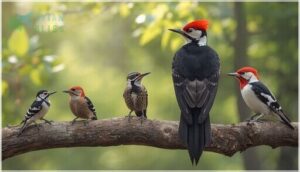
You’ll notice that size and plumage patterns form the foundation of woodpecker species identification in the field. The Downy Woodpecker spans 5.5–7.1 inches, while the Pileated reaches 16–19 inches—dramatically different.
Feather coloration ranges from the Northern Flicker’s brown base with black spots to the Red-headed’s striking crimson. Wing patterns, tail features, and beak shapes vary considerably, making accurate physical descriptions essential for distinguishing New York’s eight resident species.
Crown Color and Back Markings
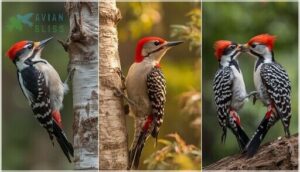
Crown color variation and back marking patterns serve as your most reliable field markers for woodpecker species identification. Sexual dimorphism shows clearly—male Downy Woodpeckers sport a red nape patch, while females lack it entirely.
- Red-headed Woodpeckers display completely red plumage on the crown in both sexes
- Red-bellied males show red crowns and napes; females have gray crowns
- Black-backed males exhibit distinctive yellow crown patches absent in females
Age-related traits complicate identification, as juvenile feather patterns differ markedly from adults.
Bill Shape and Length
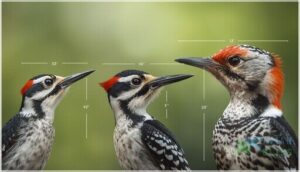
Beyond color, bill morphology offers immediate identification clues you can’t ignore. Downy Woodpeckers show compact beaks measuring 10-12 mm—less than half their head width—while Hairy Woodpeckers pack longer, chisel-shaped bills at 20-25 mm that nearly match head size. These structural adaptations directly reflect foraging strategies.
| Species | Bill Length | Head Proportion |
|---|---|---|
| Downy | 10-12 mm | <50% head width |
| Hairy | 20-25 mm | ≈100% head width |
| Pileated | ~45 mm | Sturdy, dagger-like |
| Yellow-bellied Sapsucker | 18-20 mm | Straight, drilling-adapted |
| Red-headed | Medium-long | Chisel-like, proportionate |
Distinctive Calls and Drumming
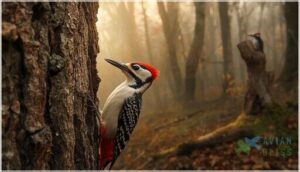
Woodpecker calls and sounds deliver acoustic cues as reliable as plumage for species identification. Red-bellied Woodpeckers produce a rolling, purr-like trill—one of New York’s most recognizable vocal signals. Northern Flickers shout a loud “wick-a-wick-a-wick” across open parks, while Pileated Woodpeckers ring out sharp “cuk-cuk-cuk” notes.
Drumming patterns serve as territorial signals during spring breeding, with Black-backed Woodpeckers striking faster (16 beats/second) than American Three-toed species (14 beats/second).
Woodpecker Habitats Across New York
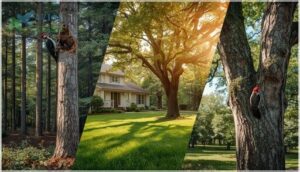
Woodpeckers in New York don’t stick to one type of landscape—they’ve adapted to everything from deep wilderness to your backyard feeder. Where you find them depends on the species and what they need to survive.
Here’s a breakdown of the key habitats where you’re most likely to encounter these birds across the state.
Forests and Woodlands
You’ll find five core woodland birds—Yellow-bellied Sapsucker, Downy Woodpecker, Hairy Woodpecker, Northern Flicker, and Pileated Woodpecker—breeding across New York’s deciduous forests and mixed woodlands. Forest ecology dictates habitat diversity: mature stands with dead standing trees support the highest densities.
Ecosystem health depends on these species, as their activity patterns reflect woodland management practices. Woodpeckers and forest ecosystems are interconnected through cavity creation, insect control, and tree species dynamics that sustain broader forest biodiversity.
Urban Parks and Backyards
You’ll spot Downy, Hairy, and Northern Flicker in New York City’s green spaces, from Central Park to small backyards with tree cover. Downy Woodpeckers visit bird feeders for suet across all five boroughs, while Hairy Woodpeckers prefer mature woodlands in Van Cortlandt and Forest Park.
Urban wildlife depends on dead tree retention and woodland patch size—tree conservation directly aids these cavity-nesting species in park management strategies.
Adirondacks and Upstate Regions
The Adirondack ecosystem harbors nine regional woodpecker species, including Black-backed and American Three-toed specialists confined to boreal forests. You’ll encounter Downy, Hairy, Pileated, Northern Flicker, and Yellow-bellied Sapsucker across most upstate New York elevations, while Red-bellied species remain rare at higher altitudes.
Upstate birding reveals how forest ecology and woodland conservation directly shape woodpecker habitats—dead snags and mature conifers support these cavity excavators throughout Adirondack woodpecker identification surveys.
Seasonal Range and Migration
Migration patterns vary sharply among New York’s woodpeckers, with Yellow-bellied Sapsuckers departing entirely each autumn while Downy and Hairy species remain year-round residents. Northern Flickers show partial migration—interior populations leave by late autumn, returning in late March.
Seasonal shifts in habitat changes and climate effects now alter stopover timing in urban parks, affecting bird tracking data for these migratory bird species across the woodpecker range.
Feeding and Behavioral Patterns
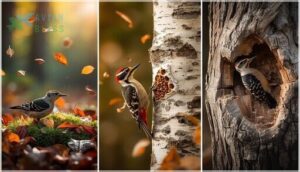
Woodpeckers aren’t just about the iconic drumming—they’ve developed distinct foraging strategies and behaviors that reflect their ecological roles. From ground-feeding flickers to sap-sipping specialists, each species has carved out its own niche in New York’s forests and backyards.
Here’s what you need to know about how these birds find food, build homes, and time their breeding cycles.
Foraging and Diet Preferences
You’ll see woodpecker foraging behavior shift dramatically with the seasons. Insect foraging dominates spring and summer, with carpenter ants comprising up to 54% of pileated woodpecker diet.
Watch for these distinct feeding techniques:
- Ground probing by flickers targeting ant colonies (40%+ of their intake)
- Sap extraction by yellow-bellied sapsuckers drilling parallel rows
- Nut caching and fruit consumption intensifying through fall
Seed preferences and suet supplement urban diets year-round.
Nesting and Cavity Creation
Cavity excavation takes three to six weeks—pileated woodpeckers chisel into trees at dawn, both partners working rotations. Nest tree selection favors stems 30–37 cm in diameter, often older growth where decay meets structural stability.
These woodpecker nests become lifelines: 47 cavity nesters depend on abandoned tree cavities. Snag management matters—maintaining 3.91 large snags per hectare sustains woodpecker nesting habits and the broader cavity-nesting guild across New York’s forests.
Seasonal Activities and Breeding
Breeding season ignites from early April through mid-September, offering a full view of woodpecker nesting habits across New York’s breeding populations. Migration timing shapes these cycles: yellow-bellied sapsuckers return in late March, while resident downies start earlier.
- Male hairy woodpeckers drum aggressively, defending territory through aerial combat
- Sapsucker pairs synchronize drumming in elaborate mating rituals
- Red-headed young fledge at 27–30 days, driven off as second broods begin
- Juvenile dispersal unfolds locally—new territories claimed within kilometers of natal sites
These fledging patterns reveal woodpecker behavior and ecology intimately tied to forest health and woodpecker conservation status.
Conservation and Ecological Importance
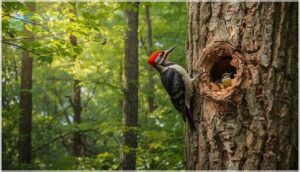
Woodpeckers aren’t just charismatic birds tapping away in your backyard—they’re essential players in keeping New York’s forests healthy and thriving.
From controlling destructive insect outbreaks to creating homes for dozens of other species, these birds punch well above their weight in ecological importance.
Understanding their conservation status and the roles they play helps you appreciate why protecting woodpecker habitat matters for the entire ecosystem.
Population Trends and Threats
You’re witnessing dramatic population shifts across New York’s woodpecker species, with habitat loss and conservation status issues threatening several species. The Red-headed Woodpecker experienced a catastrophic 76% occupancy decline between 1980 and 2005, while American Three-toed Woodpeckers face possible extirpation. Understanding these population dynamics helps you recognize the urgent threat assessment needs.
| Species | Population Trend |
|---|---|
| Red-headed Woodpecker | 76% decline (1980-2005) |
| American Three-toed | Potentially extirpated |
| Black-backed | Limited to 2.5% of blocks |
| Downy Woodpecker | Stable statewide distribution |
| Red-bellied | Expanding range northward |
Competition from European Starlings, fire suppression, and forest fragmentation accelerate species decline. Vehicle collisions and pesticide use further compound threats, making woodpecker conservation status increasingly precarious across diverse woodpecker habitats in New York.
Role in Insect Control
Beyond population concerns, woodpeckers provide invaluable pest regulation through biological control. You’ll find them targeting emerald ash borer larvae with 35-40% mortality rates in infested trees—some stands reach 95% predation.
Downy, hairy, and red-bellied woodpeckers consume over 75% insects, disrupting pest reproduction and maintaining insect ecology balance. Their foraging delivers ecosystem services worth $20 million annually, reducing chemical management costs while protecting forest health across diverse woodpecker habitats in New York.
Impact on Forest Biodiversity
Woodpeckers fundamentally reshape forest ecosystems through cavity creation and foraging. You’ll see their excavations sustaining up to 66% of cavity-nesting birds in temperate forests, while studies document 50% increases in secondary species abundance where these habitats proliferate.
Their influence on tree regeneration, species interactions, and biodiversity metrics makes them essential architects of forest ecology:
- Excavated cavities house 80% of secondary cavity-nesting birds, boosting reproductive success by 25%
- Woodpecker foraging accelerates nutrient cycling and creates canopy gaps that increase sapling recruitment
- Forest plots with high woodpecker diversity show 15% higher Shannon-Wiener biodiversity indices
- Their activity sustains complex trophic networks, increasing arthropod diversity by 20% in affected stands
Conservation Efforts in New York
New York’s conservation approach combines habitat restoration with species monitoring to protect these forest architects. The “Audubon in the Parks” program oversees 67 Important Bird Areas, while Bird Conservation Areas prioritize snag retention for nesting.
Prescribed burns in the Albany Pine Bush have stabilized red-headed woodpecker territories.
You can join citizen science efforts through Breeding Bird Atlas surveys, directly contributing data that shapes adaptive management decisions statewide.
Frequently Asked Questions (FAQs)
What kind of woodpeckers are in upstate New York?
Eight species call this region home year-round or seasonally. You’ll commonly encounter the Downy Woodpecker, Hairy Woodpecker, Northern Flicker, Pileated Woodpecker, and Yellow-bellied Sapsucker across forests, parks, and wooded backyards throughout upstate territory.
Are woodpeckers good to have in your yard?
You’d be hard-pressed to find better pest management partners. These birds devour wood-boring beetles and ants daily, delivering real yard benefits.
Creating a woodpecker-friendly backyard ecology means welcoming urban wildlife that naturally controls destructive insects while supporting broader biodiversity.
How do you tell the difference between a Downy Woodpecker and a Hairy Woodpecker?
Your quickest field mark is bill length—the Downy Woodpecker’s stubby bill measures roughly one-third its head width, while the Hairy Woodpecker’s chisel-like bill nearly matches head length.
Check tail feathers too: Downy shows black spots; Hairy displays clean white outer feathers.
Why are woodpeckers pecking my house?
Your home’s pecking behavior usually stems from three causes: territorial drumming (especially on resonant siding), foraging for hidden insects, or cavity excavation when natural snags are scarce.
Understanding woodpecker behavior helps you choose effective bird deterrents and siding protection strategies.
What kind of woodpeckers are in upstate NY?
You’ll find impressive species diversity across upstate NY—from the common Downy to the elusive Black-backed Woodpecker in Adirondack forests.
Understanding forest ecology and conservation status helps with woodpecker identification during your birdwatching adventures.
What is the largest woodpecker in NY?
The Pileated Woodpecker claims the title of largest species in NY birding circles.
You’ll recognize this striking bird by its flaming-red crest and impressive 16–19 inch length—dwarfing relatives like the Northern Flicker and Downy Woodpecker.
How do woodpeckers survive harsh winters?
Like sailors weathering a storm, woodpeckers deploy multiple cold adaptation strategies. Winter roosting in insulated cavities cuts energy loss by 20%, while food caching, energy conservation through hypothermia, and social flocking guarantee survival through New York’s brutal winters.
What are woodpeckers main predators in New York?
You’ll spot sharp-shinned hawks and Cooper’s hawks leading the charge against adult woodpeckers, while raccoons, squirrels, and black rat snakes raid nests.
Domestic cats and European starlings add pressure in urban habitat pockets.
How do woodpeckers contribute to forest health?
Think of woodpeckers as nature’s architects—excavating cavities that shelter ninety percent of forest wildlife, controlling wood-boring insects, accelerating nutrient cycling through wood decay, and signaling healthy tree species diversity across woodland ecosystems.
What unique sounds do woodpeckers make?
Woodpeckers produce distinctive drumming patterns and vocalizations for communication. Each species drums at unique tempos—from 15 to 30 beats per second—while their calls range from rolling rattles to rising pitch sequences, enabling reliable identification.
Conclusion
Every drumming pattern you decode is a doorway into a forest’s hidden architecture. Woodpeckers in New York don’t just occupy habitats—they build them, one excavated cavity at a time.
When you track a Pileated’s flight path or distinguish a sapsucker’s staccato from a Downy’s rapid-fire roll, you’re reading the pulse of an ecosystem. These birds reward attention with discovery. Grab your binoculars, learn their signatures, and you’ll never walk through New York’s woodlands the same way again.
- https://birdfact.com/articles/woodpeckers-in-new-york
- https://wildadirondacks.org/adirondack-woodpeckers.html
- https://extapps.dec.ny.gov/fs/programs/dfw/SWAP2025/Birds/black-backed_woodpecker.pdf
- https://dec.ny.gov/nature/animals-fish-plants/red-headed-woodpecker
- https://pmc.ncbi.nlm.nih.gov/articles/PMC3989232/