This site is supported by our readers. We may earn a commission, at no cost to you, if you purchase through links.
The orchard oriole doesn’t announce itself with the flashy orange and black of its Baltimore cousin. Instead, this smaller songbird sports deep chestnut and black plumage that often goes unnoticed in the canopy. Males look like they’ve been dipped in russet, while females blend into olive-yellow tones that make identification tricky for even seasoned birders.
You’ll find these orioles threading through mixed woodlands and suburban edges across eastern North America, favoring spots within a stone’s throw of water. They’re master builders, weaving hanging nests from grasses in elm and ash branches, and their foraging toolkit includes everything from snatching beetles mid-flight to sipping nectar when migration calls.
Table Of Contents
- Key Takeaways
- Orchard Oriole Identification
- Habitat and Range of Orchard Orioles
- Orchard Oriole Behavior and Diet
- Nesting and Breeding Habits
- Conservation Status and Observation Tips
- Frequently Asked Questions (FAQs)
- What’s the difference between an orchard oriole and a Baltimore Oriole?
- Where are orchard orioles found?
- Are orchard orioles rare?
- What does the female orchard oriole look like?
- How rare is an Orchard Oriole?
- What’s the difference between an Orchard Oriole and a Baltimore oriole?
- What does a female Orchard Oriole look like?
- What is the difference between a Baltimore oriole and an orchard oriole?
- Where are Orchard Orioles found?
- What do Orchard Orioles like to eat?
- Conclusion
Key Takeaways
- Orchard Orioles display deep chestnut and black plumage in males, while females show olive-yellow tones, making them smaller and less flashy than Baltimore Orioles with their burnt orange underparts and distinct rising whistle calls.
- You’ll find these birds in mixed woodlands and suburban edges across eastern North America within 200 to 400 meters of water, where they weave hanging nests from grasses in elm and ash branches at heights of 6 to 30 feet.
- Their diet shifts seasonally from insects like caterpillars and beetles during breeding season to fruits and nectar during late summer migration, using diverse foraging techniques including aerial sallies and gleaning insects from leaf surfaces.
- Population trends remain steady with a Least Concern conservation status, but habitat loss, pesticide use, climate impacts, and development threats require ongoing conservation efforts including native plant landscaping and responsible bird watching practices.
Orchard Oriole Identification
You’ll recognize an Orchard Oriole by its smaller size and distinct coloring, but identifying males, females, and juveniles requires knowing what to look for. Each age and sex shows different plumage patterns that can trip up even experienced birders.
Adult males sport deep chestnut and black plumage, while females and young birds show greenish-yellow tones that blend in surprisingly well at urban bird watching locations where they often visit flowering trees.
Here’s how to tell them apart and avoid confusing this species with other orioles in the field.
If you’re exploring other look-alike species in your region, check out this guide to identifying doves in California for similar field mark strategies.
Size and Shape
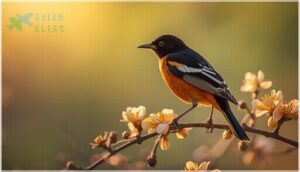
You’ll find the Orchard Oriole measuring 6.3 to 7.5 inches, with a compact silhouette and slender body proportions. Its short, pointed bill shape aids bird identification in the field. Wing spans reach 9.5 to 11 inches, while the moderately long tail adds balance.
These features help distinguish it from Alaska’s more common species, like those detailed in this guide to backyard birds of Alaska.
Size variation occurs across regions, with southern breeders averaging slightly smaller. Visual cues include a rounded head and straight back when perched.
Male Plumage and Markings
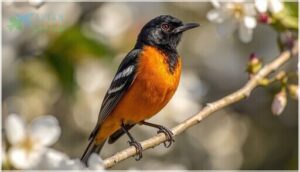
Beyond size and shape, you’ll spot the male Orchard Oriole by his bold chestnut and black plumage. His underparts glow bright orange to russet, sharply contrasting with jet-black wings and back. The crown and throat feature rich orange tones split by a thin black eye line. White wing bars arc across dark feathers, while the bill shape remains straight and pointed. Learning the importance of distinct field marks in identification can greatly improve your ability to recognize this stunning bird.
- Vibrant orange breast meets black back — a color explosion that defies the ordinary
- Sleek feather texture catches sunlight — revealing hidden ultraviolet brilliance
- Seasonal molt renews his boldness — nature’s way of keeping him sharp and striking
Female and Juvenile Appearance
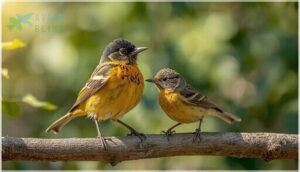
While males dazzle you, female Orchard Orioles wear olive to yellowish-olive plumage with subtle wing bars and a duller back. Juveniles mirror females but show mottled throat streaks and lighter belly tones.
Their bill shape stays straight and pointed, though juvenile markings include chalkier beak edges. Post-breeding feather molting deepens olive color patterns, while size and shape remain consistent across all ages and sexes.
Distinguishing From Other Orioles
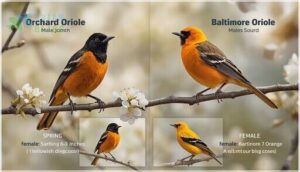
You can separate Orchard Orioles from Baltimore Orioles by their burnt orange underparts and smaller size—about 6.5 to 7.5 inches versus Baltimore’s larger frame.
These distinctions become especially valuable when observing orioles in quiet birding locations for solitude, where patient watching reveals subtle field marks.
Female orioles lack bright tones, showing yellowish-olive plumage that differs from Baltimore’s brighter females.
Listen for Orchard’s rising whistle instead of Baltimore’s buzzy trill, and note their sharper beak shape for quick field identification.
Orioles belong to the blackbird family, and you can explore key features of orioles found in North America for deeper comparison.
Habitat and Range of Orchard Orioles
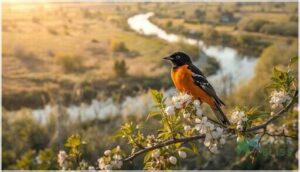
You’ll find Orchard Orioles in some unexpected places, from river edges to your own backyard. These adaptable songbirds pick habitats that blend open space with scattered trees, creating their own version of freedom across North America.
By understanding their feeding patterns and nutritional needs, you can develop healthy bird eating habits that support Orchard Orioles throughout every season.
Let’s explore where they breed, how far they travel, and why you might spot one near your home.
Preferred Breeding Habitats
You’ll spot Orchard Orioles thriving where tree density hits that sweet spot of 40 to 60 trees per hectare, mixing tall canopy with sheltered mid-level branches. They’re drawn to habitats offering:
- Dense canopy cover with connected tree crowns for predator protection
- Fruit-bearing trees like cherry and apple for high-energy food sources
- Mixed woodland edges with 20 to 40 percent shrub layer for concealment
- Water proximity within 200 to 400 meters of streams or ponds
- Low-disturbance nesting sites away from heavy foot traffic
This layered structure sustains their entire breeding cycle.
Geographic Distribution and Migration
Across eastern North America, from the Great Plains to the Atlantic, you’ll trace the Orchard Oriole breeding range from southern Canada through the central United States and into central Mexico.
Come winter, these birds fly south in late July, crossing the Gulf of Mexico along major flyway routes to settle in tropical lowlands from Mexico’s coasts through Central America into northern South America, showing distinct avian migration patterns tied to seasonal resource shifts.
Urban and Suburban Presence
Beyond wild forests, you’ll find Orchard Orioles thriving in urban habitats and suburban landscapes where city wildlife adjusts to human-modified orchard ecology. Urban planning that sustains mature trees aids these migrants during seasonal movements.
Look for them in:
- Residential yards with fruiting trees like cherry and persimmon
- City parks offering diverse canopy cover and insect-rich flowering ornamentals
- Riparian corridors threading through towns as migration stopover sites
- Street edges where roadside trees provide perching and foraging opportunities
Their conservation status benefits from backyard habitat.
Orchard Oriole Behavior and Diet
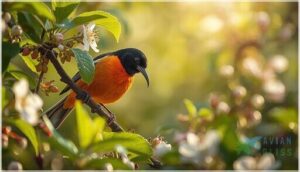
You’ll notice Orchard Orioles use specific techniques to find food in trees and shrubs, hunting insects with precision while also taking advantage of seasonal fruits and nectar.
Their feeding behavior shifts throughout the year, adapting to what’s available in their environment. Understanding what they eat and how they forage gives you real insight into their survival strategies.
Foraging Techniques
You’ll find orchard orioles using diverse foraging strategies that showcase their dietary flexibility. Watch them gleaning insects from leaf surfaces, probing bark crevices for hidden prey, and hovering at fruiting trees to sample food sources.
These bird species employ aerial sallies to capture flying insects from exposed perches. Their feeding adaptations, critical to avian ecology, reveal intricate prey capture methods across varied habitat types.
Insects, Spiders, and Other Prey
During breeding season, you’ll observe Orchard Orioles targeting large moths and beetles with impressive prey capture methods, sometimes snatching them mid-air. Their insectivorous diet extends to caterpillars on fruit trees, ants along branches, and spiders occasionally plucked from leaves.
Prey size variation ranges from 4-millimeter beetles to 20-millimeter caterpillars, demonstrating foraging strategies that support avian ecology, biodiversity, and ecological balance critical for wildlife conservation.
Fruits, Nectar, and Seasonal Diet Shifts
When insects decline, you’ll notice Orchard Orioles shifting to fruits and nectar feeding, showcasing impressive diet flexibility. Seasonal foraging patterns reveal increased fruit consumption during late summer migration, when berries and soft fruits boost energy intake for bird migration patterns.
This adaptive behavior sustains ecological balance across Orchard Oriole habitat, allowing them to exploit nectar-rich flowers and ripening fruit throughout their range.
Nesting and Breeding Habits
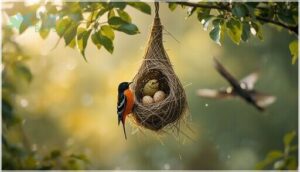
Orchard orioles don’t waste time when breeding season arrives. Males sing to claim their space and attract females, then pairs quickly get to work building hanging nests in trees and shrubs.
You’ll find everything from courtship displays to fledgling care follows a precise timeline shaped by their short summer stay.
Mating and Song Behavior
Male orioles command attention through territorial singing at dawn, announcing boundaries with vigorous repertoire bursts. Song learning occurs before the breeding season, when males improve syllables through practice.
You’ll notice courtship displays feature slower tempo motifs paired with display flights, signaling mating intent distinct from territorial songs. Females assess mate choice based on repertoire variation, preferring males with diverse note types that indicate broader learning and higher territory quality.
Nest Construction and Location
Once courtship succeeds, you’ll watch females weave nests from grasses and plant fibers into hanging pouches, demonstrating impressive nest architecture. Tree selection focuses on elms, ashes, or mulberries at 6 to 30 feet high, prioritizing branch stability and dense canopies for nest camouflage.
Site orientation near water and prey-rich areas aids habitat preservation, while tight construction deters predators—critical for ecosystem balance and wildlife conservation efforts.
Egg Incubation and Fledgling Care
After nest completion, you’ll observe females incubating eggs for 11 to 13 days at nest temperatures near 37.5°C with moderate egg humidity. Nestling diet centers on caterpillars and beetles, fueling fledgling growth through incubation periods shorter than Baltimore oriole species comparison reveals.
This avian ecology and behavior bolsters wildlife conservation efforts in ornithology, as juveniles fledge around day 12 to 16.
Conservation Status and Observation Tips
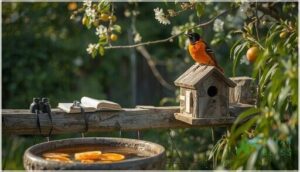
The Orchard Oriole faces real challenges in the wild, from habitat loss to shifting climate patterns that affect its range. Understanding these threats helps you appreciate why protecting these birds matters and how you can contribute to their survival.
You’ll also discover practical ways to observe them in the field and attract them to your own backyard.
Population Trends and Threats
You’ll find Orchard Oriole populations holding steady across central and eastern states, but don’t let that fool you—threats lurk just beneath the surface. Climate Impacts and Habitat Fragmentation chip away at their future, while Population Fluctuations remind us nothing’s guaranteed.
- Extreme weather events knock out migrants mid-journey
- Pesticides poison the insects your orioles depend on
- Sprawling development erases the orchards they’re named for
- Drought strips away critical fruit and nectar resources
Conservation Efforts and Wildlife Preservation programs track Migration Patterns through citizen science, earning the species its IUCN Status of Least Concern—but Environmental Conservation and Biodiversity Management remain essential as northern breeding zones contract after harsh winters.
Role in Ecosystem
You’ll witness firsthand how Orchard Orioles earn their keep in Ecosystem Balance. Their Ecological Roles of Birds span insect control through predation on caterpillars and beetles, seed dispersal via fruit consumption, and Biodiversity Support as prey for hawks and owls.
Orchard Orioles maintain ecosystem balance by controlling insects, dispersing seeds, and serving as prey for larger predators
Below, Food Web Dynamics unfold across three critical dimensions of wildlife conservation:
| Ecosystem Function | Orchard Oriole Action | Broader Ecological Impact |
|---|---|---|
| Insect Control | Consume beetles, caterpillars, grasshoppers | Regulate arthropod abundance in orchards |
| Seed Dispersal | Eat ripe fruit, excrete seeds elsewhere | Promote plant regeneration and diversity |
| Prey Base | Serve as food for snakes, hawks, owls | Support predator populations and ecology |
| Habitat Creation | Discard nest material and twigs | Add organic matter to forest floor |
Attracting Orchard Orioles to Your Yard
You can draw Orchard Orioles to your yard by hanging feeders with orange halves and grape jelly near deciduous trees by May 1. Add Water Features like shallow birdbaths with drippers to support bird watching success.
Plant Native Plants such as trumpet creeper and mulberries in your Yard Habitat to boost biodiversity. This Bird Friendly Gardens approach advances wildlife conservation while attracting these striking avian species.
Bird Watching Best Practices
You’ll sharpen your Observation Skills by keeping noise low and maintaining a distance that won’t disturb nesting birds. Use Field Guides and binoculars with 8x to 10x magnification for proper Bird Identification Techniques.
Practice Birding Ethics by staying on trails and avoiding flash Wildlife Photography near active nests.
These Conservation Efforts protect habitats while advancing ornithology and wildlife conservation and ecology through responsible bird watching.
Frequently Asked Questions (FAQs)
What’s the difference between an orchard oriole and a Baltimore Oriole?
You’ll spot the difference right away—Baltimore Orioles flash bright pumpkin orange while Orchard Orioles (Icterus spurius) wear deep chestnut.
Their coloration differences, plumage comparison, and beak shape reveal distinct identities within the blackbirds and orioles family.
Where are orchard orioles found?
You’ll find these migratory birds across eastern North America during breeding season, from southern Canada through the central United States into Mexico.
They then winter from mid-Mexico south to northern South America.
Are orchard orioles rare?
You won’t find them everywhere, but orchard orioles aren’t rare. They’re classified as Least Concern, with millions across their range, though regional abundance varies due to habitat loss and population trends.
What does the female orchard oriole look like?
You’ll notice female plumage showing yellow-green tones across the body, with olive upperparts and clear yellow underparts.
Look for two narrow white wing bars on dark gray wings and a pointed dark bill.
How rare is an Orchard Oriole?
While not globally rare, Orchard Oriole rarity patterns shift by region—abundant across the Midwest yet uncommon near range edges.
Habitat loss drives population decline of roughly 87% yearly, demanding targeted conservation efforts despite species classification as Least Concern.
What’s the difference between an Orchard Oriole and a Baltimore oriole?
Baltimore Orioles display bold black heads with bright orange bodies, while Orchard Orioles show chestnut underparts in males.
Plumage comparison reveals size differences too—Orchard Orioles measure smaller with slimmer beak structure for precise foraging.
What does a female Orchard Oriole look like?
You’ll spot greenish-yellow upperparts with two white wing bars, yellowish underparts, and a sharply pointed bill. Female plumage lacks orange tones, showing softer lemon hues that aid bird identification in wildlife research.
What is the difference between a Baltimore oriole and an orchard oriole?
You’ll notice orchard orioles are smaller with chestnut plumage compared to Baltimore’s bright orange coloration. Beak shape varies, with orchard species showing shorter bills.
Song patterns differ, and migration routes overlap across oriole species during bird identification and classification.
Where are Orchard Orioles found?
You’ll find this bird species across an impressive geographic range—breeding grounds stretch from southern Canada through central and eastern United States, then they follow migratory patterns south to Central America’s tropical woodlands each winter.
What do Orchard Orioles like to eat?
You’ll notice Orchard Orioles favor insect prey like caterpillars and beetles, alongside fruit sources including berries and oranges.
Nectar intake from flowering plants fulfills their dietary needs, with nectar feeding from coral bean tree blossoms providing essential energy.
Conclusion
Spotting your first orchard oriole feels like cracking nature’s best-kept secret—a chestnut ghost that slips through branches while flashier cousins steal the show.
You’ve now got the field marks, habitat clues, and behavioral quirks to pick this species out of a crowded canopy. Watch for those hanging nests near water, listen for the rapid warble, and remember: conservation starts in your own yard.
Every native shrub you plant writes another chapter in their survival story.