This site is supported by our readers. We may earn a commission, at no cost to you, if you purchase through links.
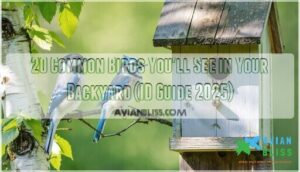 You’ll spot these 20 common birds in backyards across America, from the bright yellow American Goldfinch to the cheerful Black-capped Chickadee.
Cardinals flash crimson red while Blue Jays command attention with their bold blue crests.
Mourning Doves coo softly from fence posts, and American Robins hop across lawns hunting worms.
Northern Mockingbirds show off with their impressive vocal repertoires, copying other birds’ songs perfectly.
Downy Woodpeckers, the smallest in their family, tap rhythmically on tree bark.
House Sparrows chatter in flocks, while White-breasted Nuthatches walk headfirst down tree trunks.
Each species has distinct markings and behaviors that make identification surprisingly straightforward once you know what to look for, with complete concepts being key to understanding.
Table Of Contents
- Key Takeaways
- American Goldfinch
- American Robin
- Black-capped Chickadee
- Blue Jay
- Mourning Dove
- Northern Cardinal
- Northern Mockingbird
- Downy Woodpecker
- Hairy Woodpecker
- House Sparrow
- Frequently Asked Questions (FAQs)
- How many species of birds are there?
- How many types of birds are common in the United States?
- What birds live in North America?
- What birds live in backyards?
- What is the Great Backyard Bird Count?
- What is the most petted bird?
- What are the 20 examples of birds?
- What birds are the most common?
- What are the 10 simple birds names?
- What are the top 20 bird names?
- Conclusion
Key Takeaways
- You’ll recognize these 20 common backyard birds by their distinctive features like the cardinal’s crimson red plumage, the blue jay’s pointed crest, and the chickadee’s black cap with white cheeks.
- Seasonal changes affect bird identification—American goldfinches transform from bright yellow summer coats to olive winter plumage, while their white wing bars remain constant year-round.
- Listen for unique calls to identify birds even when you can’t see them, from the mourning dove’s soft cooing to the mockingbird’s impressive repertoire of mimicked songs.
- Size differences help distinguish similar species—the hairy woodpecker’s thicker bill and larger body separate it from the nearly identical downy woodpecker.
American Goldfinch
You’ll spot American Goldfinches easily by their dramatic seasonal wardrobe changes—males transform from vibrant yellow summer coats to subtle olive winter plumage, while those distinctive white wing bars remain visible year-round like nature’s permanent accessories.
Like feathered chameleons, goldfinches wear brilliant summer yellows before switching to camouflaged winter olives.
These acrobatic little seed-eaters often hang upside down at feeders, showing off their gymnastic skills while cracking open sunflower seeds with their small, pointed bills, demonstrating their ability to eat with small, pointed bills and showcasing their favorite food, sunflower seeds.
Bright Yellow Plumage (summer)
During summer molting, you’ll spot the American Goldfinch’s stunning transformation into a feathered ray of sunshine.
These vibrant yellow birds become impossible to miss at feeders, their bright plumage serving essential roles in mate selection and attracting goldfinches to your yard.
- Canary-yellow body that practically glows in sunlight, distinguishing them from the house finch
- Jet-black cap sitting like a tiny crown on their head
- Contrasting white wing bars that flash brilliantly during flight
- Males’ extra black markings on wingtips and tail for added flair
This eye-catching bird identification feature isn’t just beautiful—their bird colors actually help with diet influence and camouflage value in bright summer environments.
Olive Plumage (winter)
When winter arrives, you’ll witness the American Goldfinch’s remarkable transformation from bright yellow to muted olive plumage.
This seasonal adaptation provides vital camouflage benefits, helping these common birds blend seamlessly into bare branches and dried vegetation. The plumage variations aren’t just for show—they’re essential for goldfinch survival during harsh months.
| Season | Color | Purpose |
|---|---|---|
| Summer | Bright Yellow | Mate selection |
| Winter | Olive | Camouflage benefits |
| Spring | Mixed | Period of change |
| Fall | Changing | Preparation |
This bird identification feature makes spotting goldfinches trickier in winter, but their acrobatic feeding habits still give them away at your feeder. The ability to adapt to different seasons with vital camouflage is a key factor in their survival, and understanding these changes can help in effective bird watching.
White Wing Bars
American Goldfinches sport distinctive white wing bars year-round, making bird identification easier even when seasonal variation shifts their plumage brightness from brilliant yellow to olive.
These markings serve as reliable genetic markers for species identification, contrasting sharply against darker wing feathers during flight patterns and perched positions.
Look for these key features on common birds:
- Two parallel white stripes crossing each wing
- More prominent on males than females
- Visible during acrobatic feeder visits
- Consistent through all seasons
These bird patterns help distinguish goldfinches from other backyard visitors. Their wing bars remain constant while body colors change, making them valuable identification tools in any bird guides you’ll reference. They’re especially fond of Nyjer and thistle seeds.
American Robin
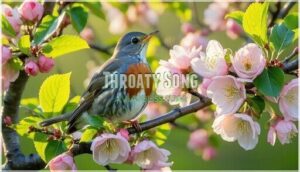
You’ll recognize the American Robin by its distinctive rusty orange belly paired with a gray back, making it one of the most recognizable birds in North America.
Listen for its rich, throaty song that provides a cheerful soundtrack to your mornings and evenings throughout the year.
Rusty Orange Belly
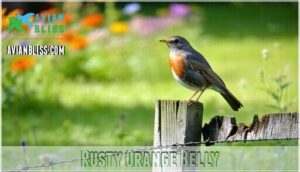
That rusty orange belly is your foolproof Robin Identification feature.
This distinctive belly coloration serves as natural camouflage value against autumn leaves and earthen backgrounds.
The vibrant hue comes from diet influence – carotenoids in berries and insects create this signature bird coloration.
Regional variations exist, with northern robins showing deeper orange tones.
Unlike the Northern Cardinal’s all-red plumage or Redbellied Woodpecker’s subtle rufous, the robin’s bold orange belly makes bird plumage identification straightforward for backyard birders everywhere.
Gray Back
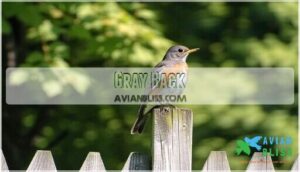
While the robin’s orange breast gets attention, its gray back provides perfect camouflage against tree bark and urban environments.
This subtle plumage helps these common birds blend into varied habitats across North American landscapes.
The gray coloring shows minimal regional differences, making bird identification easier for backyard watchers.
Despite seasonal molting, the back remains consistently gray, distinguishing robins from other types of birds in your yard.
Throaty Song
Even if you’re not a morning person, the robin’s throaty song—part of the classic Dawn Chorus—might just make you linger by the window.
Their bird songs are rich in Song Complexity, and you’ll notice Regional Variations across neighborhoods.
Here’s how to tune in:
- Wake early to catch their signature warble.
- Listen for differences—Song Learning shapes every robin’s melody.
- Compare their bird sounds to other common birds, like wrens or sparrows.
Black-capped Chickadee
You’ll spot this tiny acrobat by its distinctive black cap and bib that contrasts sharply with bright white cheeks, making it look like it’s wearing a hockey mask.
This frequent feeder visitor announces itself with its cheerful "chick-a-dee-dee-dee" call, often hanging upside down from branches as it searches for insects and seeds.
Black Cap and Chin
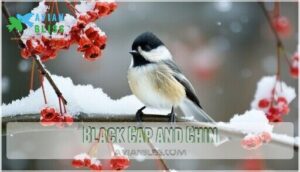
The black cap coloration makes this common bird instantly recognizable in your backyard.
Picture a tiny black helmet covering the top of its head and extending down to form a bib under its chin.
This chin size creates bold contrast against white cheeks.
The Blackcapped Chickadee’s markings differ from the Carolina Chickadee, which has a smaller bib.
Their habitat preference for mixed forests and feeders, combined with distinctive vocalizations and friendly social behavior, makes bird identification straightforward for any bird guide enthusiast.
They thrive in areas with native trees and shrubs.
White Cheeks
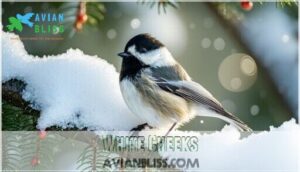
Imagine this: you’re scanning your backyard when those brilliant white cheeks catch your eye. Black-capped Chickadees sport these snowy facial plumage patches that make bird identification a snap, even for beginners.
These cheek markings create perfect cheek camouflage against winter landscapes while helping with avian identification among common birds.
Here’s what makes their cheeks special:
- Bright white contrast – stands out sharply against black cap
- Rounded shape – fuller than other backyard birds’ markings
- Year-round consistency – no species variation in cheek color
- Clean boundaries – crisp edges separate white from black areas
This bird guide tip works every time for bird watching success!
Chick-a-dee-dee Call
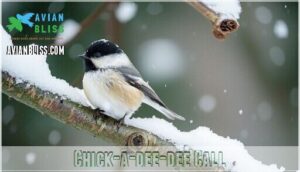
Beyond their striking white cheeks, Black-capped Chickadees announce themselves with their famous "chick-a-dee-dee" call.
This bird communication serves multiple functions in chickadee language. When relaxed, they’ll give a simple two-note call.
But listen for alarm function variations—rapid, urgent "dee-dee-dee" notes signal danger nearby.
These call variations help with social communication among flocks. Regional dialects exist too, with slight differences from Carolina Chickadee cousins.
Unlike Tufted Titmouse relatives, chickadees use their calls for complex bird behavior coordination, including complex communication and social functions.
Blue Jay
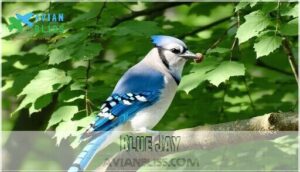
You’ll spot a Blue Jay instantly by its brilliant blue feathers and unmistakable pointed crest that rises from its head like a crown.
These bold, noisy birds aren’t shy about announcing their presence with loud, harsh calls that can wake the whole neighborhood.
Distinctive Crest
That prominent feathered crown isn’t just for show—it’s the Blue Jay’s most recognizable feature.
This pointed crest serves multiple functions, from communication to intimidation. When relaxed, it lies flat against the head, but watch it shoot upward during territorial disputes or excitement.
- Crest Display: Raised during aggression, flattened when calm or feeding
- Crest Function: Acts as visual communication tool between birds
- Crest Variations: Height and angle change based on mood and social context
- Crest Evolution: Developed as adaptation for complex social behaviors among common birds
Bright Blue Plumage
Beyond its crest, the Blue Jay’s bright blue plumage makes it unmistakable in any backyard.
This stunning bird color results from unique feather iridescence rather than true blue pigments.
The plumage display varies slightly between males and females, with species variation also seen in Stellers Jay populations.
Unlike ground-dwelling types of birds, this coloration provides excellent habitat camouflage among tree canopies.
| Feature | Description |
|---|---|
| Color Source | Microscopic structures, not pigments |
| Brightness | Varies with light angles |
| Function | Bird identification and camouflage |
This Blue Jay characteristic aids quick identification.
Loud Calls
You’ll hear Blue Jays before you see them—their harsh, brash calls serve multiple purposes in territorial defense and predator warning.
These vocal acrobats use different call types for species recognition and alarm calls, much like their cousin the Steller’s Jay.
Among common birds, Blue Jays rank as nature’s loudest announcers, making identification easy even when hidden in trees.
Mourning Dove
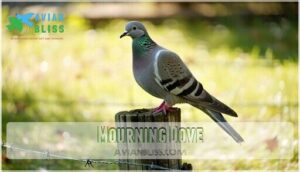
You’ll spot this 12-inch dove by its plump, gray-brown body and distinctive black wing spots that flash when it takes flight.
The mourning dove’s soft, mournful cooing might fool you into thinking there’s an owl nearby, but look for that pointed tail and gentle bobbing head as it searches for seeds on the ground, exhibiting its distinctive features.
Brown-gray Coloring
While other backyard birds flash bright colors, the Mourning Dove‘s brown-gray coloring serves as perfect camouflage in suburban settings.
This muted palette helps with habitat blending, allowing them to disappear against tree bark and dried grass.
Unlike American Crow or European Starling, doves don’t undergo dramatic seasonal molting.
Their consistent color variation makes species identification straightforward – you won’t confuse them with darker House Sparrow or Rock Pigeon once you know what to look for.
Dark Spots on Wings
Those dark spots scattered across mourning dove wings aren’t random decorations.
These distinctive markings serve multiple purposes in the bird world:
- Camouflage Purpose: Spots help doves blend into dappled sunlight and shadows
- Species Variation: Each dove’s spot pattern is unique, like fingerprints for bird identification
- Genetic Markers: Wing strength and spot development indicate healthy common birds
When you spot these types of birds, notice how the dark markings contrast beautifully with their soft brown-gray feathers, making mourning doves easier to identify among other bird species in your yard.
Woeful Cooing
Listen closely to their distinctive dove vocalization—a soft, melancholic "coo-oo, coo, coo, coo" that echoes through neighborhoods.
This mourning dove signature sound serves three essential purposes in their mating rituals:
- Territorial claims – Males announce their presence to rivals
- Mate attraction – Courting calls draw potential partners nearby
- Pair bonding – Couples strengthen relationships through vocal exchanges
Unlike their rock pigeon cousins, mourning doves prefer quieter habitat preferences for these intimate conversations.
Northern Cardinal

You’ll know the Northern Cardinal instantly by the male’s striking crimson red body, matching crest, and jet-black face mask that makes him look like a feathered superhero.
Both males and females are talented singers, with females often singing from the nest while incubating eggs—a charming duet you might catch if you listen closely.
Black Face
The male Northern Cardinal’s black face creates an unmistakable mask that makes this common bird species instantly recognizable.
This striking feature frames their bright red features like nature’s own superhero costume.
Unlike other backyard visitors, this cardinal mask sets males apart from females, who sport brown tones instead.
When studying bird identification guides, you’ll notice this bold facial pattern distinguishes cardinals from similar-sized birds.
The contrast helps with plumage differences identification among backyard species.
Crimson Crest, Beak, and Body
While the black face sets the stage, the Male Cardinal’s brilliant crimson plumage truly steals the show.
This bird’s anatomy showcases nature’s artistry—from its pointed crest to its thick, seed-cracking bill, everything gleams scarlet red.
The crest function helps with communication and displays dominance.
These bird pigments called carotenoids create that stunning color you’ll never mistake for another species in your yard.
Female Sings Equally Well
While you’re admiring that brilliant red plumage, you’ll discover something remarkable about female Northern Cardinals – they’re equally talented vocalists.
Unlike many songbirds where males dominate, cardinal females showcase impressive song complexity and female vocalizations.
This evolutionary advantage supports duet singing between mates, strengthening pair bonds through sophisticated bird communication that goes far beyond simple bird calls.
Northern Mockingbird
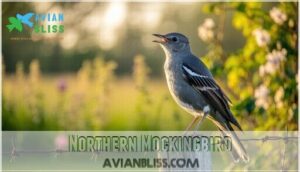
You’ll recognize this musical maestro by its sleek gray body accented with bold black wings that flash white patches in flight.
The Northern Mockingbird lives up to its name by mimicking hundreds of other birds’ songs, often cycling through its impressive repertoire for hours at a time, showcasing its ability as a musical maestro.
Gray Body
You’ll recognize the Northern Mockingbird by its elegant gray body that creates perfect camouflage in urban settings.
This sleek appearance spans from head to tail, with uniform slate-colored plumage that lacks dramatic seasonal changes.
Unlike some common birds showing dimorphism, both males and females sport identical gray coloring.
This neutral backdrop helps distinguish mockingbirds from the Gray Catbird, their darker cousin.
Black Wings
Watch those black wings flash white wing bars as mockingbirds take flight.
The black pigmentation creates striking contrast against their gray bodies, similar to American Crow and European Starling coloring.
This wing iridescence aids flight dynamics while serving camouflage purposes in shadows.
The feather composition produces these bold patterns that make identification easy during their acrobatic displays.
Endless Songs
Beyond their striking black wings, Northern Mockingbirds showcase incredible vocal learning abilities that’ll leave you speechless.
These songbirds master complex mimicry, copying everything from cardinal calls to car alarms with stunning accuracy. Their song complexity reflects sophisticated bird dialects across regions.
- Seasonal singing patterns – Males perform elaborate concerts during breeding season
- 200+ different songs in their repertoire for bird identification purposes
- Night serenades during full moons, unlike most common birds
- Mimicry abilities include mechanical sounds and other bird behaviors
Downy Woodpecker

You’ll spot the downy woodpecker as North America’s smallest woodpecker, barely larger than a sparrow with its distinctive black and white striped pattern and that oversized head that houses an enlarged brain case.
This little acrobat clings to tree bark with ease, using its chisel-like bill to tap out insects while its specialized skull protects its brain from all that hammering.
Smallest Woodpecker
You’ll spot the Downy Woodpecker easily—it’s North America’s tiniest woodpecker species.
This pint-sized powerhouse boasts remarkable Downy Identification features that distinguish it from the similar Hairy Woodpecker.
Its Habitat Preferences include wooded areas, parks, and suburban gardens where dead trees provide perfect nesting sites.
| Feature | Downy | Hairy |
|---|---|---|
| Size | 6-7 inches | 8-10 inches |
| Bill | Short, stubby | Long, chisel-like |
| Tail spots | White barring | Solid white |
Their Diet Uniqueness centers on insects, larvae, and suet. Conservation Status remains stable, making these common birds reliable backyard visitors for bird identification enthusiasts.
Black and White Plumage
Anyone can identify the Downy Woodpecker by its striking black and white plumage that creates a bold checkerboard pattern.
This plumage camouflage helps it blend against tree bark while hunting insects.
Key identification features include:
- Zebra-striped back with alternating black and white bars
- Spotted wing patches that flash during flight
- Clean white underparts contrasting with black upperparts
Unlike the American Crow’s solid black coloring, this woodpecker’s contrasting pattern makes it unmistakable among backyard birds.
Enlarged Brain Case
The Downy Woodpecker’s enlarged brain case isn’t just for show—it’s a marvel of bird anatomy that prevents brain damage during high-impact pecking.
This specialized bird morphology supports incredible cognitive abilities and problem solving skills that’ll impress any backyard observer.
| Feature | Function |
|---|---|
| Enlarged cranium | Shock absorption during pecking |
| Spongy bone structure | Distributes impact energy efficiently |
| Enhanced memory capacity | Supports complex tool use behaviors |
Their superior bird intelligence shines through social complexity and memory capacity, making them nature’s tiny engineers with serious brain power. They’re a common sight, but face habitat loss due to deforestation.
Hairy Woodpecker

You’ll easily recognize the Hairy Woodpecker by its noticeably larger size compared to its nearly identical cousin, the Downy Woodpecker.
This chunky bird sports a thicker, more dagger-like bill and a stockier body that makes it look like the Downy’s bigger sibling who hits the gym regularly, with a more dagger-like bill.
Larger Than Downy
You’ll immediately notice the Hairy Woodpecker towers over its diminutive cousin.
This size comparison makes field identification straightforward, even when habitat overlap occurs between these similar backyard birds. Like other bird species including American Robin, Northern Cardinal, and Blue Jay, understanding scale helps distinguish them.
- Wingspan stretches up to 16 impressive inches
- Body length ranges from 9-13 inches of pure power
- More commanding presence on larger tree trunks
- Stronger drumming echoes through your yard
Thicker Body and Bill
In comparison to the Downy Woodpecker, you’ll immediately notice the Hairy Woodpecker’s thicker body and bill that makes all the difference in foraging efficiency.
This bird size advantage allows better seed cracking and deeper bark penetration.
The robust bill morphology reflects specialized cold adaptation strategies, while increased body mass provides winter survival benefits.
These bird characteristics distinguish it in bird identification guides – the bird bill appears proportionally longer and more powerful, making this bird shape perfectly suited for accessing insects other woodpeckers can’t reach.
Similar to Downy Woodpecker
That bigger bill we just talked about is your best clue that you’re looking at a Hairy Woodpecker, not its nearly identical twin.
These Similar Species share remarkable Habitat Overlap and Foraging Behavior, making bird identification tricky.
- Woodpecker Diets – Both eat identical insects and larvae from tree bark
- Distinguishing Features – Hairy’s bill equals head length; Downy’s doesn’t
- Bird size – Hairy measures 9 inches versus Downy’s 6 inches
Their bird shape remains almost identical, so focus on proportions for accurate identification.
House Sparrow
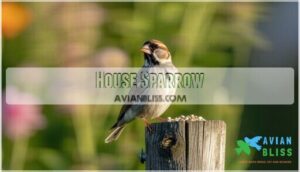
You’ll recognize the House Sparrow by its distinctive brown back and gray chest that’s topped with a matching gray cap.
The male sports a prominent black patch on his throat, making him easy to spot as he hops around your yard looking for seeds and crumbs.
Brown Back
The brown back distinguishes House Sparrows among North American birds in your backyard.
This rich brown camouflage helps them blend seamlessly with tree bark and urban structures.
Regional differences affect the intensity of their brown coloring, with some populations showing deeper hues.
Juvenile plumage appears duller than adults, while molting patterns refresh their brown feathers seasonally.
These backyard birds adapt their brown tones to match local habitat variation, making bird identification easier once you recognize this signature feature across different bird habitats.
Gray Chest and Cap
The House Sparrow’s distinctive gray chest and cap create perfect urban camouflage against concrete and steel.
Unlike the American Robin’s rusty breast or Northern Cardinal’s vibrant red, this muted coloring helps them blend seamlessly into city environments.
Their gray features become especially noticeable when they’re perched on fences or hopping along sidewalks, making identification straightforward for backyard birdwatchers.
They’re also highly adaptable, as evidenced by their global distribution.
Black Patch on Throat
Male house sparrows sport this throat-badge like a tiny tuxedo bib, distinguishing them from plain-throated females.
This black patch varies in size and intensity, serving as a status symbol during breeding season.
Unlike the American Robin’s consistent markings, house sparrows show remarkable sex differences in their throat patterns.
- Patch size indicates male dominance and breeding success
- Patch function helps establish territory and attract mates
- Sex differences make identification straightforward in backyard birds
- Seasonal variation causes patches to appear darker during spring
- Throat molt refreshes these markings annually across their bird range
Frequently Asked Questions (FAQs)
How many species of birds are there?
You’re looking at roughly 10,000 bird species worldwide, though scientists discover new ones regularly.
North America hosts about 900 species, from tiny hummingbirds to massive eagles, each perfectly adapted to their unique environments.
How many types of birds are common in the United States?
Like a backyard symphony, you’ll find about 20 common bird species throughout the United States.
These feathered neighbors include cardinals, robins, blue jays, mourning doves, and crows that frequent your feeders year-round.
What birds live in North America?
You’ll find hundreds of bird species across North America, from familiar backyard visitors like robins, cardinals, and blue jays to regional specialties.
Like Steller’s jays and acorn woodpeckers thriving in diverse habitats.
What birds live in backyards?
You’ll spot cardinals, robins, and blue jays year-round in your backyard. Mourning doves, crows, and goldfinches also frequent feeders and trees, creating a lively neighborhood bird community.
What is the Great Backyard Bird Count?
You’ll participate in a global citizen science project where you count for as little as 15 minutes in your own backyard to help expand our understanding of birds each February.
What is the most petted bird?
You’ll find that parakeets are perhaps the most popular type of pet bird the world over.
These friendly budgerigars, or budgies, win hearts with their silly personalities and low-maintenance care requirements.
These birds are known for their varied colors, as described in this detailed guide to pet birds.
What are the 20 examples of birds?
Over 10,000 bird species exist worldwide, but you’ll commonly spot these twenty: American Robin, Northern Cardinal, Blue Jay, Mourning Dove, American Crow, House Sparrow, American Goldfinch, Dark-eyed Junco, Black-capped Chickadee, White-breasted Nuthatch, Tufted Titmouse, Red-winged Blackbird, European Starling, Brown-headed Cowbird, Common Grackle, Northern Mockingbird, Barn Swallow, Song Sparrow, Yellow-rumped Warbler, and Gray Catbird.
In your backyard, these birds can be found, including the American Robin, Northern Cardinal, and Blue Jay.
What birds are the most common?
You’ll regularly encounter Mourning Doves (35%), Northern Cardinals (34%), American Robins (33%), American Crows (32%), and Blue Jays (28%) in your backyard. These five species dominate year-round sightings across North America’s diverse habitats.
What are the 10 simple birds names?
Your feathered neighbors aren’t just pretty faces—they’re nature’s everyday companions! You’ll easily recognize these ten: Robin, Cardinal, Blue Jay, Crow, Dove, Sparrow, Chickadee, Goldfinch, Woodpecker, and Starling.
What are the top 20 bird names?
You’ll spot these favorites in your yard: American Robin, Northern Cardinal, Blue Jay, Mourning Dove, American Crow, Dark-eyed Junco, House Sparrow, American Goldfinch, Black-capped Chickadee, White-breasted Nuthatch.
Plus European Starling, Red-winged Blackbird, Song Sparrow, Brown-headed Cowbird, Common Grackle, Northern Mockingbird, Barn Swallow, Gray Catbird, Yellow-rumped Warbler, and Tufted Titmouse.
These birds include the American Goldfinch, and other species like the Northern Cardinal.
Conclusion
Now that you’ve got the lay of the land, spotting these 20 common birds becomes second nature with practice.
You’ll start recognizing their unique calls echoing through your morning coffee routine and distinctive flight patterns as they visit your feeders.
Keep this guide handy during your first few weeks of backyard birding – you’ll be surprised how quickly you develop an eye for details like wing bars, crest shapes, and feeding behaviors that make each species unmistakable, allowing you to recognize birds with distinctive flight patterns.
- https://www.worldatlas.com/articles/most-populous-bird-species-in-the-world.html
- https://www.discoverwildlife.com/animal-facts/birds/most-common-bird
- https://www.allaboutbirds.org/news/not-just-sparrows-and-pigeons-cities-harbor-20-percent-of-worlds-bird-species/
- https://www.audubon.org/magazine/get-know-these-20-common-birds
- https://www.birdsandblooms.com/birding/birding-basics/common-birds-north-america/