This site is supported by our readers. We may earn a commission, at no cost to you, if you purchase through links.

Few birds command the sky with the precision of a hawk—yet every one of them started life blind, damp, and weighing less than a golf ball. A baby hawk, known formally as an eyas, hatches into a world where survival depends entirely on two attentive parents and a nest engineered to withstand wind, rain, and the weight of a growing brood.
Within weeks, that helpless hatchling transforms into a fledgling capable of powered flight—a developmental sprint that rivals almost anything else in the vertebrate world. Understanding how that transformation unfolds reveals just how impressive these raptors are from day one.
Table Of Contents
- Key Takeaways
- What is a Baby Hawk Called?
- How Do Baby Hawks Look and Behave?
- Stages of Baby Hawk Growth and Development
- Parental Care and Nesting Habits
- What Do Baby Hawks Eat?
- Threats and Conservation of Baby Hawks
- Frequently Asked Questions (FAQs)
- What should I do if I find a baby hawk?
- What is a baby hawk called?
- What do baby hawks eat?
- What is a baby red tailed hawk called?
- Are baby hawks cute?
- What does a baby hawk look like?
- When do baby hawks take flight?
- How do you identify a baby hawk?
- What should you do if you find a baby hawk?
- Can a hawk pick up a 10 lb cat?
- Conclusion
Key Takeaways
- Baby hawks, called eyas, hatch blind and helpless but transform rapidly into fledglings capable of flight within six to eight weeks.
- Parental care is highly specialized, with males hunting and females preparing food, ensuring chicks receive the right nutrition and protection at every stage.
- Sibling rivalry begins early due to asynchronous hatching, leading to a dominance hierarchy and significant differences in survival and growth among nestmates.
- Habitat loss, predation, and human impacts pose serious threats to baby hawks, but conservation efforts like nest boxes and rehabilitation centers are helping protect young raptors.
What is a Baby Hawk Called?
Baby hawks go by more names than you might expect — and each one actually means something specific. Whether you’re watching a nest or reading a field guide, knowing the right term helps you understand exactly what stage of life you’re looking at.
From fuzzy hatchling to brancher learning to fly, each stage pairs with the hawk’s habitat too — Michigan hawk species and nesting behaviors vary more than most people realize.
Here are the key names used for baby hawks, and what sets each one apart.
Eyas, Hawklet, Hatchling, and Chick
When a baby hawk hatches, it earns a surprisingly precise name: an eyas — a term straight from falconry tradition that describes any unfledged hawk or falcon still dependent on its parents.
You might also hear hawklet, hatchling, or simply chick.
Each label reflects a different stage of nestling growth and chick development, marking the hawk’s earliest, most vulnerable stretch before it fledges.
newly hatched eyases are blind and covered in down feathers.
Terminology Differences Among Raptors
Raptor terminology gets specific quickly. Hawk developmental stages follow a clear naming system:
- Nestling — stays in the nest, fully dependent
- Fledgling — has taken its first flight but still returns
- Brancher — perches near the nest, building flight strength
Beyond eyas, the immature definition covers juveniles and subadults alike. FCJ coding marks first‑cycle juvenile plumage, while SCB terminology tracks later molts.
Understanding the shift in mobility and parental care highlights the key difference between nestlings and fledglings.
When Does a Baby Hawk Become a Juvenile?
The shift from fledgling to juvenile hawk isn’t a single moment — it’s a process tied to developmental milestones in raptor fledglings. Wing Muscle Maturation peaks in the final weeks before a hawk leaves the nest, triggering the Social Independence Phase and Territorial Behavior Onset.
Below is a quick look at how hawk life cycle stages unfold across common species:
| Stage | Typical Age Range |
|---|---|
| Nestling | 0–6 weeks |
| Fledgling | 6–8 weeks |
| Juvenile | 8–16 weeks |
| Pre-Adult Molt Timing | ~1 year |
A red-tailed hawk, for example, reaches full independence around 12–16 weeks, when Hormonal Maturity Shift drives it away from its parents entirely.
How Do Baby Hawks Look and Behave?
The moment a baby hawk hatches, it’s nothing like the sharp-eyed predator it will become. From its soft downy coat to its oversized beak and wobbly calls, every feature tells a story about survival in progress.
Here’s what you’d actually notice if you could peek into a hawk’s nest.
Inside, you’d find two dedicated parents taking shifts—one hunting while the other guards—behavior that mirrors fascinating baby bird survival instincts seen across countless species.
Appearance of Newly Hatched Hawks
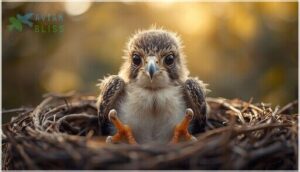
A newly hatched hawk is surprisingly small — just 10 to 12 centimeters long, with a striking large head ratio that gives it an almost bobble-headed look. Patches of pinkish skin, or skin patch visibility, show where fluffy down hasn’t filled in yet.
Fine wing joint flexibility is visible along bare skin lines, and the pale cere color shift and tiny egg tooth presence mark this as day one.
Fluffy Down Feathers and Coloration
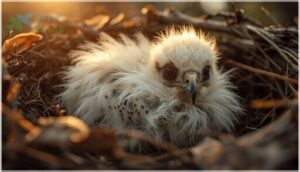
That fluffy down coating a baby hawk isn’t just soft — it’s doing serious work. The down texture lacks interlocking barbules, which creates loose, air‑trapping filaments that handle heat retention efficiently, cutting heat loss by 30–50%.
Camouflage coloration plays an equally important role: red‑tailed hawk eyas hatch white, while broad‑winged chicks display mottled patterns that break up their outline against nest debris.
Distinctive Beak, Feet, and Eyes
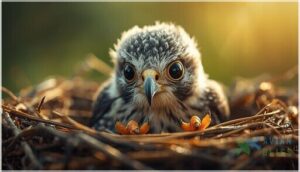
Even at hatching, a baby hawk — or eyas — arrives equipped like a miniature predator. Three features stand out immediately:
- Rhinotheca development: The hooked upper mandible is razor-sharp from day one, built for tearing prey items.
- Talon size ratio: Feet measure roughly 7% of adult tarsus length yet grip with surprising force.
- Eye color shifts: Eyes begin bluish-gray, shifting toward bright yellow eyes by juvenile stage.
Vocalizations and Communication
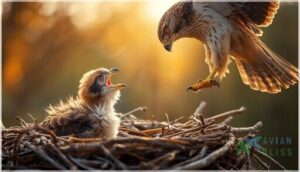
Within hours of hatching, a baby hawk begins building its entire communication system from scratch. Its first begging call patterns are thin, squeaky peeping sounds — high-pitched whistling notes that intensify when hunger peaks. By week three, squealing sounds roughen into proto-adult calls.
Non-vocal body signals, like gaping and wing-spreading, reinforce these cries.
Alarm call triggers — shadows, strange sounds — prompt silence, not screaming.
Parent-child call matching teaches chicks to beg before they even see food arrive.
Stages of Baby Hawk Growth and Development

A baby hawk’s journey from helpless hatchling to powerful flier happens faster than you’d expect — and each stage is packed with change.
The transformation involves distinct physical milestones, dramatic feather shifts, and behavioral leaps that mark a young hawk’s growing independence. Here’s how that development actually unfolds.
Hatchling to Fledgling Timeline
From hatchling to fledgling, a baby hawk’s growth rate is impressive — red-tailed hawk chicks weigh just 58 grams at hatching, then multiply that weight several times within two weeks. The bird fledging process unfolds in distinct phases driven by wing muscle growth and feather development stages:
- Days 1–10: Hatchlings rest almost motionless; weight gain rate peaks as bones strengthen
- Weeks 2–3: Nestlings sit upright, lift their heads, and beg actively
- Weeks 3–5: Wing-flapping begins, building coordination and flight muscles
- Week 6–7: Fledglings make short, clumsy first flights to nearby branches
- Weeks 10–12: Young hawks fly confidently and hunt independently
The incubation period sets the clock — once hatched, most North American hawks fledge within 4 to 7 weeks, depending on species size and local conditions.
Molting and Feather Development
Feather growth timing in a baby hawk follows a precise sequence — natal down gives way to thermal down, then contour and flight feathers emerge through the prebasic molt cycle.
By day 35, red-tailed hawk nestlings reach roughly 95% dorsal feather coverage.
Poor nutrition leaves stress bar indicators etched into feathers like fault lines, revealing exactly when the young bird struggled.
Key Developmental Milestones
A baby hawk’s growth unfolds like a tightly scheduled timeline — and each stage builds directly on the last.
- Eye opening begins around days 4–5, unlocking visual tracking almost immediately
- Beak growth nearly doubles in the first week, enabling active feeding
- Tarsus development peaks by day 14, allowing the chick to stand upright
- Wing muscle strength builds through weeks 3–4 via constant flapping exercises
- Flight coordination sharpens over 10–12 weeks post-hatch, marking true fledgling independence
Parental Care and Nesting Habits
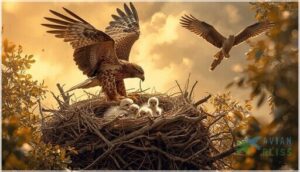
Hawk parents don’t just raise their young — they engineer the entire environment around them. From the moment a nest takes shape to the day a fledgling finally lifts off, every choice a parent makes directly shapes whether a chick survives.
Here’s a closer look at the three key areas where that parental effort really shows up.
Nest Construction and Location
Hawks are precise architects. Through careful material selection, they weave coarse oak and pine branches into interlocking bowl shapes — a process of branch architecture that produces nests spanning 71 to 97 cm wide and weighing up to 14 kg.
Tree species preference matters too: red-tailed hawks favor tall, isolated trees 4 to 21 meters high.
Nest reuse strategies mean pairs refurbish the same platform for multiple seasons.
Feeding and Protection by Parents
Once the nest is built, the real work begins. Parental role division kicks in fast — the male hunts while the female manages prey preparation, tearing food into safe, bite-sized strips for nestlings who can’t yet manage whole prey.
Feeding frequency averages 4–6 daily visits in Cooper’s hawks, and nest defense tactics are fierce, with adults diving at any intruder that gets too close.
- Male red-tailed hawks deliver small mammals, birds, and reptiles directly to the nest
- Females handle all prey preparation for young nestlings, removing bones and tough skin
- Parent hawks aggressively dive-bomb crows, raccoons, and even humans that approach too closely
Sibling Dynamics and Survival
Parental care sets the stage, but what unfolds inside the nest is a strict social order.
Asynchronous hatching — eggs hatching 24 to 48 hours apart — gives the first-hatched baby hawk a 20% weight advantage by day three, launching a dominance hierarchy almost immediately.
Aggression peaks in week two, averaging 5–10 pecks per feeding. Brood reduction follows, with survival rates dropping sharply for last-hatched nestlings.
| Factor | First-Hatched | Last-Hatched |
|---|---|---|
| Fledging Success | 95% | 60% |
| Aggression Role | Dominant | Submissive |
| Size by Fledging | Largest | 85% of sibling |
What Do Baby Hawks Eat?
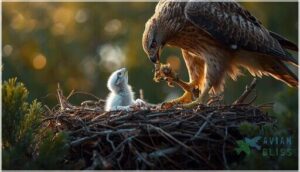
What a baby hawk eats depends a lot on its age — a newly hatched eyas can’t tear into prey the way a older chick can. Parents play a huge role in making sure each stage of development gets exactly the right nutrition.
Here’s a closer look at how that feeding process works, from hatchling to fledgling.
Diet of Hatchlings Vs. Older Chicks
What a hatchling eats looks nothing like what a fledgling handles. Feeding frequency drops from 10–15 daily regurgitated meals at hatching to just 3–4 feeds as fledglings.
The dietary habits and prey size progression shift dramatically with age:
- Regurgitated food delivers liquefied nutrients to newborns
- Primary prey types shift from earthworms to passerine birds
- Nutritional shifts add fat-rich organs for feather growth
- Prey items scale from under 1 gram to 50-gram whole mice
How Parents Hunt and Feed Young
What’s notable is how precisely divided parental care in hawks really is.
The male focuses almost entirely on prey acquisition — in Ferruginous Hawks, he manages roughly 70% of all prey delivery — while the female stays close, brooding and feeding, by parents’ standards, means tearing every morsel into safe, swallowable pieces.
| Hawk Species | Male Role | Female Role |
|---|---|---|
| Ferruginous Hawk | ~70% prey delivery | Brooding, feeding chicks |
| Red-tailed Hawk | Hunts, defends territory | Nest attendance, feeding |
| Chimango Caracara | Shared hunting equally | Shared feeding equally |
| Northern Hawk Owl | Delivers whole prey | Decapitates, portions food |
Post-fledging feeding continues weeks after chicks leave — parents gradually reduce deliveries, quietly nudging young hawks toward learning to hunt independently.
Prey Selection and Feeding Techniques
Prey selection isn’t random — it’s remarkably strategic. Mammal Preference dominates early diets, with urban Red-tailed Hawk nestlings getting 80–90% mammals by prey count.
Parents practice precise Prey Portioning, tearing soft, boneless strips for hatchlings before graduating to fur-included chunks.
Habitat Based Choice shapes everything: farmland chicks get voles, city nests see an Urban Prey Shift toward pigeons.
By fledging, Learning to Hunt begins — chicks grip, tear, and eventually swallow prey whole.
Threats and Conservation of Baby Hawks

Baby hawks face very real threats even before they leave the nest — from shrinking forests to predators that see a helpless eyas as an easy target. Human activity has pushed several hawk species, like Ridgway’s hawk, to the edge of extinction, with fewer than 500 individuals remaining in the wild.
Before baby hawks ever leave the nest, shrinking forests and predators have already pushed some species to the edge of extinction
Here’s a closer look at the key threats young raptors face and the conservation efforts working to protect them.
Habitat Loss and Human Impact
Baby hawks face threats from nearly every direction that humans have touched the landscape.
Deforestation effects strip nesting platforms from forest raptors, while urban development fragments the woodlands that Cooper’s hawks depend on — pushing nest failure rates to 52.6%.
Pesticide exposure and rodenticide poisoning compromise their development, road mortality claims roughly 22% of raptor recoveries, and wind turbine risks add yet another layer of conservation threats.
Predators and Natural Dangers
Even inside the nest, danger doesn’t take a break. Raccoon Nest Raids happen after dark — raccoons climb surprisingly high to steal eggs and nestlings.
Great Horned Owls launch Horned Owl Attacks between 3 and 4 a.m., while Snake Nest Intrusion ends with hatchlings swallowed whole.
Heat Wave Escapes turn fatal when chicks jump from nests. Sibling Siblicide claims the weakest during food shortages.
Conservation Efforts for Young Raptors
People genuinely care about saving young raptors — and the work shows.
Raptor Rehab Centers like Beijing’s rescue facility admitted 90 young birds in 2025, releasing 75 back to the wild.
Artificial Nest Boxes attract breeding kestrels and ferruginous hawks where habitat destruction has reduced nesting sites.
Hacking Release Programs and Captive Breeding Initiatives give baby hawk populations a fighting chance.
Habitat Protection Buffers shield nests from human disturbance, addressing the deepest avian conservation issues head‑on.
Frequently Asked Questions (FAQs)
What should I do if I find a baby hawk?
If you spot a nestling or fledgling on the ground, stay calm and observe first.
Assess its condition, avoid handling it with bare hands, and contact a licensed rehabilitator for guidance on wildlife rehabilitation.
What is a baby hawk called?
You’d think one word would cover it — but nestlings like these carry a rich falconry lexicon behind them.
A young hawk is called an eyas, though chick, hatchling, and hawklet are all accepted terminology for young hawks.
What do baby hawks eat?
Baby hawks eat protein-rich prey — small bits of meat, insects, mice, and lizards — carefully fed by parents.
As they grow, prey size increases, shifting toward mammals and birds matching adult diets.
What is a baby red tailed hawk called?
baby red-tailed hawk is called an eyas — a term rooted in falconry naming history, derived from Middle English “nyas.”
nestling stage lasts roughly six to seven weeks before the fledgling takes flight.
Are baby hawks cute?
Yes — most people find them irresistibly cute.
Their round, downy bodies, oversized beaks, and wide eyes trigger a strong human emotional response, making nestlings and fledglings favorites for social media appeal and wildlife nest cams alike.
What does a baby hawk look like?
Picture a fluffy white ball with oversized feet and a hooked beak — that’s your first clue.
A baby hawk’s head-body ratio, leg proportions, and wing stub development all signal the fierce raptor it’ll become.
When do baby hawks take flight?
Most hawk species fledge between 24 and 46 days, depending on size. Smaller sharp-shinned hawks take first flight at just 24 days, while red-tailed hawks need a full 42–46 days of wing muscle maturation.
How do you identify a baby hawk?
Spotting small, soft silhouettes perched near a nest tells you something special is nearby.
Pale bluish-gray eyes, fluffy white down, a hooked beak, and oversized yellow feet mark every juvenile hawk unmistakably.
What should you do if you find a baby hawk?
If you find a grounded bird of prey, don’t rush in.
Stay back, watch for parents, and contact a licensed wildlife rehabilitator immediately — moving or feeding it without guidance can cause serious harm.
Can a hawk pick up a 10 lb cat?
It sounds alarming, but no — a hawk can’t pick up a 10 lb cat. Body weight ratio and raptor flight mechanics make it impossible. Most hawks lift only 1–3 lbs.
Conclusion
They say the mightiest oak was once a tiny acorn—and every baby hawk starts just as small, blind, and fragile as that seed. Yet within weeks, precise parental care, instinct-driven development, and a carefully constructed nest transform that helpless eyas into a capable predator.
Understanding this journey doesn’t just deepen your appreciation for raptors—it reveals how resilience is built one feather, one meal, and one flight attempt at a time.