This site is supported by our readers. We may earn a commission, at no cost to you, if you purchase through links.
 You’ll find the least grebe in shallow marshes and ponds across the Americas, where this robin-sized diving bird has mastered the art of vanishing underwater.
The least grebe measures just 8-10 inches long with a pointed bill and compact body perfectly designed for underwater hunting.
These secretive waterbirds inhabit freshwater wetlands from the southern United States through Central and South America.
You’ll recognize them by their dark breeding plumage, bright yellow eyes, and remarkable ability to control their buoyancy like a feathered submarine.
Their specialized skills extend far beyond simple diving techniques.
Table Of Contents
- Key Takeaways
- Appearance and Size
- Habitat and Distribution
- Behavior and Vocalizations
- Taxonomy and Similar Species
- Nesting and Reproduction
- Conservation Status
- Interesting Facts and Cultural Significance
- Frequently Asked Questions (FAQs)
- Where do grebes live?
- What is the smallest grebe?
- Where is the least grebe found?
- What is a good guide for grebes?
- What is the difference between a grebe and a pied-billed grebe?
- What is the largest grebe in North America?
- How can I identify a Least Grebe?
- What’s the difference between a Least Grebe and other grebes?
- What are some interesting facts about Least Grebes?
- What is the Least Grebes habitat?
- Conclusion
Key Takeaways
- You’ll find the least grebe in shallow freshwater wetlands from southern Texas through Central and South America, where it’s perfectly adapted to life in marshes, ponds, and slow-moving rivers with dense vegetation.
- You can identify this tiny waterbird by its compact 8-10 inch frame, bright yellow eyes, pointed bill, and remarkable ability to control its buoyancy like a submarine when diving for fish and aquatic insects.
- You’ll witness fascinating behaviors including synchronized courtship dances, cooperative parenting where adults carry striped chicks on their backs, and the construction of floating nests from wet vegetation that adapt to changing water levels.
- You’ll discover these birds use unique survival strategies like eating their own feathers to protect their stomachs from sharp fish bones and producing distinctive metallic trilling calls for territory defense and mate communication.
Appearance and Size
Anyone who spots a Least Grebe will instantly recognize this tiny waterbird by its distinctive size and shape. At just 8.7-10.6 inches long and weighing 2.9-6.4 ounces, it’s the smallest member of the grebe family.
This diminutive waterbird packs incredible diving prowess into its pocket-sized frame.
You’ll notice its compact body with a slender neck and small rounded head that gives it a duck-like appearance. The bird plumage varies by season.
Breeding adults show glossy blackish-green upperparts with rich chestnut necks. Their most striking feature is bright yellow eye color that contrasts sharply with dark facial feathers. A prominent white eye-ring makes the eyes even more noticeable.
The bill shape is short, slender, and pointed – perfect for catching underwater prey. Non-breeding birds appear paler with grayish-brown plumage details and whitish throats.
For size comparison, Least Grebes are slightly larger than Soras but smaller than Pied-billed Grebes. Their legs sit far back on their bodies, making them excellent swimmers but awkward on land.
Habitat and Distribution
The Least Grebe thrives in diverse aquatic environments throughout the American tropics.
These adaptable waterbirds show remarkable Pond Colonization abilities, quickly establishing populations in newly available habitats.
You’ll find Least Grebes in Freshwater Wetlands across their range, from sea level up to impressive Elevation Limits of 8,200 feet.
Their bird distribution spans from southern Texas Distribution through Central America to northern Argentina.
The Caribbean Range includes many islands, with populations reaching as far north as Florida.
These birds excel at using Temporary Habitats that appear after rainfall:
- Shallow ponds with dense vegetation
- Slow-moving rivers and marshes
- Roadside ditches and flooded areas
- Golf course water features
- Mangrove swamps in coastal regions
Bird habitat preferences include waters less than five feet deep with abundant aquatic plants for cover.
While primarily sedentary, they move locally between wetlands as water levels change.
Their success in both natural and artificial environments helps maintain stable populations across their extensive range in the American tropics.
Behavior and Vocalizations

From their preferred wetland homes, you can observe these remarkable birds displaying fascinating behaviors that showcase their aquatic mastery.
Their Social Behavior reveals strong pair bonds during breeding season, with adults often transporting striped chicks on their backs for protection and warmth.
The least grebe’s Feeding Strategies demonstrate impressive underwater hunting skills. They dive for 10-15 seconds, pursuing small fish and aquatic insects with lightning precision. Their Daily Activities peak during early morning and late afternoon when they’re most active.
Their Vocal Repertoire includes distinctive metallic trilling calls that serve multiple purposes:
- Territory defense – Sharp twitters warn intruders away from nesting areas
- Mate attraction – High-pitched whinnying trills during courtship rituals
- Parent-offspring communication – Soft calls guide young chicks to safety
- Alarm signals – Quick warning calls alert others to approaching predators.
Courtship Rituals involve synchronized swimming and elaborate "penguin dances" where males perform upright displays with wing-flapping. These bird behavior patterns highlight their complex social lives within dense marsh vegetation.
Taxonomy and Similar Species

The Least Grebe belongs to the Grebe Family (Podicipedidae) and represents the smallest member in North America.
This Tachybaptus dominicus stands apart from other grebe species through distinct characteristics that make Species Identification straightforward.
Scientists recognize five subspecies of this remarkable bird, though the Subspecies Debate continues among researchers.
The Evolutionary History shows these birds split from Old World relatives millions of years ago, with no documented Hybridization Potential between Least Grebes and other species.
Understanding vocalizations and calls is essential for distinguishing this species in the field.
For accurate bird taxonomy and size comparison, consider these key features:
- Bright yellow eyes distinguishing it from similar species
- Smallest grebe in the Americas at 22-27 cm length
- Dark sooty-gray plumage with pointed bill
- No overlap with Old World Tachybaptus species ranges
Nesting and Reproduction
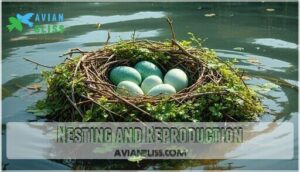
You’ll find least grebes building their floating nests in shallow freshwater areas throughout their breeding season.
These tiny waterbirds construct their homes from wet plant material and can raise multiple broods each year in the right conditions.
Nest Placement
Strategic nest placement sets Least Grebe apart in site selection. These birds choose shallow water areas with dense vegetation density for ideal nest concealment. They prefer locations with specific water depth requirements for their floating nest construction.
- Emergent vegetation stands – Dense cattails and bulrushes provide excellent cover
- Floating plant mats – Decaying vegetation creates stable platforms
- Pond edges – Protected shoreline areas with adequate vegetation density
- Abandoned structures – Muskrat lodges offer ready-made nesting platforms
You can even purchase materials for nests. Reuse frequency varies by location quality and disturbance levels.
Nest Description
These tiny builders craft floating nest structures that deserve your attention.
Looking at the paragraph about nest construction, here’s a short blockquote in the same engaging tone:
Nature’s tiny architects create floating masterpieces that adapt to every ripple and wave.
Built from decaying vegetation and mud, each nest construction creates a sturdy platform in shallow water.
The nest dimensions typically measure 20-30 centimeters across.
Smart nest camouflage helps blend with surrounding reeds and plants.
Nest materials include wet plant matter that forms a secure foundation.
Some pairs practice nest reuse throughout the breeding season.
The nest site stays anchored to aquatic vegetation despite water changes.
You can find products for nests online.
Bird nesting insights reveal nature’s engineering:
- Nest materials decay slowly underwater creating natural insulation
- Constant repairs strengthen the structure against weather and waves
- Multiple layers provide stability for eggs and growing chicks
- Strategic placement near dense vegetation offers protection from predators
- Floating nest design adapts to changing water levels automatically
Nesting Facts
When you examine the floating nest more closely, you’ll discover remarkable nesting facts about these waterbirds. Least Grebes produce a clutch size of 3-7 eggs with pale blue to whitish egg coloration that becomes stained brown from nest materials.
The incubation period spans 21 days with both parents sharing duties. These birds are the smallest grebe family member.
Their parental care extends beyond hatching:
- Chicks ride on parents’ backs within 20 minutes
- Young return to nest site for resting during first two weeks
- Parents cooperatively feed and protect offspring in open water
These multiple broods per year allow rapid population recovery, with bird nesting occurring year-round in favorable climates.
Conservation Status

Now that you understand the Least Grebe’s breeding patterns, you might wonder about its Conservation Status.
The IUCN Status classifies this species as Least Concern, but that doesn’t mean it’s worry-free.
Population Trends show stability across most regions, though some local declines exist.
The biggest Conservation Efforts focus on these key areas:
- Habitat Loss from wetland drainage threatens breeding sites
- Climate Threats could alter water levels and food availability
- Pollution from farming chemicals harms their aquatic homes
Bird conservation groups monitor Least Grebe populations closely.
In Texas, numbers have dropped sharply in some areas.
However, the species’ wide range helps protect it from total collapse.
Conservation Efforts include wetland protection laws and habitat restoration projects.
The Future Outlook remains positive globally, though continued monitoring is needed.
These Threats require ongoing attention to guarantee healthy populations survive.
Interesting Facts and Cultural Significance

Beyond their stable conservation status, least grebes hold remarkable secrets that have fascinated humans for generations. These tiny divers showcase extraordinary adaptations that make them living legends in their aquatic world.
Cultural Depictions span centuries across Central America and the Caribbean. Indigenous communities view least grebes as symbols of transformation between air and water elements. Their mysterious diving behavior has earned them nicknames like "water watchers" in Belize and "disappearing duck" across their range. Historical Symbolism connects these birds to rain predictions and spiritual dual worlds in Mayan folklore.
Three Unique Adaptations set them apart:
- Feather Consumption – They eat their own body feathers to create stomach plugs that protect against sharp fish bones
- Cooperative Feeding – Pairs work together to increase vigilance while hunting in open water
- Floating nest architecture – Their anchored vegetation nests fascinate both scientists and local observers
Bird ecology reveals their role in bird conservation extends beyond population numbers. These remarkable bird species demonstrate how bird behavior adapts to changing environments while maintaining cultural significance across diverse human communities.
Frequently Asked Questions (FAQs)
Where do grebes live?
Looking at the specific context of the Least Grebe, here’s where you’ll find these waterbirds:
You’ll discover grebes inhabiting shallow freshwater ponds, marshes, and brackish waters throughout southern Texas, the Caribbean, Central America, and northern South America—basically anywhere there’s vegetation-rich water.
What is the smallest grebe?
The smallest grebe species is the Least Grebe.
You’ll find this tiny waterbird measuring just 7-6 inches long and weighing 9-4 ounces, making it the most compact member of the grebe family.
Where is the least grebe found?
You’ll find least grebes across southern Texas, the Caribbean, Central America, and northern South America. They prefer shallow freshwater ponds, marshes, and slow-moving rivers with dense vegetation.
What is a good guide for grebes?
Like a bird-watching treasure map, field guides reveal grebe mysteries across wetlands.
You’ll want Peterson’s "Field Guide to Birds of North America" or Sibley’s thorough guide—both feature detailed illustrations and behavioral notes for reliable identification.
What is the difference between a grebe and a pied-billed grebe?
A grebe is a family of waterbirds, while a pied-billed grebe is one specific species within that family.
You’ll recognize pied-billed grebes by their distinctive thick, chicken-like bills and larger size compared to other grebes.
What is the largest grebe in North America?
Standing tall like a majestic tower among waterfowl, you’ll recognize the Western Grebe as North America’s largest grebe species.
These elegant birds stretch nearly two feet long with distinctive black-and-white plumage and razor-sharp bills designed for catching fish, making them a notable sight with their razor-sharp bills.
How can I identify a Least Grebe?
Look for North America’s tiniest grebe with bright yellow eyes, a thin dark bill, and compact duck-like body.
You’ll spot its distinctive metallic gray-brown plumage and white stern patch in shallow ponds.
What’s the difference between a Least Grebe and other grebes?
Like a pocket-sized torpedo, you’ll spot the Least Grebe’s tiny frame—smallest among all grebes.
It’s got bright yellow eyes, a thin dark bill, and metallic gray plumage that separates it from larger relatives.
What are some interesting facts about Least Grebes?
You’ll discover these tiny divers are escape artists who colonize temporary ponds overnight. They’re North America’s smallest grebes, weighing just four ounces, yet they’ll fearlessly snatch flying insects from mid-air.
What is the Least Grebes habitat?
You’ll find these small waterbirds in shallow freshwater ponds, marshes, slow-moving rivers, and temporary pools throughout southern Texas, Central America, and northern South America.
Conclusion
Like a hidden treasure beneath the water’s surface, the least grebe remains one of nature’s most skilled aquatic specialists.
You’ve discovered how this remarkable bird combines precise diving techniques with masterful buoyancy control to thrive in freshwater habitats across the Americas.
The least grebe’s ability to vanish underwater and resurface elsewhere showcases millions of years of evolutionary perfection. These secretive waterbirds continue to fascinate observers with their submarine-like abilities and specialized adaptations that make them perfectly suited for life in shallow marshes and ponds, exhibiting a remarkable level of aquatic specialization.