This site is supported by our readers. We may earn a commission, at no cost to you, if you purchase through links.
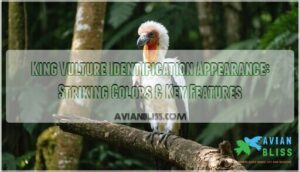 You’ll recognize a king vulture through its stunning appearance that makes it unmistakable among Central and South American birds.
Adults showcase brilliant white bodies with jet-black wing edges, while their bare heads display vibrant orange, yellow, and red colors topped by a distinctive fleshy caruncle.
These impressive raptors measure up to 32 inches with 6.5-foot wingspans, dwarfing the turkey vultures they share territory with.
Their piercing white eyes and mostly white plumage create a striking contrast against dark flight feathers.
King vulture identification becomes easier when you spot their unique coloration soaring above tropical forests, though immature birds appear entirely blackish before developing their spectacular adult colors through gradual molting.
Table Of Contents
- Key Takeaways
- Identifying a King Vulture
- Adult King Vulture Appearance
- Immature King Vulture Appearance
- Size Comparison With Turkey Vultures
- Habitat and Range
- Behavior and Flight Patterns
- Unique Characteristics
- Ecological Role
- Threats and Conservation
- Historical and Current Distribution
- Frequently Asked Questions (FAQs)
- What are the characteristics of the king vulture?
- Are king vultures rare?
- Where do you find king vultures?
- What is the physical appearance of a vulture?
- How do you identify a king vulture?
- How big are king vultures compared to turkey vultures?
- Where do the king vultures live?
- Do king vultures live in trees?
- What do king vultures look like?
- Do king vultures have white blotches?
- Conclusion
Key Takeaways
- You’ll identify adult king vultures by their striking white bodies with black wing edges, vibrant multicolored heads (orange, red, yellow), and distinctive orange caruncle above their beaks
- You can distinguish them from turkey vultures by their larger size – king vultures reach 32 inches with 6.5-foot wingspans and weigh up to 10 pounds compared to turkey vultures’ smaller 6-foot wingspan and 4-pound weight
- You’ll find juvenile king vultures challenging to identify since they appear entirely blackish for 4-5 years before developing adult colors, often resembling black vultures during this immature phase
- You can spot them soaring high above Central and South American tropical forests, using their piercing white eyes and thermal-riding flight patterns to locate carrion from great distances
Identifying a King Vulture
The King Vulture stands out as one of nature’s most distinctive raptors, making king vulture identification straightforward once you know what to look for.
You’ll recognize adults by their striking king vulture colors – vibrant reds, oranges, and yellows adorning their bare heads and necks, contrasted by piercing white eyes that seem almost otherworldly.
Witness nature’s most magnificent scavenger soaring above tropical rainforests with otherworldly beauty.
Plumage differences between adults and juveniles create common juvenile confusion. Young birds appear entirely blackish for up to five years, resembling Black Vultures until their caruncle development begins. Eye coloration shifts from brownish in juveniles to the characteristic pale white in adults.
They thrive in tropical forests across the Americas.
For flight identification, watch for their soaring behavior high above the canopy. These magnificent scavengers use thermals efficiently, making king vulture appearance easier to spot when they’re riding air currents.
The king vulture markings – white body with black wing edges – become unmistakable once you’ve learned to distinguish them from other vulture species during their impressive aerial displays.
Adult King Vulture Appearance
When you spot an adult King Vulture, you’ll immediately notice its spectacular appearance that sets it apart from all other vulture species.
The combination of vibrant facial colors, striking white plumage, and impressive size makes this bird unmistakable in the field.
Colorful Head and Neck

A king vulture’s colorful head and neck create a stunning display of vibrant reds, oranges, and purples that serves multiple functions.
This skin pigmentation and featherless adaptation help with thermoregulation and social signaling.
The prominent caruncle function includes species recognition, while juvenile colors remain subdued until maturity.
These king vulture colors make king vulture identification unmistakable among neotropical birds.
Piercing White Eyes
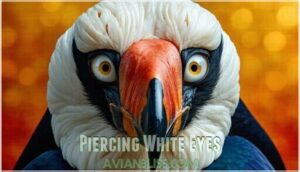
One distinctive feature you’ll notice when identifying king vulture adults is their piercing white eyes that serve as remarkable identification markers.
These pale, cream-colored irises provide exceptional visual acuity for spotting carrion from great distances.
Key eye characteristics include:
- Eye Development: Iris color shifts from dark brown in juveniles to brilliant white in mature adults
- Visual Acuity: Sharp eyesight enables precise prey detection across vast forest canopies
- Prey Detection: Enhanced vision complements their keen sense of smell for locating carcasses
- Eye Protection: Bare facial skin around eyes prevents feather contamination during feeding
These sensory adaptations make the king vulture’s white eyes essential for vulture identification and survival.
Mostly White Plumage
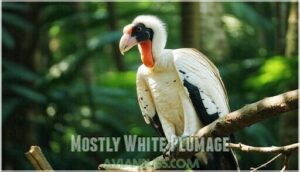
You’ll notice the adult king vulture’s mostly white plumage creates a dramatic contrast against tropical forests.
This plumage serves multiple purposes beyond identification—white feather genetics aid thermal regulation by reflecting heat, while providing excellent camouflage purpose against bright sky when soaring.
The feather composition and plumage variations make vulture identification straightforward, distinguishing this adult king vulture from darker species below.
Black Trailing Edge to Wings and Tail
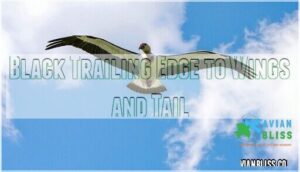
Adult King Vultures display a striking black trailing edge on their wings and tail that creates dramatic contrast against their mostly white plumage.
This distinctive Wing Edge Variation serves multiple purposes in Flight Feather Function and Species Differentiation, making identification straightforward even at distance.
Here are three key identification points for this appearance feature:
- Camouflage and Contrast – The black wing borders create a bold silhouette against sky backgrounds during soaring flight
- Plumage Development Stages – Adult birds show crisp black-white definition, unlike the gradual color transitions seen in juveniles
- Flight recognition – The contrasting black trailing edge on both wings and tail distinguishes King Vultures from other white-bodied raptors in their range
Immature King Vulture Appearance
You’ll find juvenile king vultures look dramatically different from their colorful parents, appearing almost entirely black like smaller vulture species.
These young birds gradually develop their striking adult appearance over four to five years through a series of molts and color changes.
Blackish Overall

When you spot a juvenile king vulture in the field, its blackish plumage creates a dramatically different silhouette than adults.
These immature birds wear dark, sooty feathers that can fool even experienced birders into thinking they’re observing a different species entirely.
The juvenile identification challenge lies in recognizing this dark eye color and overall dusky appearance as part of the molting process.
This color shift takes years, making subadult confusion common during plumage development.
Lack of White Wing Markings
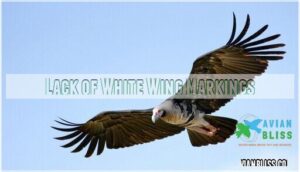
Young king vultures present a stark contrast to their colorful parents, showing completely black trailing edge feathers and lacking any white wing markings during flight.
This juvenile identification challenge makes age determination tricky, as their dark subadult plumage develops slowly through the molting process.
Unlike adult king vulture specimens with distinctive white wings, immatures display uniform darkness until wing development progresses over several years.
Resemblance to Black Vulture

Immature King Vultures create significant Juvenile Confusion due to their striking resemblance to Black Vultures.
These young birds share remarkably similar dark plumage, making Vulture Identification challenging for observers.
Their Appearance closely mimics Black Vulture coloring before adult transformation begins.
Key similarities include:
- Uniform blackish-brown plumage lacking adult white markings
- Similar flight silhouettes with broad wings and short tails
- Comparable size ranges during juvenile development stages
- Overlapping habitat use in tropical forest environments
- Shared roosting and feeding behaviors at carcass sites
Flight Comparison reveals both species soar using identical thermal patterns, while Behavior Overlap occurs frequently at feeding sites.
Size Discrepancies become less apparent when juveniles haven’t reached full King Vulture proportions, intensifying identification difficulties for birdwatchers encountering these Plumage Differences.
Gradual Development of Adult Plumage

Juvenile king vultures undergo plumage molting over four to five years, transforming from blackish immature birds to brilliant adult coloration.
You’ll notice color change begins with white patches on the belly and wing undersides.
The caruncle growth develops gradually, while eye color shifts from dark brown to piercing white.
Ruff development becomes pronounced after the fourth year, completing this remarkable transformation.
Size Comparison With Turkey Vultures

When you encounter King Vultures in the wild, you’ll notice they’re substantially larger than Turkey Vultures.
These impressive birds showcase distinct size comparison differences that make bird species comparison straightforward.
King Vultures dominate the skies with their superior dimensions.
Their wingspan differences are striking – nearly 6.6 feet compared to Turkey Vultures’ 6-foot spread.
The weight disparity is even more pronounced, with king vulture size reaching 10 pounds versus Turkey Vultures’ modest 4 pounds.
| Feature | King Vulture | Turkey Vulture |
|---|---|---|
| Wingspan | 6.6 feet | 6.0 feet |
| Weight | 10 pounds | 4 pounds |
| Body Mass | Robust build | Lean frame |
This height comparison and vulture size advantage serves them well at carcasses.
King Vultures use their powerful beaks to tear through tough hides that smaller vultures can’t penetrate, establishing dominance at feeding sites despite arriving last due to their poor sense of smell.
Habitat and Range
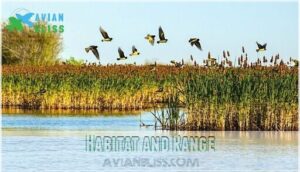
You’ll find King Vultures exclusively in the lowland tropical forests of Central and South America, from Mexico down to northern Argentina.
These impressive birds prefer pristine, mature forests and actively avoid agricultural areas and human settlements, choosing to stay in the wildest parts of their range.
Lowland Tropical Forests
Within lowland tropical forests, you’ll find king vultures soaring above the forest canopy, where their colorful head and neck make identification straightforward.
These areas provide ideal resource availability through abundant carrion, while the understory ecosystems offer nesting sites.
Forest fragmentation threatens their habitat, as king vultures prefer pristine environments over disturbed areas, making their appearance increasingly rare during seasonal changes.
Wilder Areas
Where do these magnificent birds call home? King vultures thrive in pristine forests and remote habitats across the Americas, seeking undisturbed ecosystems where conservation efforts protect biodiversity hotspots.
These forests offer diverse habitats, ranging from the forest floor to the canopy.
- Soaring over untouched rainforest canopies
- Nesting in secluded wilderness areas
- Hunting in undeveloped woodland corridors
- Avoiding human-modified landscapes entirely
Deforestation impacts these birds, as it leads to habitat fragmentation, disrupting their migration patterns.
Avoidance of Human Habitation
Spotting a king vulture near people is about as likely as finding a fish up a tree.
These birds stick to pristine ecosystems, showing a clear avoidance of human habitation.
Their forest dependence means you’ll only see them in undisturbed woods, with habitat fragmentation and human encroachment threatening their survival—key conservation implications for their identification and continued presence.
Behavior and Flight Patterns

Understanding King Vulture flight behavior helps you spot these magnificent birds in their natural habitat.
You’ll typically see them soaring high above the forest canopy using thermal currents, often joining other vultures in large circling groups called kettles rather than perching on visible branches.
Soaring Flight
Watch King Vultures master thermal utilization for effortless soaring flight.
These impressive birds demonstrate remarkable gliding efficiency while maintaining consistent flight altitude and soaring speed through superior energy conservation techniques:
- Thermal currents lift them hundreds of feet skyward
- Wind patterns guide their graceful navigation
- Broad wingspans minimize flapping requirements
- Strategic positioning maximizes lift potential
Their soaring flight patterns make king vulture identification easier during extended aerial displays.
Often Seen in Kettles
You’ll spot king vulture kettles circling high above tropical forests, where these majestic birds harness thermal updrafts for effortless soaring flight.
Kettle formation offers soaring benefits through group dynamics, allowing efficient coverage of vast territories while searching for carrion.
This thermal usage helps conserve energy during long-distance travel, often featuring species mixing with other raptors in these impressive aerial gatherings, which can be considered a thermal updrafts phenomenon.
Rarely Seen Perched
Unlike other vultures that rest on branches, king vultures prefer staying airborne for energy conservation.
Their striking plumage and colorful head make them unmistakable when they do land, but perching isn’t their specialty.
Here’s why you’ll rarely spot them perched:
- Energy Conservation – Soaring uses less energy than flapping from perch to perch
- Soaring Advantages – Their broad wings excel at riding thermals, not quick takeoffs
- Predator Avoidance – Staying aloft keeps them safe from ground threats
- Perch Competition – Other birds claim the best roosting spots first
- Habitat Accessibility – Dense forest canopies limit suitable perching opportunities
Unique Characteristics

You’ll notice several distinctive features that set King Vultures apart from other scavenging birds in their range.
Beyond their striking appearance, these remarkable birds possess unique behavioral adaptations that make them fascinating subjects for wildlife observation.
Colorful Head, Neck, and Carbuncle
You’ll immediately notice the king vulture’s vibrant coloration across its featherless head and neck, featuring brilliant reds, oranges, yellows, and purples.
The distinctive carbuncle—a fleshy orange appendage above the beak—develops fully by age four, serving as a key identifier.
This ornate neck display aids in visual signaling and individual recognition, while the skin pigmentation creates stunning color variation that makes this featherless adaptation unmistakable in flight.
Use of Sense of Smell
Contrary to popular belief, king vultures possess olfactory limitations compared to other vulture species.
Their smaller olfactory bulb size substantially reduces carcass odor detection abilities.
Instead of relying on olfaction for hunting, these magnificent birds depend heavily on visual cues and interspecies scavenging strategies.
King vultures often follow Turkey Vultures to carrion sites, using competition avoidance tactics rather than independent scent-based foraging for identification of food sources.
Defecation for Thermoregulation
You’ll notice king vultures practice defecation for thermoregulation, cooling themselves through evaporative cooling on their legs.
This behavior also provides antibacterial properties from uric acid benefits, keeping leg coloration clean after feeding on carrion.
While their colorful head and neck grab attention, this thermoregulation method showcases how king vulture appearance reflects practical survival adaptations.
Ecological Role

You’ll appreciate how King Vultures serve as nature’s cleanup crew, preventing the spread of disease by efficiently consuming large carcasses that other scavengers can’t handle.
Their powerful beaks tear open tough hides, creating access points for smaller vultures and scavengers to feed, which is a key part of their role as scavengers.
Biodegradation and Carrion Consumption
How does the king vulture contribute to ecosystem health through biodegradation processes? This remarkable scavenger plays a pivotal role in maintaining ecological balance through its carrion consumption habits and scavenger interactions.
- Carcass processing: King vultures consume dead animals efficiently, preventing disease outbreaks and maintaining ecosystem health through rapid biodegradation.
- Nutrient cycling: Their powerful digestive systems break down organic matter, returning essential nutrients to the soil and supporting the carrion food web.
- Scavenger facilitation: By tearing open tough carcasses with their strong beaks, king vultures enable smaller scavengers to access meat, promoting thorough decomposition.
Disease Prevention
Beyond removing decaying carcasses from the environment, king vultures serve as nature’s cleanup crew by preventing disease transmission throughout ecosystems.
You’ll find that their powerful acid digestion neutralizes harmful bacteria and pathogens that would otherwise spread to wildlife and water sources.
The vulture microbiome has evolved specialized enzymes that break down dangerous toxins in carrion, effectively sterilizing contaminated meat.
This scavenger’s carrion consumption creates a biological barrier against disease outbreaks, protecting entire food webs from potential epidemics that rotting carcasses might trigger in vulnerable animal populations.
Facilitating Access for Smaller Scavengers
When you spot a king vulture, you’re witnessing nature’s ultimate "can opener" in action.
Their powerful beaks tear through tough hides that smaller scavengers can’t penetrate, creating carrion hierarchy dynamics.
This facilitating access transforms single carcasses into community dining halls, supporting diverse scavenger guilds.
Through these vulture interactions, king vulture identification reveals ecosystem architects whose appearance masks their role in trophic cascade effects, demonstrating critical ecosystem dependence relationships.
Threats and Conservation
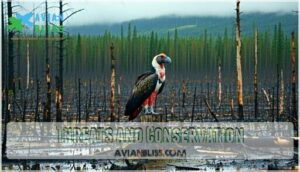
While King Vultures aren’t currently endangered, you’ll find their populations facing increasing pressure from deforestation and habitat destruction across their range.
Illegal hunting and the loss of pristine forest areas continue to threaten these magnificent scavengers, making conservation efforts essential for maintaining stable populations in the wild.
Habitat Loss
Deforestation threatens king vulture identification opportunities as habitat loss fragments their pristine forest homes.
You’ll find fewer chances to spot their colorful head and neck appearance when climate change and human encroachment destroy nesting sites.
This range reduction creates:
- Forest fragmentation disrupting territorial boundaries
- Prey scarcity from ecosystem degradation
- Nesting disruption in canopy trees
- Reduced population density
- Limited observation opportunities for identification
Deforestation leads to a cascade of effects, ultimately resulting in reduced population density and limited opportunities for observation, making conservation efforts more challenging.
Illegal Hunting
Illegal hunting compounds habitat pressures facing king vultures throughout their range.
Poisoning risks from contaminated carcasses and direct hunting impact create serious threats to these distinctive birds.
Conservation efforts struggle with enforcement challenges across remote forest areas, making population decline difficult to monitor.
You’ll find that protecting these colorful scavengers requires stronger legal frameworks and community education programs.
Population Trends
King vulture populations face mounting pressure across their range, with fewer than 50,000 individuals remaining worldwide. Habitat fragmentation and human impact drive declining numbers, particularly affecting breeding success in Central America where populations now face endangered status.
The King Vulture, scientifically known as Sarcoramphus papa, is classified within the family Cathartidae.
Key population challenges include:
- Forest loss eliminating 13.7% of suitable habitat since 1985
- Range contraction reducing distribution by 43% globally
- Climate change altering tropical forest ecosystems critical for survival
Conservation efforts focus on protecting remaining wilderness areas, though population trends continue downward despite the species’ current Least Concern classification.
Historical and Current Distribution

You’ll find King Vultures exclusively in the Americas, ranging from southern Mexico through Central America and into South America as far south as northern Argentina.
These magnificent birds inhabit lowland areas up to 4,950 feet in elevation, preferring mature tropical forests while avoiding agricultural zones and human settlements.
Exclusive to The Americas
Unlike other vultures found globally, you’ll only encounter Sarcoramphus papa in the Americas.
American Vulture Evolution shaped these magnificent birds specifically for Neotropical Ecosystem Role within New World forests.
Their Forest Dependence creates unique Conservation Challenges as Regional Population Status reflects habitat pressures.
King Vulture identification becomes easier knowing their exclusive geographic range limits where you’ll spot them during your birding adventures, highlighting the importance of understanding their Conservation Challenges.
Range in Mexico, Central, and South America
You’ll encounter King Vultures across Mexico, Central America, and South America, where regional population density varies substantially due to habitat fragmentation impact.
These magnificent birds face conservation challenges as climate change effects alter their traditional ranges. The King Vulture plays a role in ecosystem sanitation by consuming carrion.
- Mexico: Limited to southern regions with declining populations
- Central America: More stable numbers in protected forest corridors
- South America: Widest distribution but facing habitat loss pressures
- Transnational conservation efforts: Cross-border initiatives aid King Vulture identification and protection
Conservation area effectiveness remains vital for maintaining viable populations throughout their range.
Altitudinal Range and Adaptability
Anyone venturing into king vulture territory will encounter remarkable habitat versatility across their altitudinal range.
These adaptable raptors inhabit various altitudes from sea level to the Andes foothills, demonstrating impressive elevation limits despite forest dependence.
- Sea level to 3,000 meters – documented elevational range
- 500-2,000 meters – preferred montane zones in Colombia/Venezuela
- Regional travel – seasonal movement between altitude zones
Frequently Asked Questions (FAQs)
What are the characteristics of the king vulture?
You’ll spot adult king vultures by their dramatic white bodies contrasted with black wing edges.
Vibrant multicolored heads displaying orange, red, and yellow bare skin, plus distinctive orange caruncles above their beaks.
Are king vultures rare?
Like rare gemstones scattered across the Americas, king vultures aren’t exactly common. You’ll find them widespread but in small numbers, making each sighting special throughout their range.
Where do you find king vultures?
You’ll find king vultures across Central and South America’s tropical forests, from Mexico to northern Argentina. They prefer pristine rainforests and mature woodlands, avoiding agricultural areas and urban spaces completely.
What is the physical appearance of a vulture?
Majestic vultures display distinctive features you’ll recognize immediately.
You’ll spot their large, powerful bodies with broad wings, hooked beaks for tearing carrion, and bare heads that prevent feather contamination while feeding on carcasses.
How do you identify a king vulture?
You’ll recognize a king vulture by its distinctive white body with black wing edges, vibrant orange-red-yellow bare head, bright yellow nose appendage, and piercing white eyes.
How big are king vultures compared to turkey vultures?
When you’re sizing up these aerial aristocrats like some medieval knight evaluating steeds, king vultures dwarf turkey vultures substantially.
You’ll spot kings standing up to 5 feet tall with impressive wingspans, while turkey vultures remain distinctly smaller and more compact in comparison.
Where do the king vultures live?
King vultures inhabit tropical forests from Mexico through Central America to northern Argentina, preferring mature lowland forests up to 4,950 feet elevation in pristine areas.
Do king vultures live in trees?
Like towering sentinels in the forest cathedral, you’ll find king vultures perching and roosting high in the canopy of tall emergent trees.
They choose these lofty positions for easy takeoff access when soaring.
What do king vultures look like?
You’ll spot king vultures by their striking white plumage with black wing tips, vibrant orange-red-yellow head coloration, bright white eyes, and distinctive orange fleshy caruncle above their large beak.
Do king vultures have white blotches?
Like hidden treasures on a dark canvas, juvenile king vultures display white blotches on their wing undersides during flight.
You’ll spot these markings as they gradually develop their stunning adult plumage over five years.
Conclusion
Recognizing these magnificent birds becomes second nature once you’ve mastered king vulture identification appearance features.
You’ll confidently distinguish adults by their pristine white bodies, vibrant multicolored heads, and distinctive black wing edges during flight.
While immature birds challenge identification with their all-black plumage, patience reveals their gradual transformation into stunning adults.
Their impressive size, soaring behavior, and preference for remote tropical forests make these remarkable scavengers unforgettable encounters in Central and South American wilderness areas, characterized by their unique soaring behavior and ability to thrive in Central and South American environments.