This site is supported by our readers. We may earn a commission, at no cost to you, if you purchase through links.
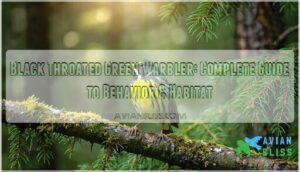 You’ll recognize the black throated green warbler by its olive-green back, bright yellow face, and distinctive black throat patch that looks like it’s wearing a formal bow tie.
These tiny songbirds measure just 4-5 inches but pack serious personality into their petite frames.
Males sport bolder markings than females, especially during breeding season when they’re trying to impress potential mates.
You’ll hear their thin, buzzy "zee-zee-zee-zoo-zee" song echoing through coniferous forests from May through July.
They’re active foragers, constantly flitting through tree canopies hunting insects and caterpillars.
What makes these warblers truly remarkable isn’t just their striking appearance—it’s their incredible journey and surprising nesting secrets.
Table Of Contents
- Key Takeaways
- Black Throated Green Warbler
- Habitat and Distribution
- Behavior and Foraging
- Breeding and Reproduction
- Conservation and Ecology
- Frequently Asked Questions (FAQs)
- Are black-throated green warblers rare?
- Where does the Black-throated Green Warbler live?
- What does a Black-throated Green Warbler eat?
- Where does a green warbler live?
- What is similar to a Black-throated Green Warbler?
- What does the Black-throated Green Warbler eat?
- How long do black-throated green warblers migrate?
- Do black-throated green warblers use birdhouses?
- What are the main predators of this warbler?
- Do black-throated green warblers ever hybridize?
- Conclusion
Key Takeaways
- You’ll find these distinctive warblers by their bright yellow faces and black throat patches in coniferous forests across eastern North America – they’re actually quite common, not rare birds
- They’re incredible migrants that travel thousands of miles twice yearly between breeding grounds in Canada/Appalachians and wintering areas in Central America and Mexico
- You’ll watch them act as nature’s pest control specialists, constantly hunting caterpillars, beetles, and other insects while flitting through tree canopies at heights of 3-10 feet
- Their populations face threats from habitat loss and climate change, with some subspecies declining by 90%, making forest conservation critical for their survival
Black Throated Green Warbler
You’ll easily recognize this striking warbler by its bright yellow face and distinctive black throat that contrasts sharply with its olive-green back.
The Black-throated Green Warbler measures 4.5 to 5.5 inches long and produces a memorable "zee-zee-zee, zoo-zee" song from high perches during breeding season.
Physical Characteristics
You’ll recognize this warbler by its striking appearance that changes with age and sex.
The black throated green warbler displays notable sexual dimorphism and plumage variation throughout its lifecycle.
Key identifying features include:
- Bright yellow face contrasting with olive cheeks and crown
- Black throat most prominent in breeding males, reduced in females
- White streaked belly with distinctive flank markings
- Tail length extending beyond undertail coverts
Color intensity varies substantially between males and females.
Juvenile markings show less vibrant yellows and minimal throat darkness compared to adults.
Vocalizations
You’ll recognize the black throated green warbler’s distinctive "zee-zee-zee, zoo-zee" song echoing through coniferous forests.
Males deliver this clear, buzzy vocalization from high perches during breeding season.
Their bird songs feature consistent acoustic adaptation patterns, with call types varying between territorial announcements and contact notes.
Green warbler song variations help distinguish individuals within populations, and bird vocalizations include sharp chip notes for communication.
Bird calls serve multiple functions beyond territorial defense in these woodland species, including contact notes and territorial announcements.
Identification Features
Looking at a Black-throated Green Warbler, you’ll spot key identification features that separate it from similar species.
Adult males display bold black throats contrasting with bright yellow faces and olive backs. Plumage variations between sexes show females with lighter, less defined throat markings.
Two prominent white wing bars help distinguish this species from Townsend’s Warbler, which shares similar coloration details but occurs in different regions.
This contrasts with the plumage of the black throated gray.
Habitat and Distribution
You’ll find Black-throated Green Warblers across a vast range that spans from eastern Canada to the Appalachian Mountains, with their breeding territories covering everything from dense coniferous forests to mixed woodlands.
Their seasonal migrations take them thousands of miles south to tropical wintering grounds in Central America and Mexico, making them one of North America’s most well-traveled songbirds with a journey that covers thousands of miles, and they are known for traveling to Central America.
Breeding Habitat

You’ll find these warblers selecting prime real estate in coniferous forests across eastern North America.
Their conifer preference drives nest placement in spruce, hemlock, and pine stands. Territory size averages 1.6 acres in mature hemlock-beech forests, while nest height typically ranges 3-10 feet above ground in dense conifers.
Nest box placement should ideally face southeast.
- Dense conifer groves – Where shadows dance and safety beckons for precious eggs
- Forked branch sanctuaries – Perfect cradles nestled against sturdy trunks
- Swamp habitats – Southern populations claim towering cypress cathedrals up to 50 feet high
- Mature forest corridors – Closed-canopy tracts spanning 250+ acres with trees exceeding 50 feet
Wintering Grounds
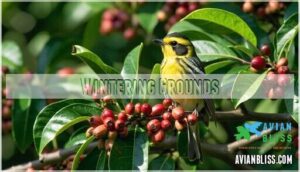
During winter months, these warblers escape to warmer climates across Mexican habitats and Central America.
You’ll find them thriving in tropical forests, mangroves, and pine-oak forests from southern Mexico to Panama.
Coffee plantations provide essential food sources, though habitat threats from deforestation challenge their winter survival in these important wintering grounds.
These birds often utilize areas near coffee plantation locations for foraging and shelter.
Migration Patterns

You’ll witness remarkable migration patterns as Black-throated Green Warblers navigate thousands of miles between breeding and wintering grounds.
These nocturnal migrants follow predictable flight strategies during their epic journeys.
- Migration Routes: Follow eastern flyways through woodland corridors and forest edges
- Stopover Sites: Rest in mixed forests and edge habitats to refuel during long flights
- Timing Factors: Spring migration occurs April-May, fall migration August-September
- Flight Strategies: Travel at night using star navigation and magnetic compass orientation
Behavior and Foraging
You’ll discover that Black-throated Green Warblers are energetic insectivores with specialized hunting techniques perfectly adapted to their forest habitat.
These small songbirds employ a combination of gleaning, hovering, and aerial maneuvers to capture their preferred prey throughout the canopy layers.
Feeding Habits
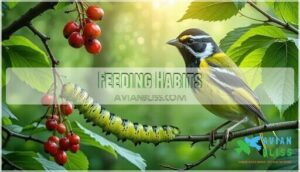
During breeding season, you’ll discover Black-throated Green Warblers exhibiting specialized caterpillar consumption patterns that define their insectivorous diet.
These warbler diet preferences shift dramatically between seasons, showcasing remarkable dietary adaptations.
Males typically forage at greater foraging heights than females, while winter berries supplement their protein-rich menu.
Their avian foraging strategies include aerial hunting when opportunities arise.
Many owners buy caterpillar bird food online.
| Food Type | Season/Behavior |
|---|---|
| Non-hairy caterpillars | Primary breeding diet |
| Beetles, aphids, spiders | Summer foraging targets |
| Poison ivy berries | Migration fuel source |
| Tropical tree proteins | Winter adaptations |
| Flying insects | Occasional aerial catches |
Foraging Techniques
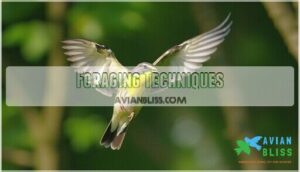
You’ll observe these birds employing diverse avian foraging strategies throughout forest canopies.
Their hovering behavior allows precise insect specialization, particularly for caterpillar consumption from leaf undersides.
Canopy stratification occurs during breeding, with males foraging higher than females.
Mixed-species foraging flocks form in late summer, and they demonstrate aerial hawking techniques, catching insects mid-flight between trees while maintaining their insectivorous diet year-round.
Diet Composition

What drives these vibrant warblers to hunt specific prey? Their diet reflects impressive adaptations across seasons.
Primary Diet Components:
- Non-hairy caterpillars – preferred protein source during breeding season
- Beetles, aphids, and spiders – supplementary arthropods for nutritional needs
- Poison ivy berries – critical winter food when insects become scarce
Their caterpillar preference stems from high protein content essential for reproduction. Seasonal diet shifts show remarkable foraging adaptations as warbler diet composition changes from insect-heavy summer feeding to berry consumption during migration.
Breeding and Reproduction
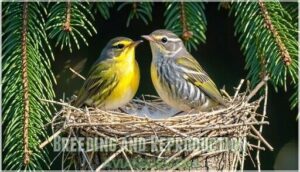
You’ll witness some of nature’s most dedicated parenting when observing Black-throated Green Warblers during their spring and summer breeding season.
These small songbirds follow precise nesting patterns that have evolved to maximize their reproductive success in the coniferous forests they call home.
Nesting Behavior
You’ll find Black-throated Green Warblers construct open cup nests using twigs, grass, bark, and spiderwebs.
Both sexes participate in nest construction, typically placing structures 3-10 feet high in coniferous trees.
Territory defense involves males singing aggressively from perches.
Nest parasitism by Brown-headed Cowbirds affects up to one-third of nests in some regions.
They use a variety of nesting materials for sale.
| Nest Construction | Details |
|---|---|
| Materials | Twigs, grass, bark, spiderwebs, moss |
| Placement | Fork of conifer branches, 3-10 feet high |
| Parasitism Rate | Up to 33% affected by cowbirds |
Egg Characteristics
You’ll discover that Black-throated Green Warbler eggs showcase distinct characteristics that reflect their boreal forest nesting behavior.
These small, delicate structures reveal fascinating adaptations for survival in coniferous environments.
Key egg characteristics include:
- Egg Coloration: Creamy white base with brown speckles concentrated at the larger end
- Clutch Size: Typically 4 eggs, ranging from 3-5 per nest
- Incubation Period: Female incubates for exactly 12 days
- Eggshell Strength: Thin shells vulnerable to cowbird parasitism effects
This contrasts with kestrels, where eggs vary in color.
Parental Care
Once hatching occurs, you’ll witness intense parental care as both male and female Black-throated Green Warblers share feeding hatchlings duties.
The nestling period lasts 8-11 days, with parents making countless trips delivering caterpillars and insects. Males continue territory defense while females focus on brooding.
Despite their dedication, cowbird parasitism threatens up to one-third of nests, reducing brood size and challenging these devoted parents’ breeding habits, which is a significant threat to their breeding habits.
Conservation and Ecology
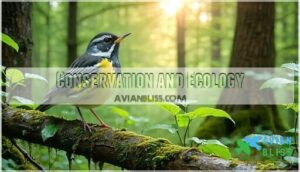
You’ll discover that Black-throated Green Warblers face significant conservation challenges from habitat loss and climate change effects on their breeding grounds.
These small insectivores play vital roles in forest ecosystems by controlling pest populations and interacting with various species throughout their range, highlighting their importance in maintaining ecosystems.
Population Trends
Population trends tell a mixed story for these adaptable warblers.
You’ll find their global population remains stable at 8.7-9.2 million individuals, with some regions actually increasing since 1970.
However, habitat fragmentation severely impacts subspecies like Wayne’s Warbler, which faces devastating 90% declines.
Climate effects and predation impact vary regionally, making conservation efforts essential for maintaining migration success.
The Black-throated Green Warbler is a success story within its family.
Habitat Loss
You’ll notice habitat loss threatens Black-throated Green Warblers through forest fragmentation and deforestation.
Urban sprawl breaks up continuous forest interiors these birds need for successful breeding. Habitat degradation from pesticide use further reduces their survival rates.
- Forest Fragmentation: Roads and development split large forests into smaller patches
- Deforestation: Logging removes mature conifers essential for nesting sites
- Conservation Efforts: Protected areas help maintain critical breeding habitats
Climate Change Impacts
Climate change threatens black-throated green warblers through habitat shifts and breeding changes.
Rising temperatures force populations northward, reducing suitable breeding range by up to seventeen percent.
Migration timing becomes mismatched with food availability as spring arrives earlier.
Extreme weather and forest habitat loss compound these challenges, contributing to population decline and highlighting urgent bird conservation needs.
Maryland’s birds are vulnerable because they may lose over half their range due to climate change.
Role in Ecosystems
You’ll find Black-throated Green Warblers acting as nature’s pest control specialists throughout forest ecosystems.
These insectivorous birds substantially impact habitat biodiversity by maintaining delicate food web dynamics.
- Insect population control – Consume thousands of caterpillars and beetles annually
- Forest health indicator – Their presence signals healthy, mature forest conditions
- Seed dispersal agent – Transport berry seeds during migration periods
- Pest control – Reduce harmful insect outbreaks that damage trees
- Forest regeneration – Support new growth by controlling leaf-eating insects
Their foraging behavior directly influences bird communities and forest regeneration patterns.
Preserving habitats guarantees support for biodiversity.
Interactions With Other Species
You’ll observe complex territorial interactions among black-throated green warblers and competing species.
Mixed flocks with chickadees provide predator avoidance benefits during migration. Cowbird parasitism affects one-third of nests in fragmented areas.
Males display territorial behavior against Blackburnian warblers through aggressive displays. Mixed-species foraging reduces competition by partitioning feeding zones within trees, creating symbiotic relationships that benefit all participants.
Frequently Asked Questions (FAQs)
Are black-throated green warblers rare?
Black-throated green warblers aren’t rare – they’re actually quite common throughout their breeding range in eastern North America’s coniferous forests.
Though brown-headed cowbird parasitism affects up to one-third of nests in some areas.
Where does the Black-throated Green Warbler live?
You’ll discover these vibrant warblers across eastern North America’s coniferous forests, from southern Canada through the Appalachians.
They winter in Central America and Mexico, making epic journeys twice yearly between breeding and wintering grounds, which are an essential part of their annual migration pattern.
What does a Black-throated Green Warbler eat?
Like a tiny feathered vacuum cleaner, you’ll watch these warblers feast primarily on hairless caterpillars, beetles, aphids, and spiders.
They’ll hover beneath leaves, gleaning insects while occasionally snatching berries during migration seasons.
Where does a green warbler live?
You’ll find green warblers thriving in coniferous forests across eastern North America, from Canada’s boreal regions through New England and the Appalachians, with some populations nesting in southern cypress swamps.
What is similar to a Black-throated Green Warbler?
You’ll spot Townsend’s Warbler as the closest match – it shares that bright yellow face and black throat pattern. Bay-breasted and Blackburnian Warblers also show similar coloring during breeding season.
What does the Black-throated Green Warbler eat?
You’ll find these feathered specialists don’t exactly dine on fine cuisine – they’re insect hunters who primarily feast on hairless caterpillars, beetles, aphids, and spiders, with berries during migration.
How long do black-throated green warblers migrate?
You’ll witness these warblers undertake remarkable journeys spanning thousands of miles twice yearly.
They migrate from eastern North American breeding grounds to Central American wintering areas, covering roughly 2,000-4,000 miles each way, which is a thousands of miles journey.
Do black-throated green warblers use birdhouses?
Don’t put all your eggs in one basket – these cavity-nesters won’t use your typical birdhouse.
Black-throated green warblers build open cup nests in conifer branches, preferring natural sites over artificial structures you’d provide.
What are the main predators of this warbler?
Common predators that’ll target you include red squirrels and blue jays, which often raid nests for eggs and nestlings.
Red squirrels are particularly potent nest predators in conifer forests where these birds nest in tall hemlocks.
Do black-throated green warblers ever hybridize?
Black-throated green warblers do hybridize, though it’s relatively uncommon.
You’ll occasionally find hybrids with Townsend’s warblers where their ranges overlap in western Canada, creating intermediate plumage patterns that challenge field identification.
Conclusion
Despite their small size, black throated green warblers prove that effective forest management doesn’t require large birds to make significant ecological impact.
You’ll find these remarkable migrants essential to maintaining healthy coniferous ecosystems through their insectivorous habits.
Their declining populations serve as indicators of forest health changes.
By protecting mature forests and supporting conservation efforts, you’re helping preserve critical breeding habitat.
The black throated green warbler’s survival depends on continued habitat conservation and climate adaptation strategies.
- https://en.wikipedia.org/wiki/Black-throated_green_warbler
- https://columbusaudubon.org/creature-feature-black-throated-green-warbler-setophaga-virens/
- https://maineaudubon.org/wp-content/uploads/2018/03/FFMB-Black-throated-Green-Warbler.pdf
- https://www.borealbirds.org/bird/black-throated-green-warbler
- https://www.allaboutbirds.org/guide/Black-throated_Green_Warbler/lifehistory