This site is supported by our readers. We may earn a commission, at no cost to you, if you purchase through links.

Most birds flee when logging crews arrive, but sooty grouse have a different strategy—they vanish without going anywhere at all. Their mottled plumage blends so perfectly with the shadowy forest floor that you can stand three feet away and never spot one.
These cryptic grouse occupy a narrow ribbon of Pacific Coast mountain forests from Alaska to the Sierra Nevada, where they’ve mastered the art of seasonal migration without traveling far. Instead of flying south for winter, they simply move upslope into the conifers, switching their diet from summer insects to pine needles that most birds can’t digest.
Understanding their identification features, habitat requirements, and declining population trends reveals why protecting old-growth forests matters beyond the trees themselves.
Table Of Contents
- Key Takeaways
- Sooty Grouse Identification and Features
- Sooty Grouse Habitat and Range
- Behavior and Diet of Sooty Grouse
- Nesting and Reproduction
- Conservation Status and Threats
- Frequently Asked Questions (FAQs)
- Are Sooty Grouse rare?
- What is the difference between a spruce grouse and a Sooty Grouse?
- What are some interesting facts about the Sooty Grouse?
- What is the difference between dusky and Sooty Grouse?
- Where do Sooty Grouse live?
- Can Sooty Grouse fly?
- Where can I find Sooty Grouse?
- How do you identify a Sooty Grouse?
- What is the difference between a Sooty Grouse and a ruffed grouse?
- What is another name for the Sooty Grouse?
- Conclusion
Key Takeaways
- Sooty grouse survive through extreme camouflage and vertical migration—moving upslope into conifers each winter to feed on pine needles most birds cannot digest, rather than flying south like typical migrants.
- Their populations have declined roughly 2% annually since 1966 due to old-growth forest loss, climate-driven habitat shifts, and increased predation in fragmented logging areas, making them increasingly vulnerable despite a global population of 2 million.
- Males produce deep ventriloquial hooting calls while displaying bright yellow throat sacs from high conifer perches during breeding season, creating one of the most distinctive yet overlooked courtship displays in North American forests.
- Conservation now focuses on protecting core habitats through prescribed burning and selective thinning to restore understories, combined with radio telemetry tracking to monitor survival rates and translate field data into effective management strategies.
Sooty Grouse Identification and Features
You can spot a Sooty Grouse by learning its key physical traits and distinctive features. Males and females look quite different, and juveniles have their own unique appearance before they mature.
Understanding how feeder types attract different bird species can help you create an environment that draws in Sooty Grouse and other ground-feeding birds to your area.
Here’s what you need to know to identify this chickenlike bird in the wild.
Physical Characteristics

You’ll recognize Sooty Grouse by their heavyset, chickenlike build and compact frame. Adults measure 7 to 9 inches from rump to tail tip.
With three key features for bird species identification:
- Short, sturdy legs feathered down to the toes for cold-weather insulation
- Dense back and wing feathers creating effective feather camouflage in dark understory
- Rounded wings built for quick forest flight, unlike the related Dusky Grouse
Coloration Patterns

Sooty Grouse wear dark brown to sooty black plumage year-round, setting them apart during bird species identification from the paler Dusky Grouse. You’ll spot irregular lighter brown patches across their back and wings—key camouflage strategies in dense conifer forests.
Males maintain uniformly darker feather texture, while females show subtle brown tones for nest concealment. This plumage variation keeps these avian species hidden under forest shadows. The evolution of these plumage patterns demonstrates the role of adaptive advantages of coloration in their survival.
Size and Weight

Beyond those dark feathers, you’ll find that adult Sooty Grouse (Dendragapus fuliginosus)—also called blue grouse or forest grouse—pack considerable heft.
Body Mass Variations range from 0.9 to 1.4 kilograms, with:
- Males usually weighing 1.1 to 1.4 kg
- Females averaging 0.9 to 1.2 kg
- Seasonal Weight Fluctuations of 5 to 15 percent
- Body length spanning 40 to 50 centimeters
- Wingspan stretching 50 to 60 centimeters
This Size Dimorphism affects display behaviors. Growth Patterns show chicks hatching at 40 to 60 grams, reaching adult proportions by season’s end. Morphometric Analysis reveals forest grouse maintain stable weights through forage shifts, distinguishing them from their dusky grouse relatives.
Male Vs. Female Differences
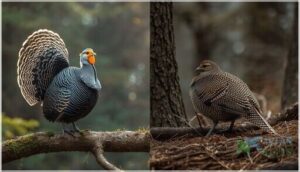
Sexual Dimorphism separates the sexes in ways you won’t miss. Males show steely gray-blue plumage and bright yellow throat patches during Courtship displays, while females wear mottled brown camouflage. Hormone Levels drive these differences—testosterone fuels male territorial hooting and display behaviors, whereas estrogen shapes female nesting instincts.
Brain Structure and Behavioral Traits differ too, with males risking visibility and females prioritizing chick survival through cryptic coloration.
| Feature | Males | Females |
|---|---|---|
| Plumage | Steely gray-blue overall | Mottled brown and buff |
| Throat Patch | Bare yellow (courtship only) | Absent |
| Tail Shape | Darker, squared | Medium length, rounded |
| Display Behavior | Deep hooting, territorial | Silent, cryptic nesting |
| Body Mass | 1.1–1.4 kg | 0.9–1.2 kg |
Juvenile Appearance
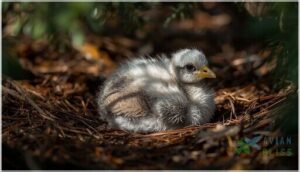
Young sooty grouse chicks wear soft, pale gray down that provides Juvenile Camouflage among leaf litter. You’ll notice yellowish beaks that darken within weeks as Feather Development progresses.
Like adult grouse, these chicks naturally forage for insects and tender greens, mirroring the diverse diet peafowl consume in the wild.
Plumage Patterns emerge gradually—faint speckling hints at adult camouflage while wing coverts shift from soft gray to brownish tones. Eye Formation shows dark brown coloring with lighter periocular regions.
Chick rearing relies on this cryptic appearance for survival in Dendragapus fuliginosus populations.
Sooty Grouse Habitat and Range
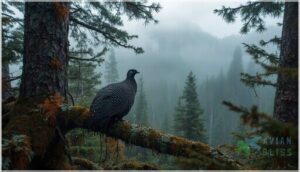
You’ll find Sooty Grouse where the Pacific meets the mountains, from the misty forests of southeastern Alaska down through British Columbia to California’s western slopes.
These birds don’t just pick any forest—they’re tied to specific elevations and tree types that shift with the seasons. Understanding where they live and how they move through the year helps you know exactly where to look.
Geographic Distribution
You’ll find Sooty Grouse clinging to the Pacific Coast’s mountain spine from southeastern Alaska through British Columbia and the Pacific Northwest, down to California’s Sierra Nevada Mountains.
Population Dynamics shift with Habitat Fragmentation across this range, where Geographic Isolation creates distinct subspecies.
Migration Patterns follow elevation rather than latitude, limiting Range Expansion opportunities despite suitable habitats beyond current boundaries.
Preferred Forest Types
Sooty Grouse thrive where old-growth coniferous forests meet mountain slopes, building their lives around dense stands of Douglas-fir, western hemlock, and Sitka spruce. You’ll spot these forest grouse where tree diversity creates layered canopies and forest structure sustains their year-round needs—especially those conifer needles they depend on come winter.
Key Forest Features That Support Sooty Grouse:
- Canopy Complexity – Multi-layered forest structure provides shelter from predators and harsh weather while creating microclimate effects that moderate ground temperatures.
- Abundant Conifers – Dominant evergreen species supply essential conifer needles and buds during winter months when other food sources disappear.
- Rich Understory – Dense shrubs and ground vegetation offer nesting cover, berry production, and invertebrate habitat critical for chick development.
- Soil Profiles – Acidic, organic-rich soils under conifers sustain the plant communities these birds browse.
- Hydrology Systems – Mountain forests with fog drip and consistent moisture maintain the lush vegetation and cool microclimates that define ideal grouse habitat.
Forests are distinguished by factors such as species composition and tree density, which influence habitat quality for many bird species including Sooty Grouse.
Elevation Range
You’ll encounter Sooty Grouse across a notable vertical range—from low montane forests around 900 meters to subalpine zones pushing past 2700 meters.
Habitat elevation shapes everything: snow line effects drive winter refugia choices, while elevation proximity to berry-rich slopes dictates summer foraging. These mountain ecosystems create layered niches along mountain slopes, where altitude migration and elevation migration patterns reflect the birds’ mastery of vertical mountain forests.
Seasonal Movements
These birds don’t wander far—instead, you’ll track them through short elevation shifts of 300 to 900 meters along the same forested slopes.
Migration patterns follow seasonal changes: Sooty Grouse climb upslope in spring chasing fresh buds, then descend in autumn as weather cues signal harsher conditions ahead.
Foraging strategies and habitat tracking reveal altitude migration tied directly to food availability and forest ecology rhythms.
Behavior and Diet of Sooty Grouse

Understanding what Sooty Grouse eat and how they behave gives you real insight into their survival strategy across mountain forests.
Their feeding patterns shift dramatically with the seasons, and their territorial displays are some of the most striking you’ll encounter in North American grouse. Here’s what you need to know about their daily routines, diet, and social dynamics.
Feeding Habits
You’ll notice sooty grouse shift their food sources dramatically with the seasons—spring brings tender willow and aspen leaves, while late summer means huckleberries and other berries fuel fat reserves.
Their foraging strategies center on nutrient intake through deciduous shoots, conifer needles in winter, and insects during breeding. These dietary adaptations match plant phenology, ensuring ideal avian diet and nutrition year-round.
Foraging Techniques
When you’re watching these grouse forage, you’ll see deliberate ground scanning paired with sharp edible plant identification skills. Their foraging strategies blend careful movement through leaf litter with upward glances into shrubs where insects and berries cluster.
- They scan forest floors methodically, targeting food source location near cover
- Mid-level shrubs offer berries and insects during growing seasons
- Seasonal foraging patterns shift focus from ground plants to conifer branches
- Diet flexibility ensures year-round feeding behavior success
Seasonal Diet Changes
You’ll notice dramatic dietary adaptations as seasons turn. Summer’s bounty of berries and insects shifts to winter feeding on conifer needles and buds—mainly Sitka spruce and hemlocks.
These nutrient shifts mirror food availability across the Pacific Coast forests. Seasonal foraging patterns show the Sooty Grouse’s impressive flexibility, switching from ground-level plants to mid-canopy branches when snow blankets their mountain home.
Social and Territorial Behaviors
Beyond feeding, Sooty Grouse display complex territorial dynamics during breeding season. Males gather at lekking sites on ridgelines, defending display perches through booming calls and aggressive chases. Females visit multiple leks for mate selection, evaluating display strategies before choosing.
Key social hierarchy elements include:
- Males establish dominance through vocal intensity and display duration
- Territorial boundaries span several square kilometers
- Site fidelity keeps birds returning to proven locations
- Seasonal movements reset breeding territories annually
Nesting and Reproduction

In the context of raising the upcoming crop of young, female Sooty Grouse take on the entire job themselves. They don’t rely on flashy nests or protective partners—just clever placement, quick incubation, and chicks that are ready to move almost immediately.
Here’s what you need to know about how these birds handle nesting and reproduction.
Nest Placement and Construction
You’ll find female Sooty Grouse nesting under fallen logs or rock ledges in coniferous forests, where site selection prioritizes camouflage and insulation.
She gathers moss, conifer needles, and rootlets from nearby to build the cup—usually 3 to 5 centimeters deep and 6 to 12 centimeters across. Material sourcing happens close by, minimizing scent trails that predators could follow.
Egg Characteristics
Sooty Grouse eggs show pale buff coloration with fine brown speckles—natural camouflage against forest debris. You’ll count 5 to 10 eggs per clutch, sometimes up to 12 in ideal conditions.
- Egg Shell Structure: Calcium carbonate forms the porous outer layer, allowing gas exchange for embryo development while the cuticle coating blocks bacteria.
- Yolk Formation: Fat-rich yolk provides essential nutrients, comprising roughly 30 percent of each egg’s total weight.
- Albumen Composition: Clear protein layers cushion the yolk, making up about 60 percent of the egg with 90 percent water content.
Incubation Period
Patience defines reproductive biology in Sooty Grouse, as females alone handle egg incubation spanning 25 to 28 days. You’ll find her motionless on the nest, relying on camouflage while embryos develop inside those pale buff eggs.
Temperature regulation proves critical, she maintains consistent warmth throughout breeding cycles, directly influencing hatchling survival and overall nesting success in these mountain forests.
Chick Development and Care
Within hours of hatching, young Sooty Grouse demonstrate impressive independence. You’ll observe precocial chicks following their mother to forage immediately, feeding themselves without parental assistance.
Feather development progresses rapidly, enabling flight within just over a week. The female provides brooding warmth and protection while monitoring health, but chick nutrition depends entirely on their ability to locate insects, berries, and tender vegetation independently during this critical fledgling care period.
Conservation Status and Threats

The Sooty Grouse isn’t facing extinction, but its future isn’t entirely secure either.
Population numbers have been slipping over recent decades, driven by habitat loss, climate shifts, and human activity across its coastal range.
Understanding these threats and ongoing conservation work helps you grasp what this species is up against and what’s being done to protect it.
Population Trends
Wildlife conservation data paints a sobering picture for the Sooty Grouse population trends across North America. The global breeding population sits at roughly 2 million birds, but decline rates hover around 2 percent annually from 1966 to 2014. While you’ll still find them secure globally, their range in the contiguous United States tells a different story—vulnerability creeps in as habitat fragmentation and demographic shifts reshape their world.
- Decline rates average 2 percent per year over nearly five decades of monitoring
- Population growth has stalled in southern portions of their historic range
- Species migration patterns may shift as climate alters seasonal movements
- Habitat fragmentation from logging creates temporary gains but long-term losses
- Demographic shifts toward older forests reduce suitable nesting areas for breeding adults
Threats to Survival
You’re watching a species caught in a tightening vise. Habitat fragmentation from logging splits breeding territories, while predation risk climbs in disturbed forests where weasels and raptors exploit exposed nests.
Sooty Grouse face mounting threats as logging fragments their habitat and predators exploit disturbed forests
Food scarcity intensifies when droughts shrink understory plants and insects vanish. Extreme weather—deep snow, late frosts—drains energy reserves.
Human disturbance from recreation and development compounds these conservation status and threats to Sooty Grouse survival.
Impact of Climate Change
Climate shifts rewrite the rules for Sooty Grouse habitat and range. Rising temperatures push nesting zones upslope, shrinking available terrain.
Weather extremes—prolonged droughts and erratic snowfall—disrupt the Sooty Grouse life cycle and behavior by depleting conifer buds and insects. Ecosystem disruption alters plant phenology, throwing off chick-rearing timing.
Climate change compounds existing conservation status and threats to Sooty Grouse, accelerating population declines.
Conservation Efforts and Research
Protecting Sooty Grouse demands action, not just concern. Conservation planning now targets core habitat restoration across 15 percent of their forested range, rebuilding understories through prescribed burning and selective thinning. Species monitoring uses radio telemetry and brood surveys to track survival. Research collaboration between agencies translates field data into wildlife management guidelines, bridging conservation biology with boots-on-the-ground habitat conservation.
- Protected area networks safeguard nesting sites and winter refuges
- Annual population models project trends from nest success data
- Multiagency working groups coordinate avian conservation efforts across jurisdictions
Frequently Asked Questions (FAQs)
Are Sooty Grouse rare?
They’re not rare globally, with about 2 million birds breeding across their Pacific range. However, populations have declined roughly 2 percent annually since 1966, making conservation status increasingly concerning in certain regions.
What is the difference between a spruce grouse and a Sooty Grouse?
Think of two cousins living in different worlds: spruce grouse haunt Canada’s boreal forests with slate-gray bodies and red eye combs, while Sooty Grouse rule Pacific coastal mountains, flaunting blue-gray plumage and bright yellow neck sacs.
What are some interesting facts about the Sooty Grouse?
You’ll notice their deep, ventriloquial hooting calls echo through Pacific Coast forests during courtship—a unique avian communication method.
Males inflate colorful throat sacs while perched high in conifers, demonstrating extraordinary wildlife adaptations within forest ecosystems.
What is the difference between dusky and Sooty Grouse?
Distinguishing Sooty Grouse from Dusky Grouse requires careful bird identification: look for plumage differences like Sooty’s broad gray tail band versus Dusky’s dark tail, plus yellow neck sacs instead of purplish-red during displays.
Where do Sooty Grouse live?
You’ll find these grouse across western North America’s conifer forests, from southeastern Alaska down through coastal British Columbia, Washington, Oregon, and into California’s Sierra Nevada—always where mountain terrain meets dense forest cover.
Can Sooty Grouse fly?
Yes, you’ll see Sooty Grouse fly, but their wing structure limits them to short, powerful bursts through dense forests.
They rely on explosive takeoffs and forest navigation rather than sustained flight patterns typical of migratory birds.
Where can I find Sooty Grouse?
You’ll find them in old-growth coniferous forests along the Pacific Northwest coast—from southeastern Alaska through British Columbia to California.
Search forest edges, mountain trails, and coastal areas where wet conifers meet dense understory.
How do you identify a Sooty Grouse?
You can identify this bird by its heavy, chickenlike build and steely gray-blue plumage in males, while females show intricate brown-and-buff mottling. Males display bright yellow neck sacs during courtship.
What is the difference between a Sooty Grouse and a ruffed grouse?
Two game birds share the woods, yet their worlds barely touch—ruffed grouse thrive in deciduous lowlands while sooty grouse haunt high-elevation conifers, their dark plumage and subtle belly barring creating clear species distinction through habitat overlap.
What is another name for the Sooty Grouse?
You’ll encounter the Blue Grouse name in older field guides before taxonomic history split this species from Dusky Grouse.
Regional classifications also reference it as Dendragapus fuliginosus or western Blue Grouse.
Conclusion
You’ll likely never see a sooty grouse even when you’re staring directly at one—that’s how effectively they’ve adapted to disappear.
Yet their invisibility can’t protect them from what they can’t hide from: vanishing old-growth forests and warming climates.
Your ability to identify these birds, understand their upslope migrations, and support habitat conservation determines whether future hikers will hear those deep hooting calls echoing through mountain conifers or find only silence.