This site is supported by our readers. We may earn a commission, at no cost to you, if you purchase through links.
You spot a gray-and-white hawk tearing through your backyard—then freeze. Was that a Cooper’s or a Sharp-shinned? Even experienced birders struggle with this ID challenge because these two Accipiter hawks look remarkably similar at first glance.
Females of one species can match males of the other in size, their plumage patterns overlap, and both species hunt the same woodland territories with breathtaking speed. The difference comes down to subtle but reliable field marks: tail shape, head proportions, body build, and flight style.
Once you know what to look for—a rounded versus square tail tip, a barrel chest versus a compact frame—these “twin” raptors reveal distinct personalities that make identification surprisingly straightforward.
Table Of Contents
- Key Takeaways
- Key Physical Differences Between Cooper’s and Sharp-shinned Hawks
- Identifying Cooper’s Hawks in The Field
- Identifying Sharp-shinned Hawks in The Field
- Flight Patterns and Behavior Differences
- Practical Tips for Accurate Hawk Identification
- Frequently Asked Questions (FAQs)
- How do you identify a Sharp-shinned Hawk?
- What is a Cooper’s Hawk called now?
- What hawk is similar to Cooper’s Hawk?
- How rare is it to see a Cooper’s hawk?
- What hawk is similar to the Cooper’s hawk?
- How to tell the difference between a Cooper’s hawk and a Sharp-Shinned?
- How do I identify a Cooper’s hawk?
- What is the difference between a northern Goshawk and a sharp-shinned hawk?
- What is the difference between a Cooper’s hawk and a northern Harrier?
- What are their preferred hunting techniques and prey?
- Conclusion
Key Takeaways
- Cooper’s Hawks show a rounded tail tip, barrel-chested build, and blocky head with sharp crown-to-nape contrast, while Sharp-shinned Hawks display a square tail tip, compact teardrop body, and flatter head with uniform cap coloring.
- Size alone fails as a reliable identifier because male Cooper’s Hawks can match female Sharp-shinned Hawks in dimensions—you’ll need to combine multiple field marks like tail shape, head projection, and body silhouette for accurate identification.
- Flight style reveals distinct personalities: Cooper’s Hawks use slower wingbeats (4-6 per second) with more gliding between perches, while Sharp-shinned Hawks maintain rapid strokes (6-8 per second) for weaving through dense branches.
- Observing both perched and flying birds gives you the complete picture—perched views showcase head shape and tail proportions clearly, while flight reveals wingbeat rhythm and maneuverability differences that cement your ID.
Key Physical Differences Between Cooper’s and Sharp-shinned Hawks
You’ve got a Cooper’s and a Sharp-shinned Hawk in front of you—now what? These two accipiters can look maddeningly similar at first glance, but once you know what to look for, the differences pop.
If you’ve ever confused these two, you’re not alone—but spotting the nuances gets easier once you understand how size and proportions distinguish similar raptor species.
Let’s break down the key physical traits that’ll help you nail the ID every time.
Size and Wingspan Comparison
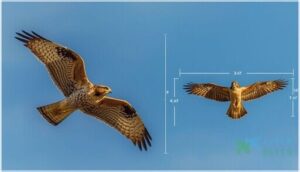
Size matters—and wingspan tells the real story. Cooper’s Hawks command the sky with wings stretching 24 to 39 inches, roughly double the Sharp-shinned’s modest 9.5 to 14 inches. That’s crow versus bluejay territory!
- Wing measurement reveals species distinction: Cooper’s averages 30+ inches, Sharp-shinned stays under 15
- Size variation between sexes complicates hawk identification—females outsize males by a third
- Flight comparison shows Cooper’s broader, more powerful hawk silhouette versus Sharp-shinned’s compact frame
Wings show impressive adaptations across birds, highlighted by that provides both lift and maneuverability.
Body Shape and Silhouette
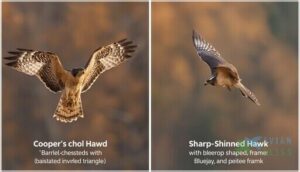
Beyond wingspan, you’ll spot the difference in overall profile. Cooper’s Hawks show that barrel-chested, sturdy silhouette—shoulders broad, chest pronounced, creating an inverted triangle that tapers gently toward the tail. Sharp-shinned Hawks? More compact and teardrop-shaped, with a slimmer body that looks almost delicate in comparison.
| Feature | Cooper’s Hawk | Sharp-shinned Hawk |
|---|---|---|
| Upper torso | Broad, barrel-shaped chest | Compact, teardrop silhouette |
| Body proportions | Muscular frame, defined shoulders | Slender body, narrower shoulders |
| Overall profile | Inverted triangle, crow-sized | Sleek, bluejay-sized |
This silhouette analysis becomes your secret weapon for Accipiter bird identification—especially when size alone won’t cut it!
Head Shape and Cap Contrast
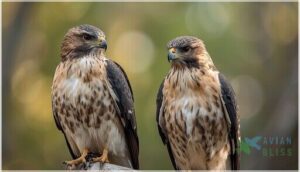
The crown tells a story all its own. Cooper’s Hawks rock that rounded crown with a sharp two-tone cap—darker up top with a pale nape contrast that practically screams “look at me!” You might even catch a lighter eyebrow area adding extra drama.
Sharp-shinned Hawks? Flatter head, uniform cap patterns that blend into the neck without fanfare.
- Cooper’s crown coloration creates distinct facial markings with contrasting tones
- Sharp-shinned’s cap blends seamlessly—no eyebrow tricks here
- Head proportions differ: Cooper’s rounded versus Sharp-shinned’s flatter profile
- Nape contrast becomes your quick-read field mark for Cooper’s Hawk identification
Tail Shape and Proportions
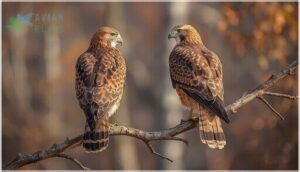
Tail geometry becomes your secret weapon once you’ve checked the head. Cooper’s Hawk flaunts a longer, rounded tail—about 3-4 inches more in adults—with bold, evenly spaced bands creating dramatic feather patterns.
These proportions mirror patterns seen in courtship-driven species with exceptionally long tails, where tail length signals fitness and breeding readiness.
Sharp-shinned has a square-tipped tail, compact, with thinner bands. That tail length difference shapes the entire silhouette in flight, giving Coopers that elongated barrel-chested look while Sharpshinned appears teardrop-compact—critical for nailing these tricky Accipiter hawk species.
Identifying Cooper’s Hawks in The Field
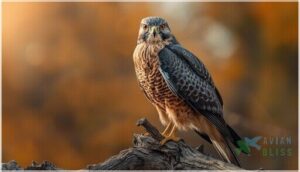
When you spot a Cooper’s Hawk in the wild, you’re looking at a crow-sized predator with an attitude—and a few telltale features that set it apart from its smaller cousin.
Getting the ID right comes down to knowing what to look for, from that blocky head to the way it carries itself on a branch. Let’s break down the key field marks that’ll help you nail the identification every time.
Adult Plumage and Coloration
You’ll spot an adult Cooper’s Hawk by its stunning slate-gray upperparts—think of it as nature’s elegant color palette.
The plumage patterns reveal key details:
- Warm orange to rufous chest with fine vertical brown streaks
- Bold, rounded orange facial patch extending from eye to throat
- Broad dark subterminal bands on rounded tail feathers
- Strong contrast between the dark crown and gray nape
These distinctive feather textures and tail markings make identification much easier than you’d expect.
Juvenile Identification Features
When you’re dealing with juvenile Cooper’s Hawks, look for that pale buffy crown with its faint eye line—it’s subtler than you’d expect. The breast shows brownish streaks (not the fine, dense patterns of a juvenile Sharp-shinned Hawk), and the tail feathers display fainter banding with a squared tip.
During molting stages, these Accipiter facial markings gradually sharpen, transforming your raptor identification challenge into something more manageable.
Size Relative to Common Birds
When you spot a Cooper’s Hawk perched in your backyard, picture a crow—that’s the ballpark size (14 to 20 inches, wingspan pushing 39 inches). Cooper’s Hawks tower over songbirds like sparrows.
Sharp-shinned Hawks? Think bluebird-to-robin dimensions (9 to 12 inches). Sharp-shinned Hawks sit closer to thrush-sized—a critical size difference when distinguishing these bird species mid-flight.
It’s important to remember that factors affecting size perception can make field identification more challenging than it appears.
Distinctive Head and Nape Markings
Look for that striking black cap—Cooper’s Hawk head marking contrast is your secret weapon. The crown coloration cuts sharply against a lighter gray nape, creating a two-toned effect.
This nape patch variations tell the real story: Cooper’s shows a bold, horizontal band (nape shape geometry matters!), while Sharpshinned Hawk blends more subtly. Adult marking pattern types deliver clearer signals than juveniles for reliable Accipiter hawk ID and raptor identification.
Identifying Sharp-shinned Hawks in The Field
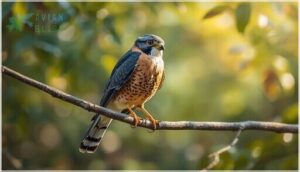
Sharp-shinned Hawks are like the scrappy younger siblings of the accipiter family—smaller, quicker, and built for tight-space aerobatics. You’ll need a sharp eye (pun intended) to separate them from Cooper’s Hawks, especially when size isn’t obvious.
Let’s break down the key features that’ll help you confidently ID a Sharp-shinned Hawk when it zips through your yard or streaks across the treetops.
Adult and Juvenile Plumage Differences
Here’s how you separate juveniles from adults in Sharp-shinned Hawks using plumage patterns and age identification. Juvenile Accipiters show streaky, brownish underparts and mottled crowns—think messy teenager phase!
Adults sport clean blue-gray backs and reddish barring below (that’s feather molting at work). The cap contrast sharpens, facial markings crisp up, and those wing coverts lose their buff fringes through maturity stages.
Color variation matters more than you’d think.
Compact Body Structure
Sharp-shinned Hawks pack a teardrop silhouette that screams agility—compact design meets flight efficiency in one sleek Accipiter package. That tighter rib cage spacing boosts structural integrity during those crazy woodland sprints, while the shorter torso cuts yaw inertia (fancy talk for “turns on a dime”).
The aerodynamic shape and body proportions differ noticeably from Cooper’s Hawk’s barrel-chested build, giving Sharpies their signature quick-twitch maneuverability through branches.
Size Compared to Familiar Birds
Want a quick hawk species comparison? Think sparrow-to-thrush scale—Sharp-shinned Hawks stretch about 24-34 cm (roughly thrush-length), way smaller than Cooper’s Hawk’s heftier build.
That wing span analysis? Just 52-81 cm versus Cooper’s broader 74-94 cm spread. Body mass variance hits hard: Sharpies weigh 70-125 grams while their crow-sized cousins pack 265-510 grams.
Bird identification techniques often start with these length proportions and feather length measurements for good reason!
Key Distinguishing Characteristics
Beyond hawk size and tail length, zero in on that distinctive cap—Sharp-shinned Hawks sport a darker crown that really pops against their pale face, plus a bolder malar stripe.
Eye color stays yellow-orange (like Cooper’s), but check the beak shape: it’s noticeably less sturdy.
Plumage patterns reveal heavily striped breasts in adults, while their flight style screams agility through tight cover.
Flight Patterns and Behavior Differences
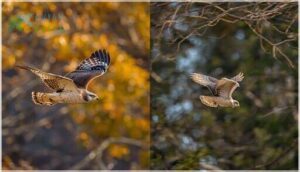
Watching these hawks in flight patterns is where the magic happens—you’ll see differences that aren’t obvious when they’re perched.
Their wingbeat patterns, hunting tactics, and how they move through trees can give you those “aha!” moments for confident IDs. Let’s break down the flight clues that’ll help you tell them apart in the field.
Wingbeat Speed and Rhythm
Once you’ve nailed down size and shape, watch how these hunters move through the air—wingbeat frequency tells a surprisingly clear story. Cooper’s Hawk averages 4-6 beats per second with deliberate, powerful strokes, while Sharp-shinned Hawk zips along at 6-8 beats per second in tight, rapid bursts.
Here’s what to watch for:
- Cooper’s shows slower, steadier wing movement with larger vertical sweeps
- Sharp-shinned delivers quicker, tighter strokes for maximum maneuverability
- Flight rhythm changes with conditions—headwinds slow both species noticeably
- Energy efficiency varies: Cooper’s glides more; Sharp-shinned maintains high tempo
- Aerodynamic power output increases dramatically when either hawk accelerates toward prey
That faster flight pattern helps Sharp-shinned Hawks weave through dense branches chasing songbirds, while Cooper’s Hawk uses broader sweeps between open perches—a real difference you’ll notice once you know what you’re looking for.
Flight Silhouette and Posture
Beyond wingbeat rhythm, watch how each hawk carries itself in flight—silhouette comparison reveals posture differences you can spot from a distance.
Cooper’s Hawk holds wings level with a broad chest and longer tail (6-7 inches), creating that classic crow-sized profile. Sharp-shinned Hawk shows a compact teardrop shape with narrower wing angles and tighter body alignment, making size difference and flight style instantly recognizable once you’ve seen both.
Hunting Strategies and Habitat Use
Habitat adaptation shapes how these accipiters hunt—Cooper’s Hawk stakes out woodland edges and open forests, using ambush tactics from concealed perches to nail larger prey like doves.
Sharp-shinned Hawk prefers fragmented cover with dense understory, relying on flight pursuit through gaps to intercept finches and sparrows mid-air.
Forest hunting strategies differ: one waits, one chases—matching prey selection to each hawk’s physical strengths.
Maneuverability Through Trees
Through tight tree navigation, both accipiters showcase impressive flight agility—but Cooper’s Hawk uses its barrel-shaped torso and longer tail to execute broader forest maneuvers, while Sharp-shinned Hawk relies on its compact, teardrop body for tighter branch weaving during aerial pursuit.
Watch how each accipiter tilts, fans its tail, and adjusts wing strokes mid-chase—these woodland habitats demand split-second precision, and flight style reveals identity.
Practical Tips for Accurate Hawk Identification
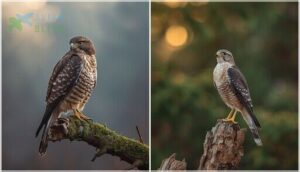
Here’s the truth—nailing down whether you’re looking at a Cooper’s Hawk or a Sharp-shinned Hawk isn’t about finding one magic clue. You need a toolbox of tricks, not a single key.
Let’s break down the practical strategies that’ll make you sharper (pun intended) in the field.
Using Multiple Identification Factors
Don’t stake your reputation on a single field mark—hawk identification demands layering clues like size, plumage patterns, and bird behavior.
Combine wingspan estimates with head shape, tail proportions, and flight style for reliable species differentiation. When you cross-check multiple identification tips (body silhouette plus cap contrast, for instance), you’ll nail raptor identification with confidence and minimize those frustrating “maybe” sightings.
Sex and Size Variation Challenges
Here’s the puzzle: sexual size dimorphism means a male Cooper’s Hawk can match a female Sharp-shinned Hawk—so size alone betrays you.
Size alone fails when male Cooper’s Hawks match female Sharp-shinned Hawks in dimensions
Measurement errors (up to 6% for wing length) and ecological factors like prey availability shift body mass by 15–25% daily.
Size overlap between species creates identification bias, forcing you to lean harder on field marks like head projection and tail shape for reliable Hawk ID.
Observing Perched Versus Flying Birds
Perched birds offer gold-standard views—that silhouette cue of a Cooper’s Hawk’s blocky head versus a Sharp-shinned Hawk’s rounded dome jumps out from any perch vantage.
Watch for flight readiness: wing trembles before launch reveal tail shape instantly. In flight, behavioral context matters—Cooper’s steady wingbeats contrast Sharp-shinned’s erratic flapping.
Both views together clinch species differentiation every time.
Frequently Asked Questions (FAQs)
How do you identify a Sharp-shinned Hawk?
Here’s the deal: spotting a Sharp-shinned Hawk means looking for a tiny, compact raptor with bold streaking on juveniles, square-tipped tail, small head, thin eyebrow, and striking eye coloration—essential hawk identification tips.
What is a Cooper’s Hawk called now?
Cooper’s Hawk still goes by Cooper’s Hawk—no name changes here.
The species retains both its common name and scientific classification, Accipiter cooperii, in current bird nomenclature and taxonomy updates across all official field guides.
What hawk is similar to Cooper’s Hawk?
When you’re out birding, Sharp-shinned Hawks are the raptor identification challenge you’ll face most often—these small Accipiters share nearly identical plumage patterns, hunting tactics, and forest habitats with Cooper’s Hawks.
How rare is it to see a Cooper’s hawk?
You’ll spot Cooper’s Hawks regularly if you’re near woodlands or suburban areas with mature trees—they’re not rare, especially during fall hawk migration when seasonal trends boost bird sightings along major flyways.
What hawk is similar to the Cooper’s hawk?
Which raptor shares the Cooper’s hawk’s hunting tactics and forest ecology? The Sharp-shinned Hawk is the most similar North American accipiter—both species patrol bird feeders, navigate dense woodland, and exhibit comparable wing structure during hawk migration.
The Sharp-shinned Hawk and Cooper’s hawk have similar behaviors, including patrolling bird feeders and navigating dense woodland.
How to tell the difference between a Cooper’s hawk and a Sharp-Shinned?
Size matters—Cooper’s Hawks are crow-sized with rounded tails, while Sharp-shinned Hawks match bluejays with squared-off tails.
Wing structure and head projection during hawk migration also reveal identity at bird feeders.
How do I identify a Cooper’s hawk?
Look for Cooper’s Hawk identification marks: crow-sized body, rounded tail with thick bands, pronounced dark cap contrasting pale nape, and blue-gray back with rusty-barred chest near your bird feeder or forest habitat.
What is the difference between a northern Goshawk and a sharp-shinned hawk?
Northern Goshawks dwarf Sharp-shinned Hawks—wingspans reach 43-55 cm versus 17-23 cm.
Goshawk habitat overlaps with these smaller raptors during hawk migration, but their bulkier build makes raptor identification straightforward when using proper bird identification techniques.
What is the difference between a Cooper’s hawk and a northern Harrier?
If you’re comparing apples to oranges, Cooper’s hawks and northern harriers are practically different fruits.
Cooper’s hawks hunt in forests with rapid wingbeats; harriers glide low over marshes with distinctive white rumps and owl-like faces.
What are their preferred hunting techniques and prey?
Both raptors rely on ambush tactics and flight precision to capture small birds.
Cooper’s Hawks favor perch-based surprise strikes on medium passerines, while Sharp-shinned Hawks weave through dense foliage targeting lighter, more agile songbirds.
Conclusion
Think of the Cooper’s hawk vs sharp-shinned hawk puzzle as a locked door—you already hold the key. Tail shape, head size, body build—they’re your field marks now.
Next time that blur rockets past your feeder, you won’t hesitate. You’ll note the squared tail or barrel chest and name your visitor with confidence. The trickiest raptor ID in North America just became your specialty. Now get out there and prove it.