This site is supported by our readers. We may earn a commission, at no cost to you, if you purchase through links.
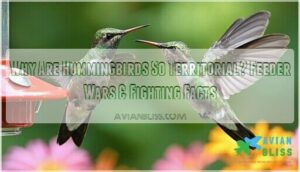 If you’ve ever wondered why are hummingbirds so territorial, you’re not alone.
These little dynamos guard their food like a dragon hoarding treasure. Nectar doesn’t last long in the wild, so hummingbirds stake their claim on flowers—and your feeder—chasing off any rival who dares buzz too close.
It’s not just stubbornness; defending food means they get the energy to survive and thrive. Even the tiniest bird can act tough when its snack is on the line!
Curious about why they sometimes fight more in certain yards, or how feeder wars start? The details might surprise you.
Table Of Contents
- Key Takeaways
- Hummingbird Territorial Behavior
- Why Hummingbirds Are Territorial
- Territorial Aggression Causes
- Hummingbird Feeder Conflicts
- Reducing Hummingbird Aggression
- Hummingbird Gender Roles
- Environmental Factors Influence
- Minimizing Feeder Conflicts
- Frequently Asked Questions (FAQs)
- Why do hummingbirds fight each other?
- Why do hummingbirds chase each other?
- Why are hummingbirds more territorial?
- Do hummingbirds fight for territory?
- Are male hummingbirds territorial?
- Are ruby-throated hummingbirds territorial?
- How to make hummingbirds less territorial?
- Why do hummingbirds chase each other off feeders?
- Why put aluminum foil around a hummingbird feeder?
- Why are hummingbirds so territorial to humans?
- Conclusion
Key Takeaways
- You’re witnessing pure survival instinct – hummingbirds defend feeders and flowers because their tiny bodies need constant fuel, making every nectar source worth fighting for to stay alive.
- Males become fierce territory guards during breeding season – they’ll aggressively chase away rivals from prime feeding spots to secure mating rights and control the best real estate.
- You can reduce feeder wars by spacing multiple feeders 15+ feet apart – this overwhelms a single bird’s ability to control all food sources and forces territorial birds to choose which areas to defend.
- Creating diverse food sources with native plants reduces aggression – planting nectar-rich flowers like bee balm throughout your yard gives hummingbirds natural alternatives to artificial feeders, leading to more peaceful coexistence.
Hummingbird Territorial Behavior
You’ve probably watched hummingbirds turn your peaceful backyard feeder into a battlefield, with these tiny warriors chasing each other away like miniature fighter jets.
This territorial behavior isn’t just random aggression—it’s a survival strategy rooted in their need to secure food sources, protect breeding areas, and maintain dominance in their small but fiercely defended territories.
Food Source Defense
When defending their precious nectar, hummingbirds transform into fierce little warriors. Their survival instincts kick in as they guard food sources with relentless energy conservation tactics.
You’ll witness hummingbird territoriality through nectar defense behaviors like dive-bombing and aggressive chasing. This resource guarding isn’t personal—it’s pure survival, as these tiny birds must protect their lifeline to maintain their lightning-fast metabolism.
This behavior is most intense during the summer nesting season, as these birds prioritize their survival above all else, making them relentless defenders of their nectar sources.
Breeding and Nesting
During mating season, males establish breeding territories like tiny kingdoms, aggressively chasing intruders to control prime real estate.
Male hummingbirds patrol their tiny kingdoms, fiercely defending the best real estate from every daring intruder.
They’re not just protecting feeders—they’re securing mating rights and nest site selection areas.
Females become fiercely territorial around nesting spots, defending eggs and chicks with surprising intensity.
This territorial behavior peaks during breeding season when stakes couldn’t be higher, and it’s all about securing the best spots for nesting and breeding.
Gender Dynamics
You’ll notice clear differences between male and female hummingbird aggression patterns.
Male dominance peaks during mating season as they fight for mating rights and prime feeding spots.
Female aggression intensifies around nesting defense, protecting eggs and chicks.
These seasonal shifts in hummingbird territoriality mean male hummingbirds typically show more consistent aggression, while female hummingbirds become fiercely territorial when breeding.
Some females are evolving male hummingbird mimicry to reduce attacks.
This behavior is a notable example of adaptive strategies in hummingbirds.
Why Hummingbirds Are Territorial

You’ve witnessed those aerial battles at your feeder, but understanding what drives this fierce hummingbird territoriality reveals fascinating survival instincts.
These tiny warriors aren’t just being cranky – they’re following evolutionary drivers that have kept their species alive for millions of years.
Individual personalities play a huge role too, with some hummingbirds being naturally more aggressive than others, creating complex social hierarchies around your yard.
Mating rights, prime feeding spots, and territorial birds’ need to control resources all stem from one simple fact: in nature, the aggressive hummingbirds often survive while the passive ones don’t.
Understanding their aggressive displays and warnings is key to interpreting their behavior, which is essentially bird territoriality at its most primal level.
Territorial Aggression Causes
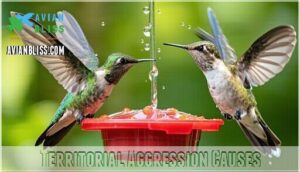
You’ll discover that hummingbird territorial aggression stems from three main survival pressures that drive their fierce feeder battles.
Their tiny bodies require constant fuel, making every nectar source worth defending against competitors who could mean the difference between life and death.
Resource Competition
You’ll witness intense Competition Intensity when multiple hummingbirds discover your feeder.
These territorial birds create a pecking order, with dominant individuals claiming Exclusive Rights to prime Feeding Space. Resource competition drives hummingbird aggression as they fight for Nectar Dominance. Even with Abundant Nectar available, bird behavior remains fiercely competitive.
Here’s what fuels feeder wars:
- Limited perching spots – Only so many birds can feed simultaneously
- Prime feeding positions – Some ports offer better access than others
- Visibility advantages – Dominant birds scout from strategic perches
- Energy conservation – Fighting for closest, easiest food sources
- Instinctual hoarding – Natural drive to secure resources despite artificial abundance
Finite Food Sources
In nature’s economy, you can’t create nectar from thin air.
Natural flowers produce limited amounts of nectar daily, making each bloom a precious commodity worth defending fiercely.
| Natural Food Source | Daily Nectar Production | Competition Level | Energy Expenditure | Survival Impact |
|---|---|---|---|---|
| Single Trumpet Vine | 2-3 milliliters | High | Moderate | Critical |
| Bee Balm Cluster | 1-2 milliliters | Very High | High | Essential |
| Cardinal Flower | 0.5-1 milliliter | Extreme | Very High | Critical to existence |
| Hummingbird Feeders | Unlimited Supply | Variable | Low | Supplemental |
| Territory Boundaries | Mixed Sources | Intense | Maximum | Life-or-Death |
This scarcity drives hummingbird aggression and bird territoriality, as each nectar source represents survival itself.
Offering high fat content seeds can also reduce territorial disputes by providing supplemental nutrition.
Predator Avoidance
While territorial behavior helps hummingbirds secure food, it’s also their secret weapon against predators.
When you’re barely larger than a ping-pong ball, every advantage counts in the survival game.
Here’s how territoriality boosts their predator avoidance:
- Vigilance behavior increases as they monitor their territory for threats while defending resources
- Camouflage strategies work better in familiar territory where they know every hiding spot
- Flight patterns become more evasive when defending space, confusing potential attackers
- Alarm calls alert other birds while establishing territorial boundaries through aggressive displays
- Nest concealment improves when females control territories with ideal cover and escape routes
Hummingbird Feeder Conflicts
You’ve likely noticed that your backyard hummingbird feeders can turn into battlegrounds, with these tiny birds chasing each other away in dramatic aerial displays.
The concentrated nectar in artificial feeders triggers the same territorial instincts that drive hummingbirds to fiercely defend flower patches in the wild, creating intense competition even when there’s plenty of sugar water to go around, driven by their natural instinct to defend concentrated nectar and dramatic aerial displays.
Feeder Design Impact
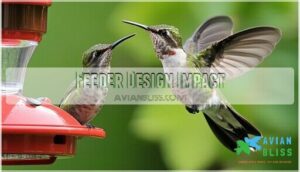
Four key feeder design elements dramatically affect hummingbird aggression and territorial behavior.
Single-port feeders reduce bird feeder aggression compared to multi-port versions that create feeding competition. Feeder material and shape influence visibility – clear plastic increases territorial disputes while red feeders attract more birds.
Baffle design can block dominant birds’ sight lines between feeders. Easy cleaning prevents fermentation that changes nectar concentration, affecting feeding patterns and territorial conflicts.
You can find a single port feeder online, which is an example of a design that reduces feeding competition and promotes a healthier territorial behavior.
Nectar Concentration Effects

Looking beyond just sweetness, nectar concentration dramatically impacts hummingbird aggression at your feeders.
Higher sugar content triggers more intense territorial behavior as birds defend premium energy sources.
Here’s how concentration affects feeder dynamics:
- 35-40% sucrose concentration maximizes energy intake rates, making feeders irresistible to dominant birds
- Low concentration nectar forces increased feeding frequency, creating more territorial encounters
- High-quality sources justify greater energy expenditure in defense, escalating hummingbird aggression
Osmotic stress from very concentrated solutions can affect nectar preference, but birds quickly learn which feeders offer superior rewards worth fighting for.
Territorial Species Interactions
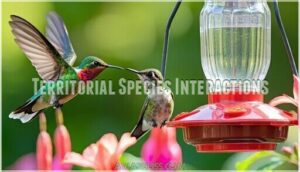
Different species create a complex web of bird behavior around your feeders.
Ruby-throated hummingbirds often clash with Anna’s hummingbirds over prime feeding spots, showing how niche overlap drives territorial species conflicts.
This interspecies competition forces weaker birds into resource partitioning strategies.
Woodpeckers, attracted by sugar water and insects, can also impact hummingbird feeder dynamics.
Their presence can lead to potential damage to feeders.
| Species Interaction | Behavioral Response |
|---|---|
| Dominant vs. Subordinate | Aggressive chasing and dive-bombing |
| Similar-sized Species | Territorial standoffs and aerial sparring |
| Mixed Species Groups | Predator-prey dynamics influence feeding times |
Understanding these coexistence strategies helps you manage bird dominance patterns effectively.
Reducing Hummingbird Aggression
You don’t have to live with a bully hummingbird hogging all your feeders while other birds go hungry.
Simple strategies like adding multiple feeders and placing them strategically can turn your backyard war zone into a peaceful dining area where everyone gets their share of nectar.
Multiple Feeder Strategy
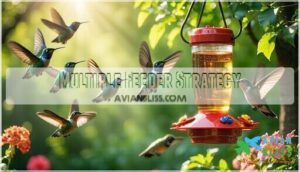
Deploying multiple bird feeders creates a powerful defense against hummingbird aggression by overwhelming a single bird’s ability to control all food sources.
Strategic feeder spacing forces territorial birds to choose which areas to defend, naturally reducing dominance. When you cluster feeders together, aggressive birds exhaust themselves trying to patrol everything.
Consider purchasing multiple feeders to further reduce aggression. This smart approach uses visual barriers and sheer numbers to break up defending territory patterns, giving smaller birds better access.
Feeder Placement Techniques

How can you outsmart a territorial hummingbird? Strategic feeder placement is your secret weapon.
Position bird feeders at least 15 feet apart with visibility reduction between them—think around corners or behind obstacles.
Remove perches where dominant birds scout their territory. Use single-port feeders instead of multi-port models to limit one bird’s control.
Try cluster feeding in high-traffic areas to overwhelm aggressive defenders, or spread feeders throughout your yard using smart spacing strategies.
Alternative Food Sources

You can reduce hummingbird aggression by creating diverse food sources beyond bird feeders.
Plant native blooms like bee balm and cardinal flower to provide natural nectar throughout the season.
These flowers support insect attraction, giving hummingbirds the protein they need, and supplementing their diet with unsalted nuts can offer essential fats.
A balanced garden ecosystem with varied nectar sources means less fighting over feeders, creating a peaceful hummingbird diet paradise with a balanced garden ecosystem.
Hummingbird Gender Roles
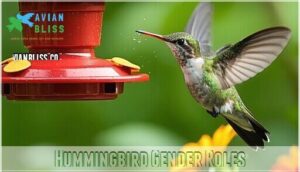
You’ve probably noticed that male and female hummingbirds don’t behave the same way around your feeders.
While both genders can be aggressive, they defend territories for different reasons and at different times of the year.
Male Territoriality
During breeding season, male hummingbirds transform into fierce warriors, claiming territories up to a quarter-acre to secure mating rights.
These dominant males use aggressive displays and relentless chasing to maintain control over prime feeding spots, with their territorial behavior intensifying as seasonal shifts trigger powerful aggression.
- Dive-bombing rivals at breakneck speeds with wings buzzing like tiny fighter jets
- Performing dramatic U-shaped flight displays while flaring their iridescent throat patches
- Chattering aggressively from strategic perches to warn off intruders
- Grappling mid-air with locked talons during intense territorial disputes
- Patrolling their claimed territory in endless loops like feathered security guards
Female Territoriality
Female hummingbirds aren’t just passive participants in hummingbird territoriality.
They’re fierce defenders in regards to nesting defense and breeding aggression.
You’ll see females aggressively chase away intruders from their breeding territories, especially during post-nesting behavior when protecting eggs and chicks.
This resource control extends to feeders near nest sites, with individual variation making some females exceptionally territorial during food resource competition seasons, and exhibiting strong breeding aggression.
Gender Differences in Aggression
Understanding hummingbird aggression means recognizing how males and females differ in their territorial tactics. Male Dominance drives most feeder conflicts, while Female Defense focuses on protecting nests during Breeding Season.
Here’s how their aggression patterns differ:
- Territorial Size – dominant males control larger areas (up to 1,000m²)
- Combat style – male hummingbirds use direct attacks, females employ strategic avoidance
- Seasonal intensity – Nesting Aggression peaks differently for each gender
- Target selection – males chase everyone, female hummingbirds focus on nest threats
- Duration – territorial males maintain year-round aggression, females intensify during reproduction
Environmental Factors Influence

Your backyard environment shapes how aggressively hummingbirds defend their territory throughout the year.
From seasonal breeding patterns to the placement of artificial feeders, these environmental factors can either fuel fierce competition or promote peaceful coexistence among these tiny warriors.
Seasonal Changes Impact
Seasonal cycles dramatically shift hummingbird behavior patterns. During Breeding Season, males become hyper-aggressive, defending territories that span a quarter-acre.
Migration Aggression peaks in fall as birds prepare for long journeys, hoarding nectar resources. Winter Scarcity forces year-round residents into fierce competition over limited food sources.
| Season | Territorial Behavior | Resource Availability | Aggression Level |
|---|---|---|---|
| Spring | Breeding territory establishment | Moderate nectar flow | High (males) |
| Summer | Nest defense peaks | Abundant flowers | Moderate-High |
| Fall | Migration prep intensity | Declining sources | Extreme |
| Winter | Survival-focused competition | Scarce natural food | Variable |
Climate change impacts are reshaping these seasonal survival strategies, making hummingbird territoriality even more unpredictable throughout migration seasons.
Artificial Feeder Effects
Ever wonder why hummingbird aggression heats up around your feeder?
Artificial feeders boost bird feeder competition by concentrating nectar resources in one spot. If you put out multiple feeders close together (location density!), don’t slack on cleaning frequency or nectar quality—dirty or poor feeders can harm your regulars and up the drama.
Think Feeder Material, too. Better upkeep, calmer birds, with a focus on cleaning frequency and nectar quality to ensure a peaceful environment.
Landscape Design Considerations
Your yard’s layout dramatically impacts hummingbird aggression levels.
Smart spatial arrangement with native plantings creates natural visual barriers between multiple feeders, reducing territorial disputes.
Strategic perch removal eliminates dominant birds’ lookout posts.
Water features and nectar-rich flowers scattered throughout your landscape provide alternative resources, forcing aggressive hummers to spread out rather than monopolizing single locations through proper bird feeder spacing techniques.
Minimizing Feeder Conflicts

You don’t have to let one bully hummingbird ruin the party at your feeders.
With smart placement strategies and a few extra food sources, you can turn those feeder wars into peaceful coexistence that benefits every tiny visitor to your yard, achieving a state of harmony.
Strategic Feeder Placement
You can outsmart territorial hummingbirds through smart bird feeder placement strategies.
Position multiple feeders at least 15 feet apart with no visibility between them—this overwhelm defense prevents single birds from controlling everything. Remove nearby perches that dominant birds use as watchtowers, and choose single-port feeders over multi-port models to reduce hummingbird aggression.
- Space feeders widely – Place them around corners or behind obstacles for visibility reduction
- Remove perching spots – Eliminate branches or structures near feeders that enable territory monitoring
- Use single-port designs – These limit one bird’s ability to guard multiple feeding spots simultaneously
Diversifying Food Sources
Beyond strategic bird feeder placement, you’ll want to create natural nectar sources that reduce hummingbird territoriality.
Plant native blooms like bee balm and cardinal flower to establish a garden ecosystem rich in food sources.
These nectar-rich flowers attract insects too, creating insect attraction opportunities that diversify nutrition.
Native plants provide natural nectar throughout the season, helping establish a balanced environment where territorial disputes decrease substantially, and support a garden with native blooms.
Creating Hummingbird Friendly Gardens
Instead of relying solely on feeders, you can create a garden ecosystem that naturally supports peaceful coexistence among hummingbirds.
Plant native blooms with staggered flowering times to reduce aggression around artificial feeders. You can improve your chances of attracting hummingbirds by purchasing hummingbird garden plants.
- Choose nectar-rich flowers in red and pink shades that bloom from early spring through late fall
- Add insect attraction plants to provide protein sources and create diverse feeding opportunities
- Use native plants vertically with trellises and climbing vines to maximize your garden’s hummingbird real estate
Frequently Asked Questions (FAQs)
Why do hummingbirds fight each other?
Hummingbirds fight because they’re fiercely territorial, especially around food sources like feeders and flowers.
You’ll see them chasing, dive-bombing, and even grappling mid-air to defend their precious nectar supply from competitors.
Why do hummingbirds chase each other?
You’ll spot these tiny aerial dogfights because males chase rivals away from feeders and flowers to defend their food sources. They’re protecting their territory since competition for nectar is fierce.
Why are hummingbirds more territorial?
Like tiny knights guarding a candy shop, you’ll see them fiercely protect feeders because food is life.
Their small size means every sip matters, so they chase off rivals to claim the best snacks for survival.
Do hummingbirds fight for territory?
Yes, hummingbirds absolutely fight for territory, especially males defending food sources like feeders and flowers.
You’ll see them chasing, dive-bombing, and even grappling mid-air to claim exclusive access to nectar-rich areas.
Are male hummingbirds territorial?
You’ll find that male hummingbirds guard their turf like tiny feathered bouncers.
They chase off rivals, dive-bomb intruders, and sometimes even battle midair—all to stake their claim on the best food sources and impress the ladies.
They engage in this behavior to secure the best food sources.
Are ruby-throated hummingbirds territorial?
Picture a tiny knight guarding a sugar-filled castle—ruby-throated hummingbirds fiercely defend their turf.
You’ll see them chase rivals away from feeders like it’s a turf war, claiming the best nectar for themselves and leaving others buzzing.
How to make hummingbirds less territorial?
You’ll reduce hummingbird territorial battles by hanging multiple feeders 15+ feet apart, removing perches they use for surveillance, and planting nectar-rich flowers to create alternative food sources throughout your yard.
Why do hummingbirds chase each other off feeders?
Hummingbirds act like tiny feeder tyrants because they’re hardwired to defend their food sources as if their lives depend on it—which they actually do.
They chase competitors away to secure exclusive access to nectar and maintain territorial control.
Why put aluminum foil around a hummingbird feeder?
Aluminum foil creates a reflective barrier that deters ants from climbing up to your feeder.
You’ll wrap it around the feeder pole, creating a slippery surface that prevents these sugar-seeking invaders from reaching the nectar.
Why are hummingbirds so territorial to humans?
Think of a tiny bouncer guarding the hottest club in town—only this club’s filled with sugar water.
When you approach the feeder, they see you as a giant competitor, ready to steal their prized snack.
Conclusion
As the saying goes, “the early bird gets the worm”—but in your yard, it’s often a hummingbird guarding the nectar like a tiny bouncer.
Now you know why are hummingbirds so territorial: they’re just doing what it takes to survive and thrive.
By understanding their tough-guy routines, you can help keep the peace at your feeders. Try adding more feeders and mixing up your yard.
Who knew such little birds could bring so much drama?
- https://www.audubon.org/magazine/where-do-hummingbirds-get-all-energy
- https://nationalzoo.si.edu/migratory-birds/hummingbirds
- https://www.birdfy.com/blogs/blogs/why-hummingbirds-are-so-territorial-and-how-to-solve-territorial-problems-at-your-feeders
- https://pmc.ncbi.nlm.nih.gov/articles/PMC3967903/
- https://www.birdsandblooms.com/birding/attracting-hummingbirds/are-hummingbirds-territorial/