This site is supported by our readers. We may earn a commission, at no cost to you, if you purchase through links.
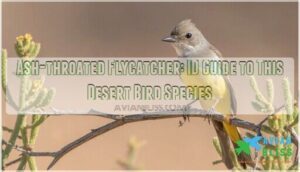 You’ll recognize the ash throated flycatcher by its pale gray-brown head, whitish throat, and distinctive lemon-yellow belly that seems to glow against desert brush.
This robin-sized bird sports rusty cinnamon wing patches and tail feathers that flash like sunset colors when it flies.
Unlike many desert dwellers, it’s surprisingly vocal, especially at dawn when its sharp "pit" calls echo across the scrubland.
These resourceful birds thrive in arid environments from Arizona’s saguaro forests to California’s chaparral, never needing to drink water since they get moisture from insects and occasional berries.
Their curious head-tilting behavior and preference for perching on exposed branches make them easier to spot than you’d expect in such harsh terrain, though their true identification secrets reveal themselves in subtle details.
Table Of Contents
- Key Takeaways
- What Do Ash-throated Flycatchers Look Like?
- Where Do Ash-throated Flycatchers Live?
- What Do Ash-throated Flycatchers Eat?
- What Do Ash-throated Flycatchers Sound Like?
- Where Do Ash-throated Flycatchers Nest?
- How Do You Identify an Ash-throated Flycatcher?
- Frequently Asked Questions (FAQs)
- What does an ash throated flycatcher look like?
- What is an ash-throated flycatcher?
- Where do ash throated flycatchers live?
- Are ash throated flies different?
- Are ash throated flycatchers common in Texas?
- When do ash throated flycatchers return?
- How do you identify an Ash-throated Flycatcher?
- What is the difference between ash-throated and great crested flycatchers?
- What does the Ash-throated Flycatcher eat?
- Are ash-throated flycatchers rare?
- Conclusion
Key Takeaways
- You’ll identify an ash-throated flycatcher by its pale gray throat, lemon-yellow belly, and rusty wing patches – these distinctive colors make it stand out against desert vegetation and help distinguish it from similar species.
- Listen for their sharp "pit" or "chip" calls, especially during morning hours – these vocal birds use these distinctive sounds for territory establishment and communication, making them easier to locate in arid habitats.
- You’ll find them thriving in western North America’s desert regions without needing water sources – they extract all necessary moisture from insects and berries, allowing them to live in extremely dry conditions from sea level to 9,000 feet.
- Watch for their curious head-tilting behavior when they’re investigating something – this distinctive side-to-side head movement helps them assess their surroundings and enhances their depth perception for hunting insects.
What Do Ash-throated Flycatchers Look Like?
When you spot an ash throated flycatcher, you’ll notice its distinctive plumage details that make bird identification straightforward.
This medium-sized flycatcher displays an ash-gray throat and breast that shifts to a pale yellow belly, creating striking color pattern variation.
The bird’s physical characteristics include a peaked head with a slight crest, olive-brown upperparts, and distinguishing features like rufous outer wing and tail feathers with two subtle wing bars.
For size comparison, it measures 7.5-8.6 inches long—larger than a Western Bluebird but smaller than an American Robin.
The facial markings show a dark mask around the eyes contrasting with paler cheeks.
Juvenile appearance tends toward more yellowish tones with less distinct markings than adults.
Its size and shape reflect typical flycatcher proportions: relatively large head, medium-thick bill, and long tail that’s perfect for aerial maneuvers while hunting insects in desert habitats.
Some birds, like the cardinal, also have a crest, which aids in communication and hierarchy.
Where Do Ash-throated Flycatchers Live?
Understanding where you’ll encounter this desert bird can help you spot one during your next outdoor adventure.
Ash-throated flycatchers have specific habitat preferences that make them perfectly suited for life in North America’s arid regions.
These adaptable birds thrive across diverse environments throughout western North America.
Their elevation range spans from sea level to an impressive 9,000 feet, allowing them to occupy everything from coastal scrublands to high desert plateaus.
You’ll find the highest regional abundance in areas dominated by mesquite, juniper, oak, and iconic desert plants like Joshua trees and saguaro cacti.
Their remarkable climate adaptation allows them to survive in extremely dry conditions by obtaining all necessary water from their food.
These desert survivors never need a water bottle—they extract every drop from their insect meals.
Like the great crested flycatcher, they’re primarily insectivorous birds.
Here’s where you’re most likely to encounter this cavity-nester:
- Breeding grounds: Open woodlands, desert scrub, and chaparral from Washington to Texas and central Mexico
- Wintering grounds: Southern Mexico, Guatemala, and Honduras in tropical climates
- Preferred nesting cavities: Woodpecker holes, rock crevices, mailboxes, and fence posts
These bird habitats showcase how this desert bird has mastered life in challenging environments.
What Do Ash-throated Flycatchers Eat?

You’ll find these flycatchers aren’t picky eaters, with insects making up about 80% of their diet including caterpillars, beetles, wasps, and flies.
They’ll also snack on spiders, small lizards, and desert fruits like saguaro berries, especially when insects become scarce during winter months, which can be a time of scarce resources.
Primarily Insects: Caterpillars, Beetles, Grasshoppers, Wasps, True Bugs, Flies
Ash-throated Flycatchers primarily hunt insects through skilled aerial maneuvers and precise picking from vegetation.
Their Insect Consumption includes diverse prey that supports their survival in harsh desert conditions.
| Primary Prey | Foraging Strategy |
|---|---|
| Caterpillars | Pick from leaves and branches |
| Beetles | Hover and snatch from surfaces |
| Grasshoppers | Ground-level hunting |
| Wasps | Mid-air captures |
| True bugs | Foliage gleaning |
These Dietary Adaptations help them thrive at various Foraging Heights, from low shrubs to tree canopies, showcasing remarkable feeding behavior flexibility.
Also Eat Spiders, Small Lizards, Fruits, and Berries
Beyond insects, you’ll find ash-throated flycatchers displaying remarkable dietary adaptations through spider predation and lizard consumption.
These birds expertly snatch spiders from foliage, while occasionally nabbing small lizards during prey shortages.
Fruit consumption becomes essential during winter’s seasonal diet shifts—desert mistletoe and saguaro berries provide indispensable moisture when insects vanish.
They’re also known to thrive in semiarid regions with dry scrub.
This flexible feeding behavior lets ash-throated flycatchers thrive where other species struggle, turning dietary diversity into survival gold.
What Do Ash-throated Flycatchers Sound Like?

You’ll easily recognize ash-throated flycatchers by their distinctive sharp "pit" or "chip" calls that pierce through the desert air.
These vocal birds are most active during morning hours, when their calls become a reliable soundtrack to help you locate them in their arid habitat.
Call: a Sharp Pit or Chip
Recognition comes through their signature sharp "pit" or "chip" call that cuts through desert air.
You’ll hear these bird vocalizations as brief, high-pitched notes from low perches. Call variations include the territorial dawn song and vocal mimicry of other species, though their unique calls maintain vocal distinction across regional dialects.
Understanding these alarm calls warn of danger.
Here’s what makes their bird sounds stand out:
- Sharp pitch – piercing quality that carries well in open habitat
- Brief duration – each call lasts only one to two seconds
- Low perching – delivered from shrubs and small desert trees
- Call function – serves territorial and communication purposes
Calls Frequently in The Morning
You’ll notice these birds are most vocal during the early morning hours when they establish their territories.
Their dawn song function serves as both a territorial call and a way to attract mates.
Call frequency factors include breeding season timing and individual variation in vocal patterns.
This territorial call meaning becomes clear as males defend their nesting sites.
Bird vocalizations help distinguish this species from other flycatchers through these distinctive morning bird sounds and serve as a territorial call.
Where Do Ash-throated Flycatchers Nest?
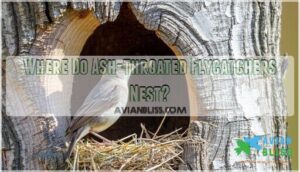
Now that you know what Ash-throated Flycatchers sound like, let’s explore where these resourceful birds build their homes. Cavity Selection is their specialty—they’re secondary cavity nesters who can’t excavate their own holes, so they get creative with what’s available.
These adaptable birds choose from various tree cavities and structures for their nesting sites:
- Old woodpecker holes in dead or living trees
- Natural hollows in sycamores, oaks, and desert trees
- Cactus cavities in saguaros, yuccas, and Joshua trees
- Rock crevices and cliff faces in desert environments
- Artificial Nests like birdhouses, mailboxes, and fence posts
Nest Height typically ranges from 2 to 25 feet above ground, depending on available sites. They’ll even use human-made nesting sites when natural options are scarce.
For Nest Materials, they gather grass, twigs, rootlets, and bark strips, then line everything with mammal hair—especially rabbit fur found in 98% of nests.
The Ashthroated Flycatcher’s breeding habits show remarkable flexibility. Their Nest Defense strategy relies on selecting well-hidden cavities that provide natural protection from predators and harsh desert conditions.
How Do You Identify an Ash-throated Flycatcher?

You can identify an Ash-throated Flycatcher by looking for a medium-sized bird with a gray throat, pale yellow belly, and rusty-colored tail feathers.
Watch for its distinctive behavior of tilting its head from side to side when curious, plus listen for its sharp "ka-brick!" call that sets it apart from other flycatchers in the desert.
Most Common and Widespread Myiarchus Flycatcher in Its Region
Across the western United States, you’ll encounter the ash-throated flycatcher more frequently than any other Myiarchus species.
This Regional Abundance stems from its remarkable Habitat Specificity – thriving everywhere from desert scrub to open woodlands where cavity-nesting sites exist.
Population Trends show stable numbers with slight increases, earning a favorable Conservation Status.
Range Expansion continues into peripheral areas, making Myiarchus cinerascens the go-to identification when spotting flycatcher species in arid Western birds habitat.
Key identification features include:
- Pale ash-gray throat and breast
- Rufous tail feathers catching sunlight
- Medium build distinguishing it from smaller Empidonax flycatchers
This widespread distribution makes the Ashthroated Flycatcher your most likely Myiarchus encounter.
Tips Head Side to Side in Curiosity
You’ll spot this desert dweller by its distinctive curiosity behavior—the Ashthroated flycatcher tilts its head tilting side to side when investigating something interesting.
This avian behavior isn’t just charming; it enhances their visual acuity and depth perception for precise foraging behavior.
These cognitive abilities help them track insects moving through desert vegetation during birdwatching sessions.
| Behavior | Purpose | Identification Value |
|---|---|---|
| Head tilting left | Depth perception | High – unique trait |
| Head tilting right | Visual triangulation | High – distinguishes species |
| Quick side movements | Prey detection | Medium – aids recognition |
| Sustained tilting | Curiosity assessment | High – memorable behavior |
| Combined with perching | Territory scanning | Medium – context clues |
Frequently Asked Questions (FAQs)
What does an ash throated flycatcher look like?
You’d think such a plain-looking bird would blend into the desert background, but you’ll spot this medium-sized flycatcher’s distinctive gray throat, pale yellow belly, and rusty tail feathers easily.
In open woodlands.
What is an ash-throated flycatcher?
A medium-sized flycatcher you’ll find across western North America’s arid regions.
It’s got grayish-ash coloring on its throat and breast, with a pale yellow belly and distinctive rusty tail feathers that catch your eye.
Where do ash throated flycatchers live?
Ten million ash-throated flycatchers call western North America home, from southern British Columbia to central Mexico.
You’ll find them thriving in dry, open woodlands, deserts, scrublands, and chaparral from sea level to 9,000 feet elevation.
Are ash throated flies different?
You’re likely thinking of "flies" as insects, not flycatchers. Ash-throated flycatchers aren’t flies—they’re medium-sized birds that hunt flies and other insects for food, making them natural pest controllers.
Are ash throated flycatchers common in Texas?
Yes, you’ll find ash-throated flycatchers quite common in Texas. The state hosts about 20% of the entire US breeding population, making it one of their primary strongholds in North America.
When do ash throated flycatchers return?
Returning migrants arrive in early spring, typically from late March through Texas and by late April farther north.
You’ll spot them setting up territories for breeding after their winter Central America vacation.
How do you identify an Ash-throated Flycatcher?
Like a detective studying clues in nature’s mystery, you’ll spot this bird’s signature gray throat contrasting with its pale yellow belly.
Rusty tail feathers, and subtle crest that gives it away.
What is the difference between ash-throated and great crested flycatchers?
Ash-throated flycatchers have gray throats and pale yellow bellies, while great crested flycatchers sport bright yellow-orange bellies with yellow throats. Great crested also show more pronounced crests.
What does the Ash-throated Flycatcher eat?
During feeding, you’ll find this bird catches insects like caterpillars, beetles, and wasps by hovering near foliage.
It’ll also snack on spiders and occasionally small fruits from desert plants like saguaro cactus.
Are ash-throated flycatchers rare?
No, you won’t find these fantastic flycatchers particularly rare. They’re actually quite common with a stable population of 10 million birds that’s been steadily increasing at 7% annually since
Conclusion
Last spring, a birdwatcher in Arizona’s Sonoran Desert spotted what appeared to be a Great Crested Flycatcher but noticed the subdued coloring and desert habitat didn’t match.
After careful observation, she correctly identified her first ash throated flycatcher by its pale throat and yellow belly.
You’ll find success identifying this distinctive desert species by focusing on its unique combination of features: the rusty wing patches, lemon-yellow underparts, and characteristic head-tilting behavior.
With practice, distinguishing the ash throated flycatcher from similar species becomes straightforward, making your desert birding adventures more rewarding.
- https://www.sacramentoaudubon.org/kids-corner/meet-the-ash-throated-flycatcher
- https://en.wikipedia.org/wiki/Ash-throated_flycatcher
- https://www.audubon.org/field-guide/bird/ash-throated-flycatcher
- https://www.gomtcharleston.com/animaloftheweek-ash-throated-flycatcher/
- https://travisaudubon.org/murmurations/bird-of-the-week-ash-throated-flycatcher