This site is supported by our readers. We may earn a commission, at no cost to you, if you purchase through links.
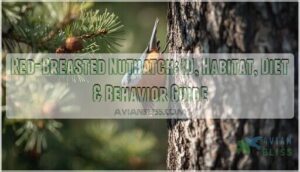
Watch a red-breasted nuthatch navigate a pine tree trunk, and you’ll see something astonishing—this tiny acrobat moves headfirst down the bark with complete confidence, defying gravity in ways most birds can’t. You won’t find many species that master this upside-down lifestyle, but this compact forest dweller makes it look seamless.
These birds measure just over four inches long yet pack distinctive personality into their petite frames, from their rusty-orange breasts to their nasal yank-yank calls that echo through conifer forests. Whether you’re trying to identify one at your feeder or hoping to understand their forest habits, knowing what makes red-breasted nuthatches unique helps you spot and appreciate these charming climbers.
Table Of Contents
- Key Takeaways
- Red-breasted Nuthatch Identification
- Habitat and Geographic Range
- Feeding Habits and Diet
- Nesting and Breeding Behavior
- Behavior, Vocalizations, and Conservation
- Frequently Asked Questions (FAQs)
- Where do Red-breasted Nuthatches live?
- What are some fun facts about Red-breasted Nuthatches?
- Is a Red-breasted Nuthatch a woodpecker?
- Where can I find a red-breasted nuthatch?
- What does a red-breasted nuthatch look like?
- Are red-breasted nuthatches aggressive?
- Are red-breasted nuthatch endangered?
- How old is a red-breasted nuthatch?
- Do red-breasted nuthatch have a call?
- Are red-breasted nuthatches rare?
- Conclusion
Key Takeaways
- You can identify red-breasted nuthatches by their signature headfirst tree descent, blue-gray back, rusty-orange breast, and bold black eye stripe with white eyebrow—males sport darker caps and richer coloring than females.
- These adaptable birds thrive in coniferous forests across northern North America but shift south during poor cone crop years, and you’ll attract them to your yard with black oil sunflower seeds, suet, and feeders placed 5-15 feet from protective conifers.
- Red-breasted nuthatches cache up to 500 seeds daily in scattered hiding spots across their territory, smear sticky pine resin around nest entrances to deter predators, and both parents share feeding duties for their young over three weeks.
- Though listed as Least Concern, these birds face emerging threats from habitat fragmentation and climate change that alter cone crops and forest structure, yet they’re adapting by nesting in urban ornamental conifers and play a crucial role controlling insect pests in forest ecosystems.
Red-breasted Nuthatch Identification
Spotting a Red-breasted Nuthatch in your backyard isn’t too difficult once you know what to look for.
Like its cousin the Hermit Thrush, this small songbird has distinctive markings that make identification straightforward for backyard birders.
These small, energetic birds have several features that set them apart from other species.
Here’s what you need to identify them with confidence.
Size, Weight, and Shape
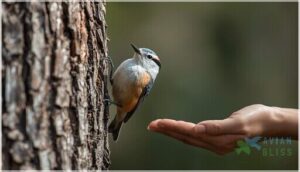
You’ll find the Red-breasted Nuthatch (Sitta canadensis) is a small songbird measuring 4.7 to 5.5 inches long with a wingspan of 7 to 8.7 inches.
This compact bird weighs just 0.5 to 0.7 ounces, with weight fluctuations occurring seasonally. Its body proportions include a short neck, sturdy 0.2-inch bill, and relatively long tail—perfect features for bird identification in the field.
Distinctive Color Patterns
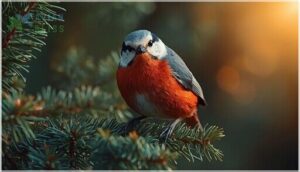
You’ll spot the Red-breasted Nuthatch by its vivid scarlet breast running from throat to upper chest—a standout feature in coniferous forest settings.
The blue-gray back creates dramatic contrast, while a bold black eye stripe and white eyebrow frame the face. Wing feathers show subtle white edging, and the black cap blends into the gray crown, making bird identification straightforward even in dappled light.
The dramatic impact of these colors mirrors how patterns and color meanings in nature influence both recognition and emotion in art and photography.
Male Vs. Female Features
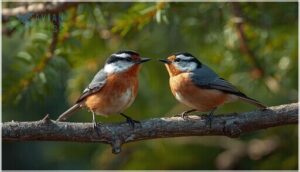
You can tell males from females by watching for subtle gender variations in the Redbreasted Nuthatch. Males sport a deeper, jet-black cap and richer rust-orange breast, while females show a softer gray cap and lighter peachy underparts.
These sex differences stem from hormonal effects during development, creating distinct facial structure and body proportions that help you identify each bird’s gender in the field.
Comparison With Similar Species
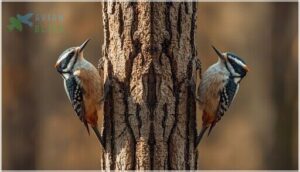
When you’re spotting nuthatches and other tree-clinging birds in your backyard, watch for key visual cues that set the Redbreasted Nuthatch apart.
The bold black eye stripe extending to the neck separates it from the White-breasted Nuthatch’s cleaner face, while its smaller size and rust-toned breast make species differentiation straightforward compared to chickadees and titmice that share similar habitats.
Habitat and Geographic Range
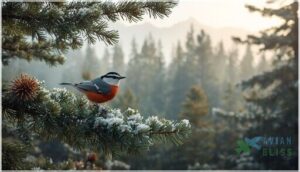
Red-breasted Nuthatches have some clear preferences regarding where they live and travel. You’ll find these birds in specific forest types across North America, though they’re surprisingly adaptable as the seasons change.
Let’s look at where you’re most likely to spot them throughout the year.
Preferred Forest Types
You’ll find red-breasted nuthatches thriving in coniferous forests, especially mature coniferous stands of spruce, fir, and hemlock across northern North America and western North America.
These birds share the same forested habitats as the Chestnut-sided Warbler, which favors second-growth woodlands across similar northern ranges.
They prefer dense tree diversity within the forest canopy, though mixed forests combining conifers with deciduous trees work well too. Urban woods with ornamental conifers attract these delightful birds, proving they adapt when mature coniferous forests and woodlands offer suitable nesting trees.
Coniferous forests make up nearly one third of the world’s global forest ecosystems, highlighting the importance of these habitats for many species.
Regional Distribution in North America
Across North America, red-breasted nuthatches show striking regional variations in their geographic range. You’ll encounter the highest densities from the Midwest through the Great Lakes to the Northeast, while western North America’s coniferous forests in Washington, Oregon, and northern California support year-round populations.
Canada’s boreal forests sustain stable communities, and migration patterns shift birds southward during poor cone crop years.
Urban and Suburban Adaptations
Beyond dense conifer forests, you’ll find red-breasted nuthatches thriving in city habitats where urban planning creates green spaces and bird-friendly corridors. Suburban wildlife now includes these delightful backyard birds, especially where you offer:
- Bird feeders stocked with sunflower seeds and suet near protective shrubs
- Mature street trees connecting parks for safe movement
- Native plantings that support insect prey and natural foraging
Your bird watching efforts directly improve their urban survival.
Seasonal Migration Patterns
You’ll notice red-breasted nuthatches don’t follow strict bird migration patterns like warblers do. Instead, they show irruptive movements driven by food availability and climate influence.
When northern cone crops fail, these birds make seasonal shifts southward along forest corridors. Some populations stay put year-round in milder areas, while others undertake short-distance migrations tracking conifer resources—a fascinating example of species adaptation and survival through flexible habitat selection.
Feeding Habits and Diet
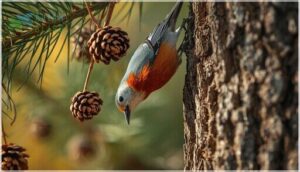
Red-breasted nuthatches are skilled acrobats that forage in ways most birds can’t match. Their diet shifts with the seasons, and they’re famous for stashing food in creative hiding spots.
Let’s explore how these little birds find their meals, what they eat throughout the year, and how you can bring them to your own backyard.
Foraging Techniques and Behavior
You’ll love watching red-breasted nuthatches master tree bark foraging with their signature headfirst descents. These acrobatic birds use rapid pecking motions for insect extraction, probing bark crevices and chiseling shallow grooves to reach beetle larvae.
Their foraging techniques include surface gleaning for scale insects and switching between conifers and hardwoods. They’re remarkably adaptable, adjusting foraging height from understory to canopy while using auditory cues to locate hidden prey.
Primary Food Sources by Season
Red-breasted nuthatch diets shift dramatically with the seasons, showcasing notable seasonal adaptations. You’ll notice these birds change their feeding priorities throughout the year.
- Spring foraging focuses on protein-rich insects like caterpillars and beetles, plus tree buds and blossoms
- Summer insects including aphids remain the primary food source alongside conifer seeds
- Autumn seeds feature acorns, beechnuts, and mast crops for building fat reserves
- Winter caching relies on stored nuts, plus suet feeder visits for high-energy foods
- Backyard bird feeding stations with sunflower seed and peanuts supplement natural diets year-round
Food Caching and Storage
These birds exhibit fascinating hoarding behavior you can observe in your own yard. Red-breasted nuthatches wedge seeds and larvae into tree bark crevices, creating scattered caches across their territory—often 50 to 200 meters from foraging spots.
Their impressive cache memory lets them relocate hundreds of food storage sites throughout winter. Watch them probe bark knots and limb angles to retrieve their hidden treasures.
Attracting Red-breasted Nuthatches to Feeders
You can bring red-breasted nuthatches to your yard by choosing the right feeder placement and seed selection. Mount feeders 5 to 15 feet from conifers, offering safe retreat routes.
Try these bird-friendly gardens additions for winter feeding success:
- Black oil sunflower seeds with high fat content
- Suet recipes that provide essential energy
- Peanuts in shell for natural foraging
- Mealworms during late winter months
Wild birds unlimited resources help support bird conservation and wildlife habitat goals.
Nesting and Breeding Behavior
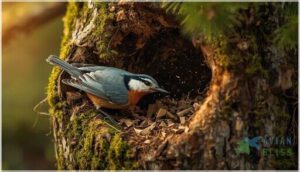
Red-breasted nuthatches take a hands-on approach to building their homes, and what they do is pretty impressive. These birds don’t just find a cavity—they excavate their own nest holes and defend them fiercely during breeding season.
Here’s what you need to know about how they choose nest sites, build their homes, court their mates, and raise their young.
Nest Site Selection and Excavation
When choosing where to raise their young, red-breasted nuthatches favor mature forests packed with dead or dying trees. You’ll find them excavating cavities 1 to 3 meters above ground in soft, rotted wood. They prefer entrances 1.5 to 2.5 centimeters wide—just right to keep larger predators out while letting parents slip through easily.
| Cavity Feature | Typical Measurement | Purpose |
|---|---|---|
| Entrance diameter | 1.5–2.5 cm | Deters larger predators |
| Height above ground | 1–3 meters | Balances safety and access |
| Cavity depth | 8–15 cm | Facilitates brooding movement |
| Nest site choice orientation | Away from prevailing winds | Reduces heat loss |
| Tree selection | Soft rotted hardwoods | Speeds excavation process |
These skilled excavators often reuse old woodpecker holes if the cavity nest remains intact. They’ll choose sunnier tree sides to warm early morning incubation and pick spots near insect-rich bark to shorten food runs.
Nest Construction Materials
Once your nuthatches have excavated their cavity nest, they line it with soft grasses, moss, and shredded bark to create a cozy cup. You’ll notice they weave fine plant fibers for structural integrity and tuck feathers around the edges for insulation. The most unique touch? They smear sticky pine resin or pitch around the entrance hole, deterring predators and competitors from invading their carefully crafted home.
- Soft grass and moss cushion eggs and provide moisture balance inside the cavity
- Feathers and plant down add thermal insulation to keep nestlings warm through cool nights
- Pine resin or pitch creates a sticky barrier that catches intruders and protects the nest entrance
Breeding Season and Courtship
From early spring through mid-summer, you’ll witness the Red-breasted Nuthatch‘s delightful courtship displays as males deliver high-pitched calls and flash bright plumage to attract females.
These monogamous birds form pair bonds before nesting begins, strengthened through mutual preening and synchronized foraging. Males defend compact territories around chosen nest sites, performing display flights that showcase their fitness and the quality of their selected cavity.
Parental Care and Chick Development
Once the female red-breasted nuthatch completes incubation after 12 to 13 days, both parents share nestling care duties. You’ll notice their dedicated parental investment through coordinated feeding trips and brooding behavior that fosters chick development over three critical weeks:
- Days 1-7: Female broods naked hatchlings while male delivers food
- Days 8-18: Both parents feed growing nestlings insects and invertebrates
- Days 19-35: Fledgling growth continues as parents guide newly independent young through post-fledging learning
This extended care reflects complex avian behavior and nesting habits unique to red-breasted nuthatches.
Behavior, Vocalizations, and Conservation
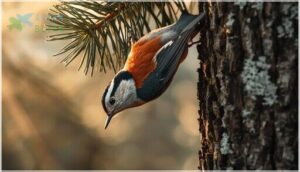
Red-breasted nuthatches are surprisingly bold little birds with distinctive personalities you’ll notice right away.
Their high-pitched calls echo through conifer forests, making them easy to identify by sound alone.
Understanding their behavior and conservation needs, as well as their ecological importance, helps you appreciate why these acrobatic foragers matter so much to healthy woodland communities.
Social and Territorial Behavior
You’ll notice something fascinating when you watch these little acrobats: redbreasted nuthatch territorial defense operates like a vertical chess game on tree trunks. They chase rivals across bark lanes and flick their tails to mark boundary claims. Group dynamics shift seasonally—winter brings mixed flocks with mutual tolerance, while breeding pairs defend 20-30 acres through threat displays and alarm calls that rally nearby allies.
| Behavior Type | Key Actions | Purpose |
|---|---|---|
| Territorial Defense | Chase intruders, drum on bark, defend cavity entrances | Maintain exclusive foraging lanes and nesting sites |
| Social Hierarchy | Rotate group leaders, younger birds learn routes | Improve foraging strategies and predator responses |
| Boundary Marking | Follow daily paths, respect woodpecker holes as markers | Reduce confrontations between neighboring flocks |
| Aggressive Interactions | Wing flutter displays, bill tapping, brief physical bouts | Settle resource disputes at high-value food sites |
| Group Dynamics | Form winter flocks, synchronized movements, greeting displays | Balance cooperation with individual resource access |
Vocal Calls and Songs
You’ll hear these birds before you spot them—their nasal calls cut through the forest like tiny toy horns. The Red-Breasted Nuthatch relies on vocal learning to master call patterns that vary by region and context, with trill characteristics revealing everything from alarm to courtship.
Song structure includes rapid-fire notes, frequency variation across seasons, and that signature nasal call that makes identification easy.
- A high-pitched, squeaky “yank-yank” that sounds like a miniature bicycle horn
- Quick staccato bursts resembling a machine gun’s rhythm during territorial disputes
- Soft, whistling trills between mates that bounce like a gentle conversation
- Sharp alarm notes cracking through the canopy when predators approach
- Rising-and-falling musical phrases lasting about a second, repeated in loops
Conservation Status and Threats
The Red-Breasted Nuthatch holds a Least Concern IUCN Status, but you shouldn’t ignore emerging challenges. Habitat Fragmentation from logging disrupts nesting sites, while Climate Change alters cone crops and forest structure.
Forest Management practices and Species Adaptation offer hope—these birds nest in ornamental conifers now. Conservation Efforts focus on biodiversity conservation and wildlife conservation to protect their future.
| Threat Category | Impact on Population |
|---|---|
| Habitat loss | Reduces nesting and foraging areas |
| Climate shifts | Alters food availability and forest health |
| Urban expansion | Limits natural corridors and seed sources |
Role in Forest Ecosystems
Think of red-breasted nuthatches as tiny forest engineers—their ecosystem engineering keeps woodland communities thriving. You’ll find them controlling insect pests that threaten forest health while promoting biodiversity support through seed caching and tree rehabilitation.
Red-breasted nuthatches act as tiny forest engineers, controlling pests and spreading seeds that keep woodland ecosystems thriving
Their bark-pecking activity creates habitat preservation opportunities for other tree-clinging birds, maintaining ecological balance across forest ecosystems. These biodiversity conservation champions support wildlife interactions that strengthen entire woodland food webs.
Frequently Asked Questions (FAQs)
Where do Red-breasted Nuthatches live?
While most birds stick to one climate zone, you’ll find these adaptable acrobats everywhere from Alaska’s coastal forests through Canada’s boreal habitats to high mountains in the western United States.
What are some fun facts about Red-breasted Nuthatches?
You’ll notice these treeclinging birds smear sticky pine resin around their nest entrance—a clever trick in avian behavior that keeps predators away.
They also cache food like miniature forest squirrels, hiding seeds for later retrieval.
Is a Red-breasted Nuthatch a woodpecker?
Despite their tree-climbing prowess, nuthatches aren’t woodpeckers. These tree-clinging birds belong to family Sittidae, lacking the chisel-like beak structure and stiff tail of true woodpeckers.
Their slender bill shape probes rather than drills bark.
Where can I find a red-breasted nuthatch?
In coniferous forests across northern North America, you’ll spot nuthatches clinging to tree trunks year-round.
Winter irruptions bring them south to mixed woodlands and urban trees, especially during feeder visits when cone crops fail.
What does a red-breasted nuthatch look like?
You’ll recognize this bird species by its vibrant plumage: blue-gray wing structure, cinnamon underparts, and striking black eye stripe.
The head color contrasts beautifully—black cap, white eyebrow. Notice the straight beak shape, ideal for bark probing.
Are red-breasted nuthatches aggressive?
Yes, these birds show surprising aggression. Red-breasted nuthatches fiercely defend territories, chase larger woodpeckers from nest cavities, and bully other species at feeders through bold confrontations and persistent territorial displays.
Are red-breasted nuthatch endangered?
No, they’re not endangered.
Conservation assessments list them as Least Concern because population trends remain stable across their wide range, though habitat loss and climate change impacts do pose localized threats.
How old is a red-breasted nuthatch?
In the wild, you’ll find these birds usually live around six years, though some individuals push past seven. First-year mortality from predators and disease pulls down the average lifespan considerably.
Do red-breasted nuthatch have a call?
You’ll often hear a distinctive nasal “yank-yank” sound from these birds—their most recognizable call pattern. This high-pitched, toy-horn-like acoustic signal helps with bird communication and identification throughout coniferous forests.
Are red-breasted nuthatches rare?
Think of them as little acrobats of the north woods—red-breasted nuthatches aren’t globally rare.
Their conservation status remains stable across vast ranges, though habitat loss and climate impact create localized population trends worth monitoring.
Conclusion
A single red-breasted nuthatch can cache up to 500 seeds daily during peak autumn months, storing each one in a different hiding spot across its territory. That industrious spirit keeps conifer forests thriving while delighting backyard observers.
Once you recognize their rusty breast and headfirst descents, you’ll spot these nimble climbers everywhere they roam. Keep your feeders stocked with sunflower seeds, and you might just earn their trust as they patrol your pines.