This site is supported by our readers. We may earn a commission, at no cost to you, if you purchase through links.
 You’ll spot a white faced ibis by its striking burgundy-red plumage and distinctive white border around its face and bill.
These medium-sized wading birds have long, curved bills perfect for probing muddy wetlands.
They’re about 23 inches tall with dark, glossy feathers that shimmer bronze-green in sunlight.
Look for them in shallow marshes, flooded rice fields, and mudflats across western North America.
They wade through water jabbing their bills into mud to catch crayfish, worms, and insects.
White faced ibis often gather in flocks, especially during migration when they travel between breeding and wintering grounds.
Understanding their seasonal patterns and preferred feeding spots makes identification much easier.
Table Of Contents
- Key Takeaways
- White Faced Ibis Overview
- Habitat and Distribution
- Diet and Foraging
- Breeding and Nesting
- Conservation Status
- Frequently Asked Questions (FAQs)
- Are white-faced ibis rare?
- What are white ibis eating in my yard?
- Where can I find white-faced ibis?
- Is white-faced ibis rare?
- Where do white-faced ibis migrate to?
- What do white-faced ibis eat?
- What colors are the White-faced Ibiss eyes and legs?
- How long is the White-faced Ibiss wingspan?
- How do White-faced Ibises search for food?
- What is the scientific name of the White-faced Ibis?
- Conclusion
Key Takeaways
- You’ll spot white-faced ibis by their burgundy-red plumage, white facial border, and long curved bills, especially during breeding season.
- You’ll find them in shallow freshwater marshes, flooded fields, and irrigated pastures across western North America, often gathering in flocks.
- You’ll notice they probe mud and water with their bills to catch insects, crustaceans, worms, and small fish.
- You’ll see their populations are stable, but habitat loss, pesticides, and climate change remain ongoing threats to their wetland homes.
White Faced Ibis Overview
You’ll recognize the White-faced Ibis by its distinctive curved bill and glossy bronze-green plumage that shimmers in sunlight.
This medium-sized wading bird stands out with its characteristic white facial border during breeding season and long red legs.
Physical Description
The Whitefaced Ibis stands 18-22 inches tall with a crow-sized build.
Its thick oval body supports a long neck and broad wings.
Dark plumage shows metallic iridescence in sunlight.
The strongly curved bill measures 6-7 inches long.
Dark leg coloration contrasts with the bird’s glossy feathers.
Size comparison places it between Cattle and Great Egrets, with its glossy feathers being a notable feature.
Facial Features
The white faced ibis shows striking facial coloration during breeding season.
You’ll notice bright white feathers forming a distinct border around reddish facial skin.
The bare facial skin turns vivid red while the iris color shifts to bright red too.
Outside breeding plumage the white facial features disappear.
This makes identification much harder compared to similar species like glossy ibis.
The combination of these factors, including the bright red coloration and the striking facial patterns, contributes to the unique appearance of the white faced ibis.
Body Size and Shape
You’ll notice the White-faced Ibis has a distinctly crow-sized build that makes it instantly recognizable among wading birds.
This medium-sized species shows consistent body proportions across its range.
Key bird measurements include:
- Bird length: 18-22 inches from bill to tail
- Weight fluctuation: 16-18 ounces depending on season
- Body proportions: Thick oval torso with elongated neck
- Shape variation: Minimal differences between males and females
The bird’s compact frame sits between a Cattle Egret and Great Egret for size comparison.
Wing Characteristics
You’ll spot the white-faced ibis by its broad wings and rounded wing tips.
These wing characteristics help the bird soar effortlessly over wetlands. The wingspan reaches 35-39 inches with strong flight patterns.
During molting process, feather structure changes affect soaring ability.
Their avian anatomy includes long wings perfect for gliding between feeding sites.
They often forage in shallow wetland habitats, searching for food.
Habitat and Distribution
You’ll find white-faced ibis thriving in shallow freshwater marshes, flooded agricultural fields, and irrigated pastures across western North America.
These adaptable waders migrate seasonally, with breeding populations stretching from California to Louisiana and wintering grounds extending into Central America.
Wetland Habitats

Freshwater marshes serve as the primary home for these striking wetland birds.
You’ll find them wading through shallow waters where cattails and bulrushes create perfect hunting grounds.
These habitats face serious challenges from development and climate change.
Ibis survival depends on quality habitat products for nesting and feeding.
Essential wetland features include:
- Water depth – Shallow areas under 18 inches deep
- Vegetation cover – Dense emergent plants for nesting
- Water quality – Clean, nutrient-rich environments
- Seasonal flooding – Variable water levels throughout year
- Food availability – Abundant invertebrates and small fish.
Habitat loss threatens these bird conservation strongholds.
Restoration efforts focus on protecting remaining freshwater wetlands while improving water quality through marsh conservation programs.
Agricultural Fields

You’ll find Plegadis chihi thriving beyond natural wetlands in agricultural landscapes.
Irrigated fields provide excellent foraging opportunities when farmers flood their land.
The birds probe soft soil for insects and worms in these man-made habitats.
Flooded pastures especially attract large flocks during migration.
However, pesticide exposure poses risks in heavily treated areas, making field selection critical for their survival.
Geographic Range

White-faced ibis span western North America from California to Texas.
You’ll find breeding populations in the Great Basin and Central Valley.
Their range extends south through Mexico and Central America.
Some populations reach northern South America.
Range expansion occurs when suitable wetlands become available.
Habitat overlap exists with glossy ibis in southeastern regions.
Regional variations depend on water availability and seasonal flooding patterns.
Migration Patterns

Migration triggers for whitefaced ibis include seasonal weather changes and food availability shifts.
These longdistance migrations follow established flyway connectivity routes across western North America.
Bird migration patterns show populations moving from northern breeding grounds to southern wintering areas, with stopover ecology playing a vital role as birds rest at key wetlands.
Climate influence affects timing and routes, and bird distribution changes seasonally, with genetic diversity maintained through population mixing during migration, influenced by climate influence.
Diet and Foraging
You’ll watch white-faced ibis wade through shallow water using their long curved bills like precision tools to probe mud and vegetation.
These skilled hunters gather in flocks of 10 to 50 birds to search wetlands for insects, crustaceans, snails, and small fish.
Foraging Behavior

Through shallow water and wet soil, you’ll watch these birds use their curved bills like precision instruments for prey detection.
Their bill sensitivity helps them locate aquatic insects and crustaceans buried in mud.
White-faced ibis show fascinating flock dynamics while feeding.
Groups of 10-50 birds work together systematically.
Seasonal variation affects their feeding behavior as water levels change habitat impact on available food sources.
Some birds exhibit distinct water-based feeding techniques with unique strategies.
Diet Composition

Aquatic insects make up the bulk of your white-faced ibis’s diet.
These birds target water beetles, dragonfly larvae, and water boatmen as primary prey. Crustaceans like crayfish provide essential protein, while earthworms and snails round out their nutritional needs.
During breeding season, they’ll add small fish and amphibians to support chick development and growth, which is crucial for the young ibis.
Foraging Habitat

You’ll find white-faced ibis in diverse wetland environments where prey abundance and water depth create ideal foraging conditions.
These birds prefer freshwater wetlands but also use saltwater wetlands when seasonal changes affect habitat quality.
They hunt in shallow marshes, flooded fields, and irrigated agricultural areas, and human impact has actually expanded their range by creating more irrigated fields.
To assist in this task, some people purchase specialized ibis tools, as they probe muddy bottoms for insects and crustaceans in water depths of just a few inches.
Social Behavior

You’ll often spot these birds forming tight-knit groups called flocks during feeding times.
Their flocking dynamics create safety in numbers while cooperative foraging helps them locate food more efficiently.
Watch for their subtle communication signals – soft grunts and body movements that coordinate group activities.
These social hierarchies become apparent when dominant birds claim prime feeding spots first, and mixed-species flocks frequently include herons and egrets.
Breeding and Nesting
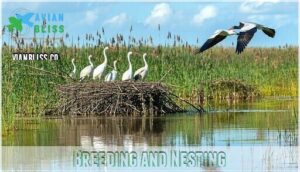
When you observe white-faced ibis during breeding season, you’ll find them gathering in large colonies that can include hundreds of pairs.
These social birds choose nesting sites in dense marsh vegetation or low shrubs near shallow water, often sharing space with herons and egrets for added protection, which can be considered a social behavior.
Breeding Grounds
You’ll discover white-faced ibis breeding grounds in shallow freshwater marshes across western North America.
These birds select colony sites with dense vegetation like cattails and bulrushes.
Colony location depends on water levels and habitat quality.
Unlike glossy ibis, they prefer inland wetlands.
Breeding success relies on stable water conditions.
Colonies shift annually as conditions change, ensuring ideal nesting environments for chick development.
Nesting Sites
White-faced ibis choose their nesting habitat with care.
These birds prefer dense marsh vegetation or shrubs near water for nest construction.
Site fidelity varies as colonies shift locations annually based on water levels and habitat conditions.
They often require specific materials for nest building.
- Colony substrate: Built in cattails, bulrush, or low shrubs above water
- Nest construction: Platform of woven stems and grasses lined with finer materials
- Habitat selection: Dense vegetation providing cover and stability for eggs
- Nesting synchrony: Timing coordinated within colonies for protection and success
Colony Formation
Hundreds of ibis birds gather in colonies during breeding season.
This ibis bird behavior creates powerful colony benefits through shared protection and mate selection opportunities.
Nesting density can reach impressive levels with dozens of pairs in small areas.
Bird habitat selection focuses on dense marsh vegetation or shrubs near water.
Colony defense becomes a group effort against predators.
Bird behavior within colonies helps synchronize breeding cycles.
Nesting materials often include twigs and plant fibers.
These nesting communities shift locations annually based on water levels, creating a dynamic breeding environment with shared protection.
Incubation Period
Both parents typically share incubation duties for their precious clutches.
You’ll witness dedicated parental care as they rotate egg-warming responsibilities every few hours.
The incubation length spans 17-26 days, with most eggs hatching around day 21-22.
Here’s what makes this period remarkable:
- Temperature effects can dramatically impact hatching success rates
- Egg development progresses steadily when conditions remain stable
- Parental roles switch seamlessly between male and female birds
- Young emerge semi-helpless but grow incredibly fast
- Incubation creates the foundation for colony survival
Conservation Status

You might wonder how stable white-faced ibis populations are across their range. These birds face ongoing challenges from habitat loss and environmental changes that affect their wetland homes.
Population Status
With global numbers reaching 1.2 to 2.0 million individuals, you’ll find White-faced Ibis populations holding steady across their range.
North America hosts roughly 300,000 breeding birds, while South American populations remain stable but less documented.
Current numbers show regional variations, with western US states supporting the largest concentrations, despite local threats from habitat loss and pesticide contamination, their conservation status remains secure.
Population Trends
You’ll find encouraging news in this species’ recovery story.
North American Breeding Bird Survey data shows overall population increases since the 1960s, with numbers now exceeding 1.1 million individuals.
Range expansion into new breeding areas across the Great Basin occurred after 1970.
Despite historic lows from habitat loss and pesticide use in the 1940s-1960s, conservation efforts have supported stable growth.
Climate impacts and breeding success vary regionally, but bird population trends remain positive through targeted habitat management.
This indicates a stable growth in the species’ population.
Threats
Several major threats face white-faced ibis populations.
Habitat Loss from agricultural conversion destroys critical wetland habitats. Climate Change alters precipitation patterns and dries breeding areas.
Pesticide Use reduces prey availability and causes direct poisoning. Water Pollution from agricultural runoff degrades feeding areas.
These factors combine to threaten bird conservation efforts and avian diversity across their range. Sadly, 78% of bird species face extinction because of these issues.
Habitat Requirements
White-faced ibis need specific wetland conditions to thrive.
You’ll find these wading birds in freshwater marshes with ideal water quality and dense vegetation density.
They prefer shallow waters with low salinity levels for successful foraging.
They also require habitat conditions that support their ecological needs.
Habitat fragmentation and climate change threaten their traditional bird habitats.
These specialized wetland habitats require careful management to support healthy bird ecology populations.
Frequently Asked Questions (FAQs)
Are white-faced ibis rare?
You’ll find white-faced ibis aren’t particularly rare, though they’re more localized than some waterbirds.
They’re common in western North America’s wetlands but less abundant than herons or egrets in most areas.
What are white ibis eating in my yard?
Surprisingly, those white birds in your yard are likely hunting earthworms, grubs, and insects.
They’ll probe soft soil with their curved bills, searching for beetle larvae and other tasty invertebrates hiding beneath the surface.
Where can I find white-faced ibis?
You’ll spot white-faced ibis in freshwater marshes, shallow ponds, and irrigated fields across western North America. They’re year-round residents in California, Texas, and Louisiana, but migrate elsewhere seasonally.
Is white-faced ibis rare?
Fairly frequent finds you’ll find throughout freshwater wetlands of western North America.
The 2012 population was estimated at 2 million individuals and increasing.
The species isn’t considered rare, classified as Least Concern by the IUCN.
Where do white-faced ibis migrate to?
Migratory populations winter from the southern United States through Central America. You’ll find them moving south from breeding grounds in western North America to warmer climates with suitable wetland habitats.
What do white-faced ibis eat?
Like a dining detective with a curved magnifying glass, you’ll find white-faced ibis probe shallow waters for insects, crustaceans, earthworms, small fish, frogs, and snails using their specialized bills.
What colors are the White-faced Ibiss eyes and legs?
During breeding season, you’ll notice the white-faced ibis has bright red eyes and vivid red legs that really stand out against its dark, iridescent plumage.
How long is the White-faced Ibiss wingspan?
Wingspan wonderfully stretches between 90-100 centimeters in adult White-faced Ibis.
You’ll spot these impressive birds displaying their broad wings across wetland habitats.
The measurement equals roughly 35-39 inches for easy reference, which is a key aspect of identifying these birds with a notable wingspan.
How do White-faced Ibises search for food?
You’ll watch White-faced Ibises wade through shallow water using their long curved bills like probes.
They stick their beaks deep into mud and sediment to find insects, crustaceans, and small fish hiding below the surface.
What is the scientific name of the White-faced Ibis?
You don’t need to worry about the formatting issues between the two style instructions – they’re conflicting styles and the second one overrides the first.
You’re looking for the scientific name that officially labels this wading bird.
The white-faced ibis scientific name is Plegadis chihi. This binomial name follows standard taxonomy rules for classifying species.
Conclusion
Some people think the white faced ibis is hard to spot, but you can identify it with a bit of practice.
Look for its burgundy-red feathers and white facial border.
You’ll often find these birds in flocks, wading through marshes or fields.
Their curved bills help them hunt for food in muddy water.
Understanding their habitat and migration patterns lets you find the white faced ibis more easily.
Watch for them during migration in wetlands near you.