This site is supported by our readers. We may earn a commission, at no cost to you, if you purchase through links.
The piercing trill of an Eastern Screech-Owl cuts through a warm Alabama evening, and you freeze on your backyard deck. Most folks think of owls as mysterious northern birds, but Alabama hosts seven distinct species year-round or during migration.
These nocturnal hunters range from the palm-sized Northern Saw-whet Owl to the formidable Great Horned Owl with its five-foot wingspan. You’ll find them perched in suburban oaks, gliding over coastal marshes, and calling from deep Appalachian hollows.
Understanding which owls share your neighborhood—and recognizing their calls, hunting patterns, and preferred habitats—transforms every twilight walk into a potential wildlife encounter.
Table Of Contents
- Key Takeaways
- Owl Species Found in Alabama
- Habitats and Distribution Across Alabama
- Owl Behavior and Hunting in Alabama
- Conservation Status and Protection Efforts
- Frequently Asked Questions (FAQs)
- What is the most common owl in Alabama?
- Is it good to have owls in your yard?
- Can an owl pick up a 10 lb cat?
- Are owls good to have in your yard?
- Why is an owl always in my yard?
- What time of day are owls active?
- How do owls maintain silent flight?
- What adaptations allow owls to hunt at night?
- Why are owl neck rotations beneficial?
- What is the purpose of owl pellets?
- Conclusion
Key Takeaways
- Alabama hosts seven distinct owl species year-round or during migration, ranging from the palm-sized Northern Saw-whet Owl to the five-foot-wingspan Great Horned Owl, each adapted to specific habitats from suburban neighborhoods to coastal marshes.
- Eastern Screech-Owls and Barred Owls thrive in residential areas and woodlands across Alabama year-round, while species like Short-Eared Owls and Long-Eared Owls visit only during winter migration, making seasonal timing critical for owl watching.
- Owls use specialized hunting adaptations including silent flight powered by serrated feather edges, 270-degree head rotation for panoramic vision, and acute hearing that allows them to approach prey undetected within 10 meters before striking with precision talons.
- Conservation efforts protect Alabama’s owls through federal Migratory Bird Act enforcement, habitat preservation initiatives like wetland restoration and wildlife corridors, and citizen science programs that track population health and breeding patterns statewide.
Owl Species Found in Alabama
Alabama’s woods and fields are home to seven owl species, each with its own personality and favorite haunts.
These fascinating raptors are part of the broader Strigiformes order, which includes nearly 200 types of birds of prey found across the globe.
From the tiny, well-camouflaged Eastern Screech-Owl to the imposing Great Horned Owl, you’ll find owls adapted to nearly every corner of the state. Let’s meet each species and discover what makes them unique.
Eastern Screech-Owl
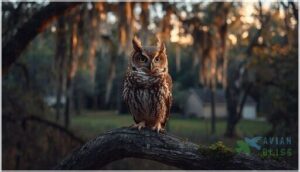
You’ll find the Eastern Screech-Owl tucked into woodlands and suburban neighborhoods across Alabama year-round. This pint-sized hunter measures just 16-25 cm with a wingspan of 46-61 cm, weighing 121-244 grams.
Listen for its distinctive screech calls echoing through hollow trees and bird boxes where owl nesting occurs. Unlike migratory species, this year-round resident enriches Alabama habitats with its ghostly presence.
To compare more species, check out these details on owl characteristics and habitats.
Great Horned Owl
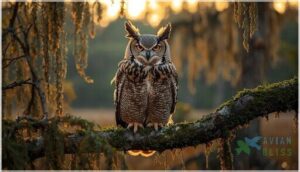
While screech owls stay small, Alabama’s Great Horned Owl dominates as a top predator. You’ll recognize this powerful hunter by its bold ear tufts, yellow eyes, and impressive 44-57 inch wingspan spanning forests to urban parks.
Key features include:
- Length of 18-25 inches with mottled brown-gray feather camouflage
- Distinctive “whooo-whoo” hooting vocalization
- Hunting strategies targeting mammals, birds, and reptiles
- Habitat adaptation across wetlands, woodlands, and cities
- Year-round nesting patterns throughout Alabama
For further details, explore this guide to.
Barred Owl
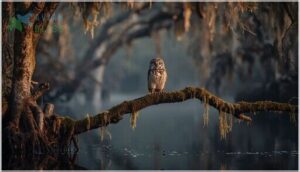
While Great Horned Owls reign as top predators, you’ll discover the Barred Owl thriving in Alabama’s swamps and wooded neighborhoods. This medium-sized hunter stretches 16-25 inches with rich brown feather camouflage and distinctive horizontal chest barring.
| Feature | Details |
|---|---|
| Wingspan | 39-43 inches |
| Barred Owl Diet | Small mammals, birds, amphibians, large insects |
| Vocalization | “Who cooks for you, who cooks for you” repetitive call |
| Owl Nesting | Dense wooded swamps, riparian forests, parks |
| Conservation Status | Least Concern (3 million individuals) |
Listen for their unmistakable “who cooks for you” call echoing through forests at dusk.
If you’ve ever wondered why owls hoot, these barred owls use their signature call to establish territory and communicate with mates.
Barn Owl
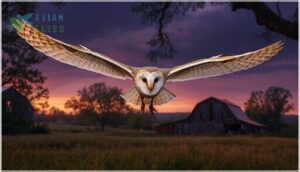
You’ll recognize Alabama’s pale ghost hunter by its striking heart-shaped facial disc that channels sound like radar. This Barn Owl stretches 13-15 inches with a 34-40 inch wingspan, preferring open farmland and nesting in old barns or hollow trees.
Watch for silent flight as it hunts voles and mice using outstanding hearing. Listen for its soft, exultant screech echoing across fields at dusk.
Long-Eared Owl
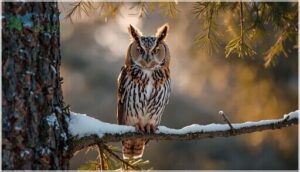
You’ll spot this winter visitor by its distinctive long ear tufts and reddish-brown plumage that provides excellent feather camouflage. The Long Eared Owl measures 13-16 inches with a 38-44 inch wingspan, preferring dense coniferous forests for roosting behavior during daylight.
Watch for silent flight as it hunts small mammals at dusk. This Long-eared Owl species demonstrates fascinating owl migration patterns across Alabama’s woodlands.
Short-Eared Owl
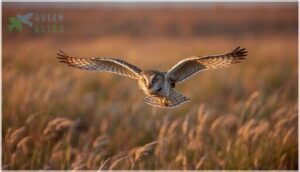
Unlike most owls in Alabama, this open field hunter breaks the nocturnal mold with impressive diurnal activity over grasslands and wetlands. The Short-Eared Owl shows buffy-brown plumage with streaked undersides and small ear tufts you’ll barely notice.
Watch for low, moth-like flight patterns as it patrols open habitats hunting voles and mice. Its roosting habits include ground nests in dense vegetation, making bird identification challenging during winter visits.
Northern Saw-whet Owl

This tiny owl measures just 7 to 8 inches long, making the Northern Sawwhet Owl Alabama’s smallest nocturnal bird. You’ll find it in evergreen roosts within dense coniferous forests during winter migration patterns.
Its high-pitched, repetitive tooting vocalizations sound like a saw being sharpened. Research needs include better tracking of owl habitat and behavior since bird identification proves difficult for this secretive species.
Habitats and Distribution Across Alabama
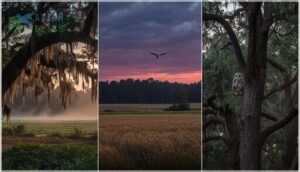
Alabama’s diverse landscapes provide a home for seven distinct owl species, each with its own preferred terrain. From dense forests to open farmlands, these raptors have carved out niches across the state.
Let’s explore where you’re most likely to encounter each species and what draws them to these particular habitats.
Forests and Woodlands
When you explore Alabama’s forests, you’ll find owls thriving from the forest canopy down to the forest understory.
Barred Owls dominate woodlands where tree diversity sustains healthy prey populations and strong soil health promotes forest resilience.
National parks and forests like Bankhead and Talladega offer prime owl habitat for nesting and feeding behaviors.
These layered forests create perfect hunting grounds for Alabama’s woodland owl species.
Grasslands and Wetlands
You’ll discover Short-Eared Owls patrolling open grassland ecosystems and wetland functions in Alabama’s coastal marshes, where habitat connectivity links water to land.
These owl species in Alabama exploit habitat preservation areas like Wheeler National Wildlife Refuge, scanning for voles and shrews.
Wetlands create avian habitat rich in species interactions—amphibians breed in seasonal pools while owls hunt the edges, making these wildlife habitats essential for survival.
Urban and Residential Areas
You might spot Eastern Screech-Owls right in your backyard, thriving amid residential design that includes green spaces and mature street trees.
Urban planning in Alabama increasingly fosters wildlife in Alabama by preserving wooded corridors and parks, while noise reduction buffers help owls hunt successfully.
Community engagement in bird watching in Alabama reveals that owl species in Alabama adapt surprisingly well when habitat and distribution patterns overlap with thoughtful neighborhood layouts.
Key Locations for Owl Watching
North Trails like Monte Sano State Park and Key Cave National Wildlife Refuge bring you close to calling Barred Owls and wintering Short-eared Owls across grassland sites.
Coastal spots including Gulf State Park and 5 Rivers Delta harbor Great Horned Owls, while Bankhead Forest’s Sipsey Wilderness echoes with dusk hoots—prime destinations for bird watching in Alabama and exploring owl habitat and behavior.
Owl Behavior and Hunting in Alabama

Owls in Alabama aren’t just masters of stealth—they’re incredibly skilled hunters with fascinating behaviors that vary from species to species. Some hunt exclusively under the cover of darkness, while others patrol fields in broad daylight, and their techniques for catching prey are nothing short of extraordinary.
Let’s explore how these nocturnal predators live, hunt, and raise their young across Alabama’s diverse landscapes.
Nocturnal and Diurnal Activity
You’ll find that owls in Alabama are masters of the night, with peak activity cycles unfolding between dusk and midnight.
Nocturnal patterns dominate their hunting schedules, though some species show crepuscular behavior during dawn and dusk hours.
Moonlight effects can intensify their prey detection abilities, making these nocturnal birds incredibly efficient hunters in Alabama’s diverse habitats.
Prey Preferences
When you watch owls in Alabama hunt, you’ll notice their prey preferences reveal fascinating dietary adaptations shaped by predator prey ratios and food web dynamics. Each species targets different prey size variation, creating unique feeding behaviors.
- Small rodents like mice and voles dominate most diets, especially for barn owls
- Great horned owls tackle larger prey up to 10 inches long, including rabbits
- Insects and invertebrates supplement meals during warmer months
- Songbirds and nestlings increase spring prey availability
- Amphibians and crayfish provide wetland hunting opportunities
Hunting Techniques
After owls in Alabama choose their prey, you’ll see them employ stealth approaches that showcase impressive hunting strategies.
Silent flight is their secret weapon—serrated feather edges muffle sound so they can approach closer than 10 meters undetected.
Owls approach prey undetected within 10 meters using silent flight powered by serrated feather edges that muffle sound
They use ambush tactics, perching low and watching before diving with precision.
Their talons grip instantly during prey capture, often delivering a fatal neck strike in one clean motion.
Nesting and Feeding Behaviors
You’ll find that nesting habits vary widely among Alabama’s owl species, reflecting diverse avian ecology. Eastern Screech-Owls favor tree cavities and readily use nest boxes for breeding cycles starting in February.
Barred Owls select natural hollows or repurpose old hawk nests. Parental care is intensive—females incubate while males deliver prey, continuing feeding habits for weeks after chick development and fledging.
Conservation Status and Protection Efforts
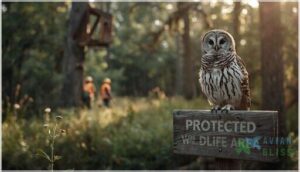
While Alabama’s owls aren’t facing the same wildlife crisis as some wildlife, they still need our attention and protection. You’ll find that different species face unique challenges, from habitat loss to human disturbance, and their conservation status varies widely.
Let’s look at what threatens these birds, what’s being done to help them, and how Alabama protects its owls through legal safeguards and active conservation work.
Threats to Owl Populations
Owls face mounting pressures across Alabama that threaten their survival. Road collisions claim birds hunting along highways, while poisoning effects from anticoagulant rodenticides accumulate when owls eat contaminated prey.
Habitat fragmentation breaks up forests and grasslands, shrinking territories. Climate impacts shift prey availability. Human persecution, though illegal, still occurs.
Understanding these threats is vital for owl conservation status and maintaining ecological balance through bird conservation efforts and environmental protection.
Habitat Preservation Initiatives
Across Alabama, you’ll find conservation easements protecting critical hunting grounds while wetland restoration programs rebuild marsh edges where owls pursue prey.
Forest management through prescribed burning maintains open understory habitat, and urban habitat initiatives transform residential yards into stepping stones for wildlife.
These habitat preservation efforts create wildlife corridors that link protected lands, sustaining avian biodiversity and ecological balance through dedicated environmental protection and wildlife conservation work.
Research and Monitoring in Alabama
You can help track owl species in Alabama through Breeding Atlas Data surveys that map Eastern screech-owl and barred owl activity across standardized blocks.
OwlNet Banding networks monitor northern saw-whet movements while Rehab Center Insights from places like Oak Mountain reveal injury patterns.
Citizen observations strengthen Ornithological Research and Studies, helping ADCNR assess Owl Conservation Status and guide Wildlife Management and Conservation decisions statewide.
Legal Protections for Owls
Federal law shields every owl in Alabama under the Migratory Bird Act, making it illegal to harm, capture, or possess them without permits. State Law Penalties reinforce this protection, fining violators $250 to $500.
Falconry Permits allow limited use of certain species, but Owl Conservation Status remains tied to strict Wildlife Management and Conservation rules. Together, these safeguards anchor habitat preservation and species conservation across wildlife conservation in Alabama efforts.
Frequently Asked Questions (FAQs)
What is the most common owl in Alabama?
When you think “common owl,” you might picture rare forest dwellers.
Not in Alabama. The barred owl claims top spot, thriving statewide in swamps and hardwood forests with its distinctive “who-cooks-for-you” call echoing everywhere.
Is it good to have owls in your yard?
You’ll enjoy natural pest control benefits and improved yard ecosystem balance when owls visit, though you’ll need to follow owl safety tips for small pets and maintain a respectful distance during nesting season.
Can an owl pick up a 10 lb cat?
Most Alabama owls can’t lift a 10-pound cat due to flight capabilities and bird prey limits.
Great horned owls, despite strong talon strength, usually carry prey near their 3-5 pound body weight, making owl attack risks low for larger cats.
Are owls good to have in your yard?
Yes, owls provide excellent natural pest control—a barn owl family can eat around 1,000 rodents per breeding season.
You’ll reduce mice and rats while enjoying Alabama’s native wildlife coexisting peacefully in your backyard.
Why is an owl always in my yard?
Your yard likely sits within an owl’s hunting territory and offers reliable food sources like mice or voles, safe roosting sites in tall trees, and quiet perches that the bird returns to nightly.
What time of day are owls active?
Most owl species show nocturnal patterns, hunting after sunset through dawn.
However, you’ll also spot crepuscular behavior at twilight, and some demonstrate flexible scheduling or diurnal activity depending on prey availability and seasonal conditions.
How do owls maintain silent flight?
Three special feather features work together to create acoustic stealth: wing serrations break up airflow, feather velvet dampens friction noise, and trailing edges scatter turbulence, letting owls glide silently toward prey.
What adaptations allow owls to hunt at night?
Like shadows slipping through moonlight, these raptors rely on acute hearing, night vision, silent flight, and camouflage feathers to ambush prey.
Stealthy behavior and specialized adaptations make nocturnal wildlife masters of avian ecology after dark.
Why are owl neck rotations beneficial?
Rotating heads about 270 degrees gives them panoramic vision and enhanced hearing for silent hunting.
This stealth advantage helps pinpoint prey while blood flow protection keeps their brains safe during extreme neck turns.
What is the purpose of owl pellets?
Think of them like nature’s recycling system—owl pellets bundle indigestible bones and fur for safe regurgitation, protecting the digestive tract while offering scientists a window into diet and ecosystem health.
Conclusion
Knowledge is power, especially in identifying owls in Alabama after dark. You’ve now got the tools to recognize seven species by sight, sound, and habitat preference.
Whether you’re spotting a Barred Owl’s dark eyes in your neighborhood or tracking Short-Eared Owls across winter grasslands, each encounter deepens your connection to Alabama’s nocturnal ecosystem. So grab binoculars, step outside at dusk, and let the hunt begin.