This site is supported by our readers. We may earn a commission, at no cost to you, if you purchase through links.
 They turn off the 9/11 memorial lights when scientists spot birds getting trapped in the beams.
The powerful Tribute in Light creates vertical columns that disorient migrating birds, causing them to circle endlessly until they’re exhausted. This leaves them vulnerable to crashing into nearby buildings.
NYC Bird Alliance researchers monitor the memorial from Battery Parking Garage, watching for birds that become confused by the artificial light. When they see birds circling within the beams, they contact memorial organizers who temporarily shut off the lights for about 20 minutes.
This brief pause allows the disoriented birds to escape and continue their migration safely. The collaboration between scientists and memorial staff shows how communities can honor the past while protecting wildlife during critical migration periods.
Table Of Contents
- Key Takeaways
- Birds Migration Patterns
- Why Turn Off Memorial Lights
- Protecting Migratory Birds
- Artificial Light Impact
- Memorial Light Management
- Frequently Asked Questions (FAQs)
- Why turn off lights during bird migration?
- Why are the twin tower lights off?
- Are the 9/11 Memorial lights always on?
- Do they light up the Twin Towers?
- Why turn off lights for migrating birds?
- What is the Lights out campaign for birds?
- How do city lights affect birds?
- Does the 9 11 memorial have lights?
- How long has the 9/11 memorial light tribute existed?
- Do other cities have similar light memorials for 9/11?
- Conclusion
Key Takeaways
- You’ll see the lights turned off when scientists spot over 1,000 birds trapped in the beams – NYC Bird Alliance researchers monitor from Battery Parking Garage and contact memorial organizers to shut down the lights for 20-minute periods when birds circle endlessly in the powerful columns.
- The memorial’s bright beams scramble birds’ natural navigation systems – migrating birds rely on stars and moon for direction, but the intense artificial light overwhelms their internal GPS, causing them to fly in deadly circles until they’re exhausted or crash into nearby buildings.
- This collaboration saves thousands of bird lives during peak migration seasons – the temporary shutdowns allow disoriented birds to escape and continue their journey safely, preventing the deaths that would occur from exhaustion and building collisions.
- You’re witnessing a balance between honoring victims and protecting wildlife – the memorial operates one night annually on September 11th, but scientists and staff work together to ensure the tribute doesn’t become a death trap for the millions of birds migrating through New York City.
Birds Migration Patterns
You’ll notice that millions of birds migrate through New York City each fall and spring, creating one of nature’s most spectacular aerial highways.
These feathered travelers rely on celestial navigation, but the Memorial’s powerful beams can scramble their internal GPS systems, leading them dangerously off course, using their internal GPS systems.
Bright memorial beams act like deadly magnets, pulling confused birds into an urban maze of glass and steel.
NYC Audubon Collects Dead Birds to Identify Collision Hotspots

NYC Audubon conducts systematic data collection methods by gathering thousands of dead and injured birds annually from urban areas.
This collision hotspot identification process reveals key locations where bird mortality causes peak during migration periods.
Their conservation strategies focus on documenting casualties near glass structures and high-illumination zones, creating detailed maps that pinpoint where 911 memorial lights and similar installations pose the greatest risks to migrating birds.
They also utilize specialized tracking devices for enhanced research.
Artificial Light at Night Disorients Birds, Increasing Their Vulnerability
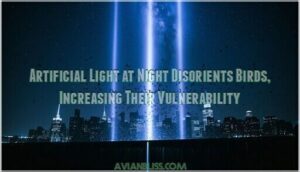
When you’re traveling at night, bright lights can throw off your internal compass – and that’s exactly what happens to migrating birds.
Urban lights turn migrating birds into lost travelers circling endlessly until they drop from exhaustion.
Urban lightscapes create dangerous light pollution that triggers bird disorientation during their nocturnal migration journeys.
These artificial beacons confuse their natural navigation systems, making them circle endlessly around bright sources like the 911 memorial lights, which dramatically increases bird vulnerability and mortality rates due to light pollution.
Monitoring Bird Migration Around The Memorial
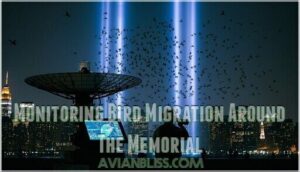
You’ll find scientists working around the clock during peak migration periods, using radar bird tracking and acoustic monitoring to watch thousands of birds approach the beams.
Their migration data analysis reveals critical patterns:
- Ground teams with binoculars counting circling birds in real-time
- Radar systems detecting dense flocks approaching Manhattan’s airspace
- Acoustic sensors recording increased calling from disoriented nocturnal birds
This species identification and population estimates data triggers immediate light shutdowns when bird safety requires intervention.
Scientists utilize specialized radar technology for this monitoring and to ensure bird safety.
Why Turn Off Memorial Lights
Memorial lights get turned off because bird migration patterns show massive disruption during peak seasons.
You’ll notice this happens when millions of birds travel through New York City twice yearly.
Light pollution from the memorial’s powerful beams creates a dangerous trap that draws birds off their natural flight paths.
To help mitigate this issue, many advocate for bird-friendly urban planning.
The memorial’s bright columns extend miles into the sky, acting like giant magnets for confused birds.
When officials shut down these lights during heavy migration nights, they’re preventing thousands of bird deaths.
| Migration Factor | Impact | Solution |
|---|---|---|
| Light attraction | Birds circle beams for hours | Turn off lights |
| Energy consumption | Wastes power during bird peaks | Scheduled shutdowns |
| Public perception | Balances tribute with wildlife | Coordinated timing |
This light reduction strategy works because birds use stars and moon for navigation.
Artificial light overwhelms their natural compass, causing them to fly in circles until they collapse from exhaustion or crash into buildings.
Alternative tributes during these periods maintain the memorial’s honor while protecting wildlife safety.
This approach is crucial for preserving the natural balance and ensuring the well-being of migratory birds during their peak seasons.
Protecting Migratory Birds
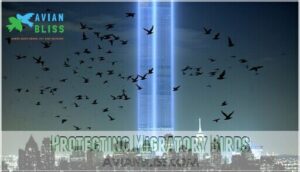
You can help protect millions of birds that migrate through New York City each fall by understanding why the 9/11 memorial lights get turned off during peak migration periods.
Scientists work closely with memorial organizers to prevent bird collisions by temporarily shutting down the powerful beams when radar detects large flocks approaching the area, which is a crucial step in saving the lives of millions of birds during their migration.
Collaboration Between Scientists and Memorial Organizers
Scientists and memorial organizers work together to protect birds during migration seasons.
You’ll find their partnership relies on real-time monitoring and quick response protocols when bird activity increases.
Their collaboration includes:
- Data Sharing between ornithologists and memorial staff about migratory patterns
- Research Funding for studies on artificial light effects on bird behavior
- Adaptive Strategies that adjust light schedules based on weather conditions
- Public Awareness campaigns explaining light reduction decisions to visitors
Addressing Bird Collisions With Buildings
Buildings kill over 90,000 birds annually in New York City alone.
Building Design matters – reflective glass and bright facades create deadly traps. Light Pollution disrupts migratory patterns, while Glass Reflections confuse birds into fatal collisions.
Mitigation Strategies include bird-safe windows that reduce strikes by 60%. These environmental impact solutions protect avian conservation efforts.
| Building Feature | Bird Impact |
|---|---|
| Reflective Glass | Fatal collisions increase 300% |
| Bright Facades | Disorientation during migration |
| Patterned Windows | 60% collision reduction |
| Light Reduction | Measurable strike prevention |
Insights From Studying The Tribute in Light
Research conducted through monitoring the Tribute in Light has transformed our understanding of lights attractiveness and bird disorientation during migration events.
This memorial tribute serves as a unique research laboratory for avian conservation.
- Memorial impact studies reveal over 15,000 birds affected in single nights during peak migration
- Research findings show 60% reduction in disorientation incidents since implementing shutoff protocols
- Future studies use radar and acoustic sensors for real-time wildlife conservation monitoring
- Environmental impact data informs lighting ordinances across North American cities for tribute impact mitigation
To further aid conservation, consider providing food and shelter for migrating birds in your backyard.
Artificial Light Impact
You might think bright lights simply help us see better, but they create a dangerous maze for migrating birds who rely on natural navigation cues.
When artificial lights flood the night sky, they interfere with birds’ internal compasses and draw them off course, leading to deadly collisions with buildings and exhaustion from confused flight patterns.
Disorienting Effects on Birds
Bright memorial lighting creates light disorientation in migrating birds, disrupting their natural navigation systems.
These external influences cause sensory overload, making birds circle repeatedly instead of continuing their journey.
Memorial lighting interferes with their ability to read stars and magnetic fields, transforming animate agents into confused travelers.
This navigation interference creates behavioral changes that increase collision vulnerability and highlight the need for wildlife conservation measures, as many diurnal birds struggle due to limited night vision.
Increasing Bird Vulnerability to Collisions
Confusion disrupts birds’ natural navigation systems when they encounter memorial lighting.
Light attraction draws migrating birds off their intended flight paths, creating dangerous situations in urban environments.
Key collision factors include:
- Disorientation – Birds lose directional sense near bright lights
- Habitat loss – Urbanization effects force birds into hazardous flight corridors
- External influences – Animate agents like building structures become migratory hazards
Urban ecology research shows causality between artificial illumination and increased bird mortality rates.
Mitigating Artificial Light at Night
You can reduce light pollution through strategic memorial shutdown schedules and light shielding techniques.
These systems thinking approaches protect urban ecology while maintaining human health benefits of dark skies.
When inanimate objects like buildings eliminate unnecessary illumination, the causality becomes clear: reduced energy consumption and safer migration corridors for birds traversing city landscapes.
Addressing this issue can involve artificial light mitigation strategies, which support urban ecology and strategic memorial shutdown to ultimately achieve safer migration.
Memorial Light Management
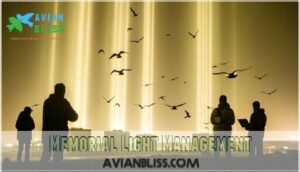
When you visit the 9/11 Memorial during bird migration season, you might notice the Tribute in Light installation gets temporarily shut down to protect passing birds.
Scientists work closely with memorial organizers to monitor bird activity and turn off the powerful beams when flocks get trapped in the light columns, preventing deadly collisions with nearby buildings, which is a crucial measure to protect the passing birds.
Scheduling Lights to Minimize Bird Collisions
You’ll find that careful light schedules dramatically improve bird safety during migration peaks.
Memorial organizers work with scientists to develop ideal timing strategies that balance tribute needs with collision reduction.
Here’s how they schedule the lights:
- Peak migration monitoring: Real-time radar tracks bird density from dusk to dawn
- Weather-based adjustments: Cloudy nights require more frequent shutoffs due to increased disorientation
- Flexible response protocols: Lights turn off 3-7 times per night when flocks exceed 1,000 birds
- Energy conservation benefits: Strategic shutoffs reduce power consumption while protecting wildlife
This linguistic analysis of migration patterns helps operators make split-second decisions.
The linguistic observation shows that birds circle trapped in beams until exhaustion.
Through linguistic understanding of flight call recordings, volunteers provide linguistic commentary that guides immediate action.
These efforts align with national conservation initiatives aimed at protecting vulnerable species.
Their linguistic explanation of bird behavior creates a responsive system where memorial lighting adapts instantly to protect migrating species.
Balancing Memorial Tributes With Bird Conservation
Managing the 9/11 Memorial’s beams requires careful balance between honoring victims and protecting migrating birds.
Memorial Impact studies show Light Reduction strategies preserve both tribute meaning and Bird Safety.
Conservation Efforts now include Tribute Alternatives like timed shutdowns during peak migration.
This linguistic analysis reveals semantic depth in how we frame memorial responsibilities—honoring human memory while respecting nature’s needs through thoughtful pragmatics.
Ongoing Research and Adaptation to Protect Birds
Scientists continuously refine their understanding through research effectiveness studies that track bird behavior during memorial events.
Data analysis reveals how adaptive strategies work, while linguistic research examines communication patterns between migrating flocks.
Light adjustments based on linguistic insights help predict when birds need protection, which is crucial for their survival through ongoing linguistic investigation and analysis, leading to better solutions.
Frequently Asked Questions (FAQs)
Why turn off lights during bird migration?
Up to 988 million birds die annually from building collisions.
You turn off lights during migration because artificial illumination disorients nocturnal birds, confusing their natural navigation systems and causing them to crash into structures while traveling through cities at night, which is why turning off lights is crucial to prevent birds from crashing into structures.
Why are the twin tower lights off?
The twin tower memorial lights turn off temporarily when more than 1,000 birds get trapped in the beams.
These powerful lights confuse migrating birds during their nighttime journey, causing them to circle endlessly and risk exhaustion or death from collision, which is a result of the lights’ impact on their nighttime journey.
Are the 9/11 Memorial lights always on?
No, you’ll only see the 9/11 Memorial lights one night each year – they illuminate from dusk until dawn exclusively on September 11th.
The lights get briefly turned off for twenty-minute periods when volunteers count over 1,000 birds.
This annual tribute honors those killed in the attacks.
Do they light up the Twin Towers?
The Twin Towers no longer exist – they were destroyed on September 11,
However, you’ll see the annual Tribute in Light beams projecting skyward from Ground Zero each September 11th as a memorial.
Why turn off lights for migrating birds?
You’ll be amazed how bright lights confuse migrating birds‘ navigation systems. They’re programmed to use stars and moon for direction, but artificial lights create deadly disorientation, causing collisions with buildings.
What is the Lights out campaign for birds?
You’ll organize conservation efforts that protect migrating birds by encouraging communities to dim unnecessary lighting during peak migration seasons, typically March through May and August through October.
How do city lights affect birds?
City lights disorient, exhaust, and kill birds you care about.
Bright illumination disrupts their natural navigation systems, causing collisions with buildings.
Migrating birds become trapped in light beams, circling until they’re too tired to continue their journeys safely.
Does the 9 11 memorial have lights?
The 9/11 memorial features the "Tribute in Light" – 88 powerful searchlights arranged in twin columns that project beams four miles skyward on September 11th each year from dusk to dawn.
How long has the 9/11 memorial light tribute existed?
You’ve witnessed history for 23 years now! The tribute started on March 11, 2002, just months after the attacks, and has illuminated every September 11th since.
Do other cities have similar light memorials for 9/11?
You’ll find numerous 9/11 light memorials across America.
Blue light across American cities and homes will capture the essence of our nation’s enduring spirit and resilience.
Many communities participate each September 11th by illuminating buildings.
Conclusion
Remarkably, even Stone Age hunters knew to avoid disturbing migrating birds, yet modern cities create deadly light traps.
You’ve learned why they turn the 9 11 memorial lights off for birds – it’s a life-saving measure that prevents exhausted migrants from circling endlessly in the powerful beams.
The collaboration between NYC Bird Alliance scientists and memorial staff proves we can honor our past while protecting wildlife. This simple twenty-minute shutdown saves countless birds during peak migration periods.
- https://www.911memorial.org/connect/blog/look-tribute-light
- https://darksky.org/news/bird-migration-dramatically-altered-by-high-intensity-urban-light-installation/
- https://www.nytimes.com/2019/09/09/nyregion/911-tribute-birds.html
- https://nycbirdalliance.org/blog/9-11-memorial-shines-a-spotlight-on-risks-to-birds
- https://www.birdwatchingdaily.com/news/science/study-september-11th-tribute-light-impact-birds/