This site is supported by our readers. We may earn a commission, at no cost to you, if you purchase through links.
 You’ll find that owls don’t stick together like love-struck teenagers after mating. Most owl species practice seasonal monogamy, staying paired only during breeding season.
Once their chicks fledge, many couples go their separate ways. However, some species like Tawny Owls and Great Horned Owls can maintain lifelong partnerships if they’re successful breeders and both survive.
Their commitment depends on territory, survival rates, and breeding success rather than romance. Site fidelity often trumps mate fidelity—they’re more loyal to prime real estate than partners.
The bond strength varies dramatically across the 200+ owl species worldwide, revealing fascinating patterns about avian relationships.
Table Of Contents
- Key Takeaways
- Owl Mating Habits
- Do Owls Stay Together
- Owl Territorial Behavior
- Owl Pair Bonding
- Owl Mate Loss Impact
- Frequently Asked Questions (FAQs)
- Do owls mate and stay together?
- Do owls live alone or in pairs?
- Do owls stay with their mates?
- What happens when an owl’s mate dies?
- What are the mating habits of owls?
- Do owls stay in the same spot?
- Do owls stay together after mating?
- Do owls mate?
- Do owls switch mates each year?
- How do owls bond with their mates?
- Conclusion
Key Takeaways
- Most owls don’t stay together year-round – While they’ll form seasonal partnerships during breeding, many couples separate once their chicks leave the nest
- Some species do mate for life – Great Horned Owls and Tawny Owls can maintain lifelong bonds if they’re successful breeders and both survive
- Territory matters more than romance – You’ll find owls are more loyal to prime real estate than to their partners, often choosing good hunting grounds over familiar mates
- Survival determines commitment levels – Their bond strength depends on breeding success, territory quality, and survival rates rather than emotional attachment
Owl Mating Habits
You’ll discover that owl mating habits are far more complex than a simple seasonal encounter.
Most owl species form monogamous pairs that stay together for years, with many mating for life through elaborate courtship rituals and strong territorial bonds.
Courtship Rituals
You’ll witness spectacular owl courtship displays that put most romantic comedies to shame.
Male owls don’t just show up empty-handed—they bring dinner dates to a whole new level through elaborate aerial performances and gift-giving rituals.
Three mesmerizing courtship displays include:
- Wing-clapping acrobatics – Males perform mid-air stunts with dramatic wing sounds
- Food presentation ceremonies – Up to four prey deliveries per night during peak season
- Synchronized duet vocalizations – Pairs create haunting melodies that strengthen their bond
These ritualistic behaviors serve as fitness tests, allowing females to evaluate potential mates’ hunting prowess and territory quality before pair formation begins.
Monogamous Pairs
Most owl species form monogamous pairs during breeding seasons, showing strong mate selection preferences.
These owl couples often stay together for multiple breeding seasons, demonstrating high fidelity rates among monogamous birds.
Pair bonding occurs through mutual recognition and shared nesting behavior, with each partnership typically involving one male and one female.
This animal monogamy pattern helps guarantee successful reproduction when environmental conditions support their owls mating habits across different habitats.
Owls exhibit strong territorial defense mechanisms to protect their nests and offspring, ensuring the survival of their young in various habitats.
Mate for Life
Lifelong partnerships represent nature’s strongest commitment among monogamous birds.
You’ll discover that owl monogamy varies substantially between species, with some forming lifelong partners while others seek new mates seasonally.
- Great Horned Owls maintain pair bonding for multiple breeding seasons through consistent mating rituals
- Barn Owls often reunite with previous partners if both survive winter migration periods
- Screech Owls demonstrate mate fidelity by returning to established territories with familiar partners
- Snowy Owls typically form new partnerships each season despite their strong territorial behavior
- Barred Owls show exceptional animal monogamy, with owl couples staying together for decades
Do Owls Stay Together
**Partnership patterns in owls reveal fascinating insights into avian relationships.
**Most owl species don’t simply mate and part ways like many birds.
Instead, you’ll find that many owls form seasonal partnerships that can extend well beyond the breeding period.
Some species, particularly larger owls like Great Horned Owls and Barn Owls, often maintain these bonds for multiple seasons or even years.
Owl Social Bonds vary substantially across species, with Pair Dynamics influenced by habitat availability and survival pressures.
Mate Selection involves complex courtship behaviors, while Nesting Behavior strengthens partnerships through shared responsibilities.
Understanding owl silent flight unique physical traits is essential for appreciating their hunting success and social behaviors.
| Species Type | Bond Duration | Relationship Pattern |
|---|---|---|
| Large Owls | Multi-year | Strong pair bonds |
| Medium Owls | Seasonal | Moderate partnerships |
| Small Owls | Single season | Brief associations |
Owl relationships demonstrate that bird pair bonding extends beyond reproduction.
Partners often roost together, share hunting territories, and maintain contact through vocalizations.
This owl social structure supports successful reproduction and territorial defense, making partnership advantageous for survival.
Owl Territorial Behavior

You’ll find that owls don’t just pick any random tree branch for their home base—they’re surprisingly strategic about real estate.
Once a pair establishes their territory, they’ll defend it fiercely through vocalizations, physical displays, and even direct confrontation with intruders, which showcases their fiercely protective nature.
Nesting Sites
You’ll find owl pairs selecting diverse nesting locations that suit their specific species needs.
Tree cavities provide secure shelter for many owl families, while artificial nest boxes offer modern alternatives in developed areas.
Ground-dwelling species prefer burrow sites in open terrain, and some choose dramatic cliff faces for elevated protection. Hollow logs serve smaller owl species perfectly.
These owl nesting choices directly influence pair bonding strength and successful owl relationships within established territories.
Owls often exhibit unique behaviors related to nesting site preferences that play a vital role in their breeding habits.
Territorial Marking
You’ll recognize their boundaries through multiple communication methods.
Owl pairs establish territorial claims using vocal declarations at dawn and dusk, while scent marking occurs through specialized glands.
Visual displays include wing-spreading and aggressive posturing near nest sites.
These boundary signs create clear habitat defense zones, ensuring successful owl partnerships and protecting essential resources for their owl family bonds.
Understanding owl territorial markers, such as those related to territorial marker systems, is essential for recognizing their habitat defense strategies.
Mate Bonding
You’ll notice that owl love runs deeper than territory alone.
Mate bonding strengthens through mutual preening and coordinated vocalizations near nesting sites.
These bird mating rituals create powerful owl family bonds with impressive fidelity rates.
Pair formation involves shared hunting and close proximity roosting.
Bond strength increases through repeated physical contact during nesting behavior, making owl partnership remarkably resilient across seasons.
Owl Pair Bonding
You’ll notice that owl pairs maintain their connection through several distinct bonding behaviors that strengthen their relationship.
These behaviors include mutual preening, staying close together, and coordinating their hunting activities throughout their shared territory.
Mutual Preening

You’ll spot owl partners engaging in careful feather grooming sessions that strengthen their bond.
This mutual preening involves gentle beak rubbing along wing feathers and delicate head nuzzling between mates.
These bird mating rituals showcase owl behavior at its most intimate – partners methodically stroke each other’s wings while performing social bonding activities that reinforce their connection throughout breeding season.
Close Proximity
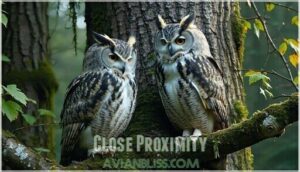
Owl pairs stick close after mating, maintaining remarkable mate proximity within their territorial boundaries.
You’ll find breeding couples roosting just 20-100 meters apart during nesting season.
Their coordinated nesting behavior includes synchronized feeding runs and shared territorial defense.
Radio-tracking reveals these bird couples often choose the same trees for roosting, strengthening their pair bond through consistent physical closeness and social interaction patterns.
Understanding bird communication methods, such as vocal learning processes, is essential for grasping the nuances of their social behaviors.
Shared Hunting

Beyond staying close, paired owls hunt together in remarkable ways. You’ll witness cooperative hunting that strengthens their bond while maximizing success rates.
Here’s how shared hunting works for owl couples:
- Territory Division – Partners split hunting grounds to avoid competition while covering more area
- Coordinated Strikes – One owl flushes prey while the other intercepts the escape route
- Prey Size Targeting – Larger owls take bigger game, smaller partners handle quick, nimble prey
- Resource Sharing – Successful hunters share catches, ensuring both partners stay nourished
- Nest Provisioning Duties – Both adults alternate bringing food back to feed their young
This cooperative hunting demonstrates sophisticated bird social behavior. These hunting strategies aren’t just about survival – they’re about building stronger animal relationships. When bird couples work together, their foraging techniques become more efficient than solo efforts.
The bird family benefits as parents perfect their teamwork, creating a reliable food supply system that supports both the pair bond and their offspring’s development. Effective owl hunting requires the right hunting gear tools.
Owl Mate Loss Impact

When an owl loses its mate, you’ll find that survival instincts quickly override grief as the bird adapts to solo life.
Most owl species will actively search for a new partner during the next breeding season, though some may remain unpaired if suitable mates aren’t available in their territory, driven by their innate grief.
Finding New Mates
When you lose a mate, finding replacement partners becomes your top priority during mating season.
Most species won’t seek new partners until the next breeding cycle, but northern owls like Snowy Owls often remate quickly due to shorter breeding windows.
Mate selection depends heavily on territory availability and population density.
Barn Owls show impressive 80% re-pairing rates across seasons, while experienced birds have better success finding replacement mates through vocal displays and courtship feeding behaviors.
Some birds, like the Trumpeter Swans, form long-term pair bonds.
Territorial Changes
When a mate dies, you’ll notice dramatic territorial changes that reshape the survivor’s entire world.
Territory Defense weakens substantially as single owls struggle to patrol and maintain their established boundaries alone.
Research shows widowed owls often abandon prime nesting sites they’ve defended for years, moving to smaller territories that match their reduced defensive capabilities.
Habitat Loss and Urbanization Impact compound these challenges, forcing displaced owls into suboptimal areas with increased Resource Competition and Climate Effects during mating season.
Survival Strategies
When survival hangs in the balance, owls employ remarkable health strategies.
Single owls adapt their behavioral patterns to maximize survival chances after mate loss.
Key survival adaptations include:
- Enhanced Hunting Techniques – Extending active hunting periods to compensate for lost cooperative hunting advantages
- Improved Predator Avoidance – Increased vigilance and altered roosting patterns to reduce vulnerability
- Strategic Habitat Adaptation – Relocating to territories with abundant prey and fewer competitors
- Modified Food Storage – Caching more prey during abundance to survive lean periods alone
- Climate Resilience – Adjusting daily activity patterns based on weather conditions for ideal energy conservation
These health behaviors demonstrate owls’ remarkable ability to restructure their survival dynamics when facing solitary life.
Owls also utilize effective wildlife survival techniques to increase their chances of survival in harsh environments.
Frequently Asked Questions (FAQs)
Do owls mate and stay together?
Like loyal songbirds returning to their favorite perch, you’ll find owls form strong pair bonds.
Most species practice monogamy, staying with the same mate for breeding seasons or even life, sharing territory and parenting duties together.
Do owls live alone or in pairs?
Most owl species are solitary hunters, but you’ll find some surprising partnerships.
Many owls form monogamous pairs during breeding season, sharing territory and parenting duties.
However, they typically roost separately outside of mating periods, maintaining their independent lifestyles.
Do owls stay with their mates?
Birds of a feather often flock together, but you’ll find most owl species don’t maintain lifelong pair bonds.
Many owls stay together for just one breeding season, then part ways when raising young is complete.
What happens when an owl’s mate dies?
When your feathered friend loses their lifelong partner, they’ll typically remain alone for the rest of that breeding season.
Most owl species will search for a new mate the following year, though some may stay solo permanently.
What are the mating habits of owls?
During courtship’s mysterious dance, you’ll witness owls engaging in elaborate rituals that bond pairs for life.
Most species practice monogamy, with couples sharing territories, hunting duties, and raising young together through synchronized hooting displays and gift exchanges.
Do owls stay in the same spot?
You’ll find owls don’t necessarily stay in the same spot year-round.
Most species are territorial during breeding season, defending specific areas.
However, they’ll move seasonally following prey availability, weather patterns, and habitat changes throughout their range.
Do owls stay together after mating?
Most owl species don’t stay together after mating – they’re typically solitary creatures who meet briefly for reproduction then part ways.
However, some species like barn owls and great horned owls form seasonal pair bonds.
Do owls mate?
Yes, owls do mate! Most species are monogamous, forming seasonal or lifelong pair bonds. They engage in elaborate courtship rituals including calls, food offerings, and aerial displays before breeding.
Do owls switch mates each year?
While some owls commit to lifelong partnerships, most species you’ll encounter actually switch mates each breeding season. They’re seasonal romantics, forming new bonds when spring arrives and hormones surge.
How do owls bond with their mates?
During courtship, you’ll find owls engaging in elaborate rituals that strengthen their partnership.
They perform synchronized duets, share prey as gifts, and participate in mutual preening sessions that reinforce their emotional connection and trust.
Conclusion
Understanding owl relationships reveals striking contrasts in commitment strategies.
While some species form lifelong bonds, others prioritize seasonal partnerships.
The question "do owls stay together after mating" depends entirely on species, territory quality, and breeding success.
Territory loyalty often outweighs mate loyalty across owl populations.
These adaptable relationship patterns demonstrate owls’ remarkable evolutionary flexibility in balancing survival needs with reproductive success strategies, showcasing their ability to adapt to various environments and circumstances, with a focus on reproductive success.