This site is supported by our readers. We may earn a commission, at no cost to you, if you purchase through links.
Your cat sits frozen at the window, eyes locked on a sparrow hopping across the fence. Then it happens—that strange, stuttering sound somewhere between a chirp and a chatter, accompanied by rapid jaw movements that make her look like she’s shivering. You’ve probably wondered what possesses your normally dignified feline to make such a peculiar noise.
The answer lies deep in her DNA, where ancient hunting instincts collide with the frustrating reality of a glass barrier. This quirky behavior reveals fascinating truths about predatory wiring, brain chemistry, and the complex inner world of your tiny carnivore—understanding it helps you see your cat’s behavior through a whole new lens.
Table Of Contents
- Key Takeaways
- Why Do Cats Chirp at Birds?
- What Does Cat Chirping Sound Like?
- Theories Explaining Cat Chirping
- Factors That Influence Chirping at Birds
- How to Respond to Your Cat’s Chirping
- Frequently Asked Questions (FAQs)
- Is it good or bad for cats to chirp?
- Is my cat frustrated when it chirps?
- Why does my cat chirp?
- Is it normal for cats to chirp at birds?
- Why does my cat chirp when he sees a bird?
- Why does my cat chirp at birds outside the window?
- Do cats chirp?
- What is Cat chirping?
- Why does my cat make a chirping sound at birds?
- Why does my cat make a sound when he sees a bird?
- Conclusion
Key Takeaways
- Your cat’s chirping at birds is a hardwired hunting instinct that fires up when predatory excitement collides with the frustration of glass barriers, revealing thousands of years of evolutionary programming in real time.
- That strange chattering sound combines rapid jaw movements practicing the killing bite with vocal expressions of anticipation, showing your tiny carnivore’s brain rehearsing the entire prey capture sequence even when success is impossible.
- Chirping intensity depends on how close the bird is, how much it moves, and your individual cat’s personality and past hunting experiences—extroverted cats with successful hunt histories chirp more boldly than nervous felines.
- You can channel this predatory energy into healthy play using interactive toys that simulate bird-catching movements, preventing overstimulation while strengthening your bond through shared hunting-style games.
Why Do Cats Chirp at Birds?
When your cat spots a bird through the window and launches into that strange chattering sound, you’re witnessing thousands of years of predatory instinct in action. This peculiar vocalization isn’t random—it’s deeply rooted in your cat’s DNA as a hunter.
When your cat chatters at birds through the window, you’re watching thousands of years of predatory instinct come alive
Let’s break down the three main reasons your little carnivore can’t help but chirp at those feathered creatures outside.
Natural Hunting Instincts
Your cat’s chirping is a window into ancient wild predation. Deep-rooted feline hunting instincts drive this behavior—the same prey detection reflexes that helped ancestors survive.
That instinct extends beyond your windowsill—outdoor cats pose serious threats to local bird populations by killing billions of songbirds annually.
When your tiny carnivore spots a bird, instinctual behavior kicks in. Feline stalking sequences activate, preparing jaw muscles for the killing bite. It’s natural hunting behavior on full display, even through glass.
This reaction is closely related to fundamental aspects of hunting instinct observed across many animal species.
Predatory Excitement and Anticipation
That instinct doesn’t just activate—it explodes into predatory excitement. You’ll see arousal signals as your cat’s hunting behavior reaches a fever pitch:
- Rapid tail twitching and dilated pupils lock onto the target
- Whiskers thrust forward with tense body posture
- Ears tilt sharply toward prey, scanning every rustle
- Small chirps intensify as prey anticipation builds
These sensory triggers reveal feline hunting instincts firing on all cylinders, turning your pet into a focused predator driven by animal instincts and cat communication.
The Unattainable Prey Response
When your tiny carnivore spots a bird behind glass, predatory excitement slams into a wall—literally. That moment of intense prey detection with zero chance of success triggers the unattainable prey response.
Visual triggers fire up hunting reflexes, and sensory stimulation reaches peak levels, but feline stalking goes nowhere.
The result? Rapid jaw chattering, tense whiskers, and that distinctive cat chirp born from pure hunting frustration.
While cats chirp at birds, your feathered friends have their own fascinating vocalizations—explore how to encourage vocal development in pet birds at home through interactive bonding techniques.
What Does Cat Chirping Sound Like?
If you’ve never heard your cat chirp, you might wonder what all the fuss is about. This sound stands out from the usual meows and purrs because it’s sharper, more staccato, and unmistakably different.
Let’s break down what makes chirping so unique and how you can spot it when your tiny carnivore gets excited.
Distinguishing Chirping From Other Cat Sounds
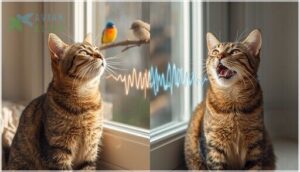
When your tiny carnivore starts making unusual sounds, you need to decode what’s happening. Here’s how chirping stands out from other feline communication:
- Chirps are staccato and abrupt, resembling bird calls with a higher sound frequency than meows
- Meows flow as elongated syllables, often directed at you rather than prey
- Chattering includes rapid jaw movements with a clacking quality, while chirping emphasizes vocal cadence
- The chirping sound is crisp and compact, not the frantic loudness of chattering
Understanding these vocalization patterns helps you read your cat’s behavioral expressions.
To learn more about the ways cats communicate with humans, explore further research on feline vocalizations.
Physical Signs Accompanying Chirping
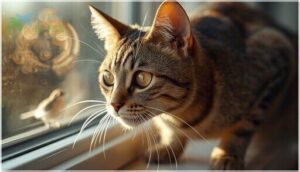
Your feline companion’s entire body shifts when she locks onto that sparrow outside. You’ll notice her pupils widen, ears rotate forward, and whiskers fan out toward the target. Her jaw vibrates rapidly during each chirp, while her mouth opens in a rounded shape.
Watch for posture changes too—spine arches slightly, shoulders rise, and her tail flicks in controlled bursts as she intensifies her vocal cues.
When and Where Chirping Occurs

Generally, morning chirps erupt at dawn when birds outside flood feeders and gardens with sound. Your cat’s window perch becomes ground zero for bird watching—especially during spring and early summer seasonal peaks.
Garden fences, balcony planters, and indoor triggers like open doors all set the stage. Notice how feline hunting instincts fire up when feathered targets flutter close to glass.
Theories Explaining Cat Chirping
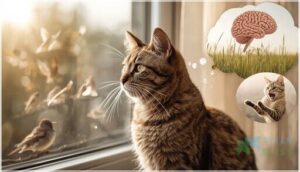
Scientists have spent years puzzling over why your cat makes that strange chattering sound at the window. The truth is, there’s no single answer—researchers have developed several competing theories to explain this quirky behavior.
Let’s explore the three main explanations that help us understand what’s going on in your tiny carnivore’s mind.
Frustration and Barrier Theory
Ever wonder why your cat sounds like a broken motor at the window? The frustration response theory explains that chirping happens when hunting instincts collide with barrier effects.
Your cat’s arousal levels spike as visual triggers activate their predatory drive, but they can’t reach the bird. That pent-up energy bursts out as rapid jaw movements and distinctive chirps during bird watching sessions.
Mimicry and Camouflage Hypothesis
Some researchers believe the mimicry theory offers a fascinating twist on feline behavior. Your cat’s bird chatter might be sensory deception in action, using mimicry techniques to imitate prey sounds.
Through adaptive concealment and camouflage tactics, cats may employ stealth strategies that blur the line between hunter and hunted.
This approach to animal communication and behavior suggests your tiny carnivore is craftier than you thought.
Jaw Practice and Prey Sequence
Think of chirping as your cat’s dress rehearsal for the big show. When your feline watches birds, those rapid jaw movements and chattering teeth are actually bite rehearsal—a hunting reflex that coordinates motor skills for the killing bite.
This prey simulation helps practice the exact prey sequence needed during capture, fine-tuning hunting skills even when the target stays frustratingly out of reach.
Factors That Influence Chirping at Birds

Not every cat chirps the same way, and that’s because different triggers set off this fascinating behavior. Some cats go wild at the sight of a single feather, while others stay silent until a bird lands right on the windowsill.
Let’s look at what makes your little hunter start chattering.
Visual and Auditory Triggers
Your cat’s chirp is hardwired by sensory cues that fire up feline instincts. Birdwatching turns into a multisensory integration event when sight and sound align, triggering responses that mimic the prey sequence.
- Bright feathers capture your cat’s gaze in under three seconds, sparking instant auditory processing.
- Fluttering wings create sharp sounds that sync with visual cues.
- Birdsong through windows ignites spatial awareness and animal vocalizations.
- Synchronized chirps and movements boost attention by thirty percent.
Proximity and Movement of Birds
Shorter flight distances to nearby refuge spots trigger rapid, intense vocal bursts—your tiny carnivore’s chirp accelerates when birds hover within arm’s reach of the window.
Wing movement and flock behavior heighten visual cues that ignite feline instincts. The closer birds perch, the more urgent your cat’s animal vocalizations become, turning casual birdwatching into a high-stakes predatory rehearsal shaped by bird flight patterns.
Individual Cat Personality and Past Experiences
Beyond the birds themselves, your cat’s unique feline temperament shapes every chirp. Extraverted cats display bolder hunting-related gazes and frequent vocalizations, while nervous felines may hold back even when prey appears close.
Past experiences—successful hunts or repeated window encounters—forge behavioral patterns that influence how intensely your cat reacts. Environmental factors and personality traits work together, making each cat’s response distinctly their own.
How to Respond to Your Cat’s Chirping

When your cat chirps at birds, you’re witnessing raw hunting instinct in action—and that’s worth celebrating, not suppressing.
The key is channeling that predatory energy in ways that satisfy your tiny carnivore without creating endless frustration.
Here’s how you can turn those chattering moments into opportunities for play, connection, and mental enrichment.
Encouraging Safe Play and Stimulation
Daily play sessions redirect your cat’s hunt-driven energy into safe, satisfying outlets. Try these environmental enrichment strategies to honor your tiny carnivore’s wild side:
- Interactive games with wand toys for twice-daily exercise bursts that simulate bird-catching sequences
- Sensory toys featuring varied textures and puzzle feeders to challenge their instincts
- Play area design with vertical climbing zones that transform indoor cat enrichment into adventure
These feline exercise opportunities turn cat chirp moments into productive play and socialization.
Preventing Overstimulation or Frustration
While play channels energy, you’ll want to watch for signs your cat’s crossed the line into overload. Frustration reduction begins with recognizing when that bird outside becomes too much. Here’s your sensory load management toolkit:
| Trigger Signal | Calming Techniques | Environmental Optimization |
|---|---|---|
| Tail lashing rapidly | Redirect to puzzle toys | Close blinds during peak bird activity |
| Dilated pupils, fixed stare | Offer quiet retreat space | Add vertical escape perches |
| Excessive cat chirp | Gentle voice, no touching | Dim lights, reduce noise |
| Pacing or aggression | Brief timeout in calm room | Schedule bird-watching windows |
| Flattened ears | Slow blink reassurance | Maintain predictable routines |
These stress mitigation strategies honor feline communication and socialization needs while preventing meltdowns.
Strengthening Your Bond Through Interaction
When your cat chirps, you’re witnessing feline communication and socialization in action. Respond with playful engagement—use interactive games that mirror their hunting drive.
This builds an emotional connection and strengthens trust between you and your tiny carnivore. Try bonding exercises like feather wands or laser pointers.
These moments deepen pet owner relationships and interactions, turning cat behavior and psychology into shared joy that benefits cat owners and their chirping companions alike.
Frequently Asked Questions (FAQs)
Is it good or bad for cats to chirp?
Chirping is a healthy expression of your cat’s natural instincts and feline psychology.
It benefits cat emotional health by releasing predatory energy, offering feline stress relief when prey remains out of reach without harm.
Is my cat frustrated when it chirps?
Sometimes your tiny carnivore is absolutely seething with frustration when it chirps—especially if tail flicking, pawing, or rapid head movements accompany the chatter—but not every chirp signals stress or irritation.
Why does my cat chirp?
Your tiny carnivore is channeling its inner hunter. Chirping reveals feline behavior rooted in predatory excitement, animal instincts, and cat communication—a vocal learning response triggered when prey activates that hardwired chase drive.
Is it normal for cats to chirp at birds?
Yes, this feline vocalization is completely normal cat behavior. Bird watching triggers predatory excitement in your pet, and the chattering reflects healthy hunting instincts—a natural form of animal communication rooted in feline psychology.
Why does my cat chirp when he sees a bird?
Your cat’s bird-watching chirp is pure feline behavior—a hunting reflex that blends predatory excitement with frustration.
This cat chatter shows his instinct firing up even when prey stays out of reach.
Why does my cat chirp at birds outside the window?
Your feline’s window gazing transforms into cat chatter when prey instincts ignite. Bird watching triggers feline behavior rooted in hunting readiness, creating those distinctive feline noises as excitement meets the barrier of glass—pure animal vocalizations and communication in action.
Do cats chirp?
Picture a house cat locked in silent focus, jaw trembling as wings flutter outside.
Yes, cats chirp—a staccato, birdlike vocalization signaling alertness, predatory excitement, and the irresistible pull of feline hunting instincts toward unreachable prey.
What is Cat chirping?
That sharp, trilling sound your tiny carnivore makes is a distinctive feline vocalization—a brief chirp or chatter produced with the mouth mostly closed, involving rapid mouth movements that reveal your cat’s hunting instincts and communication style.
Why does my cat make a chirping sound at birds?
Your tiny carnivore chirps because those moving wings ignite ancient feline hunting instincts. The sound mirrors prey calls and helps practice jaw mechanics, blending predatory excitement with frustration when birds stay tantalizingly out of reach.
Why does my cat make a sound when he sees a bird?
Your cat’s sound when spotting birds stems from feline hunting instincts and predatory excitement. The vocalization reflects animal instincts triggered by bird watching, expressing anticipation through cat communication while practicing prey capture movements behind the barrier.
Conclusion
That tiny chatter might be the most honest glimpse into your cat’s soul you’ll ever get. Behind those vibrating whiskers and stuttering jaw lies thousands of years of predatory mastery, bottled up and buzzing with purpose.
When you finally understand why cats chirp at birds, you’re not just solving a quirky mystery—you’re witnessing evolution itself, alive and electric in your living room. Your cat isn’t broken. She’s brilliantly, frustratingly wild.