This site is supported by our readers. We may earn a commission, at no cost to you, if you purchase through links.
 Birds communicate through a sophisticated blend of songs, calls, body language, and visual displays.
You’ll hear territorial songs during breeding season, sharp alarm calls warning of danger, and soft contact calls keeping flocks together.
Their body language speaks volumes too—raised crests signal alertness, wing displays show aggression or courtship intentions, and specific postures indicate submission or dominance.
Many species use colorful feather patterns and elaborate dances to attract mates.
Even their flight patterns carry meaning, from tight formations that coordinate group movement to erratic flights that confuse predators.
This complex communication system varies dramatically between species, with some birds even developing regional "dialects" that differ from neighboring populations, showcasing a unique form of communication and visual displays.
Table Of Contents
- Key Takeaways
- How Do Birds Communicate With Each Other?
- The Language of Birds
- Decoding Bird Songs and Calls
- Body Language and Visual Cues
- Interspecies Communication
- Territorial and Courtship Communication
- Communication for Survival
- Learning and Observing Bird Communication
- The Complexity of Avian Dialogue
- Frequently Asked Questions (FAQs)
- How do birds communicate?
- Why do birds talk to each other?
- How do birds communicate alarm?
- What is Bird communication?
- How do blackbirds communicate?
- What is vocal communication in birds?
- Do birds know what each other is saying?
- How do birds often communicate with each other?
- Which is the method used by most birds to communicate?
- Do birds know what each other are saying?
- Conclusion
Key Takeaways
- You’ll discover birds use two distinct vocal types: complex songs for attracting mates and defending territory, plus quick calls for immediate needs like warning about predators or maintaining flock contact
- You can decode their visual language through body postures, feather displays, and flight patterns—raised crests signal alertness, puffed feathers show dominance, and erratic flight warns of danger
- You’ll notice birds share information across species through universal alarm calls, with different sounds indicating specific threats like hawks (sharp, rapid calls) versus ground predators (harsh chattering)
- You’ll find each species develops regional "dialects" and individual vocal signatures, much like human accents, creating unique communication patterns that vary by location and social group
How Do Birds Communicate With Each Other?
Through a symphony of sounds, colors, and movements, birds have mastered bird communication that rivals any human conversation.
You’ll discover they use bird vocalization including complex bird songs for territory claims and mate attraction, plus quick bird calls for immediate needs like danger warnings.
Birds orchestrate nature’s most sophisticated conversations through songs, calls, and body language.
Their avian language extends beyond sound.
Visual displays showcase vibrant plumage during courtship rituals, while body postures signal aggression or submission.
Mimicry allows some species to copy other birds’ calls, creating fascinating examples of Cultural Transmission where young birds learn from adults.
What’s remarkable is how Scent Communication through preen gland secretions helps with mate selection, while Tactile Signals during close interactions strengthen social bonds.
Some birds even use Avian Deception, mimicking alarm calls to steal food from competitors.
This intricate communication system reveals birds aren’t just chirping randomly—they’re having sophisticated conversations about survival, romance, and territory.
The Language of Birds

When you watch birds, you’ll notice they use songs, calls, body language, and even feather displays to share information.
These communication methods help them find food, warn each other about danger, and interact within their flocks.
Vocal Communication
You’ll hear birds using two main types of vocal communication: bird songs and bird calls.
Song learning happens early in life, creating vocal dialects across regions.
Males often engage in duetting behavior with mates, while some species show remarkable mimicry functions.
Through acoustic adaptation, birds adjust their vocalizations for different environments, making acoustic communication incredibly sophisticated and varied.
Visual Communication
While vocalizations grab your attention, birds rely heavily on visual communication for daily interactions.
You’ll notice their intricate body language tells stories through posture meanings and feather positioning.
Key Visual Signals You’ll Observe:
- Plumage signals – Bright patches and colorful displays attract potential mates during breeding season
- Courtship dances – Elaborate movements showcase fitness and genetic quality to partners
- Feather positioning – Puffed feathers indicate dominance while flattened ones show submission
- Flight patterns – Erratic movements signal alarm while smooth gliding suggests calm behavior
- Bird body language – Forward-leaning postures demonstrate aggression, tail flipping shows irritation
Non-vocal Sound Production
Beyond songs and calls, birds create remarkable nonvocal communication through mechanical sounds.
Woodpeckers drum on trees to claim territory, while hummingbirds produce wing whistles during courtship flights. Bill clattering signals aggression in storks, and some species use foot stomping or tail tapping for emphasis.
These feather sounds and percussion create a rich acoustic landscape.
| Sound Type | Example Species | Purpose | Description |
|---|---|---|---|
| Wing Whistles | Hummingbirds | Courtship | High-pitched sounds from specialized feathers |
| Bill Clattering | White Storks | Greeting/Defense | Rapid bill snapping creates percussive rhythm |
| Foot Stomping | Ground birds | Alarm/Dominance | Deliberate ground strikes for emphasis |
| Tail Tapping | Woodpeckers | Territory | Rhythmic tail drumming on surfaces |
Decoding Bird Songs and Calls
You’ve probably heard birds chirping outside your window, but did you know they’re actually having complex conversations using two distinct types of vocalizations.
Understanding the difference between songs and calls reveals a sophisticated communication system where each sound carries specific meaning, from attracting mates to warning about danger.
Songs Vs. Calls
Birds speak two distinct languages: songs and calls.
Songs are complex, elaborate vocalizations that males use for attracting mates and defending territories.
These intricate performances showcase genetic fitness through their complexity.
Calls are brief, simple sounds for immediate communication needs.
Here’s how they differ functionally:
- Song Complexity – Males weave intricate melodies during breeding season to impress potential partners
- Call Versatility – Quick alerts for danger, food locations, or maintaining flock contact throughout the day
- Dialect Variations – Regional song differences emerge as young birds learn from local mentors
- Function Overlap – Some vocalizations blur the line, serving both territorial and social purposes simultaneously
Understanding these distinctions helps you decode what’s happening in your backyard’s avian conversations.
Meaning Behind Different Vocalizations
Each bird vocalization carries specific meaning, creating nature’s complex communication network.
Nature’s feathered conversations reveal survival secrets hidden in every chirp and flutter.
Alarm calls feature sharp, high-pitched notes that warn of immediate danger, with some species like chickadees adding extra "dee" sounds to indicate threat severity.
Contact purpose calls help flocks stay together during foraging, using soft tones for location tracking.
Distress signals trigger mobbing behavior against predators.
Song complexity varies dramatically between species, with courtship melodies showcasing health and genetic fitness.
Call variations within the same species reflect regional dialects and individual recognition.
Understanding bird sounds reveals their sophisticated bird language system that coordinates survival activities.
Many birds use calls for social interaction, but only songbirds produce birdsong.
Body Language and Visual Cues
While you’re watching birds at your feeder, you’ll notice they’re constantly "talking" with their bodies through subtle head tilts, wing positions, and feather arrangements.
These visual signals work alongside their vocalizations to create a rich communication system that reveals everything from their mood to their intentions.
Postures and Gestures
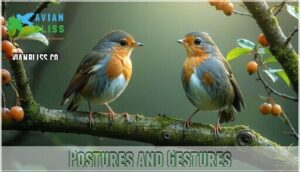
When you watch birds interact, their body language reveals a complex conversation unfolding before your eyes.
Dominance displays involve puffing up feathers, leaning forward, or spreading wings to appear larger and more threatening. Conversely, submissive postures include crouching low, tucking the head, or avoiding direct eye contact.
Agonistic behavior encompasses these competitive interactions, where birds use contextual gestures like head-bobbing to assert status or show deference.
Appeasement signals help defuse tension—a quick head tilt or wing flutter can prevent conflict. These visual signals form an intricate language that governs bird behavior and social hierarchies within flocks.
Feather Displays

Feather displays serve as nature’s billboard advertisements, conveying powerful messages across species.
You’ll notice how plumage signaling transforms ordinary birds into visual storytellers through strategic feather positioning.
Courtship dances showcase vibrant breeding plumage, while threat displays involve puffed feathers to appear larger.
Species recognition relies on unique feather patterns and colors.
Birds may also engage in elaborate courtship displays to attract mates.
- Territorial dominance – Fanned tail feathers and raised crests intimidate rivals
- Mate attraction – Bright breeding plumage signals genetic fitness and health
- Alarm warnings – Sudden wing flashes alert flock members to danger
Behavioral Signals

Beyond feather displays, behavioral patterns reveal deeper messages through movement and actions.
These visual signals help birds navigate complex social situations and communicate intentions without sound.
Key behavioral signals to observe:
- Courtship dances – Males perform elaborate choreographed movements, head-bobbing, or food presentations to attract potential mates
- Agonistic displays – Birds use posture signaling like puffed feathers, open beaks, or aggressive chasing to establish dominance hierarchies
- Flight patterns – Erratic or specific aerial movements signal alarm, territory claims, or coordinate flock movements during migration
Watch for these subtle cues that complement bird vocalization in their communication toolkit.
Interspecies Communication

When you observe different bird species together, you’ll notice they often share essential information about dangers and opportunities.
Mixed-species flocks demonstrate remarkable cooperation, where one bird’s alarm call can trigger protective responses across multiple species that understand these universal warning signals, including universal warning signals.
Alarm Calls
When you observe birds suddenly freeze mid-song or scatter frantically, you’re witnessing alarm calls in action. These high-pitched emergency broadcasts serve as nature’s security system, with different acoustic properties signaling specific predator types.
Hawks trigger sharp, rapid calls while ground threats produce harsher chatters. The characteristics of these calls can be summarized in the following table:
| Predator Type | Call Characteristics |
|---|---|
| Aerial (hawks) | High-pitched, sharp, rapid |
| Ground (cats) | Harsh, chattering sounds |
| Snake threats | Low, drawn-out calls |
| General danger | Mixed frequency patterns |
What makes this system remarkable is its interspecies effectiveness—chickadees, robins, and even squirrels understand each other’s warnings. However, predator specificity creates eavesdropping risks, as some predators exploit these calls to locate prey.
Context dependence means the same call can vary based on threat proximity, while mimicry deception occasionally occurs when birds false-alarm to access food sources. This complex communication network highlights the intricate social dynamics at play in the natural world, where nature’s security system is both a vital warning mechanism and a potential vulnerability.
Flock Dynamics
Beyond alarm calls, birds use sophisticated flock communication to maintain social cohesion and coordinate group behaviors.
Each flock operates like a well-organized team, with birds constantly sharing information through subtle signals.
Here’s how flock dynamics work:
- Social Hierarchy – Dominant birds lead group movements and feeding decisions
- Coordinated Movement – Synchronized flight patterns prevent collisions during migration
- Group Foraging – Information sharing helps locate food sources efficiently
- Predator Evasion – Collective responses create confusion tactics against threats
This bird behavior demonstrates remarkable social intelligence in action.
Territorial and Courtship Communication
When birds need to claim their space or find a mate, they pull out all the stops with their most dramatic performances.
You’ll witness everything from dawn chorus concerts that establish neighborhood boundaries to elaborate dance routines designed to win over potential partners, showcasing their ability to perform elaborate moves.
Defending Territory

How do birds claim their space? Territorial songs serve as powerful boundary markers, with males singing from prominent perches to announce ownership.
These bird vocalizations aren’t just melodies—they’re intimidation tactics that communicate strength and determination. Aggression displays like puffed feathers, spread wings, and forward-leaning postures reinforce vocal warnings.
When intruders persist, song duels escalate into aerial chases and physical confrontations.
This territorial defense protects essential resources like food sources and nesting sites. Bird behavior during resource defense demonstrates how effective communication prevents costly battles while establishing clear property lines.
Attracting Mates

Attracting the perfect mate requires showcasing your best qualities, and birds have mastered this art through elaborate mating displays.
Males combine complex territorial songs with stunning visual performances to prove their fitness.
You’ll witness intricate courtship dances, brilliant plumage signals, and even bower building as part of these mating rituals.
- Complex bird songs demonstrate male health and genetic quality
- Vibrant plumage displays signal breeding readiness and energy
- Synchronized courtship dances showcase physical coordination and stamina
- Elaborate bower building proves resource-gathering ability for mate selection
Communication for Survival

When danger strikes or food appears, birds rely on instant communication to survive.
Their alarm calls, foraging signals, and flock coordination behaviors create a sophisticated survival network that keeps entire communities safe and well-fed, utilizing instant communication to ensure their survival.
Food Location
When you spot a bird enthusiastically pecking at seeds, it’s actually broadcasting dinner invitations through food calls and foraging signals. These vocalizations attract flockmates to abundant resources, creating a dining network that benefits everyone through resource mapping and sharing food strategies.
You can further support this behavior by providing supplemental feeding options.
| Communication Method | Purpose | Example Species |
|---|---|---|
| Food calls | Alert others to abundant food | Chickadees, Titmice |
| Visual flocking | Draw attention through group feeding | Finches, Sparrows |
| Assembly calls | Gather birds before directing to food | Crows, Jays |
| Ground pecking signals | Show feeding location through movement | Robins, Thrushes |
| Scavenger communication | Share carrion locations | Vultures, Ravens |
Predator Warnings
Using advanced threat assessment, birds decode alarm calls to identify specific predators and their proximity.
You’ll notice how eavesdropping birds from different species respond to these warnings, creating a neighborhood watch system. Some species even use silent alarms through subtle body language when vocal warnings might attract attention.
- Alarm specificity varies by species – chickadees use different calls for hawks versus owls
- Mobbing behavior occurs when multiple birds gang up to harass and drive away predators
- Vocalizations can indicate predator size, speed, and hunting style to help birds choose appropriate escape strategies
Flock Coordination
When you watch a flock move like a single organism, you’re witnessing remarkable bird communication in action.
These vocalizations and visual cues create seamless group cohesion during migration patterns. Each bird mirrors its neighbors’ movements, responding to contact calls that maintain social behaviors.
This synchronized dance improves foraging efficiency while enabling swift predator evasion.
Through social learning, experienced birds guide newcomers, ensuring the entire flock benefits from collective wisdom and enhanced bird social dynamics.
Some species even use chemical cues to assess predation risks.
Learning and Observing Bird Communication
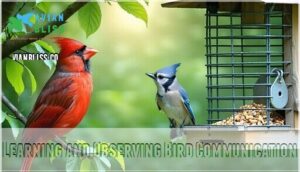
You can learn to understand bird communication by setting up feeders in your yard and watching how different species behave around food sources.
Once you start observing regularly, you’ll notice that each bird species has unique calls, body language, and social patterns that reveal their complex communication methods, which include unique ways of interacting with each other.
Setting Up Bird Feeders
Bird feeders create perfect observation stations for studying bird communication. Choose multiple feeder types—tube feeders for finches, platform feeders for cardinals—and select quality seed selection like nyjer and sunflower seeds.
Strategic feeder placement near windows but away from predators guarantees bird safety. Install squirrel deterrents and maintain strict feeder hygiene with weekly cleaning.
Many enthusiasts find specialized feeders beneficial for attracting specific species. You’ll soon witness fascinating bird watching opportunities as different bird species display unique vocalizations and social behaviors during feeding interactions.
Identifying Species-Specific Behaviors
Each bird species reveals its identity through distinct communication signatures that serve as nature’s fingerprints. Cardinals whistle clear notes while crows caw harshly, and woodpeckers drum rhythmically on trees. These Vocalization Uniqueness patterns help with Species Recognition in your backyard observations.
To accurately identify these sounds, consider using a reliable identifier tool.
- Visual Signatures: Cardinals flash red crests during territorial displays, while blue jays raise head feathers when agitated
- Behavioral Adaptations: Woodpeckers communicate through drumming patterns, while finches use soft contact calls during feeding
- Communication Evolution: Each species develops unique alarm calls – hawks trigger sharp chips from songbirds, while owl calls cause mobbing behavior
- Bird vocalizations: Listen for species-specific patterns like robin’s liquid warble versus wren’s bubbling trill to identify different bird species communication styles
Recognizing Patterns
Recognizing patterns in bird communication becomes easier with practice.
You’ll start noticing consistent behaviors that reveal important messages between birds and their environment.
- Song recognition: Different species have unique melodies and rhythms you can learn to identify
- Call differentiation: Short alarm calls versus longer contact calls serve distinct purposes
- Visual cues: Body postures and feather positions change based on context and individual variation in bird vocalizations
The Complexity of Avian Dialogue

You might think all birds of the same species sound identical, but they actually develop unique communication patterns based on where they live and who they learn from.
Just like humans have regional accents and dialects, birds create their own local "languages" that can vary dramatically across different geographic areas and social groups.
Variations Within Species
Looking closely at your feathered neighbors, you’ll discover that individual variation creates unique signatures within species.
Each bird develops distinct vocalizations through song learning and genetic influence, much like humans acquiring accents.
Environmental adaptation shapes their bird communication, while personal experiences fine-tune their songs.
These variations in bird language help individuals stand out during mating season and establish stronger territorial claims through personalized bird dialects.
Regional Dialects
Just like you might speak differently than someone from another state, bird dialects vary dramatically across regions.
Geographic isolation creates unique song variation – White-crowned Sparrows in San Francisco have three distinct dialects within the city alone!
These learned dialects develop through dialect formation when young birds learn from local adults, creating fascinating dialect evolution that shapes bird communication patterns.
Birds also use various non-vocal sounds like wing flapping to communicate.
Adaptations to Environment
Environmental pressures shape how birds communicate, creating fascinating Habitat-Specific Signals that match their surroundings.
Urban birds adjust their calls to cut through Environmental Noise, while forest species use lower frequencies that travel better through dense vegetation.
Key Environmental Adaptations include:
- Light Conditions – Dawn chorus timing shifts based on artificial lighting
- Migration Communication – Flocks develop specialized contact calls for long journeys
- Sensory Adaptations – Desert birds rely more on visual displays when water limits vocal range
These bird adaptations guarantee survival across diverse ecosystems.
Frequently Asked Questions (FAQs)
How do birds communicate?
Ironically, you’d think birds just chirp randomly, but they’re actually sophisticated communicators.
They use songs for mating and territory, calls for warnings and contact, plus visual displays through colorful plumage and body language, which are all important aspects of their communication.
Why do birds talk to each other?
Birds communicate to survive and thrive.
They use calls to warn about predators, songs to attract mates, and contact calls to stay connected while foraging.
They’re coordinating activities, defending territories, and maintaining social bonds essential for their survival.
How do birds communicate alarm?
When you spot danger approaching, you’ll notice birds use high-pitched alarm calls that vary by predator type.
These urgent vocalizations alert the entire flock, triggering immediate escape responses and protective behaviors.
These urgent vocalizations are a key part of the birds’ defense mechanism.
What is Bird communication?
Roughly 10,000 bird species exist worldwide, each using unique communication methods.
You’ll observe birds communicating through vocalizations like songs and calls, plus visual displays involving feather positioning and body language for mating, territory defense, and survival coordination.
How do blackbirds communicate?
Blackbirds communicate through melodic songs for territory and mating, sharp alarm calls warning of predators, and visual displays like tail-fanning and aggressive postures during territorial disputes.
What is vocal communication in birds?
Ironically, you’d think silent flight would make birds quiet creatures, but they’re actually nature’s chatterboxes!
Vocal communication includes songs for attracting mates and defending territory, plus calls for warnings, contact, and coordinating group activities effectively.
Do birds know what each other is saying?
Yes, birds understand each other’s messages.
They recognize alarm calls for specific predators, respond to contact calls from their flock, and interpret territorial songs from rivals.
This communication isn’t random—it’s meaningful.
How do birds often communicate with each other?
Like feathered orchestras filling the air, you’ll find birds communicate through elaborate songs for mating and territory.
Quick calls for warnings and location updates, plus visual displays using colorful plumage and body language, are also key components of their communication.
Which is the method used by most birds to communicate?
Most birds communicate through vocalizations—songs and calls you’ll hear daily.
These sounds serve different purposes: songs attract mates and claim territory, while calls warn of danger or coordinate group movements effectively.
Do birds know what each other are saying?
You might think they’re just making noise, but birds actually understand each other’s specific messages.
Different calls convey distinct meanings—alarm calls warn of predators, contact calls maintain group connection, and songs establish territories or attract mates through learned vocalizations.
Conclusion
Like a vast symphony orchestra where each musician contributes their unique voice, the avian world demonstrates remarkable communication complexity.
You’ve discovered how birds communicate with each other through intricate combinations of songs, calls, visual displays, and body language.
From territorial declarations to mate attraction, predator warnings to flock coordination, birds possess sophisticated messaging systems that rival human conversation.
Their regional dialects and species-specific behaviors reveal intelligence that continues surprising researchers, showing that birds have meaningful conversation happening above.
Next time you hear birdsong, you’ll appreciate the conversation happening above.
- https://birds.fieldmuseum.org/stories/behavior/communication
- https://www.audubon.org/magazine/10-common-bird-songs-made-less-confusing
- https://animals.howstuffworks.com/birds/can-bird-species-talk-with-each-other.htm
- https://www.mylearning.org/stories/communication-in-the-animal-world/1288
- https://birdfact.com/bird-behavior/communication